


Pitch decks that get 2× more investor responses. We'll build yours. First 10 founders.

Interactive AI pitch decks that get 2× more investor responses. Hand-built in 3 business days. Reviewed by ex-YC founders and active investors.
Your deck answers investor questions in your voice, even at 2 a.m., and generates IC-ready memos on demand.
You get:
A rebuilt deck
1 month of FluidDocs Pro
An embedded product demo
A feedback report from ex-YC founders + investors
Normally $1,000. $100 for the first 10 Venture Curator readers. No success fee, no equity.
*2× claim based on the first 50 FluidDocs decks vs PDF baseline.
👋 Hey, here’s today at a glance -
The Billion-Dollar Founder Study: What 20 years of unicorns say about who you should build with.
Is software shrinking or about to 10x? - Redpoint’s data reveals the truth.
How to actually name your startup: a proven framework from leading founders
📜 DEEP DIVE
The Billion-Dollar Founder Study: What 20 years of unicorns say about who you should build with.
There’s a very common belief in startups: the best companies are built by people who already know each other well - friends, ex-colleagues, college roommates. It feels logical. Trust is already there, communication is easier, and things move faster in the early days.
Andy Chen and Amy Lin (from Outcast Venture) decided to actually test this idea by analysing 20 years of $1B+ startup exits, manually reconstructing how founding teams were formed. And what they found challenges a lot of what founders assume.
Working together before doesn’t actually lead to bigger outcomes.
Founders who had prior working relationships ended up with lower median exit values compared to those who didn’t. The same pattern shows up with school connections as well. These relationships help you get started, but they don’t give you an edge where it really matters - during scale.
Prior work relationship → ~$2.3B median exit
No prior relationship → ~$2.9B median exit
Same-school founders also show slightly lower outcomes
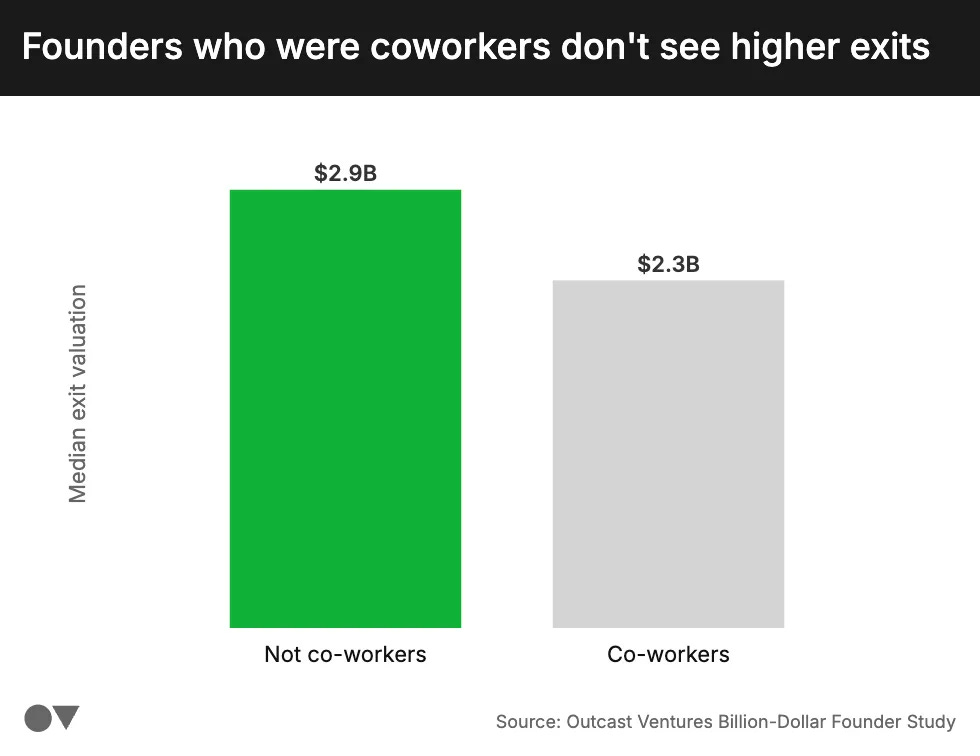
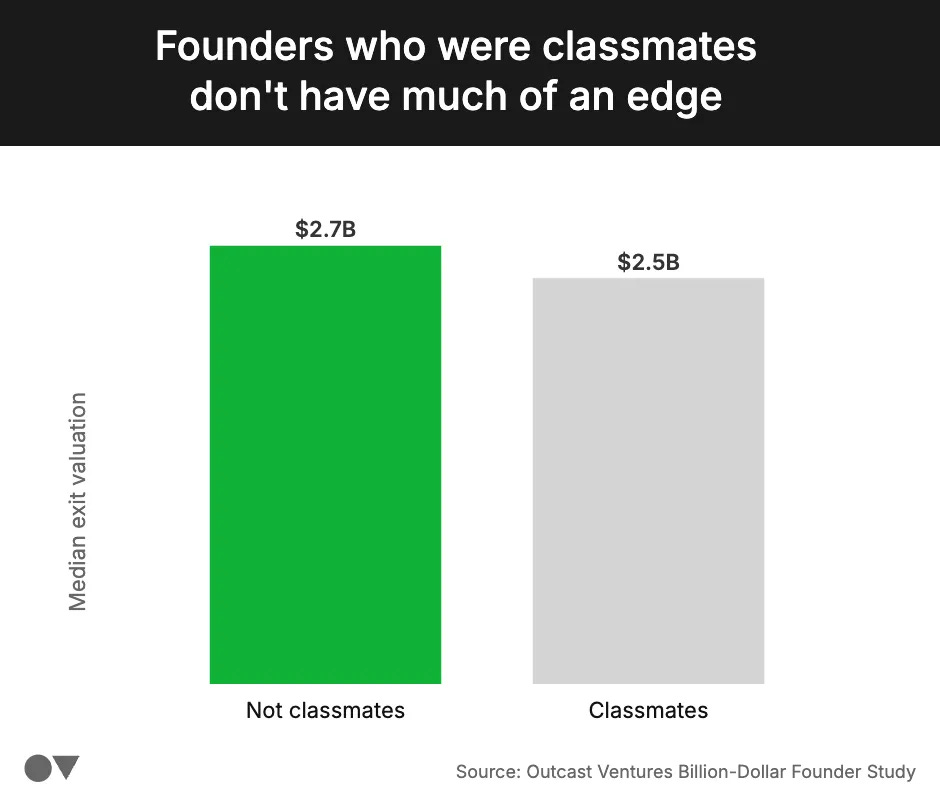
What this suggests is simple: familiarity reduces early friction, but billion-dollar companies are not decided in the first year. They’ve decided over a decade of building, hiring, and navigating completely new problems.
That’s where a different factor starts to dominate -complementarity.
The best teams aren’t the most comfortable ones. They’re the ones where skills, thinking styles, and strengths don’t overlap too much. As the company scales, that diversity becomes a real advantage.
You see the same pattern when you look at team structure more broadly.
Most large outcomes are not built by solo founders. While solo founding is increasing (especially post-AI), it rarely shows up in the biggest companies.
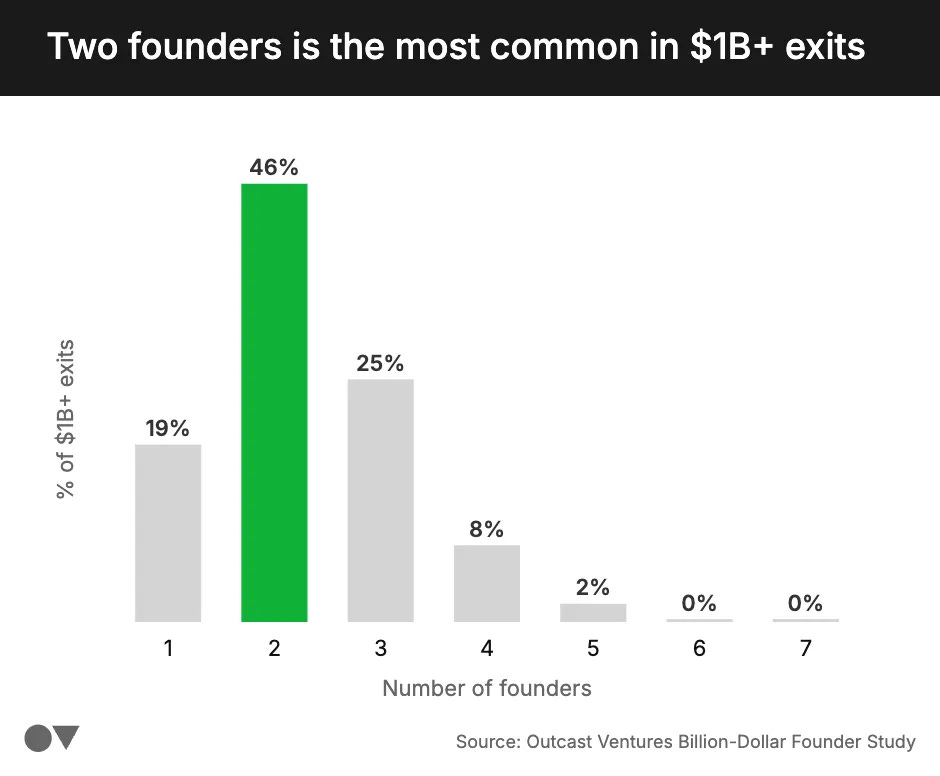
82% of $1B+ companies had multiple founders
Solo founders account for ~20%, but almost disappear in top-tier outcomes
Solo companies also take ~3 years longer to reach exit
Starting alone is clearly possible. But sustaining and scaling complexity over 10+ years is where teams outperform.
Another strong signal in the data is experience.
Founders who have been through the startup cycle before - especially those who have already built or exited a company- consistently produce larger outcomes. The gap is meaningful.
CEOs with prior startup experience → ~41% higher median exit
Teams with at least one prior exit → nearly 2x higher valuations
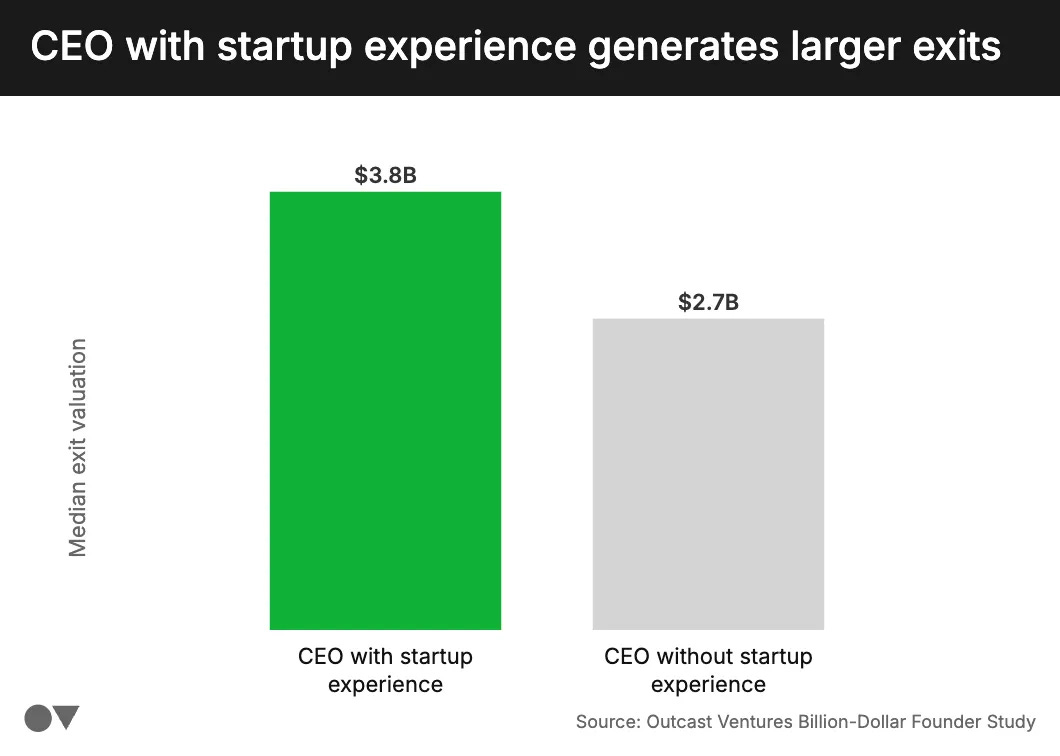
This makes sense when you zoom in. Scaling a company isn’t just about product or vision. It’s about hiring at speed, managing investors, navigating downturns, and making decisions under uncertainty. Founders who’ve done it before simply recognize patterns faster.
Time is another underestimated variable.
Most founders think in 3–5 year horizons. But the data shows something very different.
The median time to a billion-dollar outcome is around 12 years, and the largest outcomes often take even longer. Founding CEOs typically stay for a decade or more, which means the real job isn’t launching - it’s continuously rebuilding the company as it grows.
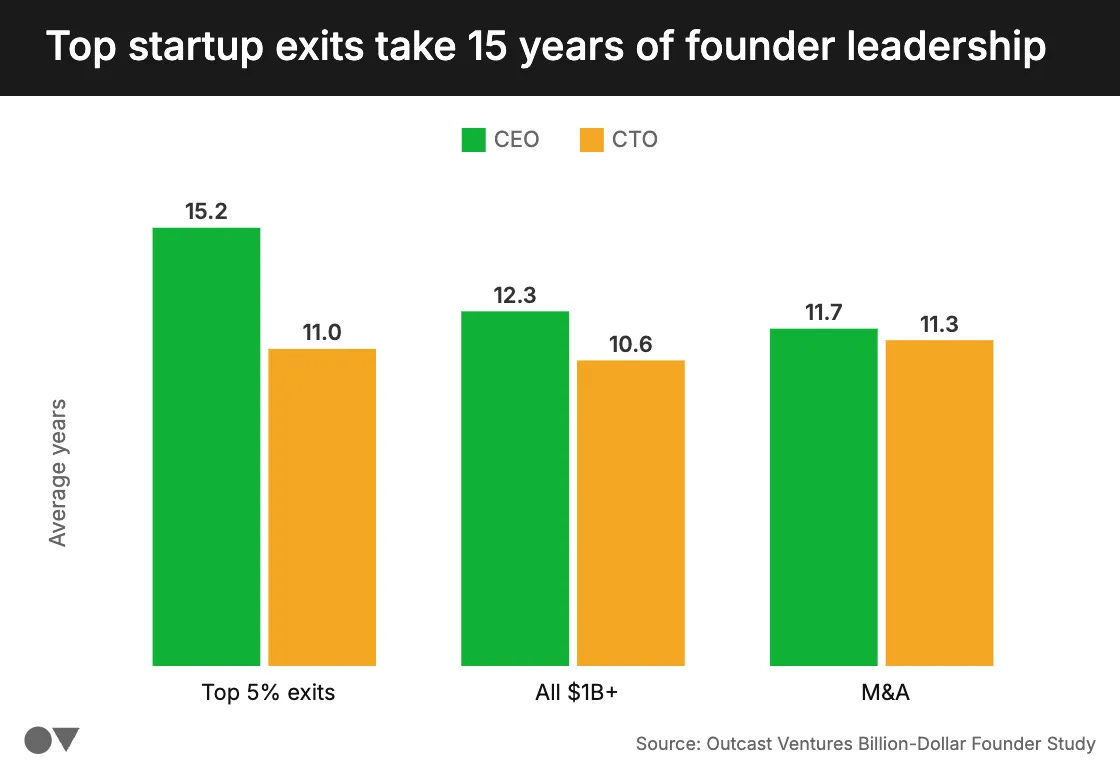
Even the founder’s age reflects this dynamic. The median age is around 35—not extremely young, not too late, but more importantly, it aligns with timing.
The biggest outcomes tend to come from founders who hit their prime during major platform shifts.
1980s-born founders → mobile and cloud
1990s-born founders → now benefiting from AI
So it’s not just about who you are. It’s about when you build.
What’s interesting is what doesn’t matter as much as people think.
Elite schools show up frequently in founder lists, but they don’t correlate with larger exits. Family founding teams are extremely rare. Even long-standing relationships between founders don’t translate into better outcomes.
The pattern across all of this is surprisingly consistent.
Big companies are not built by the most obvious or convenient teams. They are built by small, complementary groups of people who bring different strengths, have some level of experience, and are able to endure and adapt over a long period of time, often aligned with a major technology wave.
The takeaway is simple, but most founders ignore it: Don’t optimise for who feels easiest to start with. Optimise for who you can build with for the next 10–15 years.
PARTNERSHIP WITH US
🤝 Get your brand in front of 120,000+ audience.
Our newsletter is read by 120,000+ tech professionals, founders, investors (VCs / Angel Investors) and managers around the world. Get in touch today.
📃 QUICK DIVES
Is software about to shrink or expand 10x? Redpoint’s data reveals the truth.
Every time markets pull back, the same comparison shows up - “this looks like 1999 again.”
Redpoint Venture recently broke this down in their 2026 market update, and the data tells a very different story. What we’re seeing isn’t speculative excess running ahead of reality. Its demand is pulling the entire ecosystem forward.
In the dotcom era, infrastructure was massively overbuilt with almost no usage. Today, it’s the opposite.
OpenAI and Anthropic are already doing $20B+ ARR
90%+ of new data centre capacity is pre-committed before it’s even built
ChatGPT reached ~1B users in ~4 years (the internet took a similar time to reach just ~70M)
The constraint today isn’t demand - it’s supply. Power, land, and compute are limiting how fast infrastructure can scale. That’s a fundamentally different setup from 2000.
But the more important shift isn’t infrastructure - it’s what AI is doing to the software market itself.
Until recently, most AI products lived in “copilot mode” - they helped people do their jobs better. That meant they competed for existing software budgets.
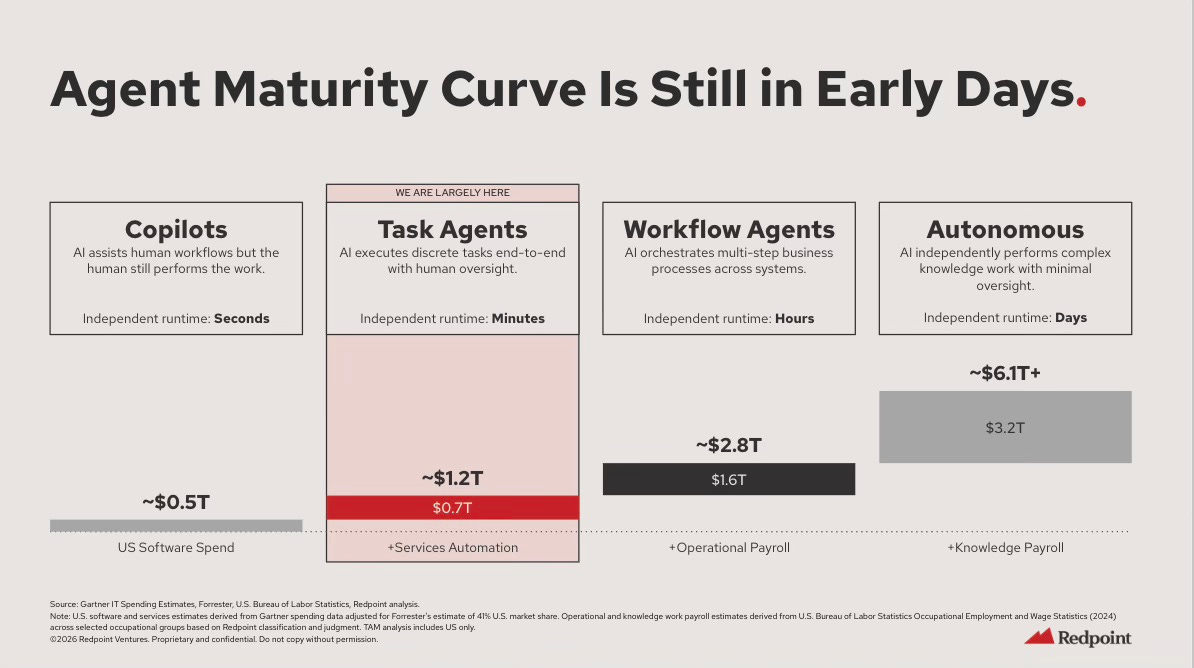
Now we’re moving into something bigger: agents that actually do the work.
Software market today → ~$0.5T
With task-level agents → expands to ~$1.2T
Fully autonomous systems → could tap into ~$6T+ knowledge worker labor
This is where things change. AI stops being a feature and becomes a substitute for labour.
And that shift is already showing up in how software companies are being valued.
The selloff in software isn’t random - it’s selective.
Vertical SaaS is holding up → strong data moats, embedded workflows
Infrastructure is stable → AI increases demand for compute, storage, observability
Horizontal SaaS is down ~35% → most exposed to AI disruption
The pattern is clear. Products that own data + workflows survive. Products that mainly coordinate tasks are at risk - because coordination is something AI does natively.
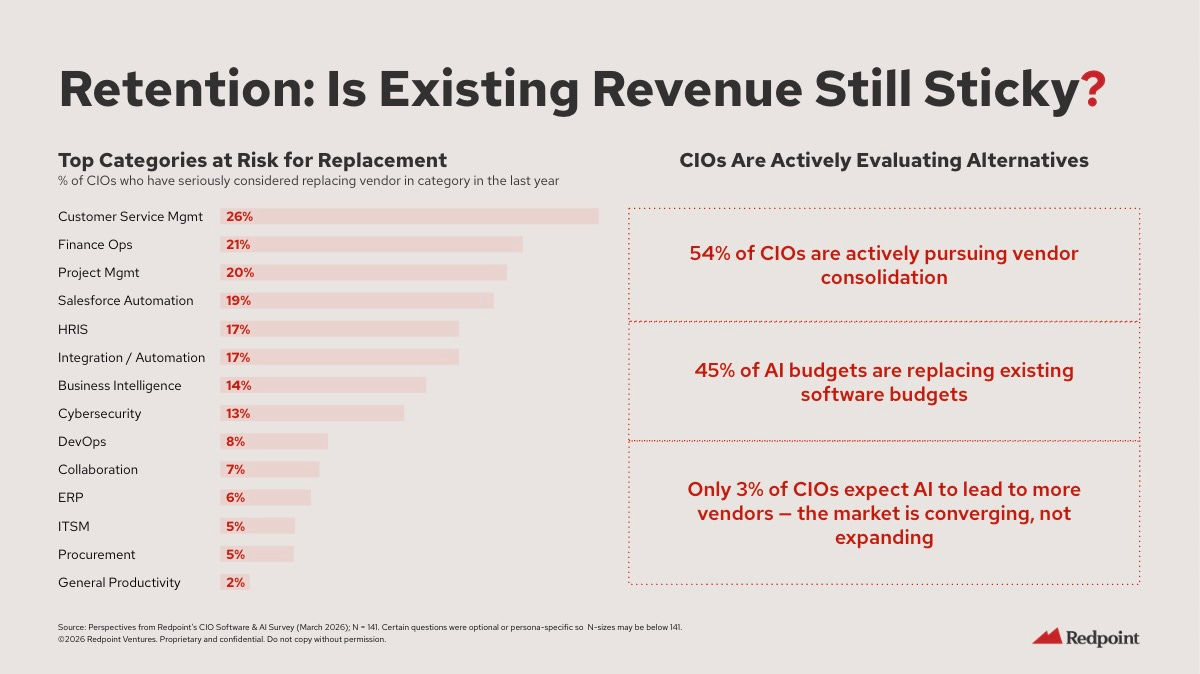
This is also visible from buyer behaviour. CIOs aren’t increasing budgets. They’re reallocating.
45% of AI spend is coming from existing software budgets
54% of companies are consolidating vendors
Only 3% expect to add more tools
So the pressure isn’t just competition - it’s replacement.
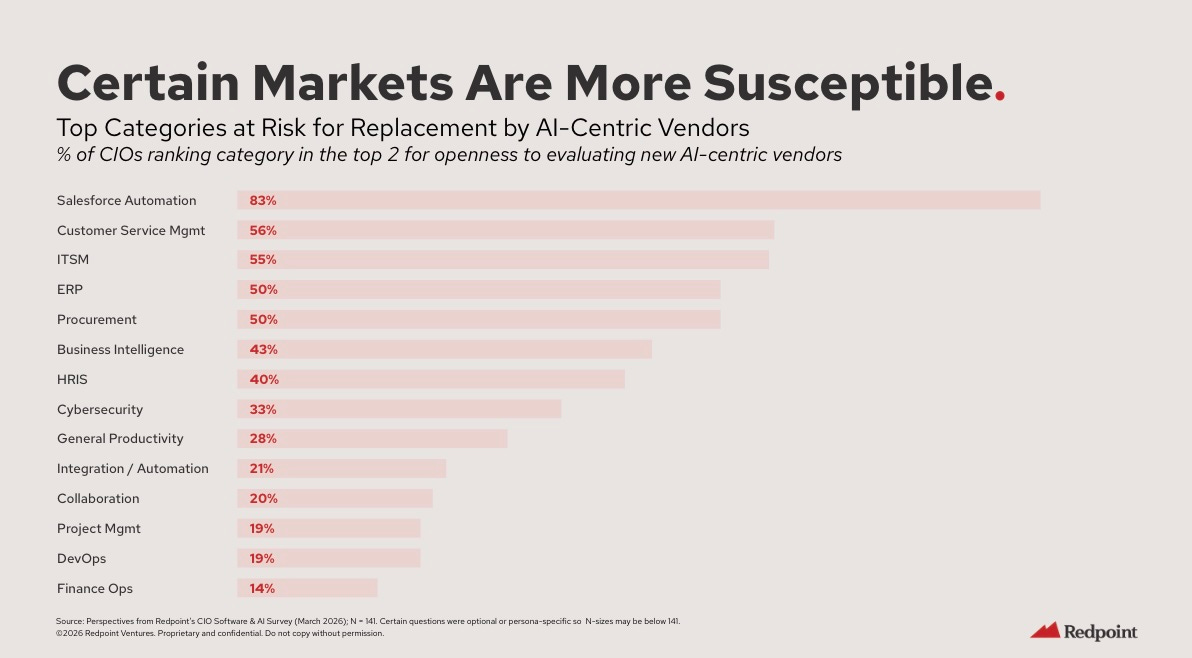
Categories like sales automation, customer support, and IT management are the most exposed - not randomly, but because AI can directly do the job, not just assist it.
At the same time, incumbents aren’t out yet.
More than half of buyers still prefer to add AI to existing vendors rather than switch. But that creates a different challenge: these companies don’t just need to ship features - they need to rebuild themselves.
And that’s where most will struggle.
AI-native companies are built differently:
They rely on first-principles thinkers, not “pattern-matching” operators
Product development starts from capability (what models can do), not just customer requests
The entire org is structured around speed and iteration
This isn’t a feature upgrade. It’s a re-founding. Finally, one subtle but important insight from the data:
Private AI companies look expensive - until you adjust for growth.
Private growth-stage companies → ~61x ARR
Public comps → ~9.7x ARR
But growth rates flip the story:
Private → ~640% growth
Public → ~29% growth
On a growth-adjusted basis, private companies are actually cheaper per unit of growth.
The takeaway here isn’t just about markets - it’s about timing.
Historically, the biggest companies in every tech wave were founded around years 4–5 of the shift. We’re now in year 4 of the AI cycle.
That window is open - but it’s also the most competitive it’s ever been.
Which makes this moment unusual: It’s not a bubble driven by hype. It’s a market being reshaped in real time, where demand is real, stakes are higher, and the bar to win is significantly tougher.
How to actually name your startup: a proven framework from leading founders.
Most founders think naming is a quick brainstorm or a “let’s run it through ChatGPT” exercise. Arielle Jackson (From First Round) has helped hundreds of startups name companies and products, and her view is simple: naming is emotional, subjective and slow and still one of the most important early brand decisions you make.
The biggest mistake founders make? They want the perfect name on day one, even though the best names often become great over time (Disney, Nike, Square). Your job is to pick a name that fits the strategy today and doesn’t limit you tomorrow.
Here’s the practical way to approach it.
Start with a placeholder
Your incorporation name is not your final name. Most good companies don’t start with the name they end up with. Some founders even intentionally pick ridiculous incorporation names just to avoid attachment. It’s better to incorporate as something unusable and rename once you’re clear about your product.
When should you pick the real name?
When you’ve hit clarity on positioning
When you’re about to launch and need a public-facing brand
When your old name stops fitting your product
When legal risk forces a change
Founders who rush naming end up boxed in. Founders who delay it slightly make far better choices.
Start with positioning, not creativity
Arielle’s process always begins with a simple question: Who is this for? What space do we occupy? What makes us different?
A clear positioning statement makes naming dramatically easier because you know what your name should signal: sophistication, speed, trust, creativity, community, or something else entirely.
Build a naming brief
Before brainstorming, outline the constraints:
Who is the target user?
What tone and personality should the name convey?
Do you prefer descriptive, suggestive or abstract names?
Any languages, meanings or connotations to avoid?
Any domain or trademark constraints?
Five names you love, five you hate — and why
This reduces randomness and helps others understand your taste.
How to namestorm
This is where founders usually go wrong. They brainstorm alone. Arielle suggests the opposite — widen the surface area. Bring in employees, friends, even linguists. And use AI not to “name your startup” but to explore:
synonyms
technical words
metaphors
foreign-language variations
historical references
Keep the prompts specific. AI is better at generating raw material than finished names.
What themes to explore
Use both direct and indirect angles:
Your core value (expertise → Maven)
Your product’s motion (gather, connect, accelerate)
Patterns, metaphors, symbols
Names from mythology or history
Simple phrases (PayPal, First Round)
A good brainstorm should produce hundreds of words, not ten.

Narrow the list with structured criteria - Evaluate your list against:
Distinctiveness, Memorability, Trademark risk, Domain feasibility, How it sounds when spoken, How it looks visually, & Whether it will age well.
Then shrink to a shortlist of 10–25, then a top 3.
Signs you’ve found a good name

It’s polarising — some people love it, some hate it
It grows on you over a few days
It works on two levels (simple now, deeper meaning later)
It avoids the obvious, generic and forgettable
Signs it’s a bad name
Too many companies already use it
It’s easy to parody
Locks you into a narrow future use case
Sounds like a competitor
User feedback helps, but lightly
Ask small groups of users what each name communicates, not which one they “like.” People tend to choose descriptive names because they’re familiar. You want clarity, not consensus.
A simple memorability test works well: share three names today and see which one people recall tomorrow.
Legal + domain basics
Arielle’s rule: Get the name right first. Then solve the domain. You can use:
prefixes (usemaven.com, tryfigma.com)
suffixes (squareup.com, awaytravel.com)
alternative TLDs (.ai, .co, .io)
lease-to-own domain deals
Trademark clearance should be done before spending money on identity work. A quick USPTO search rules out obvious conflicts. A trademark lawyer helps determine if you can register the name.
Product naming vs company naming
If you have one product, keep the same name as the company. Once you have multiple products, use a simple structure like: Company + Descriptor
Example: Google Maps, Google Drive, Square Reader.
Use unique product names only when they help establish a separate identity (Cash App, Android).
Naming is messy. It’s emotional. And it takes time. But with the right framework, it becomes structured enough to produce a name that supports your positioning, doesn’t box you in, is easy to remember and ages well.
TODAY’S JOB OPPORTUNITIES
💼 Venture Capital & Startup Jobs
Most aspiring VCs struggle with interviews, unclear expectations, no structured prep, and generic advice that doesn’t actually help. So we partnered with a leading investor group to build an all-in-one VC Interview Preparation Guide that gives you real clarity and frameworks. (Access Here)
Summer Analyst - Thomson Reuters Venture | USA - Apply Here
Investment Associate/VP - Venture+ | Taiwan - Apply Here
Vice President, Investor Relations - General Atlantic - Apply Here
Senior Associate - RA Capital | USA - Apply Here
VC Investment Associate - Mercuri | UK - Apply Here
PE & VC Partner Manager - Dealhub | UK - Apply Here
Partner 22 -a16z | USA - Apply Here
Venture Capital Analyst / Associate - Z57 | Hybrid - Apply Here
Infra / Platform Engineer - Pear VC | USA - Apply Here
Investment Associate - Eka Venture | USA - Apply Here
Associate / Senior Associate - Stepstone Group | Italy - Apply Here
Investment Analyst - Lunicorn Venture | UK - Apply Here
Investment Associate - Struck Capital | USA - Apply Here
Finance & Operations Manager - Antler | Singapore - Apply Here
Investor (Senior Associate/Principal) - Square Peg | USA - Apply Here
Program Manager - a16z | USA - Apply Here
PARTNERSHIP WITH US
🤝 Get your brand in front of 120,000+ audience.
Our newsletter is read by 120,000+ tech professionals, founders, investors (VCs / Angel Investors) and managers around the world. Get in touch today.
🔴 Share Venture Curator
You currently have 0 referrals, only 5 away from receiving a 🎁 gift that includes 20 different investors’ contact database lists - Venture Curator