

👋 Hey, Sahil here — Welcome back to Venture Curator, where we explore how top investors think, how real founders build, and the strategies shaping tomorrow’s companies.
Big idea + report of the week :
Is AI in a bubble? 5 charts show why investors are getting nervous.
Pitchbook Data: Is an MBA still worth it if you want to make it in VC?
Frameworks & insightful posts :
31 ways to grow your startup fast in 2025.
Why Forward Deployed Engineers became the hottest job in tech in 2025.
Is freemium right for your SaaS product? Ask these 3 questions.
The unit economics Excel sheet template every founder should use.
FROM OUR PARTNER - ROCKET
🤝 Command-Based AI Building That Just Works

AI building shouldn’t require guessing. Rocket introduces command-based development that eliminates vague prompts and unpredictable output.
With over 100 structured commands like “Add Stripe checkout,” “Fix mobile layout,” and “Connect Supabase database,” Rocket builds production-grade apps with precision and speed. No retries. No debugging loops. Just clean execution from prompt to deployment.
Whether you’re validating ideas or scaling quickly, Rocket replaces iteration fatigue with structured velocity.
Try Rocket’s Precision Mode - rocket.new →
🤝 PARTNERSHIP WITH US
Get your product in front of over 95,000+ audience - Our newsletter is read by thousands of tech professionals, founders, investors and managers worldwide. Get in touch today.
START WITH
🧠 Big idea + report of the week
Is AI in a bubble? 5 charts show why investors are getting nervous.
Bank of America’s latest fund manager survey shows something we haven’t seen since 2005: Most public-market investors now believe corporations are overspending on CapEx, and AI is the reason.

Here’s what’s driving the concern:
Investors think AI CapEx is getting out of control

Hyperscalers have tripled data-center CapEx since late 2023.
For the first time in 20 years, a majority of fund managers say companies should slow spending and repair balance sheets.
This fear is amplified by the fact that AI data centers depreciate quickly, meaning ROI must come fast — and that’s uncertain.
AI infrastructure needs ~$5T — but there’s a $1.4T funding gap
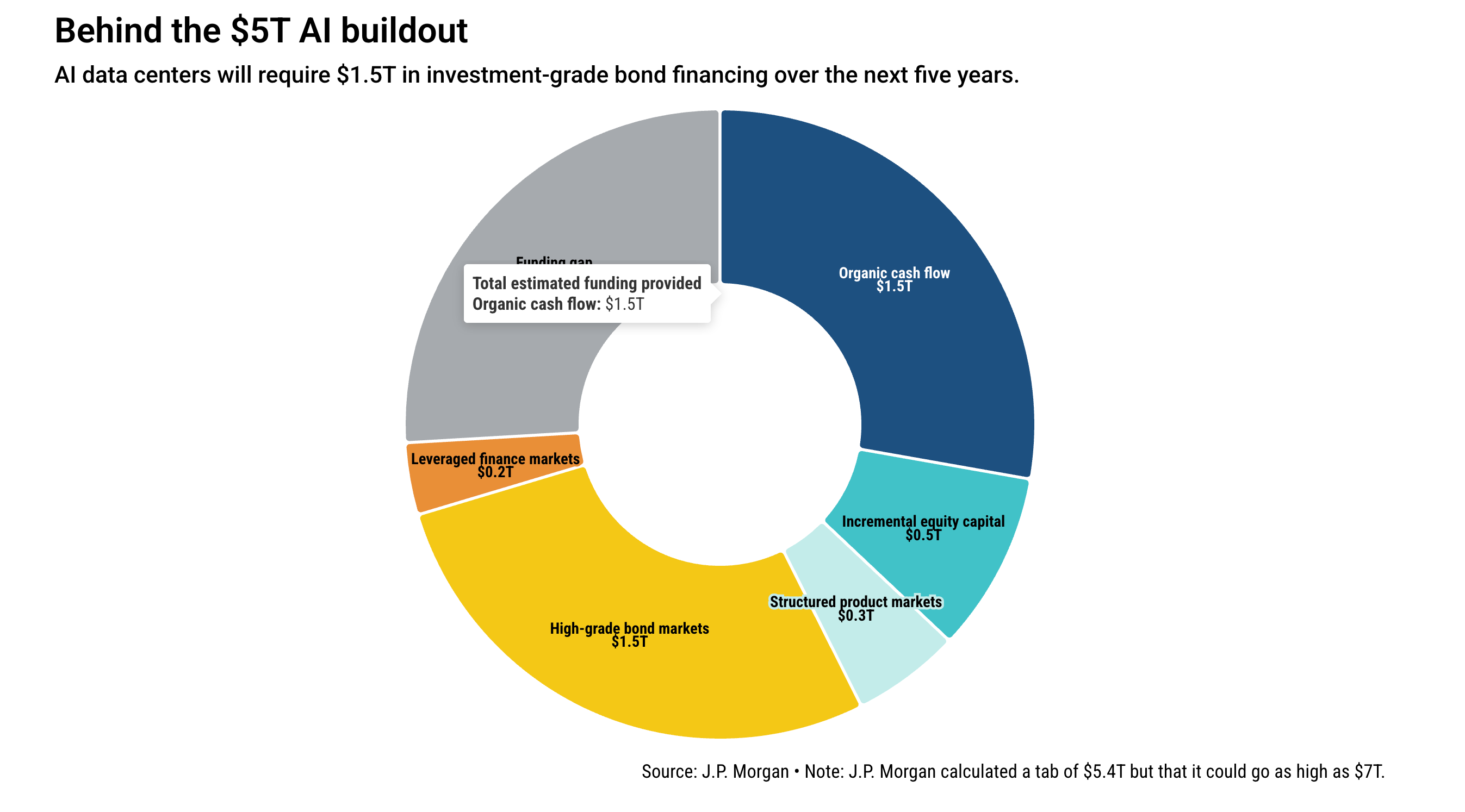
JPMorgan estimates the full AI buildout requires $5 trillion over the next decade.
Even with Big Tech + public markets + private equity + debt markets combined, there’s still a $1.4T shortfall.
This gap likely forces:
Private credit funds to step in
Governments to sponsor national computing
New financing structures (JVs, project finance, sovereign-backed GPU deals)
Meta–Blue Owl’s $27B deal shows where things are headed
Meta partnered with Blue Owl in a $27B joint venture to build AI data centers.
Blue Owl is funding a portion via PIMCO and bond investors, not equity.
This signals that AI infrastructure is outgrowing Big Tech’s internal cash flow — and now needs Wall Street scale financing.
Public markets are cautious — private markets are euphoric
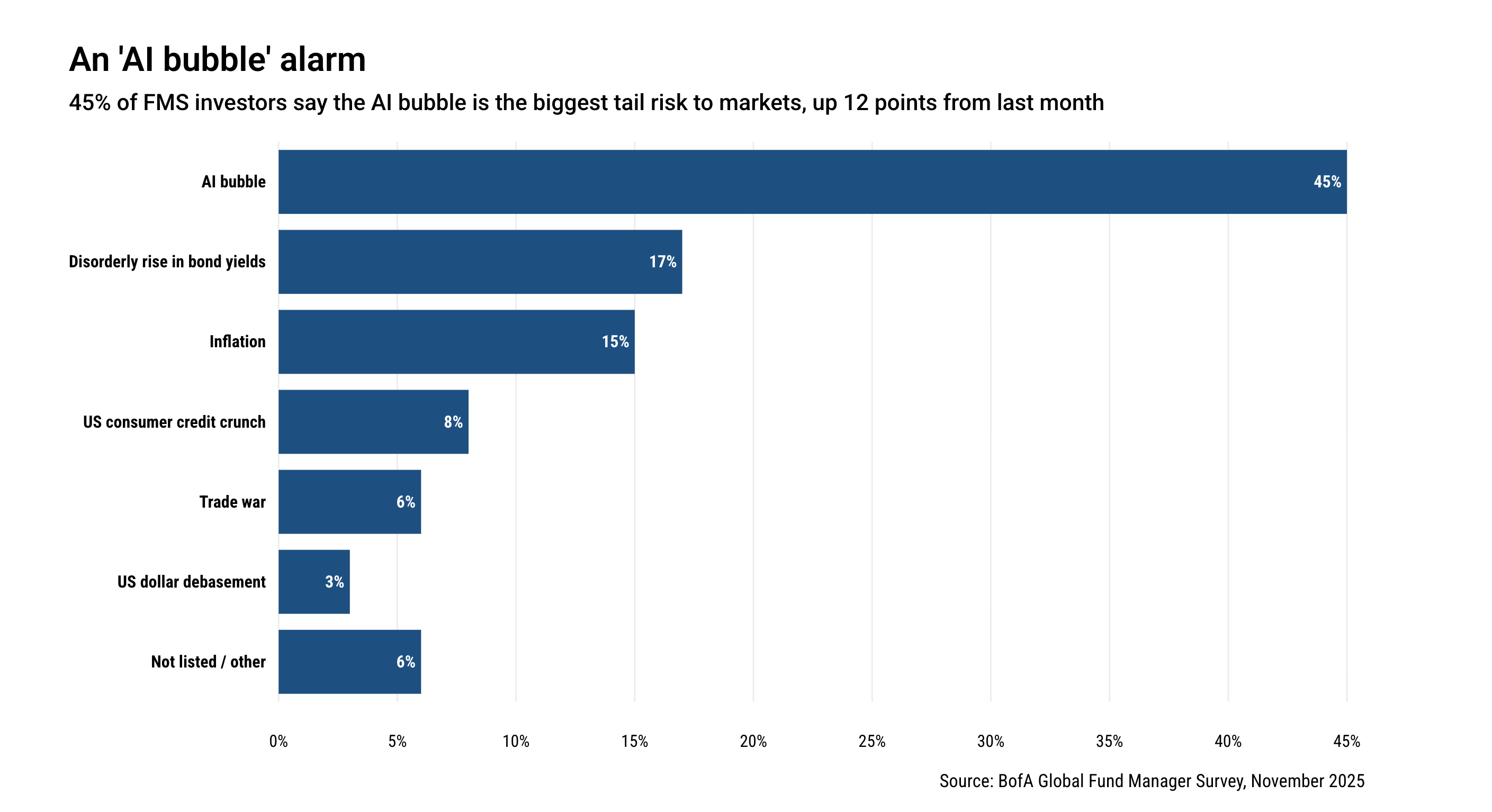
Public investors are jittery. Private markets? Doing the opposite:
AI valuations have rebounded above 2020–2022 bubble levels.
Mega-rounds are normal again.
Every major VC is raising dedicated AI funds.
This disconnect is exactly what happened during the dot-com and ZIRP-era peaks.
If confidence cracks, private AI valuations could snap
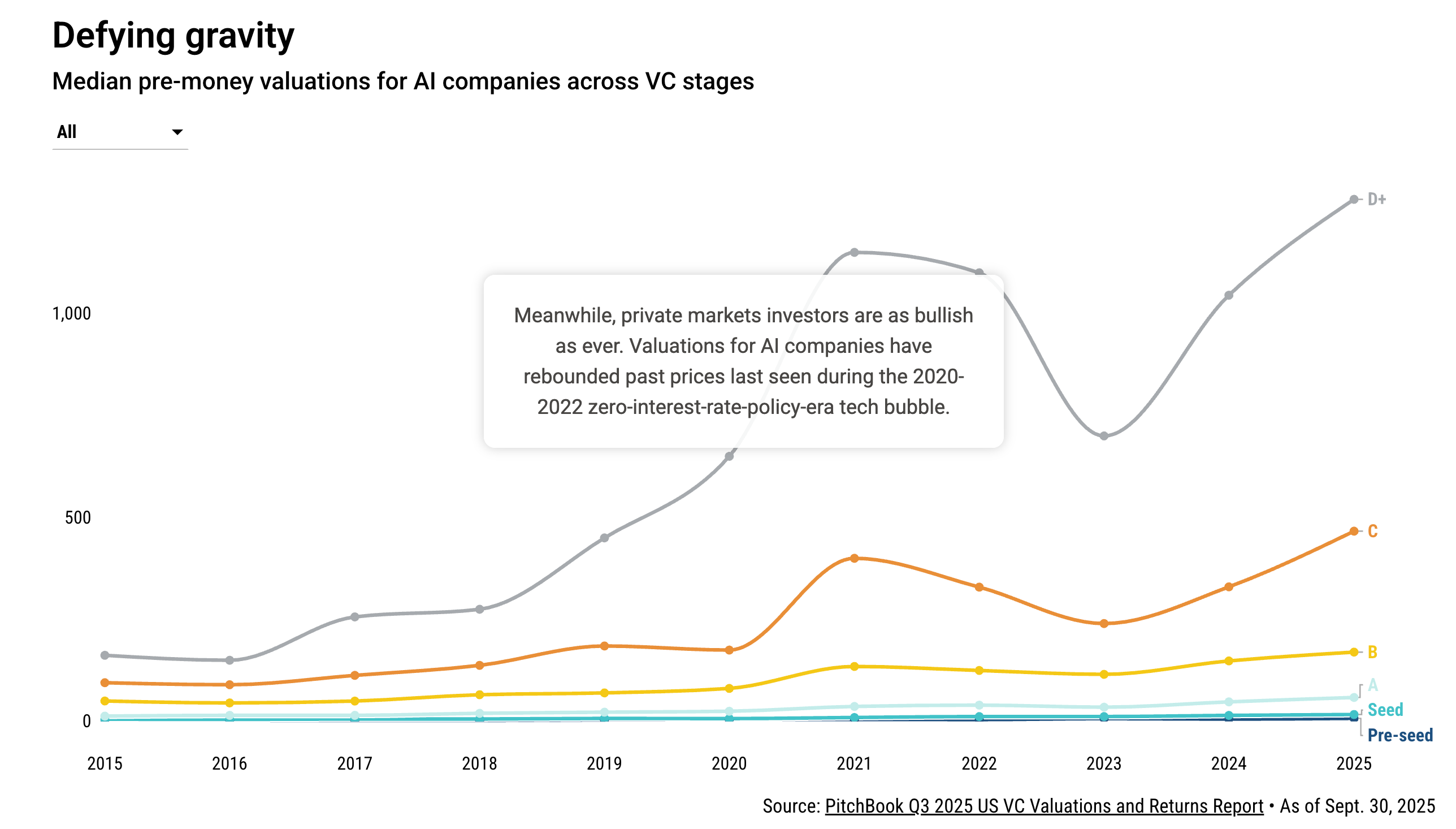
Every major AI boom in the past decade ended abruptly when public markets pulled back.
Sundar Pichai even acknowledged: “No company is going to be immune.”
If CapEx concerns accelerate, private AI deal prices could correct suddenly, especially for: LLM developers, AI infra startups, and Capital-intensive agentic companies
For now? VCs keep writing huge checks. Hyperscalers keep spending. Debt markets keep underwriting massive AI data-center projects.
But the anxiety is rising — and the “is this a bubble?” question is no longer fringe.
Pitchbook Data: Is an MBA still worth it if you want to make it in VC?
For decades, Stanford, Harvard, and Wharton MBAs were a near-guarantee to break into venture. But PitchBook’s recent analysis shows that the advantage is fading fast.
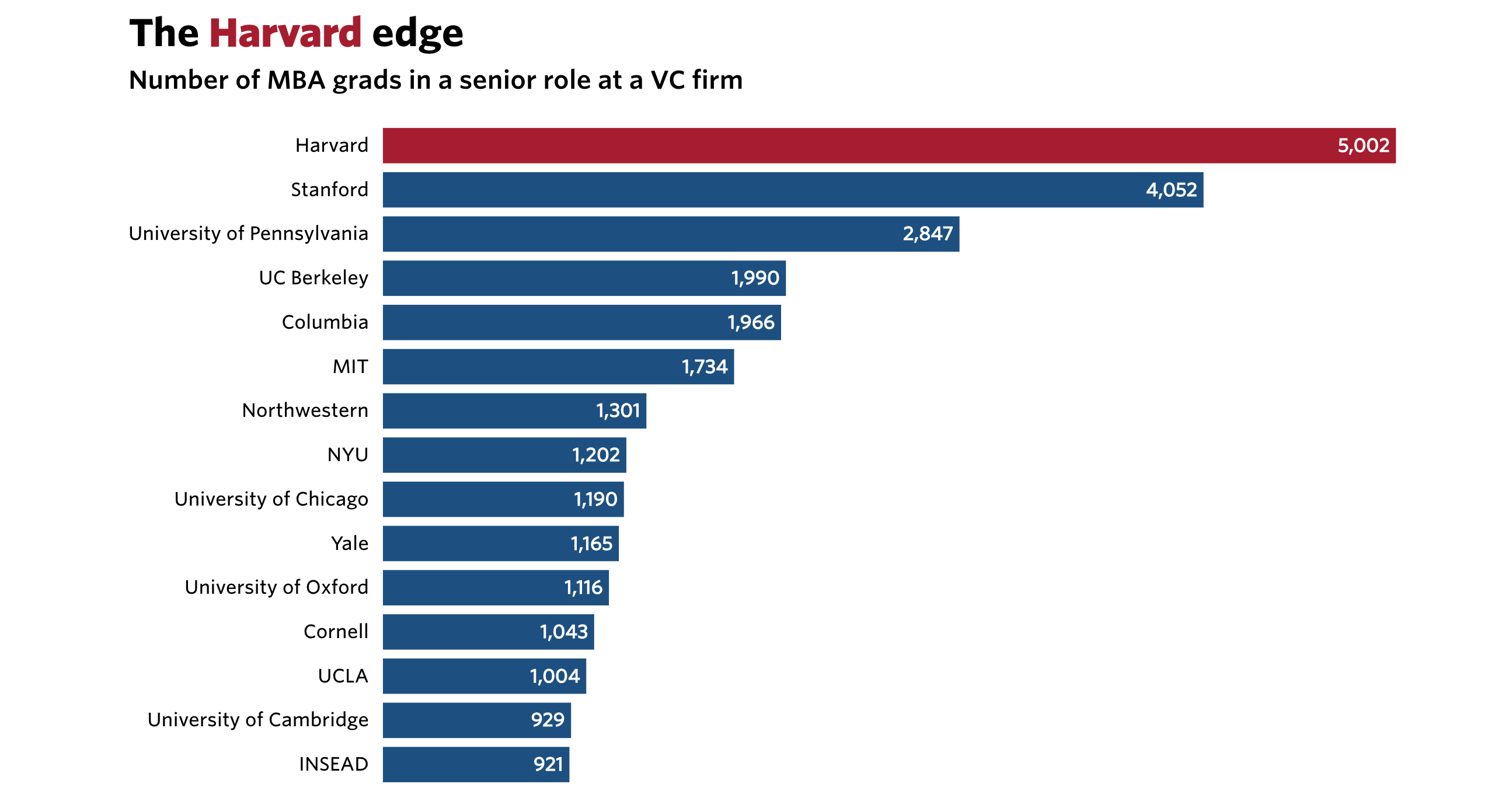
The numbers: Around 50 Harvard MBAs and 30 Stanford MBAs joined VC firms last year, with a median starting salary of $177,500. Yet the share of new VCs with MBAs has dropped from 44% in the early 2000s to ~32% today.
The shift: Firms now prize “builders” from places like OpenAI, SpaceX, and Palantir over B-school résumés. These hires bring direct operating experience and strong founder networks.
Still a signal: Certain schools (Stanford, Harvard, Wharton, LBS, Columbia, Kellogg) show a statistical boost in investment performance, according to new research. Alumni networks also continue to drive deal flow.
The tradeoff: An MBA can still open doors, but it comes with a ~$200K opportunity cost. Meanwhile, AI is replacing many junior VC tasks, narrowing entry-level roles.
The MBA badge is no longer the default path into venture. It may help at specific firms and networks, but increasingly, operating at a breakout startup is the stronger credential.
TOOL FOR FOUNDERS
📑 Startup Legal Pack: VC-Ready Docs in One Place
Messy or missing legal docs slow founders down and turn off investors.
The Startup Legal Document Pack gives you everything you need to incorporate, protect equity, and raise confidently.

What’s inside:
Incorporation docs & founder agreements
SAFE notes, term sheets, cap tables
Employment, IP, and advisor agreements
NDAs, privacy policies & customer contracts
Built with startup attorneys and VC teams. Investor-ready. Easy to use.
SOMETHING MORE
🧩 Frameworks & insightful posts
31 Ways to Grow Your Startup Fast in 2025.
Most founders try every growth tactic they see on the internet. The fastest-growing SaaS companies don’t. They sequence their growth — using the right 3–5 levers at the right revenue stage. ICONIQ, Founderpath, and hundreds of SaaS founders keep repeating the same thing: growth is not about working harder, it’s about picking leverage that compounds.
Below is a cleaner, practical breakdown you can follow no matter where you are shared by Nathan Latka :

Stage 1: Bootstrap to $1M Revenue — Speed and Cash First
At this stage, anything slow is a distraction. You want distribution loops, cheap awareness, and anything that directly converts attention into revenue.
What works best
Virality loops Add sharing triggers like “Powered by…”, referral rewards, and shared dashboards. This is how tools like Typeform and Dropbox grew without ads.
Webinars that sell Run tight, niche sessions with a strong CTA. Founders who are good storytellers convert faster because webinars collapse trust cycles.
Product Hunt launches. One strong PH push = thousands of new users. Relaunch often, test different angles, collect emails.
Cold outreach with personalisation, Loom videos + targeted lists outperform templates. Even 100 great emails can get your first $10K–$20K MRR.
Influencer marketing (micro-creators only) Bottom-up trust works better than polished brand ads. Partner with niche creators who feel “native” to your audience.
What founders should remember At <$1M, your job is to find one repeatable way to acquire users cheaply. Most founders stall because they chase too many channels instead of doubling down on one.
Stage 2: $1M–$3M ARR — Build Compounding Inbound + Partnerships
This is where the engine needs more predictability. Founders who grow 300%+ yearly build content systems, partner loops, and scalable inbound.
Plays that work consistently
Free tools Calculators, templates, grading tools — these index extremely well and convert better than blog posts. Shopify scaled free tools into billions.
Newsletter Publishing weekly builds authority, lowers CAC, and compounds trust. At this stage, the founder voice is still the strongest asset.
Co-marketing with partners Joint webinars, shared ebooks, mutual case studies. This drives warm leads at almost zero cost.
Affiliate programs Think of it as a distributed sales team that only gets paid on performance. Stripe and Zapier used this extremely early.
Compare pages and programmatic SEO “X vs Y” pages rank fast for high-intent queries and consistently pull in users without spending.
Founder reminder Your time shifts from raw selling → building repeatable acquisition flywheels.
Stage 3: $3M–$5M ARR — Paid Growth + Acceleration
Now you have a working engine. The question becomes: how do we scale what already works while keeping CAC under control?
High-impact tactics
Retargeting Target people who already touched your product — demo viewers, free trials, website visitors.
Lookalike ads Feed Meta/Google a list of your top 500 users. This performs better than any cold targeting.
LinkedIn + short-form video ads Works well for B2B if messaging focuses on revenue triggers, not features.
Acquisitions (small ones) Buy small tools, Chrome extensions, or utilities that give you more distribution or features instantly.
Founder reminder Paid acquisition works when your retention is strong. If churn is weak, nothing in this stage will scale.
Stage 4: $5M+ ARR — Build Moats That Defend Your Category
At this point, growth comes from trust, brand presence, and ecosystem dominance. These plays are slow but incredibly durable.
Moats that actually work
Review site dominance G2, Capterra, and TrustRadius. Enterprise buyers care more about peer validation than ads.
App marketplace distribution: Salesforce, HubSpot, Zapier — marketplaces can become passive growth channels.
Books + podcasts + events These aren’t vanity — they’re how you cement a category narrative and attract higher-ticket buyers.
Live events + communities You build a tribe around your brand. Companies like Notion and Figma built defensibility with community long before they had revenue.
Founder reminder At scale, your advantage is no longer speed. It’s authority, relationships, and the ecosystems you control.
You don’t need all 31 tactics. You need the right ones for your stage. The best founders don’t hustle harder, they sequence smarter — and they resist the temptation to mix Stage 1 tactics with Stage 4 tactics. That’s how companies go from $0 to $10M without burning themselves out.
Why Forward Deployed Engineers became the hottest job in tech in 2025.
Henley Wing Chiu just analysed 1,000 forward-deployed engineer (FDE) job postings, and the findings explain why every AI startup is suddenly hiring them.
The role has exploded by 1,165% YoY, and yet most people still can’t define what an FDE actually does. Henley’s breakdown clears up the confusion and shows why this job has become critical in the era of AI agents.
Most companies aren’t hiring “sales engineers with a cooler title.” They’re hiring a new kind of engineer: someone who embeds with customers, writes production code, and gets complex AI systems working in messy real-world environments.
Here’s the practical summary founders and operators should know:
What a real FDE actually is Forward-deployed engineers fall mostly into one category:

A full-stack engineer who works directly with customers
Codes 70–90% of the time
Deploys LLMs, agents, integrations and backend systems
Travels and embeds inside customer teams until the solution works
If the job carries quota or demo targets, it’s not an FDE — it’s a sales engineer rebranded.
Why demand is exploding (1,165% YoY) Startups learned the hard way that selling AI isn’t enough. Deploying it into existing workflows is where everything breaks. Companies need engineers who can:

Integrate LLMs into legacy systems
Build RAG pipelines that don’t hallucinate
Debug real failures in production
Translate customer requirements into actual shipped code
AI moved from “experiment” to “deployment,” and that shifted demand straight into FDEs.
The skill stack companies want
Python (66%) and TypeScript (35%)
Cloud + container skills (AWS, GCP, Kubernetes, Docker)
AI/LLM experience (Claude, GPT-4/5, RAG, agents)
Strong communication and customer-facing ability
The surprising part: soft skills appeared almost as often as technical skills — companies want engineers who can speak to executives, handle ambiguity, and guide customers through change.
Who hires FDEs
Mostly growth-stage startups (11–200 employees)
Heavy in financial services, healthcare, defense, insurance
Companies whose product wins only when it is successfully deployed
If your product requires deep integration or agent workflows, an FDE becomes a force multiplier.
Compensation and experience
Average salary: $174K
Equity in 70% of postings
Most hires have 3–7 years experience
This is an engineering role — not a GTM one — and compensation reflects that.
Forward-deployed engineering is rising because AI deployment is brittle, complex, and customer-specific. Founders building AI products should think about hiring their first FDE long before building a big services team. And for engineers, this is the fastest-growing, highest-leverage job in tech if you enjoy both shipping code and working with real customers.
Is freemium right for your SaaS product? Ask these 3 questions.
Deciding whether to offer a freemium model is a common dilemma for founders. Many try out freemium strategies, but not all SaaS companies can replicate the success of Dropbox or Typeform.
Done wrong, freemium can end up cannibalising your paid user base while also draining your company’s precious engineering and customer support resources.
So how can you determine if it’s the right move for your company?
The most reliable way to find out is through A/B testing. However, getting solid results can take a long time, especially if you’re looking at the impact on virality and your viral cycle is six months or longer.
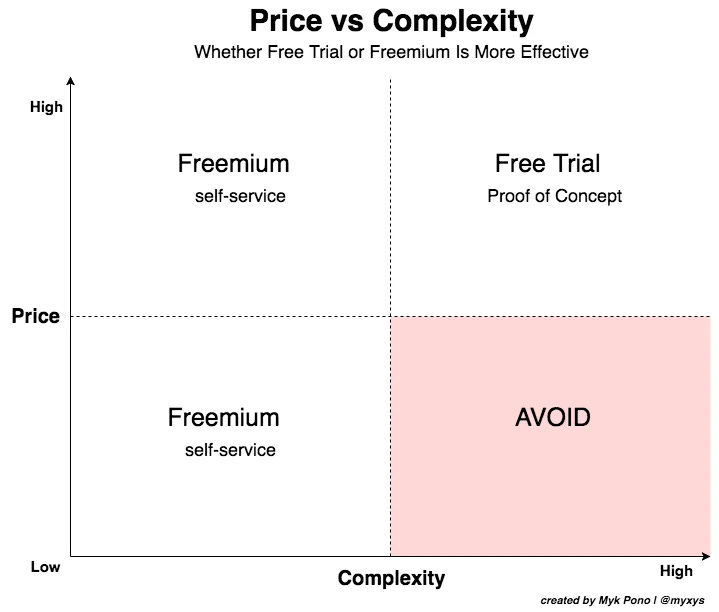
If you can’t wait that long or aren’t set up for a full A/B test, consider these “Three Factors for Freemium Strategy”:
Does your paid plan have a gross margin of 80–90%?
If you have a lower gross margin — for example, because your product is not fully self-service, requires extensive customer support or is extremely costly in terms of tech infrastructure — freemium will probably not work for you.Does your free plan attract the right audience?
If your free users are too different from your paying users, your free-to-paying conversion will be low, and you’ll risk developing your product for the wrong audience.Is your product inherently viral?
If your answer is no, that doesn’t make it a complete no-go, but it does mean that it’s much less likely that freemium is right for you.
In the end, freemium only makes sense if a certain percentage of your free users do one of three things:
Eventually, convert to paid,
Refer paying customers, or
Provide the kind of valuable feedback that will improve your product.
A freemium product that fails to achieve any of these effects will merely saddle you with extra costs and distract you from servicing your most important users.
Also, check out this interesting article on why companies fail with freemium. I highly recommend it, definitely worth a read.
The unit economics Excel sheet template every founder should use.
Most founders talk about growth. Few can clearly show how each new customer makes or loses them money. That’s why running a unit economics model early matters; it tells you if your business will compound or collapse.

Here’s how to use the sheet I’ve shared:
1. Map your revenues
Enter your average revenue per unit (subscription, fee, or transaction).
Decide if it’s recurring (monthly/annual) or one-time.
Pro tip: if you don’t know exact numbers yet, start with estimates and refine over time.
2. Add cost of sales (COGS)
Enter costs as a % of revenue (hosting, delivery, support).
The sheet calculates your gross margin per unit automatically.
3. Plug in churn + growth assumptions
Set billing cycle (monthly = 1, annual = 12).
Add churn % (customers who drop each cycle).
Add expected annual margin growth (e.g., 5%).
The model uses these to estimate the average customer lifetime.
4. Add acquisition + retention costs
Enter your CAC (cost to acquire one customer).
Add optional retention/expansion costs if relevant.
5. Review key outputs
LTV (Lifetime Value): how much a customer is worth over their lifecycle.
LTV/CAC ratio: >3 is usually healthy.
CAC payback period: months it takes to earn back the acquisition spend.
Cumulative cash flows: show when you turn profitable per customer.
6. Stress-test scenarios
Increase churn by 30%.
Drop your AOV (average order value) by 20%.
Raise CAC by 50%.
See how fast LTV/CAC breaks. This is where most founders get surprised.
Why this matters
Investors use this as a quick sanity check.
It forces you to confront pricing, churn, and acquisition head-on.
A business with shaky unit economics will break no matter how good the growth story sounds.
Download the sheet, plug in your numbers, and run 3 scenarios: best case, expected case, worst case. You’ll instantly see whether your idea scales or needs fixing.
EXPLORE MORE
💡 Reports, Articles and a few interesting stuffs
Evan Fisher on what most founders miss about in-house rounds (Link)
Chris Smith shares 3 distinct ways to play the VC game (Link)
Eddie Lou on 3 things he looks for in startup investing (Link)
Gokul Rajaram on weekly founder emails (Link)
John Rush shares lessons learned from failing 30 startups in 20 years (Link)
Microsoft’s AI Strategy Deconstructed. (Link)
NEWS RECAP
🗞️ This week in startups & VC
New In VC
nvp capital, a New York-based seed-stage venture capital firm investing globally in enterprise software and vertical AI, closed its second fund at $80M. (Link)
J2 Ventures, a Boston, MA-based venture capital firm investing in technologies that advance both commercial markets and U.S. national security, closed its Brookhaven Fund at $250m. (Link)
VC Jennifer Neundorfer explains how founders can stand out in a crowded AI market. (Link)
New Startup Deals
Federato, a San Francisco, CA-based provider of an AI-native platform for insurance work, raised $100M in Series D funding. (Link)
Asseta AI, a NYC-based provider of an accounting platform for family offices, raised $4.2m in seed funding. (Link)
Orion, a Los Angeles, CA-based provider of a personalized smart mattress, raised $17.5m in seed funding. (Link)
Self, a San Francisco, CA-based provider of zero-knowledge (ZK) identity solutions, raised $9M in Seed funding (Link)
Confidein, a Los Angeles, CA-based AI and Faith technology company, closed its $6m seed funding round. (Link)
Bedrock Data, a Menlo Park, CA-based provider of a DSPM platform for data-centric security, governance and management, raised $25m in Series A funding. (Link)
TODAY’S JOB OPPORTUNITIES
💼 Venture capital & startup jobs
All-In-One VC Interview Preparation Guide: With a leading investor group, we have created an all-in-one VC interview preparation guide for aspiring VCs. Don’t miss this. (Access Here)
Senior Principal - Newsbreak Venture | USA - Apply Here
Investment Analyst - Cornell University | USA - Apply Here
Associate - Venture Capital - Artha Venture Fund | India - Apply Here
Investment Team - WEH Venture | India - Apply Here
Fund Operations Executive - Sauce VC | India - Apply Here
Venture Scout - First momentum Venture | Remote - Apply Here
Analyst / Associate - Core Innovation Capital | USA - Apply Here
Program Associate - Plug and Play tech Center | USA - Apply Here
Executive Assistant - AN Venture Partner | USA - Apply Here
Communications Analyst - Oui Capital | Hybrid - Apply Here
Visiting Investment Analyst - Join Capital | USA - Apply Here
AI Tech Lead - Core Innovation Capital | USA - Apply Here
Investment Analyst - Caanan | USA - Apply Here
Venture capital Fellowship for PhDs - Contrarian Venture | USA - Apply Here
VC Associate UK - Breega | UK - Apply Here
Analyst - Investments - Blackhill Fund | India - Apply Here
Partner 16, Deal Operations - a16z | USA - Apply Here
PARTNERSHIP WITH US
Get your product in front of over 95,000+ audience - Our newsletter is read by thousands of tech professionals, founders, investors and managers worldwide. Get in touch today.
🔴 Share Venture Curator
You currently have 0 referrals, only 5 away from receiving a 🎁 gift that includes 20 different investors’ contact database lists - Venture Curator