


👋 Hey, Sahil here - Welcome back to Venture Curator, where we explore how top investors think, how real founders build, and the strategies shaping tomorrow’s companies.
5 predictions that reveal where AI agents will actually make money.
Wispr Flow’s framework to reach 100,000+ daily users - The CEO’s exact consumer playbook.
Mark Cuban’s AI Thesis: The $495B AI opportunity that most founder missing.
FROM OUR PARTNER - FRAMER
🚀 Launch fast. Design beautifully. Build your company’s website on Framer

Framer helps teams design, build, and launch their marketing sites lightning fast. With the ability to publish hundreds of CMS pages in a single click, operate at a global scale with seamless localisation, and even host unified content across multiple domains, teams have never been able to ship faster. Trusted by companies like Miro, Bilt, and Perplexity
Speed without chaos: ship pages and updates faster without turning the site into a fragile set of one-off hacks
Reduce dependency: shift routine brand and marketing work out of product engineering queues.
Production-grade foundation: Run real marketing systems (CMS, SEO, performance optimisation) with governance and collaboration
Build your company’s site on Framer today →
VENTURE CURATORS’ FINDING
📬 My Favourite Finds
Media Posts:
It’s time to expose a huge scam in AI startups: Contracted ARR. (Link)
Excel template: early-stage startup financial model for fundraising. (Link)
Tim Cook is stepping down as CEO. Meet John Ternus, the new CEO of Apple. (Link)
Jeff Bezos is raising $10B for a new AI lab quietly targeting industrial AI. (Link)
Reports/Articles:
What investors ask and how to answer: A practical Q&A prep kit for founders. (Link)
The SaaS Rout of 2026 is even worse than you think? (Link)
Venture Capital has a starting line problem. (Link)
The growth metric Silicon Valley loves most is also its least trusted. (Link)
Deedy Das visually clusters what VCs are investing in right now (Link)
📜 DEEP DIVE
5 predictions that reveal where AI agents will actually make money.
Everyone is talking about AI agents. But the real question isn’t whether agents will exist - it’s where the money will flow once companies start deploying them at scale.
A recent report from CB Insights breaks this down using hiring signals, funding activity, and enterprise surveys.
Building agents is no longer the hard part. Deploying, securing, and scaling them inside enterprises is.
That shift is creating several new markets around the “agent stack.” Here are the five areas where the biggest opportunities are emerging.
Multimodal AI agents will dominate customer service
Customer support is quickly becoming the largest deployment ground for AI agents. According to the enterprise survey, it’s already the #1 adoption area for enterprise AI agents, with 115+ companies competing in the market and at least 6 private companies generating $100M+ in revenue.
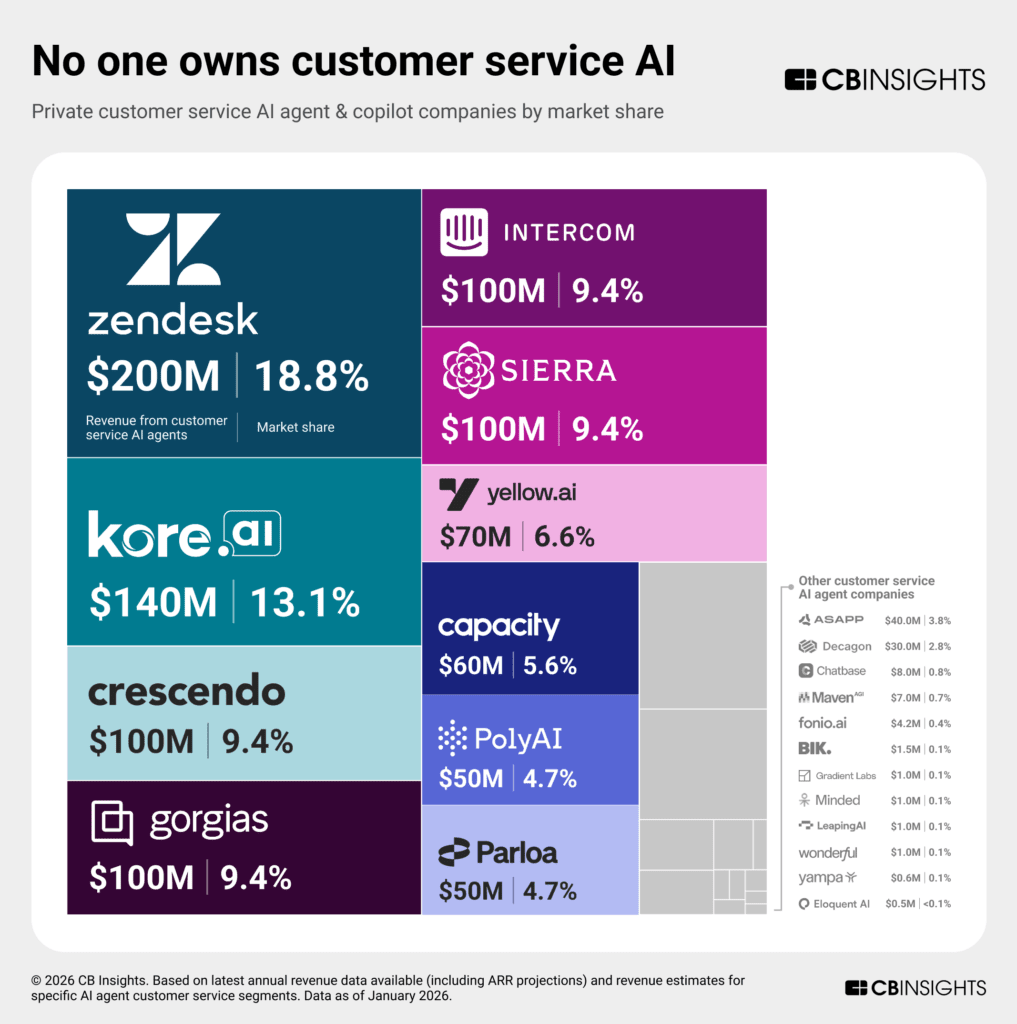
The next wave of competition will revolve around multimodal capabilities - agents that seamlessly operate across: voice, text, documents, images and video inputs.
Voice is becoming the real proving ground. Handling interruptions, latency, and conversational turn-taking requires much deeper architectural design than text agents simply adding voice later.
This is why AI-native entrants like Sierra (2023) and Crescendo (2024) are quickly climbing into the top revenue leaders alongside earlier companies like PolyAI.
So the next generation of customer service tools won’t just automate tickets, they’ll manage conversations across every channel.
Voice AI will shift to “high-touch” deployments
Most AI tools today follow a self-serve model. Voice AI is going the opposite direction.
Startups such as ElevenLabs, Deepgram, Bland AI, Vapi, and Synthflow are increasingly hiring forward-deployed engineers and solutions architects to work directly with enterprise clients.
Why? Most enterprises still struggle with real-world AI implementation.
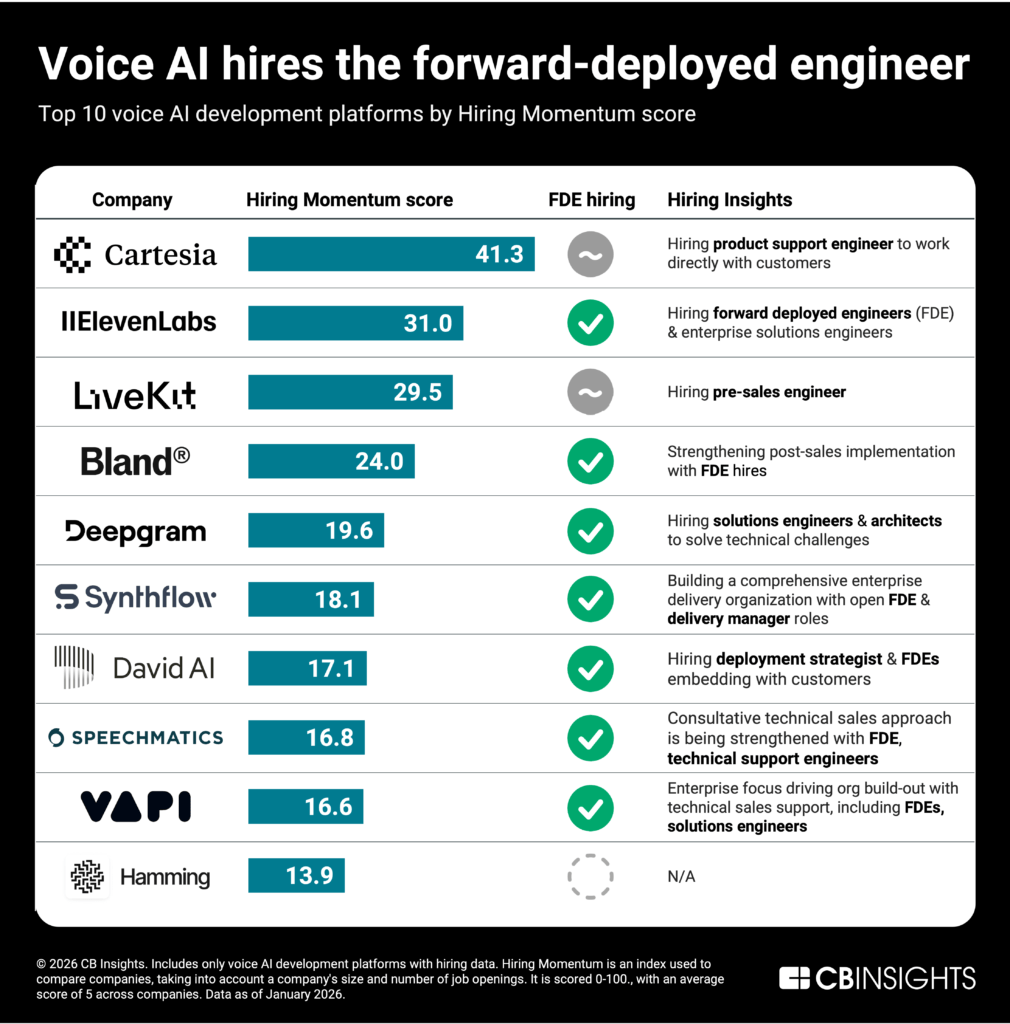
CB Insights’ survey found:
65% of companies lack internal expertise
59% cite integration complexity as the main barrier
So instead of selling software alone, vendors are embedding engineers directly inside customer environments to integrate voice agents with legacy systems.
This approach sacrifices some margin but dramatically increases enterprise adoption - especially in industries like healthcare, finance, quick-service restaurants, and government.
AI agent security will become mandatory infrastructure
Agents introduce a new type of security risk. Unlike copilots, agents can:
execute code
call APIs
move data between systems
make decisions autonomously
That means every tool an agent accesses becomes a potential attack surface.
Security vendors are responding with continuous red teaming systems, tools that simulate attacks against AI agents to uncover vulnerabilities before real attackers do.
These systems test issues like: prompt injection, agent hijacking, tool misuse and multimodal attacks
Startups like Virtue AI are building platforms that continuously stress-test agents in production environments.
Large cybersecurity players are already moving quickly:
Palo Alto Networks acquired Protect AI
Check Point acquired Lakera
F5 acquired Calypso AI
The message is clear: AI security is becoming an extension of traditional cybersecurity infrastructure.
AI agent observability will trigger a wave of acquisitions
Once agents are deployed, enterprises need tools to answer a simple question:
What are these agents actually doing? That’s why the market for agent observability and evaluation tools is heating up.
These tools help companies:
monitor agent decisions
audit behavior
Evaluate model performance
manage permissions and governance
M&A activity across the AI agent ecosystem jumped 10x in 2025, approaching 100 deals, with observability and evaluation tools becoming prime acquisition targets.
Examples include:
Coralogix acquiring Aporia
Snyk is acquiring Invariant Labs
ClickHouse acquiring Langfuse
Anthropic acqui-hiring HumanLoop
Even infrastructure giants are positioning themselves.
Datadog has already invested in multiple observability startups, including LangChain, Arize, Braintrust, and Patronus AI. Enterprise platforms like Salesforce and Workday are also expected to acquire reliability tooling to support their own agent ecosystems.
As Bessemer Venture Partners recently noted, AI evaluation remains one of the biggest bottlenecks in enterprise deployment.
Solving that bottleneck could unlock the next wave of adoption.
World models will power the next generation of physical AI
While software agents are transforming enterprise workflows, another frontier is emerging: physical AI agents.
These systems rely on world models, AI systems that simulate real-world physics such as gravity, friction, and object interactions.
World models allow robots, autonomous vehicles, and factory systems to train in simulated environments before operating in the real world.
Signals suggest this market is accelerating quickly:
Funding activity ranks in the top 3% of CB Insights markets
Talent from leading AI researchers is entering the space
Major companies are hiring aggressively to build simulation environments
Examples already appearing across industries include:
Waymo is building 4D world models for autonomous driving
Agility Robotics and Figure AI using Nvidia simulation models
Manufacturing systems using AI agents to autonomously manage factory operations
The result is a new foundational layer for robotics and physical automation.
Half the companies in this category are still early-stage or research-focused, but the hiring, investment, and deal activity suggest world models will soon become core infrastructure for physical AI systems.
Put together, these signals reveal an important shift.
The first wave of AI focused on models.
The second wave focused on applications.
The next wave will focus on deployment infrastructure.
And the companies that capture value will likely sit in the layers that make AI agents reliable, secure, and usable inside real businesses.
PARTNERSHIP WITH US
🤝 Get your brand in front of 120,000+ audience.
Our newsletter is read by 120,000+ tech professionals, founders, investors (VCs / Angel Investors) and managers around the world. Get in touch today.
📃 QUICK DIVES
Wispr Flow’s framework to reach 100,000+ daily users - The CEO’s exact consumer playbook.
Most consumer startups don’t fail because the UI was ugly or the ads didn’t convert. They fail because they never became a habit.
Tanay Kothari, CEO of Wispr Flow (raised $81M), recently shared the internal playbook behind scaling to 100,000+ daily active users and over 10 billion words dictated. What’s powerful is not that it’s complicated. It’s that it’s simple, but brutally disciplined.
If you’re building a consumer, this is worth studying carefully.
(Wispr Flow is voice-first productivity software that helps people write, code, message, and work hands-free by speaking instead of typing )
Psychology: You can only change one behaviour at a time
This is the most expensive lesson for consumers.
Before Wispr Flow became software, the team built a hardware earpiece that could read neural signals from silent speech. It worked. Technically impressive. But it required two behaviour changes:
Wear a new device
Speak instead of typing
That’s where most products die.
Look at the pattern: Humane AI Pin asked users to wear a new device and interact with a projector. Google Glass asked users to wear a camera and talk in public.
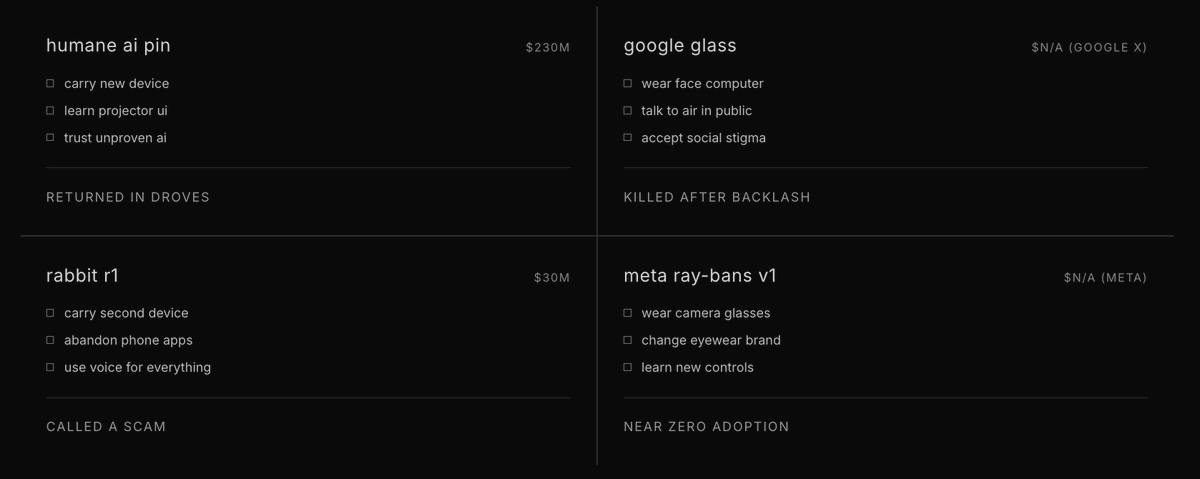
Two behaviour shifts at once are too much cognitive friction.
When they pivoted to software, they asked for exactly one behaviour change: speak instead of type. Everything else stayed the same: same apps, same workflows, same screen.
That constraint became the growth engine.
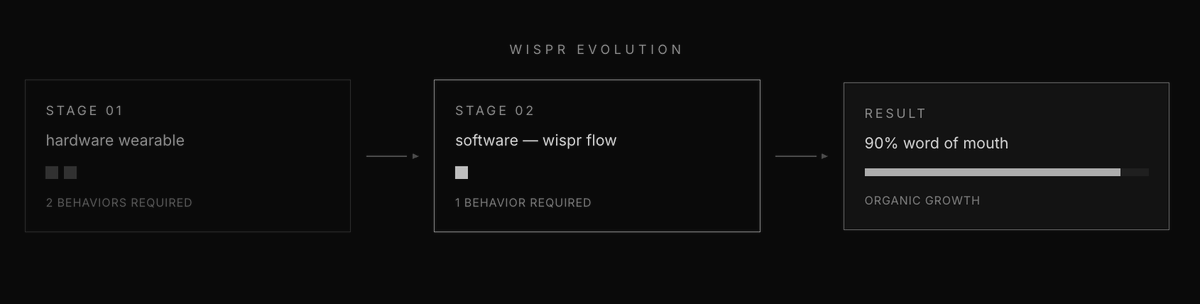
90% of their growth is word of mouth. Not because of virality tricks but because they engineered around one psychological moment.
Product: Dependency beats demo
Most products impress in a demo. Very few become dependent. Two things moved the needle for Wispr.
First: they talked to 500+ people.
Not surveys. Not Typeform. Real conversations. Watching users struggle with existing dictation tools. Noting the exact moment frustration hit.
That’s where product clarity came from.
Patterns became obvious:
Names are constantly misspelt
Tone inconsistencies
Tools failing when users corrected themselves mid-sentence
Every core feature traces back to something someone said in those conversations.
Second: they built a product that learns about the user.
Not just AI dictation. Personalization:
Personal dictionary — if you fix a word once, it remembers
Tone controls — match capitalization, punctuation, style
Self-correction — “Let’s meet tomorrow, no wait, Friday” outputs correctly
These seem small. But they signal care.
And care compounds.
When users feel that a product improves with them, it stops feeling like software and starts feeling like infrastructure.
Team: How 200 people out-ship much larger companies
The product doesn’t matter if the team moves slowly.
Wispr’s team principles are unusually sharp.
Two-person pods: Two engineers per project. Full ownership. No handoffs. No ambiguity.
Communication overhead scales exponentially with team size. Pods contain it.
Hire ex-founders Not for prestige. For instinct.
Ex-founders don’t file tickets. They fix problems. They can’t ignore broken things.
That ownership bias compounds velocity.
Hire for taste, not just skill
In consumer, taste is leverage.
The person who knows an animation is 50ms too slow.
The designer who rejects something technically correct but emotionally wrong.
The engineer who refactors invisible code because it feels wrong.
You can train skill. Taste is rare.
The underlying pattern
What’s striking is that none of this is a growth hack.
It’s alignment.
Psychology → one behaviour change
Product → remove friction repeatedly
Team → maximise ownership and taste
When these align, you don’t need constant marketing tricks. The product carries itself.
And the most important line Tanay shared:
Don’t build something people want. Build something people can’t live without.
Consumer products don’t win on features. They win on feelings. And the companies that understand that gap build habits instead of installs.
Mark Cuban’s AI Thesis: The $495B AI opportunity that most founder missing.
Most founders are chasing the wrong layer of the AI stack.
They think the opportunity is in building the next foundation model, the next ChatGPT, or the next AI-native SaaS unicorn. But when Mark Cuban calls AI the biggest job creation wave since the internet, he’s not talking about model labs.
He’s talking about services. And when you look at the numbers, the thesis becomes hard to ignore.
There are 33 million businesses in the United States that need AI integration. Yet only 8.8% actually have AI in production. The current AI services market sits around $11B, but the projected opportunity ranges between $165B and $495B. Even a modest 10% buy-in implies nearly half a trillion dollars in addressable spend.
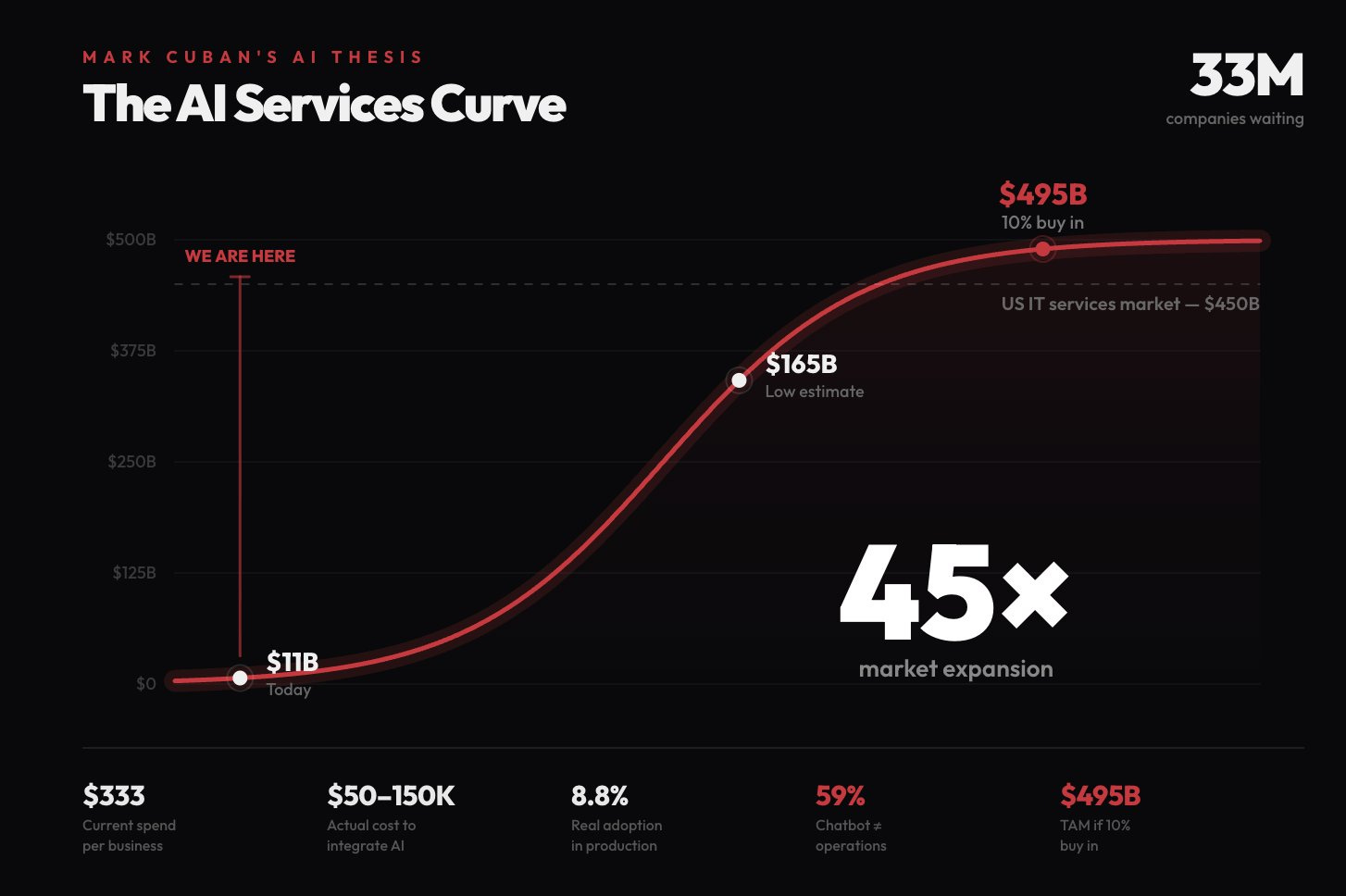
That’s not incremental growth. That’s a structural shift.
The real gap isn’t between “no AI” and “ChatGPT access.” It’s between experimentation and operational transformation.
Most businesses today fall into the illusion of adoption. You’ll hear that 68% of companies use AI. But in practice, that often means:
Someone in marketing prompts ChatGPT for email drafts
A manager uses AI to summarise documents
Teams experiment with generic copilots
That’s surface-level usage. It doesn’t touch the core of how the business runs.
The distance between “I used a chatbot” and “AI runs parts of our operations” is massive. And that distance is where the real opportunity sits.
What businesses actually need isn’t another SaaS subscription. They need someone who can walk into their company, understand how work flows, and design AI systems that execute real tasks.
That requires a different skillset than building models from scratch. The opportunity lies in agent orchestration.
Most companies don’t struggle with access to AI. They struggle with integration. No tool, on its own, can:
Map messy workflows
Identify repetitive decision loops
Connect CRM, support, finance, and internal tools
Design escalation paths
Monitor performance and reliability
Continuously improve outputs
This is not a feature problem. It’s a systems problem.
Agent orchestration is about turning AI from a chatbot into an operational layer. Instead of “AI helping,” it becomes “AI doing.”
That might mean:
Support tickets auto-resolved with guardrails
Sales leads are pre-qualified before a human touches them
Internal reporting is generated autonomously
Contract review is automated end-to-end
Repetitive back-office tasks delegated to agents
When you frame it that way, the job creation thesis becomes clearer. Every one of those 33 million businesses needs someone who can:
Understand business incentives
Translate processes into logic
Deploy agentic workflows
Build safeguards
Iterate based on results
And most of those people will not be pure engineers.
The next high-demand profile in tech isn’t necessarily the person training foundation models. It’s the translator, someone who understands both business operations and agent systems. Former operators, product leaders, consultants, technical generalists, people who can bridge workflows and orchestration.
That’s why betting on agent orchestration makes sense. The foundational models are largely built. The APIs exist. The tools are improving weekly. What’s missing is deployment at scale.
If you’re building in AI right now, the real strategic question is not whether your product uses the best model. It’s whether you are closing the gap between curiosity and execution.
Because the $11B market today isn’t the ceiling. It’s the starting point. The expansion to $165B-$495B won’t come from better demos. It will come from businesses that move from “AI experiment” to “AI runs part of our company.”
That transition requires people who can design, implement, and operate agent systems inside real-world constraints.
And those people are about to become some of the most in-demand operators in tech. Not because they built AI. But because they made it work
TODAY’S JOB OPPORTUNITIES
💼 Venture Capital & Startup Jobs
Most aspiring VCs struggle with interviews, unclear expectations, no structured prep, and generic advice that doesn’t actually help. So we partnered with a leading investor group to build an all-in-one VC Interview Preparation Guide that gives you real clarity and frameworks. (Access Here)
Associate - DN Capital | Germany - Apply Here
Investment Intern - DTCP | UK - Apply Here
Analyst, Global Investment Team - 500 Global | USA - Apply Here
Associate, Data Operations - Iconiq Capital | USA - Apply Here
Investor - AI - Samsung Next | USA - Apply Here
Finance Associate - RA Capital | USA - Apply Here
Fund Controller - NFX | USA - Apply Here
Vice President, Investor Relations - General Atlantic - Apply Here
Senior Associate - RA Capital | USA - Apply Here
PE & VC Partner Manager - Dealhub | UK - Apply Here
Partner 22 -a16z | USA - Apply Here
Infra / Platform Engineer - Pear VC | USA - Apply Here
Associate / Senior Associate - Stepstone Group | Italy - Apply Here
Investment Analyst - Lunicorn Venture | UK - Apply Here
Investor (Senior Associate/Principal) - Square Peg | USA - Apply Here
Program Manager - a16z | USA - Apply Here
PARTNERSHIP WITH US
🤝 Get your brand in front of 120,000+ audience.
Our newsletter is read by 120,000+ tech professionals, founders, investors (VCs / Angel Investors) and managers around the world. Get in touch today.
🔴 Share Venture Curator
You currently have 0 referrals, only 5 away from receiving a 🎁 gift that includes 20 different investors’ contact database lists - Venture Curator
the wispr insight about only asking users for one behavior change at a time is something every consumer founder should tattoo on their arm.