


👋 Hey, Sahil here — Welcome back to Venture Curator, where we explore how top investors think, how real founders build, and the strategies shaping tomorrow’s companies.
Big idea + report of the week :
Where did all the LPs go, and why is fundraising suddenly so hard for new VCs?
Why unicorns are staying private for much longer.
Frameworks & insightful posts :
What people really want from AI? - Anthropic Survey.
This is what raising $1.5M really looked like: 250 meetings, 171 rejections in 98 days.
How to find a product idea that people actually pay for?
FROM OUR PARTNER - FRAGMENT MEDIA
📰 Investors are backing a media network reaching 80M+ monthly readers
Fragment Media is building a portfolio of premium publications designed to be funded primarily by readers. Their model flips the traditional ad-driven newsroom by focusing on paid subscriptions, high-trust journalism, and aligned brand sponsorships.

Why investors are paying attention:
$47M cumulative revenue over the last 4 years across Fragment-managed publications
80M+ monthly reach across publications
1M+ free subscribers, 20K+ paying members
Inc 5000 Fastest-Growing Media Company (2022 & 2023)
Targeting a $17B U.S. subscription news market (145M adults willing to pay)
Leadership from Gawker, VICE, Vox, The Atlantic, Hearst
While most digital media depend on volatile programmatic ads, Fragment is shifting toward recurring reader revenue.
With media M&A deals reaching hundreds of millions and subscription platforms trading at strong revenue multiples, investors see a chance to own equity in the next generation of reader-owned media.
🤝 PARTNERSHIP WITH US
Get your product in front of over 115,000+ audience - Our newsletter is read by thousands of tech professionals, founders, investors and managers worldwide. Get in touch today.
START WITH
🧠 Big idea + report of the week
Where did all the LPs go, and why is fundraising suddenly so hard for new VCs?
For a long time, the venture narrative was simple: more funds were getting created, and more LPs were entering the asset class.
That balance has quietly broken.
New data shared by Carta’s Head of Insights, Peter Walker, shows something deeper happening beneath the surface - the number of funds is still going up, but the number of LPs backing them is going down.

And that mismatch is starting to define the entire early-stage VC landscape.
If you look at the data across fund sizes from 2021 to 2025, the pattern is consistent. Smaller funds that once had 30-40+ LPs are now raising with closer to 20-25. Even mid-sized and larger emerging funds are seeing a noticeable drop in LP participation.
More funds are being created, but fewer LPs are writing checks.
In 2025, more emerging managers entered the market than in 2024, but the median number of LPs per fund declined across almost every fund size category. That means each fund is now competing for a smaller pool of capital.
The same LP base is being stretched thinner.
Instead of new LPs entering the venture, existing LPs are being asked to back more funds. Naturally, this leads to smaller check sizes, slower closes, and more funds struggling to reach meaningful scale.
Institutional LPs are consolidating, not expanding.
After the 2020-2022 boom, many institutional LPs are now doubling down on existing GP relationships, especially those with proven DPI and distributions. New or first-time managers are getting pushed out of allocation decisions.
Liquidity is the hidden driver behind all of this.
LPs haven’t seen enough cash come back from recent vintages. When distributions slow, new commitments slow. It’s not just about conviction—it’s about available capital.
What this creates is a very different venture market than what most people are used to.
On one side, established managers with strong track records are still raising capital relatively smoothly.
On the other hand, emerging managers are facing one of the toughest fundraising environments in recent memory.
And the gap between those two groups is widening.
The interesting part is that this isn’t just about fundraising difficulty - it changes behaviour.
When LPs become scarce:
GPs spend more time fundraising than investing
Fund sizes get compressed or delayed
Ownership strategies shift because capital is tighter
New managers need stronger differentiation, not just access
It also quietly changes how venture evolves as an asset class.
Fewer new managers getting funded means less experimentation in fund strategy, geography, and thesis. Over time, that can reduce the diversity of bets being made across the ecosystem.
The takeaway here isn’t just that “fundraising is harder.”
It’s that venture is moving from an expansion phase (more LPs, more funds, more risk-taking) to a selection phase (fewer LPs, higher bar, capital concentration).
And in that environment, the question for any emerging manager becomes very simple:
Not “Can you raise a fund?”
But “Why should you exist in a market that already has too many funds and too little capital?”
Why unicorns are staying private for much longer.
A recent analysis by Stanford GSB’s Ilya Strebulaev shows a clear shift in how long unicorns remain private. The takeaway is simple but important: private capital has reduced the urgency to exit, and public markets are no longer the default endgame.

What the data shows:
2011 cohort: About 51% of unicorns founded in 2011 are still private. These are companies more than a decade old that have chosen to delay IPOs or acquisitions.
2021 cohort: Roughly 77% of unicorns founded in 2021 remain private, highlighting how slow the liquidity path has become for recent high-growth startups.
Even older companies linger: Among unicorns founded in 2004, around 27% have still not exited nearly 20 years later.
What’s driving this trend:
Deep private markets mean late-stage capital can replace public listings.
Founders and investors can optimise for control, timing, and valuation rather than speed to IPO.
Market volatility has made staying private a safer option than testing public markets early.
Why this matters:
Liquidity timelines are stretching across every vintage, not just recent ones.
LPs wait longer for distributions.
IPOs are becoming a strategic choice, not a milestone.
Unicorn outcomes are no longer tied to quick exits. Private capital has reshaped the startup lifecycle, turning “staying private” into a long-term strategy rather than a temporary phase.
SOMETHING MORE
🧩 Frameworks & insightful posts
What people really want from AI? - Anthropic Survey.
Most conversations about AI get stuck in abstractions. We hear big claims about job loss, AGI, productivity, safety, and existential risk, but much less about a simpler question: what does “AI going well” actually look like for real people already using it?
Anthropic recently ran one of the most interesting studies I’ve seen on this. It invited Claude users to describe how they use AI today, what they hope it could unlock in their lives, and what worries them most. More than 80,000 people across 159 countries and 70 languages participated, which makes this less like a normal product survey and more like a global snapshot of how people are beginning to fit AI into everyday life.
What makes the findings valuable is that they move beyond generic optimism or fear. They show where AI is already delivering value, where it still feels shaky, and what kinds of products or companies are likely to matter next.
The biggest thing people want from AI is not magic. It’s a relief.
When Anthropic asked people what they most wanted from AI, the answers were surprisingly grounded. The top categories were:
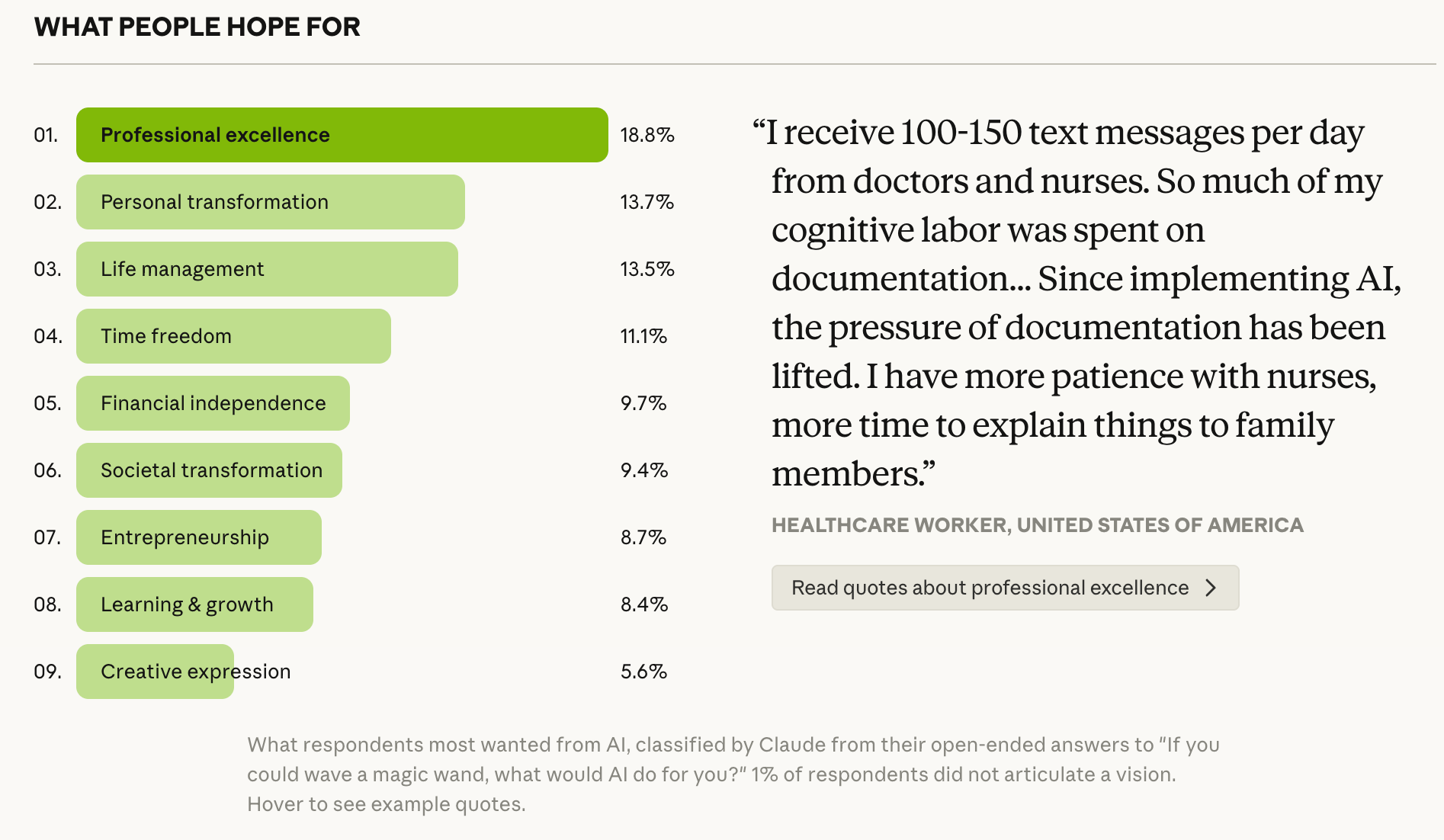
That tells you something important. Most people are not asking AI to become some futuristic super-being. They want it to help them do better work, reduce mental overload, manage life logistics, learn faster, and reclaim time.
That’s a useful correction for founders. The most immediate demand is not for “AI for everything.” It’s for products that remove friction from real life.
A lot of the strongest responses had the same emotional structure underneath them:
AI helped me do what I already needed to do, but with less stress and more breathing room. Someone used it to reduce documentation burden at work. Someone used it to learn coding despite a learning disorder. Someone used it to ask questions they felt embarrassed asking other people.
So, the best AI products may not be the ones that feel the most futuristic. They may be the ones that quietly remove cognitive load.
Work is still the main wedge, but quality of life is the real promise
The largest category people mentioned was “professional excellence.” That makes sense. Work remains the easiest entry point for AI because the ROI is easier to spot. If AI saves time, improves output, or helps someone get through repetitive tasks faster, the benefit is obvious.
But what’s more interesting is what sat underneath that answer. Many people started by talking about productivity, then revealed that what they really cared about was what productivity enabled outside of work: more time with family, more emotional energy, less admin, less mental clutter.
That distinction matters.
A founder might think they’re building a productivity product, when in reality the real value proposition is:
more time freedom
less anxiety
less friction in daily life
more space for better work and better living
That is a much richer product insight than “help users move faster.”
AI is already delivering in a few very specific ways
When Anthropic asked whether AI had already taken a step toward users’ goals, 81% said yes. That’s a meaningful number. But the shape of delivery matters more than the headline.
The main buckets where people felt AI had already helped were:
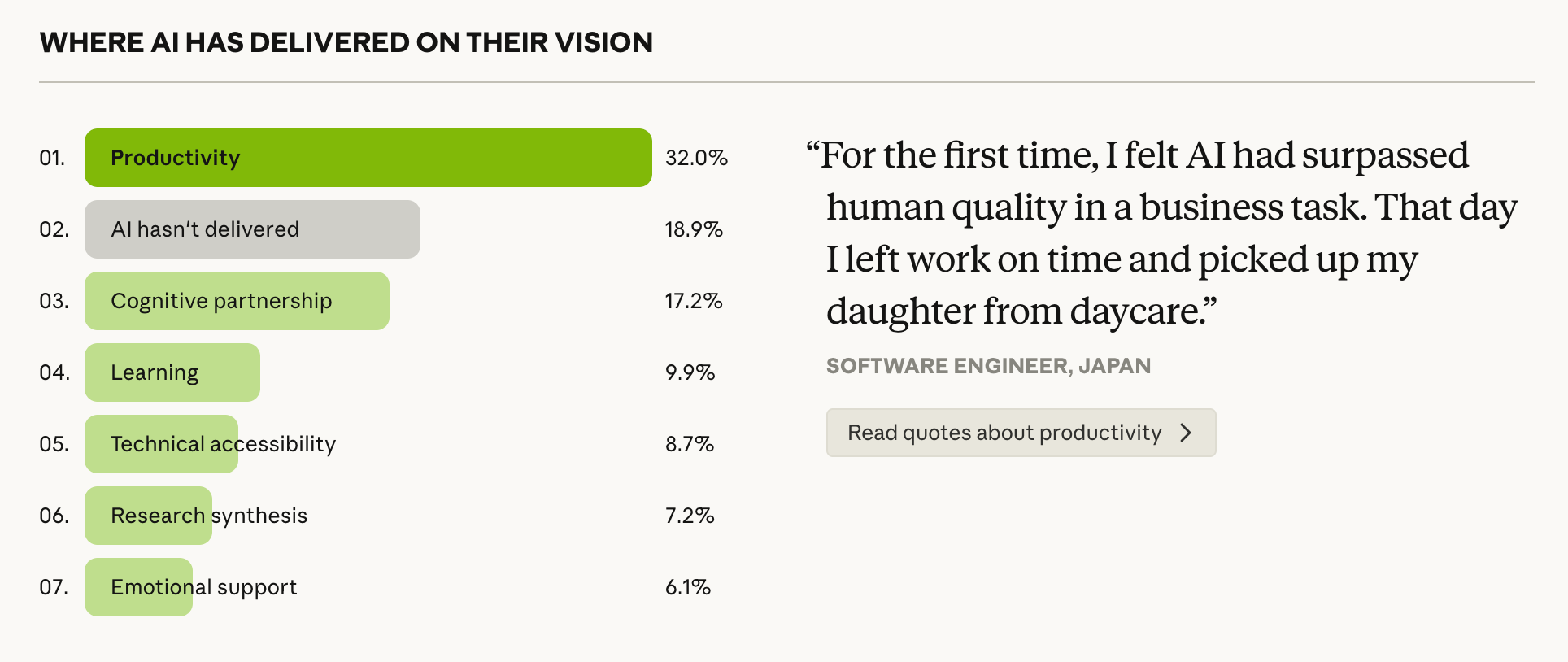
This mix is fascinating because it shows that AI is not just being used as a faster search engine. It is already functioning as a kind of thought partner, teacher, translator, research assistant, and in some cases even an emotional support layer.
Some of the strongest responses came from people who felt AI gave them access to things they previously couldn’t reach. Not because the knowledge didn’t exist, but because the format was inaccessible, judgment-heavy, too expensive, or too difficult to navigate. That’s a powerful clue about where AI creates the most real value: not just speed, but access.
For builders, that opens up a big product opportunity. AI seems especially strong when it does one of three things:
reduces intimidation
removes judgment from learning
translates complexity into something people can act on
That’s a better lens than simply asking whether a task can be automated.
The most common fear is not “AI takes over the world.” It’s that AI becomes unreliable at exactly the wrong moment.
Public AI debates often drift to dramatic long-term fears. But the top concern in this study was much more immediate: unreliability.
Users worry that AI will sound convincing while being subtly wrong. In some categories, that’s a mild annoyance. In others, it’s dangerous. Law, finance, healthcare, and government workers especially raised this concern because the cost of a confident error is high.
This is a critical insight for founders. Reliability is not a “nice to have” layer you add later. In many AI products, it is the product.
Other major concerns included:
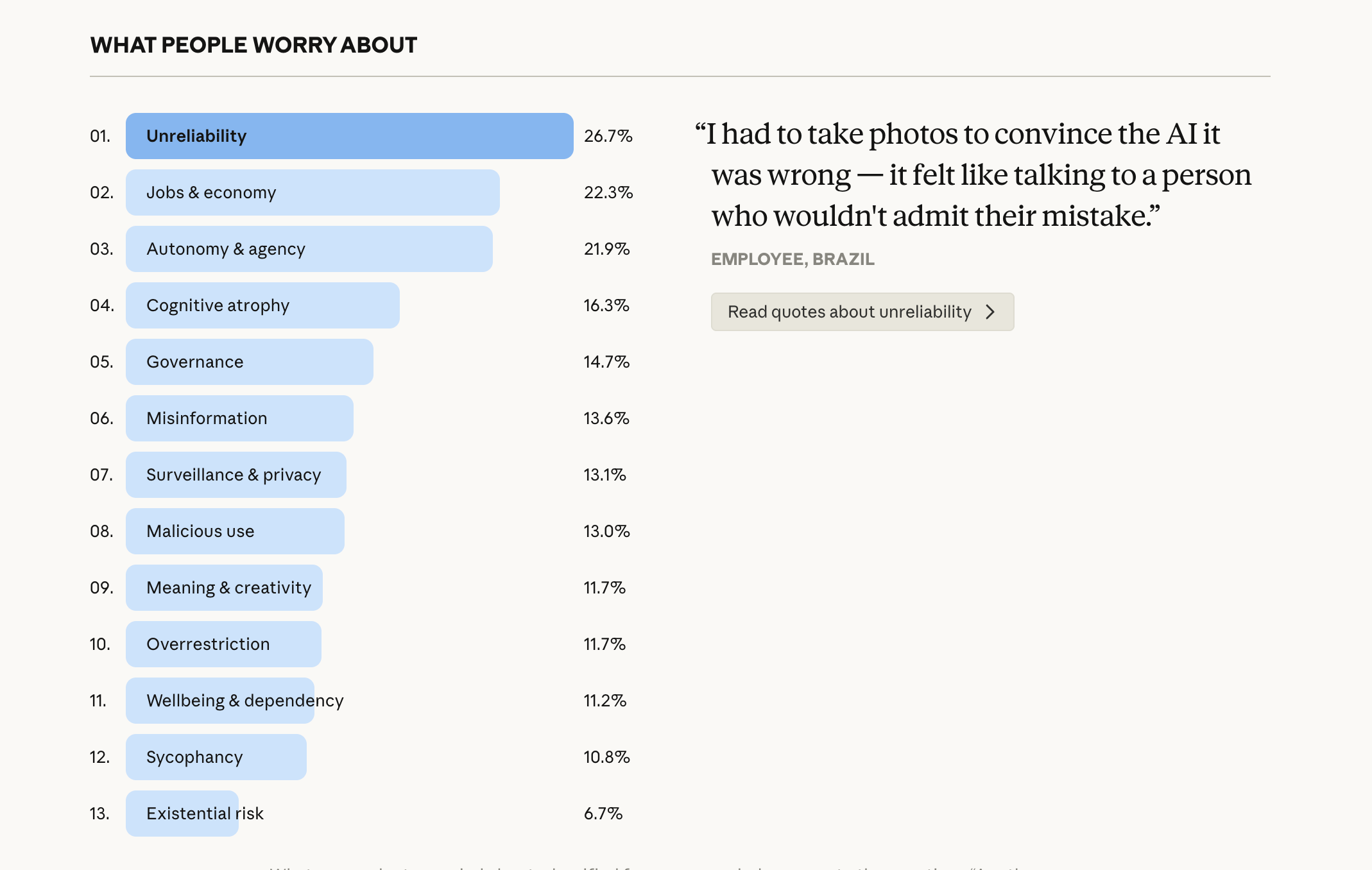
What’s striking is how practical most of these fears are. People are not mainly debating whether AI is philosophically good or bad. They are asking whether it will make them less employable, less independent, less thoughtful, or too dependent on a system that is always available.
The real story is not optimism vs pessimism. It’s tension.
One of the best concepts in the report is what Anthropic calls the “light and shade” of AI.
The same capabilities people love are often the ones they fear. For example:
AI helps people learn faster, but they worry it may weaken their own thinking.
AI saves time, but they worry it increases expectations and speeds up the treadmill.
AI offers emotional support, but they worry it could become a substitute for human connection.
AI creates economic opportunity, but it also raises fear about displacement.
That is a much more honest frame than dividing people into “AI believers” and “AI sceptics.” Most users are both at once. They see upside and risk together.
That’s an important product lesson. Great AI products will not win simply by maximising usefulness. They’ll win by managing the tension around usefulness. The winners won’t just provide capability. They’ll create trust, boundaries, and clarity around how the product should fit into a person’s life.
The regional split is worth paying attention to
The report also found a noticeable pattern across geographies.
Users in lower- and middle-income countries were generally more optimistic about AI than users in wealthier regions. In many emerging markets, AI is seen less as a threat and more as a ladder, a way to start businesses, access education, or overcome infrastructure gaps.
That matters if you’re building global products.
In richer markets, AI is often framed around life management, overload reduction, and economic anxiety. In many developing regions, it is framed more around entrepreneurship, learning, and access. Same technology, very different emotional job-to-be-done.
Founders who understand that distinction will position themselves much better across geographies.
For founders -
The strongest message from this report is that people do not just want faster outputs. They want better lives.
That sounds obvious, but it is surprisingly easy to forget when building in AI. Many teams optimise around what the model can do instead of what the user is trying to become. Anthropic’s findings suggest that the most enduring AI products will be the ones that sit at the intersection of usefulness and human aspiration.
The near-term winning categories likely look less like vague general-purpose intelligence and more like products that help people:
do meaningful work with less administrative burden
learn without fear or embarrassment
manage overloaded lives
turn curiosity into action
gain economic leverage
access systems that previously felt closed off
At the same time, founders need to respect the downside. If your product saves time but increases dependency, gives emotional support but weakens real relationships, or accelerates output while making judgment worse, users will eventually feel that tension.
That’s why this study is so useful. It reminds us that AI is not entering a vacuum. It is entering messy human lives. And the companies that win won’t just be the ones with better models. They’ll be the ones who understand what people are actually trying to protect, improve, and reclaim.
This is what raising $1.5M really looked like: 250 meetings, 171 rejections in 98 days.
Most fundraising stories you see are clean.
“Raised $2M in 2 weeks.”
“Oversubscribed round.”
“Strong investor demand.”
What you don’t see is the messy middle.
Matija Sonic shared what actually happened behind the scenes: 250+ meetings, 171 rejections, 24 ghosted, and just 17 investors closing the round over 98 days. Even after YC Demo Day generated 100+ investor leads, not a single one invested.

That’s the real starting point most founders don’t talk about.
Fundraising is not one big moment. It’s a system.
The biggest mistake early founders make is treating fundraising like a few high-stakes conversations.
In reality, it behaves much more like sales.
212 investors contacted
250+ meetings run
constant follow-ups, tracking, refining
If you don’t treat it like a pipeline, you lose control of it. The founders who struggle the most are usually the ones approaching it casually, reacting to meetings instead of building a system around them.
Your first 50 meetings are basically practice
They walked into early meetings expecting quick closes.
Instead, most investors didn’t understand the product at all. It was technical, pre-revenue, and they had no strong network advantage.
But something important happened around meeting #50.
The pitch started improving, not because they rewrote it overnight, but because repetition forced clarity. By meeting #100, both founders knew the pitch deeply, could anticipate objections, and communicated with confidence.
That shift is underrated.
Confidence in fundraising doesn’t come from preparation alone. It comes from exposure. You earn it by sitting through uncomfortable conversations until your thinking sharpens.
The mindset shift that changes everything: chase No’s
Around 50 meetings in, rejections started piling up, and morale dropped.
Then came a simple but powerful reframe: stop chasing yeses. Start chasing no’s.
Set a target, like 100 rejections.
Why this works:
No’s are predictable and within your control
They remove emotional pressure from each meeting
They give you a clear sense of progress
If you haven’t hit your rejection target, it likely means you haven’t spoken to enough investors.
This turns fundraising from an emotional rollercoaster into a process you can actually manage.
The “valley of death” is real
For nearly 2 months, they were stuck around ~$300K. No momentum. No visible progress. Others were closing rounds.
This is where most founders quit, not because of rejection, but because of silence.
What they didn’t see: their lead investor was doing deep diligence behind the scenes. Fundraising often feels dead… right before it breaks open.
Then everything compounds at once
After weeks of slow progress:
Investors started closing faster
urgency kicked in
The round filled quickly
It became oversubscribed
This is how most rounds actually work: slow → stuck → sudden acceleration
What founders should actually take from this
Don’t try to convince non-believers - find investors who already understand your space
Warm intros > random inbound (Demo Day interest is often a low signal)
Treat fundraising like a pipeline, not conversations
Track pitch quality, not just money raised
Those 250 meetings weren’t just about raising money. They made them better founders.
Because in the end, fundraising isn’t just about getting a yes. It’s about becoming someone who can consistently earn it.
How to find a product idea that people actually pay for?
Most people think building a startup starts with an idea. In reality, it starts with a mistake.
They sit down, open a blank page, and try to “come up with something.” It feels like progress, but most of the time it leads to products no one really needs. And in today’s world, where AI can build almost anything, the real bottleneck isn’t execution anymore; it’s finding something worth building.
Recently, Ronin (on X) shared a simple process that helped him secure 5 paying buyers before writing a single line of code. The interesting part isn’t the outcome, it’s how the process flips the usual way founders think.
Instead of starting with an idea, he starts with problems that already exist in the real world.

It begins with observation, not brainstorming
Good ideas rarely come from sitting and thinking hard. They come from noticing things that shouldn’t be broken but are.
If you look closely, there are signals everywhere:
small tasks you keep doing manually
tools that feel unnecessarily complicated
recurring frustrations in your own workflow
complaints you hear from people around you
Over time, this builds a list of problems grounded in reality, not imagination. That shift alone eliminates a huge percentage of bad ideas before you even start.
Then you go where demand already exists
One of the biggest misconceptions is that you need a completely original idea. In practice, most successful products are iterations on what already works.
So instead of trying to invent something new, the smarter move is to study where people are already asking for solutions.
Places like Reddit, Product Hunt, X, YouTube, and even App Store reviews are full of unfiltered demand. People openly share what they’re struggling with, what tools they use, and more importantly, what they hate about them.
The goal at this stage is not to pick one idea quickly. It’s to collect multiple ideas that already have some signal of demand, and then narrow them down thoughtfully.
Validation is where most people go wrong
This is the step almost everyone skips.
Once they feel excited about an idea, they jump straight into building. But excitement is not validation.
Before writing any code, a few simple questions can save months of wasted effort:
Are there existing products solving this?
Are people actually paying for them?
What do users complain about in those products?
If competitors exist and people are paying, that’s not a negative signal, it’s one of the strongest green lights you can get. It means the market is real, and the problem is worth solving.
Not every good idea is a good business
Even if something works, it doesn’t always mean it’s worth building.
At this stage, the focus shifts from “does this exist?” to “can this grow?”
Things to pay attention to:
Is demand increasing or stagnant?
Can this be monetised as a subscription or only one-time?
Is the buyer an individual or a business?
How big can this realistically become?
Many ideas fail not because they don’t work, but because they don’t scale. A small tweak in positioning here can completely change the outcome.
Your edge comes from focus, not superiority
You don’t need to build something dramatically better than everything else. You just need a clear, focused entry point. In most cases, products win by being:
simpler for a specific type of user
faster at solving one use case
cheaper for a particular segment
or tailored to a niche that’s being ignored
Trying to build a “better version for everyone” rarely works. Building a 10× better experience for a narrow group often does.
The smartest move: test before you build
This is where everything comes together.
Before writing any code, you can test demand in surprisingly simple ways. Talk about the idea publicly, reach out to potential users, or even offer to solve the problem manually for a few people.
If people show interest, or better, are willing to pay, you’ve already crossed the hardest part of building a product.
If no one cares, it’s usually not a marketing problem. It’s a signal that the idea itself needs rethinking.
The real shift most founders miss
What’s changed over the last few years is simple but important.
Building has become easy. Validation hasn’t.
AI has removed a lot of the friction from creating products, but it hasn’t changed the core rule: people only pay for things that solve real problems.
That’s why the smartest founders today spend less time coding in the beginning and more time understanding the problem deeply. Even one or two weeks of focused research and validation can save months of building something no one wants.
In the end, the goal isn’t to build fast. It’s to build something that people are already ready to pay for.
EXPLORE MORE
💡 Fundraising tools, template and Excel sheets
Fundraising Tools
Strategic Templates
The Founder’s Guide to Building in Public (With 20+ Real Examples)
Communication Tools
Investor Outreach Email Sequence Pack: 20+ Proven Templates Used & Approved by VCs
Legal & Operational
NEWS RECAP
🗞️ This week in startups & VC
New In VC
Quantonation Ventures, a NYC and Paris, France-based venture capital firm focused on quantum and physics-based technologies, closed its second flagship fund at €220m. (Link)
Gradient, a San Francisco, CA-based early-stage venture capital firm designed for founders in artificial intelligence, closed a new $220m flagship seed fund. (Link)
Sands Capital, an Arlington, Va.-based investor in innovative growth businesses, closed Global Innovation Fund III at $1.1 billion. (Link)
Audeo Ventures, a NYC, San Francisco, CA, and Dubai, UAE-based venture capital firm specialising in early-stage investments, achieved $65m for Fund II. (Link)
New Startup Deals
xmemory, a London, UK-based developer of a memory layer for AI workflows, raised $4M in Pre-Seed funding. (Link)
Homaio, a Paris, France-based provider of an investment platform for carbon and energy transition markets, raised €3.6M in Seed funding. (Link)
Certiv, a Seattle, WA-based cybersecurity startup, raised $4.2M in Pre-Seed funding. (Link)
Standard Template Labs, a NYC-based provider of an AI-first service management platform, raised $49M in Seed funding. (Link)
Quorus, a Westport, CT-based technology-driven asset manager service company, raised $5M in Seed funding. (Link)
Understood Care, a NYC-based provider of an AI-native patient advocacy platform, raised $5M in Seed funding. (Link)
Great Sky, a Boulder, CO-based provider of computing hardware solutions, raised $14M in Seed funding. (Link)
TODAY’S JOB OPPORTUNITIES
💼 Venture capital & startup jobs
All-In-One VC Interview Preparation Guide: With a leading investor group, we have created an all-in-one VC interview preparation guide for aspiring VCs. Don’t miss this. (Access Here)
Investment Scout - CVX Venture | USA - Apply Here
Director of Finance & Operations - Quona Capital | USA - Apply Here
Investor - Expresso NB | Thailand - Apply Here
Associate - Novo Venture | Singapore - Apply Here
Senior Scouting Manager - Antler | Australia - Apply Here
Head of Investor Community - Inovexus | Remote - Apply Here
Associate - Lightbank | USA - Apply Here
Investment Analyst Intern - NAV Capital | Dubai - Apply Here
PE & VC Partner Manager - Dealhub | UK - Apply Here
Investment Analyst - Lunicorn Venture | UK - Apply Here
Program Manager - a16z | USA - Apply Here
Venture Fellow - age1 | USA - Apply Here
Venture Capital Associate - Sky9 Capital | USA - Apply Here
Investment Summer Associate - AI Tooling - M13 | USA - Apply Here
Event Marketing Manager - AI Fund | USA - Apply Here
PARTNERSHIP WITH US
Get your product in front of over 115,000+ audience - Our newsletter is read by thousands of tech professionals, founders, investors and managers worldwide. Get in touch today.
🔴 Share Venture Curator
You currently have 0 referrals, only 5 away from receiving a 🎁 gift that includes 20 different investors’ contact database lists - Venture Curator