


👋 Hey, Sahil here - welcome to today’s edition of Venture Curator, where we break down how great startups grow, how top investors think, and what’s shaping the future of tech.
P.S. Get access to 100+ startup & VC resources, investor databases, fundraising templates, 150+ premium archive posts and exclusive startup research - all in one place.
FROM OUR PARTNER - ALTS
Film Studios Wait on Tax Credits, You Get Paid

Everyone’s chasing AI. Meanwhile, a quiet corner of the market keeps delivering - film bridge lending.
Studios sit on millions in approved tax credits they can’t access yet.
Bridge lenders step in, fill the gap, and get repaid when the deal closes.
These are not complicated structured products. They’re simple, 12-week asset-backed loans for productions that are already greenlit. It’s boring. It works.
If you’re an accredited investor looking for uncorrelated yield, this is worth your attention.
WORK WITH US
🤝 Partnership With Us
Get your product in front of over 125,000+ audience - Our newsletter is read by thousands of tech professionals, founders, investors and managers worldwide. Get in touch today.
📜 DEEP DIVE
Before VCs invest, they’ll call your customers. But what do they really ask?
A while back we went through what happens when a VC reference-checks a founder - the backchannel, the people they call who aren’t on your list, what they’re actually testing for.
Founders read that and prepare for it. Then they get blindsided by the second set of calls, which almost nobody prepares for and which carries a cost the first one doesn’t.
Your investors are going to call your customers.
And here’s what makes it different. When a VC calls your former colleague, the worst-case scenario is that you don’t get the money. When a VC calls your biggest customer, the worst case is you don’t get the money, and your biggest customer now knows you’re running out of it.
That’s the part founders don’t price in.
What you’re actually spending
I’ve talked this through with a few investors, and with people who’ve run diligence from inside firms. The framing that stuck: the damage isn’t what your customers say. It’s what the call puts in their head.
Will this company have the funding to do what they promised us? Will they even be here in a year?
And if that investor passes, it quietly costs you something. Do it across five funds with four passes, and your customers form a private view that you’re struggling. Nobody says it out loud. It shows up later, in a renewal conversation that’s harder than it should be.
You’re not spending your customers’ time. You’re spending their confidence, and it doesn’t refill.
This is also the only part of diligence where you’re removed completely - no chance to read the tone, clarify a bad answer, or steer. Your customer has probably never done one before. The investor will push, will spend real time on the negatives, and isn’t listening for one bad comment. They’re assembling a pattern.
The mistake almost everyone makes
An investor asks for customer intros. The founder, wanting to look cooperative, sends them.
That’s it. That’s the mistake.
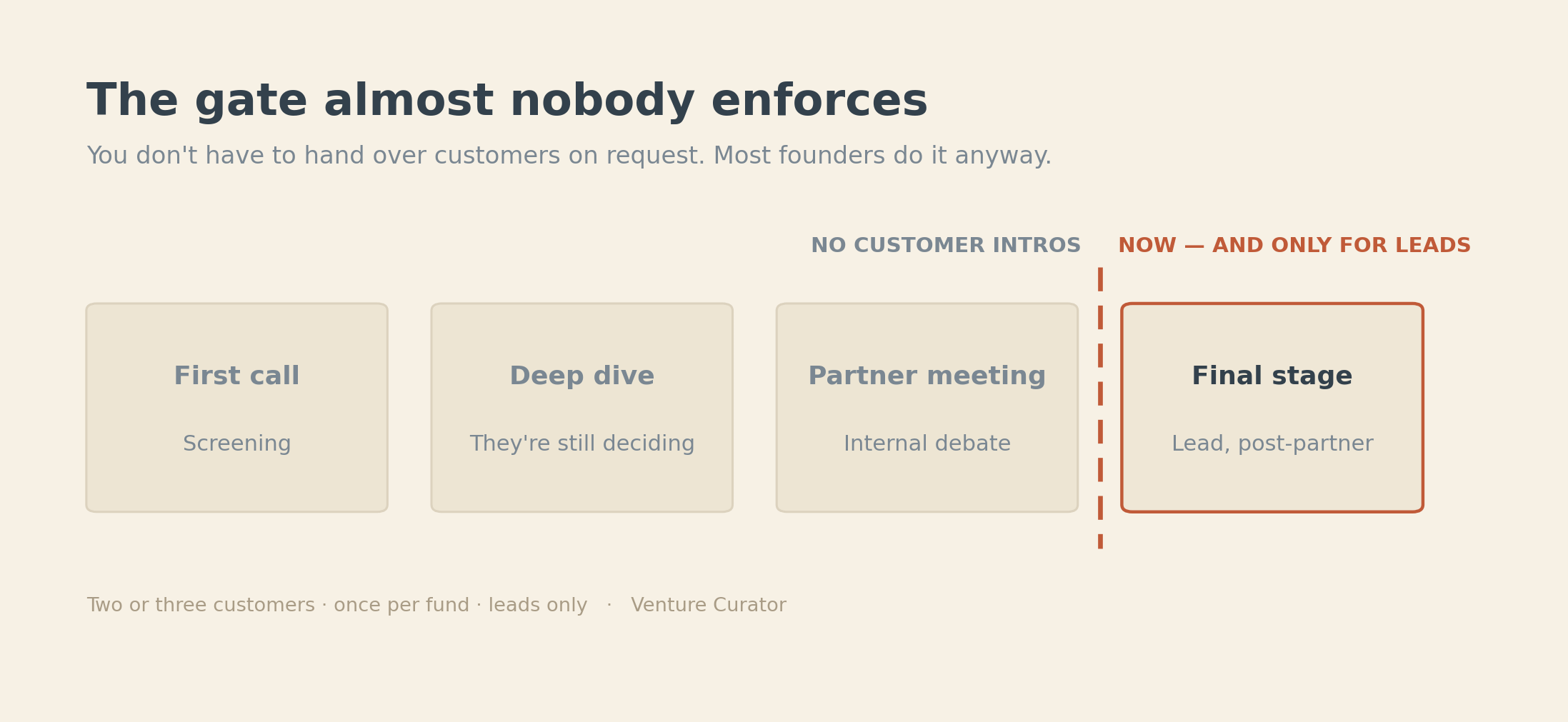
You don’t have to, and the investors I spoke to were clear about it. You can hold customer references for funds in the final stage of diligence. There’s no reason to hand them over after a first or second call, before you’ve even spoken to someone who can write the cheque.
Almost no founder knows this. So a twenty-fund process turns into the same three customers taking six investor calls, five of them pass, and by the time the round closes, your customers have drawn their own conclusions.
The round closed. The relationship got worse. Nobody ever connects the two.
What’s inside today’s deep dive
When should you actually agree to a customer intro? The three rules for deciding which funds get access, and the sentence that lets you say “not yet” without sounding defensive.
What do they actually ask your customer? The full question set, grouped - plus the three questions that decide the call.
Which customers should you never put forward? Including one your instinct says is your strongest.
How do you prepare a customer without coaching them? The line founders cross without noticing, and the prep note you can send as is.
What protects the relationship if the fund passes? One sentence, said before the first call, that changes how a pass looks to your customer.
What does a reference that kills a deal actually sound like? Versus a lukewarm one, which is usually fine.
Plus the debrief loop that makes every call better than the last, and the prep script to send your customer.