


👋 Hey, Sahil here — Welcome back to Venture Curator, where we explore how top investors think, how real founders build, and the strategies shaping tomorrow’s companies.
How to raise money with cold outreach: tips from a founder who raised $1 billion.
How founders can build AI agents with OpenClaw: a step-by-step guide.
What founders actually pay themselves in 2026?
FROM OUR PARTNER - STARTUP SCIENCE
🤝 Investors are backing a founder platform solving a $27B startup problem
Startup Science is unifying the startup ecosystem, which brings founders, accelerators, mentors, investors, universities, and service providers into one structured platform.
Instead of founders jumping between disconnected tools and advice, Startup Science guides them step-by-step through each stage of their startup journey. They get the resources they need, exactly when they need them.

Why investors are paying attention:
Built by 12x Exited Founder Gregory Shepard, including a recent $925M transaction
Fixing a $27B annual problem of preventable startup failure in the U.S.
89,000 users across four continents
200+ accelerators, universities, and government partners onboarded
3 acquisitions completed to consolidate the ecosystem
As AI makes it easier than ever to start companies, failure rates are still near 90%. Startup Science believes the issue isn’t talent, it’s a fragmented ecosystem that doesn’t set up founders for success. Their platform brings structure, timing, and alignment to the entire founder journey.
This is infrastructure for the next wave of entrepreneurship.
VENTURE CURATORS’ FINDING
📬 My Favourite Finds
Media Posts:
The only pitch preparation you will need. (Link)
$20K to $700K ARR in 6 Weeks Inside YC. (Link)
Be distinctive & don’t die. (Link)
The two positions that create a durable moat. (Link)
Investor data room superpack: everything you need to build a VC-ready data room (Guide/Templates) (Link)
Reports/Articles:
AI industry spedning $1 to make 0.99. (Link)
10 charts that shows world is changing. (Link)
Anthropic’s AI Jobs Report is a 17-page deep-dive on how AI is reshaping jobs across industries. (Link)
What’s next for AI agent ROI? (Link)
How to find one metric to rule them all. (Link)
🤝 PARTNERSHIP WITH US
Get your product in front of over 115,000+ audience - Our newsletter is read by thousands of tech professionals, founders, investors and managers worldwide. Get in touch today.
📜 DEEP DIVE
How to raise money with cold outreach: tips from a founder who raised $1 billion.
The probability of success for a high-growth company is predicated on your ability to raise capital. As a leader, you will never achieve your maximum entrepreneurial potential without being able to raise capital quickly and successfully.
Capital is the lifeblood of any high-growth company. It has to be treated as a key priority. It can never be outsourced or downgraded to a second priority.
Brett Adcock, the founder and CEO of Figure AI, secured $1 billion in 2025. Also, his previous ventures, Adcock has successfully raised significant capital: Vettery was acquired for $110 million, Archer Aviation went public with a valuation of $2.7 billion and raised over $1 billion. He shared the framework for founders to raise capital. So read along -
“Remember - Investors are looking for certain traits. Without these, you have little chance of raising a single dollar. Let’s talk about how you can use the formula to build a repeatable process for raising capital.
Fundraising Formula:
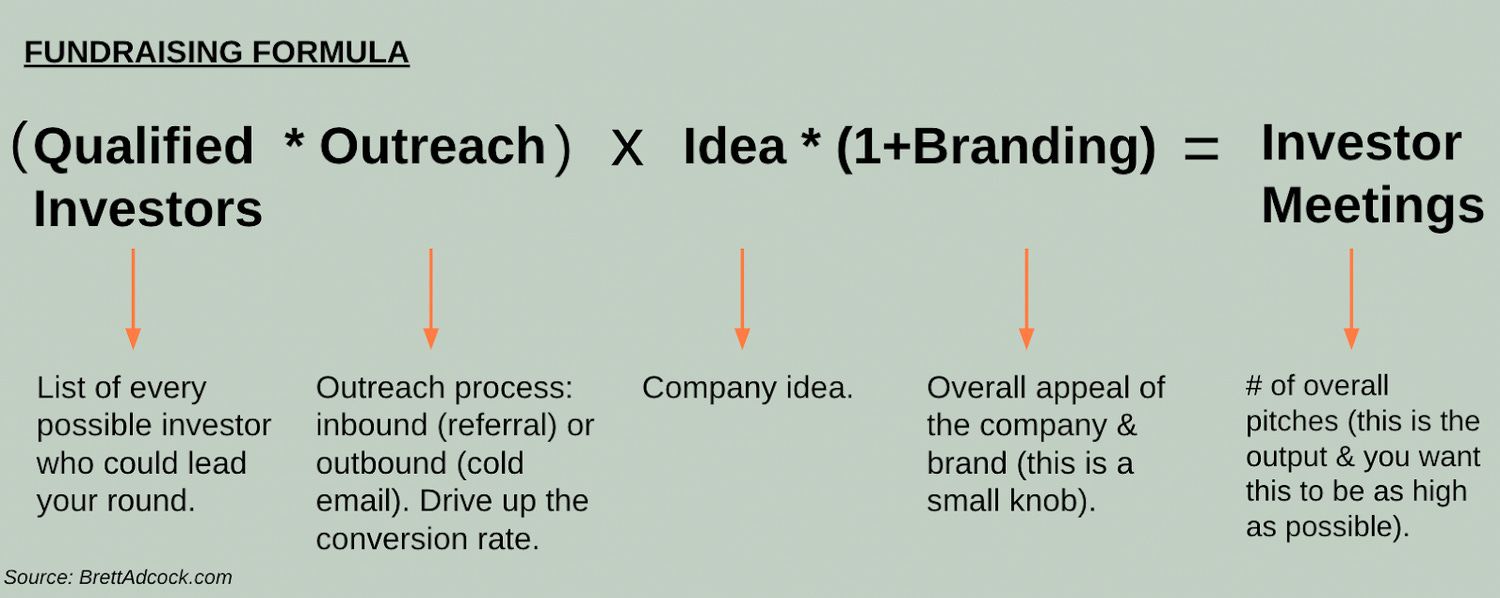
You need to maximise the number of shots on goal in fundraising. Aim to get as many meeting attempts with investors as possible. The above formula for capital raising is a combination of -
the number of qualified investors you are targeting, combined with
the company idea & overall branding.
The first step in the fundraising process is defining success. The ultimate goal is to raise capital successfully. If you work backwards from there, getting to a lead investor “term sheet” is the next clear milestone. And if you work backwards once more, the goal is to maximise the number of unique investor meetings.
The Fundraising Formula is a way to compute how to maximise the number of qualified investor meetings. Fundraising is about talking to 200 investors and finding the 1 person who will take a bet on you. I’ve always experienced really low conversion rates in these efforts - it’s never been easy for me to raise capital. And that’s quite normal.
Here is the sensitivity to each part of the formula:
Qualified investors: You want to drive this number as high as possible. I speak to so many founders who are “waiting for referrals”. This inevitably means this number is too low. You want to identify every possible investor on the planet or else your equation will point to low odds of success.
Outreach: This is your reach-out process to investors. I gauge this as a percentage conversion rate. This will be really sensitive to the way you are reaching out (referral vs. cold email) and the messaging associated with the reach-out process (e.g. subject and body of a cold email). There is an art to this. The conversion rate can greatly increase if you treat it as a recursive project to get better.
Idea: This is the company idea, and it’s fixed. There is very little you can do besides pivot your company to a new idea. The idea will instantly either A) resonate or B) turn off investors based on their industry focus or their internal thesis of the market/industry.
Branding: This is how well-branded or attractive your company is at first glance. You have limited time to impress an investor enough for them to commit to a meeting. There are many ways to drive this up, including a nice investor deck. But ultimately, that’s a small lever, so don’t stress too much over this.
Investor Meetings: This is the output of all your hard work. The goal is to drive up the number of qualified investor meetings as high as possible. You want to do 50-200 of these meetings. The more qualified investor meetings, the higher your odds of raising capital.
Building the Fundraising Machine:
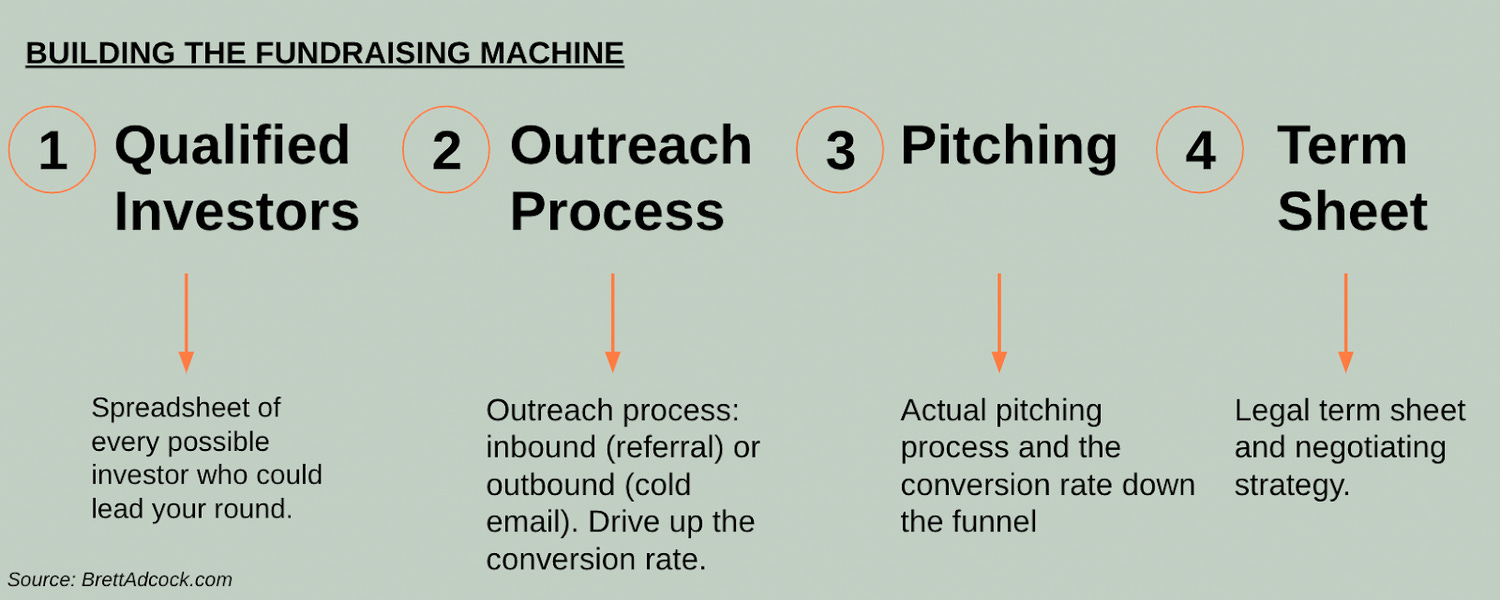
I believe in building and executing on a highly structured “machine” for fundraising processes. This machine is something you can wash, rinse, and repeat. This should be similar to how you would run a sales or marketing team.
I track this process in a Google sheet, similar to how you track items in a CRM. Let’s break down the key elements of the formula so you can go out and execute it yourself.
Key Elements of a Fundraising Machine:
Qualified List of Investors: This is a list of investors who are tailored specifically to your company. Start with investment groups that match well with your company sector. Research to find an investment partner who covers your specific industry and maturity. Ideally, you have found 100% of every investor on the planet that you think could give you a term sheet.
Outreach Process: Reach out to investors with the goal of setting up a meeting. Try to get as many referrals as possible, then move to outbound for the rest.
Pitching: Your first interaction with the investor that includes them previewing the deck. Optimise the conversion rate from the first meeting to the term sheet.
Term Sheet: Receiving a term sheet is the ultimate goal for the first leg of capital raising. Negotiate quickly and fairly to get the lead investor signed up.
The entire process from start to finish will take at least 3 months. Spend 30 days preparing the investor deck and data room, mapping out investors, and your cold email template. The next 30-60 days are for investor outreach and meetings. Once you have a term sheet, it generally takes <10 days to negotiate and sign, and you usually close in 30 days.
Additional Capital Raising Insights:
Show metrics and customers that can potentially correlate to long-term success for early investors to understand your product’s potential.
Understand VC mandates and match them to your industry to avoid spinning your wheels.
Showcase your “Championship Team” - there’s no way you’re building a great product without a #1 team.
Aim for 80% of investor pitches to come from outbound processes (cold calls or emails) and 20% from inbound processes (referrals).
Build a well-branded investor deck, as it’s often the first impression investors have.
Recognise that interested investors move quickly. If they’re not hurrying, it’s likely a sign you don’t have a deal.
Focus on finding a “lead” investor who can give you a term sheet and lead your round.
Balance fundraising time with product development, as fundraising can be distracting for founders.
Remember, fundraising is a competitive process. Once the round is complete, put your attention back to the product and get building. I suggest setting up a quarterly “nurture” sequence to keep investors updated.”
Many founders still struggle to write cold emails to investors. They’re often confused about what to include, how to reply, what to send, and how to follow up.
With this in mind and drawing insights from leading founders and investors, we’ve created an all-in-one guide: Investor Outreach Email Sequence Pack: 20+ Proven Templates Used & Approved by VCs.
More than 100+ founders are already using it and have found it extremely useful.
TODAY’S RESOURCE PICK
📬 Startup legal document pack
Messy or missing legal documents can slow down fundraising and create unnecessary risk.
This Startup Legal Document Pack gives you everything you need to incorporate, protect equity, and raise confidently — all in one place.

Inside:
Formation & incorporation documents (C-Corp, LLC)
Founder agreements & equity splits
SAFE notes, term sheets, and cap tables
Employment, contractor & advisor agreements
IP protection (NDAs, invention assignments)
Customer contracts, TOS & privacy policies
Built with startup attorneys and VC teams. Investor-ready. Fully editable.
If you want your legal foundation set up properly before you scale or raise, this pack does the job.
📃 QUICK DIVES
How founders can build AI agents with OpenClaw: a step-by-step guide.
AI agents are quickly moving from demos to practical tools people actually use every day. Instead of manually prompting models again and again, an agent can run tasks for you - checking emails, researching topics, scheduling work, or sending updates through messaging apps.
Recently, Alex Prompter shared a way to architect an AI agent using OpenClaw. What’s useful about his approach is that instead of experimenting randomly, you start with a structured blueprint that defines the entire system: the workflow, the tools, the guardrails, and how the AI should behave.
Below is a simplified and practical breakdown of how this method works.
First: understand what OpenClaw actually does
OpenClaw is a local-first AI agent framework. Instead of running in the cloud like most AI tools, the agent runs directly on your own machine and connects to messaging platforms such as:
WhatsApp
Telegram
Discord
Slack
Signal
You can interact with your AI agent through these apps the same way you would message a colleague.
The system works with three main components:
The LLM (the brain)
This can be Claude, GPT-4o, or DeepSeek. The model handles reasoning, understanding instructions, and generating decisions.
OpenClaw (the body)
This is the execution layer. It performs actions like:
browsing the web
accessing email
scheduling calendar events
running automations
triggering scripts
Skills (the capabilities)
Skills extend the agent’s abilities. For example:
search the internet
read emails
send notifications
Run scheduled jobs
interact with APIs
Together, these components allow the AI to think, decide, and execute tasks.
The key idea: design the entire agent before building it
Instead of manually experimenting with configurations, Alex recommends prompting Claude to generate a full agent architecture first.
You describe the goal of your agent, and the AI generates a detailed blueprint including:
the agent’s purpose
which messaging platform to use
Which LLM works best
What skills are required
The system prompt that defines the agent’s behaviour
the workflow logic and decision paths
safety guardrails
This makes the build process much more structured.
The prompt used to design the agent
"You are a world-class OpenClaw agent architect.

OpenClaw is a local-first autonomous AI agent that runs on your own
device and operates through messaging platforms like WhatsApp,
Telegram, Discord, Signal, and Slack. It connects to Claude,
GPT, or DeepSeek as its brain, and uses Skills to extend
its capabilities.

My goal: [DESCRIBE WHAT YOU WANT YOUR OPENCLAW AGENT TO DO]

Build me a complete OpenClaw agent blueprint with:

AGENT NAME & PURPOSE: [Name + one-line objective]

RECOMMENDED CHANNEL: Which messaging platform to use and why (WhatsApp / Telegram / Discord / Slack / Signal)

LLM SELECTION: Which model to connect (Claude / GPT-4o / DeepSeek) and why for this specific use case

SKILLS NEEDED: List each skill the agent requires, what it does, and how to configure it (browser search, cron scheduling, email reader, calendar manager, note generation,  web scraping)

WORKSPACE SETUP: How to structure the workspace and agent sessions for this task

SYSTEM PROMPT FOR THE AGENT: Write the full system prompt that goes into OpenClaw for this agent's behavior, tone, and decision rules

TOOL CONNECTIONS: Which tools to enable (browser, cron, canvas, email, calendar, etc.) with exact purpose for each. For example -
- browser → research tasks
- email → inbox automation
- calendar → scheduling meetings
- cron → recurring tasks
- canvas → document creation

WORKFLOW STEPS:
1. Trigger → Action → Output
2. Decision point → If X then Y, if Z then W (Map every step completely)
For example - User sends message → agent searches sources → summarizes insights → sends response

SAFETY GUARDRAILS:
- What permissions to restrict
- Confirm-before-acting rules for destructive actions
  (deleting emails, sending messages, etc.)
- How to run: openclaw doctor to check for risks

EXAMPLE COMMANDS TO TEST IT: Give me 5 real commands I can send via WhatsApp/Telegram
to test this agent immediately

Be specific. Production-ready. No placeholders."
How to actually build the agent
Once Claude generates the blueprint, the build process is straightforward.
Step 1: Install OpenClaw using the terminal: openclaw onboard
Step 2: Run the setup wizard and configure:
gateway
messaging channel
workspace
Step 3: Copy the architecture prompt and insert your goal.
Step 4: Paste it into Claude to generate the full agent blueprint.
Step 5: Implement the system prompt, tools, and skills inside OpenClaw.
Step 6: Test the agent using the example commands generated by Claude.
If you’re building products or running a startup, agents like this can automate surprisingly useful workflows.
Examples:
Customer feedback summarizer - reads incoming support emails and generates daily insights.
Investor research agent - Tracks funding announcements and summarises interesting companies.
These kinds of tools are increasingly becoming personal operating systems for knowledge work.
And frameworks like OpenClaw make it possible to build them locally with full control over how they operate.
What founders actually pay themselves in 2026?
Founder compensation is one of the most misunderstood topics in startups.
From the outside, people assume founders of venture-backed companies are paying themselves massive salaries. In reality, most founders keep salaries relatively modest because the real upside comes from equity, not salary.
A new report analysing (Creandum) compensation across hundreds of startups (from bootstrapped to Series D) shows a clear pattern:
Founder salaries increase steadily with stage, but the biggest payoff still comes from ownership.
Founder salaries grow with the company stage
Founder compensation tends to scale alongside funding and company maturity.
Median salaries increase consistently as companies raise larger rounds:
Seed founders: ~€89K median salary
Series A founders: ~€154K
Series B founders: ~€199K
Series C founders: ~€225K

Bonuses also become more common as companies scale. By Series C, around 70% of founders receive bonuses, reflecting more structured compensation systems.
Interestingly, Pre-Seed salaries actually declined about 12% year-over-year, suggesting early founders are conserving cash and extending runway rather than paying themselves more.
Another surprising data point: bootstrapped founders sometimes earn more than Pre-Seed founders. Many profitable bootstrapped companies generate enough revenue to support higher salaries even without outside capital.
The biggest salary gap is in geography
Where a founder builds matters a lot.
US founders earn significantly more than their European peers.
On average:
US founder salaries are about 1.5× higher than European founders
Companies that raised €100M+ pay ~€225K in Europe vs ~$350K in the US
The difference reflects several factors:
larger funding rounds
the higher cost of living
stronger venture competition for talent

Even within Europe, there are interesting regional differences. Baltic and Nordic founders reported surprisingly strong compensation levels, sometimes surpassing those in more traditional tech hubs.
AI founders are not the highest paid
Given the massive funding flowing into AI startups, many people assume AI founders are earning the most.
The data says otherwise.

Median founder salaries by sector:
FinTech: ~€142K
CleanTech: ~€142K
AI-native startups: ~€122K
Two structural reasons explain this.
FinTech companies often monetise quickly, allowing founders to justify higher compensation earlier.
CleanTech companies tend to have long development cycles, so higher salaries help compensate founders during the long journey to profitability.
AI startups, despite the headlines, still vary widely in funding size and maturity, meaning founder compensation hasn’t yet caught up with the hype.
CEOs actually earn less than revenue-focused founders
Another interesting trend: founders responsible for revenue tend to earn more than CEOs.
Median compensation by founder role shows:

CRO / CCO founders: ~€133K
CEO founders: ~€118K
Product-focused founders: ~€85K
This reflects the current market environment.
Investors and boards are prioritising revenue generation and capital efficiency, rewarding founders who directly influence growth and sales.
The gender gap is shrinking, but representation remains low
Encouragingly, the pay gap between male and female founders is narrowing.
At Seed and Series A:
Female founders earn within 3–5% of male founders
At Series C, female founders even slightly out-earned their male peers in median compensation.

However, there’s still a major representation problem.
Only 13% of founders surveyed were women, reflecting the broader startup funding gap where:
only 2.3% of global VC funding goes to female-only teams
Equity still matters far more than salary
The biggest financial outcome for founders is still equity ownership.
And one factor dominates equity outcomes: how early you joined the company.
For example:
Founder joining at incorporation: ~48–50% ownership
Founder joining six months later: ~20–24%

That difference can translate into millions in exit value.
In other words, while salary matters for day-to-day life, the real financial impact comes from ownership and dilution over time.
How founders should think about compensation
The report suggests a practical framework for setting founder pay. Good founder compensation balances five principles:
Alignment: Most founder wealth should come from equity, not salary. Salary should support focus, not create lifestyle inflation.
Sufficiency: Pay enough to remove financial stress, but avoid draining company cash.
Transparency: Compensation decisions should be documented, benchmarked, and board-approved.
Accountability: Cash and bonuses should align with performance and operational impact.
Consistency: Founder pay should evolve predictably with company maturity, not spike suddenly after funding rounds.
Founder salaries are rising again after the startup slowdown in 2023. But the data reinforces a core truth of startups: Founders don’t get rich from a salary. They get rich from equity.
Salary keeps the lights on. Ownership is what changes your life.
TODAY’S JOB OPPORTUNITIES
💼 Venture Capital & Startup Jobs
All-In-One VC Interview Preparation Guide: With a leading investor group, we have created an all-in-one VC interview preparation guide for aspiring VCs. Don’t miss this. (Access Here)
Venture Capital Associate - Sky9 Capital | USA - Apply Here
Analyst - Infrastructure & Real Assets - Stepstone Group | Australia - Apply Here
Analyst / Associate - Saints Capital | USA - Apply Here
Investor - Expresso NB | Thailand - Apply Here
Head of Investor Community - Inovexus | Remote - Apply Here
Associate - Lightbank | USA - Apply Here
General Partner - mHub | USA - Apply Here
Investment Analyst Intern - NAV Capital | Dubai - Apply Here
PE & VC Partner Manager - Dealhub | UK - Apply Here
Investment Analyst - Lunicorn Venture | UK - Apply Here
Program Manager - a16z | USA - Apply Here
Investment Summer Associate - AI Tooling - M13 | USA - Apply Here
VC Platform & Events Manager - 1001 VC | USA - Apply Here
MBA Venture Capital Intern - Cerity Partners | USA - Apply Here
MBA Venture Capital Intern - Cerity Partners | USA - Apply Here
🤝 Partnership With Us
Get your product in front of over 115,000+ audience - Our newsletter is read by thousands of tech professionals, founders, investors and managers worldwide. Get in touch today.
🔴 Share Venture Curator
You currently have 0 referrals, only 5 away from receiving a 🎁 gift that includes 20 different investors’ contact database lists - Venture Curator
Structuring AI agents and fundraising processes like this makes complex founder challenges far more manageable and repeatable
The "design the agent before building it" approach is solid advice. Most founders I've seen (myself included early on) skip straight to installing OpenClaw and start bolting on skills without thinking about what the agent actually needs to do. You end up with a Frankenstein setup that does 20 things poorly instead of 3 things well. One thing I'd add for founders specifically: start with the task that's eating the most founder hours per week, not the one that sounds coolest. For most early-stage teams that's competitor monitoring or investor update prep, not the flashy "AI runs my whole business" stuff. Get one workflow rock solid, then expand. The compound time savings are wild once you stop treating it like a toy.