
👋 Hey — it’s Sahil, this time together with Appy AI!
Welcome back to Venture Curator, where we explore how top investors think, how real founders build, and the strategies shaping tomorrow’s companies.
Most founders don’t lack ideas. What they lack is the time and headspace to turn those ideas into systems that actually run.
There’s always a list somewhere. Internal tools you know would save hours. Small automations that would reduce mental load. Workflows you keep postponing because they don’t feel important enough to justify engineering time right now.
Competitor tracking. Lead qualification. Daily reporting. Investor FAQs.
All of them are useful. All of them are repetitive. And almost all of them end up living in Notion or in your head, untouched.
AI was supposed to help here. In practice, a lot of AI tools still expect you to think like an engineer. You’re asked to deal with prompts, APIs, integrations, templates, and plenty of trial and error before anything feels reliable enough to use daily.
That’s why Appy.AI stood out when we spent time testing it.
Instead of building software, you describe a job in plain English. Appy takes that description and turns it into a working AI agent that actually runs on its own. There’s no code to write, no setup to manage, and no handoff to an engineering team.
To make this concrete, we built a simple agent that most founders can use immediately.
A simple but high-leverage use case: competitor radar
Every founder wants to stay on top of what’s happening in their market. Very few manage to do it consistently.
Some days you skim Google News. Other days you open a couple of blog posts. You miss a funding announcement because you didn’t check that morning. You hear about a product launch a week late. Over time, important updates slip through, not because they don’t matter, but because tracking them manually is fragmented and time-consuming.
So we built a simple agent with one clear responsibility.
It monitors competitors and industry keywords across the web and sends a short, clean summary to your inbox every morning, with direct links to the original sources.
No dashboards to check. No tabs to keep open. No manual effort.
Below, I’ll walk through the exact steps we followed to build this in about ten minutes, and why it ended up being far more useful than we expected.
Step 1: Describe the agent in plain English
After signing up on Appy.AI, you land in a simple chat-style interface.
It asks just one thing: “Describe your agent.”
Here’s exactly what we pasted: “I want an AI agent that monitors public sources like Google News, Hacker News, and tech blogs for updates on specific competitors and industry terms, then emails me a short daily digest by 7 am. Keep the summaries concise and include links to the sources. This is for internal use.”
That was enough to get started.
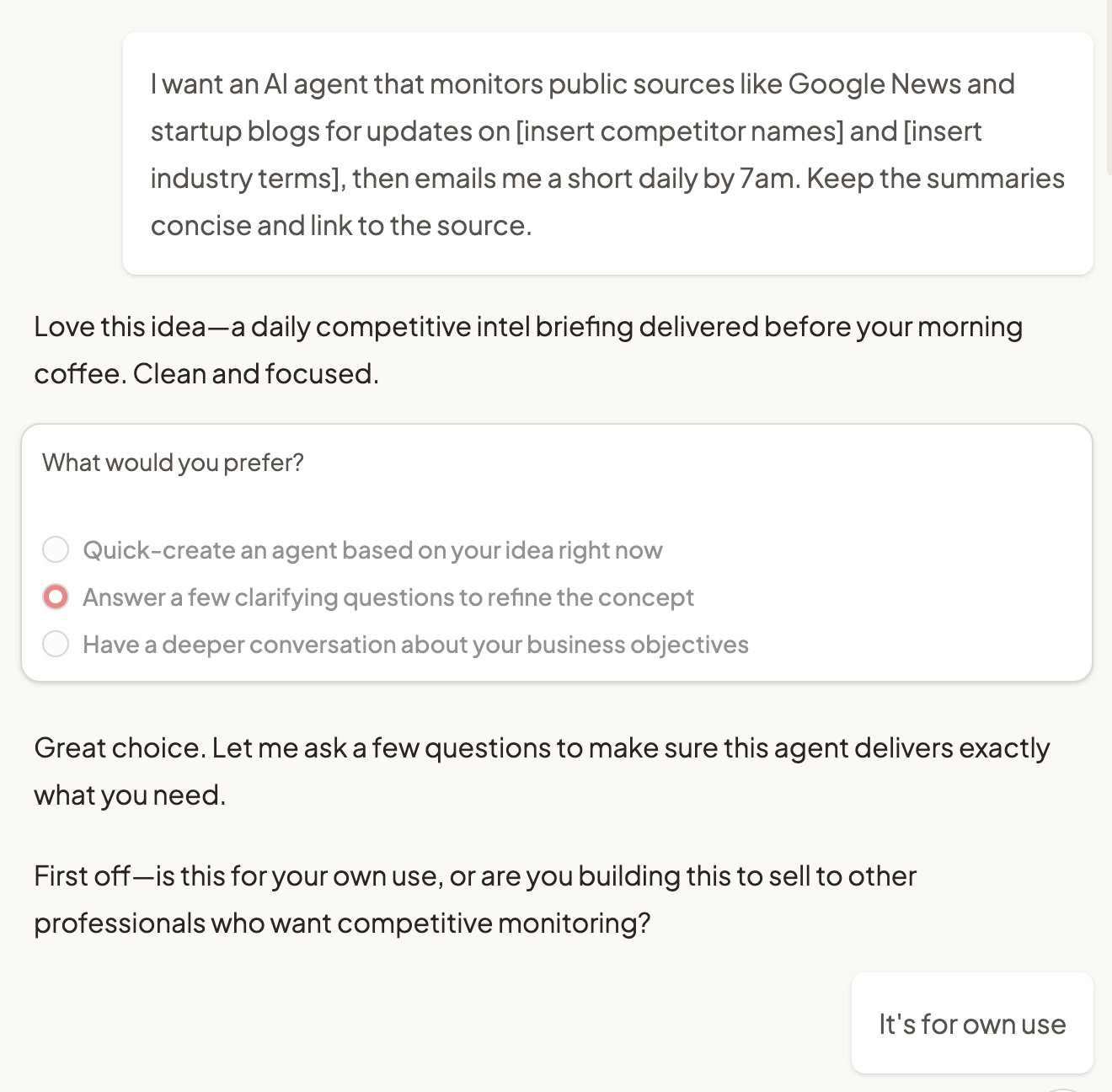
From there, Appy asked follow-up questions that felt natural, not technical. Things like what sources to prioritise, how often to send updates, and how the email should look. We kept answering in normal language, and Appy kept refining the agent.
That back-and-forth is what turns this from a generic bot into something actually useful.
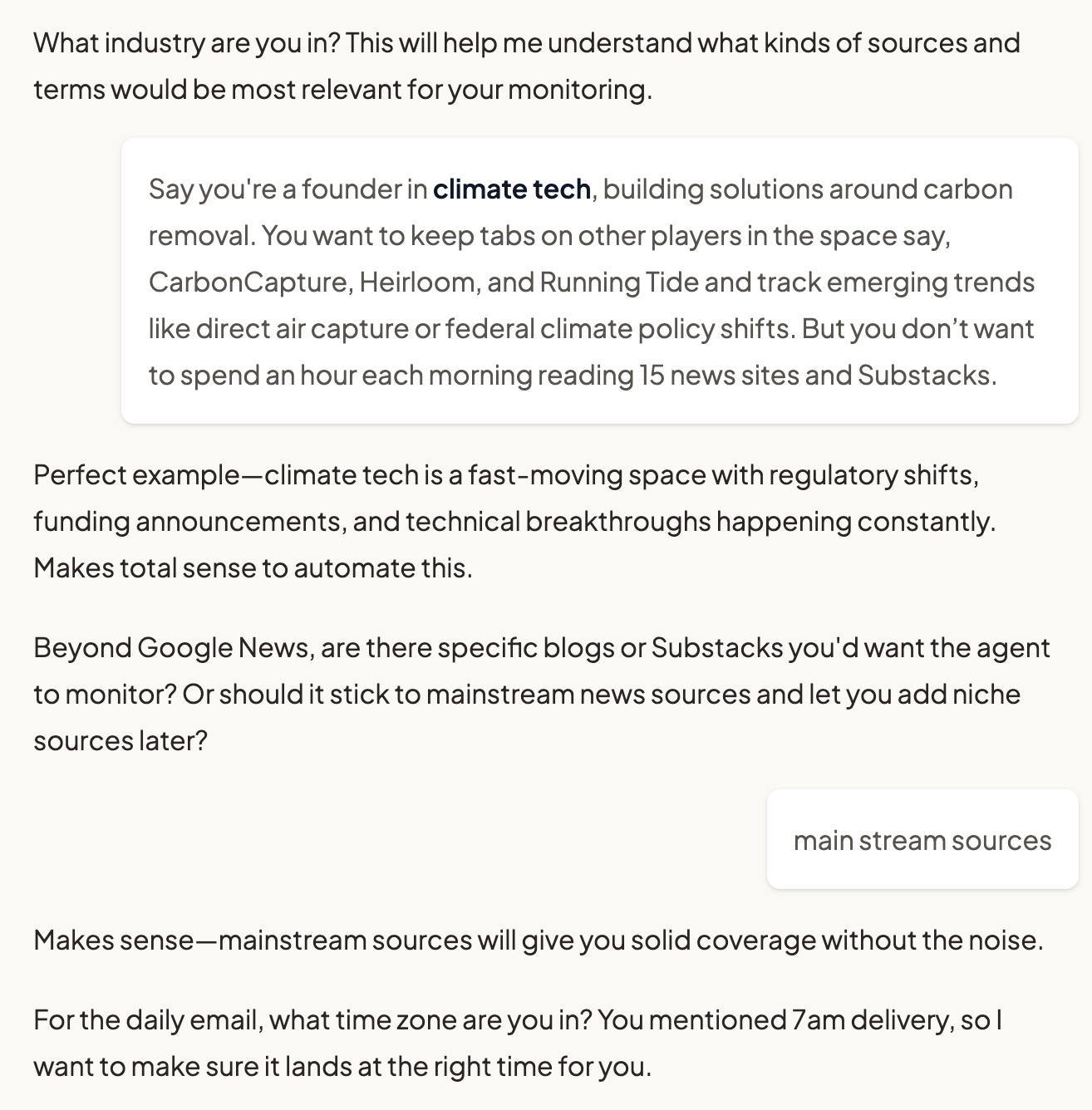
Step 2: narrowing the scope (this part matters)
One thing that made a big difference was starting narrow.
Instead of tracking everything, we picked a specific sector. In our case, climate tech, and then we narrowed it further to a focused niche inside that space. The output immediately improved.
Instead of generic headlines, the agent started surfacing updates that actually mattered to the companies we were tracking.
If you build this yourself, this is the key takeaway: start narrow, then expand later.
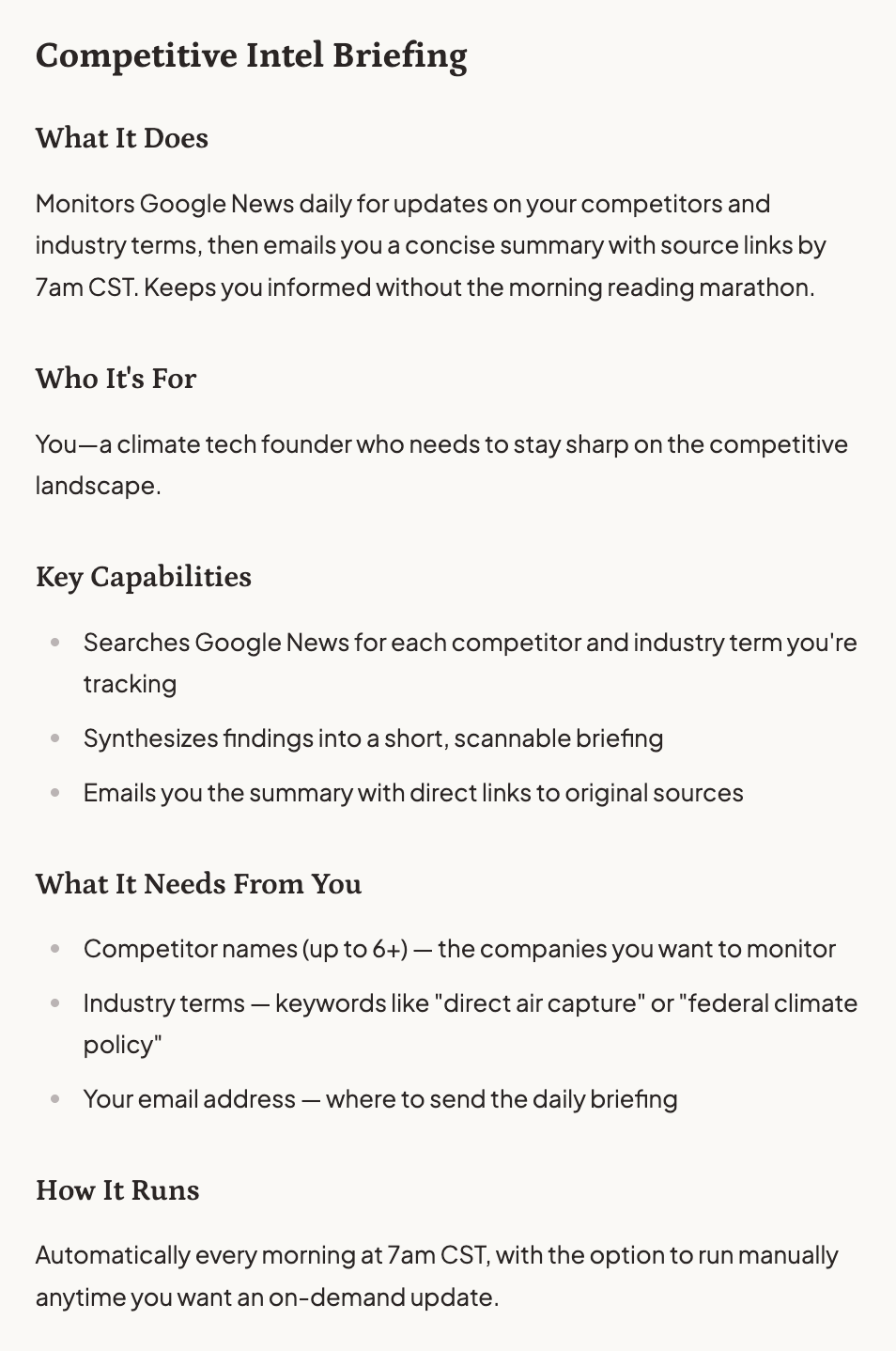
Within seconds, it generated a full agent:
Step 4: Testing before publishing
Before going live, we tested the agent in preview mode.
We typed something simple like, “What’s new today?”
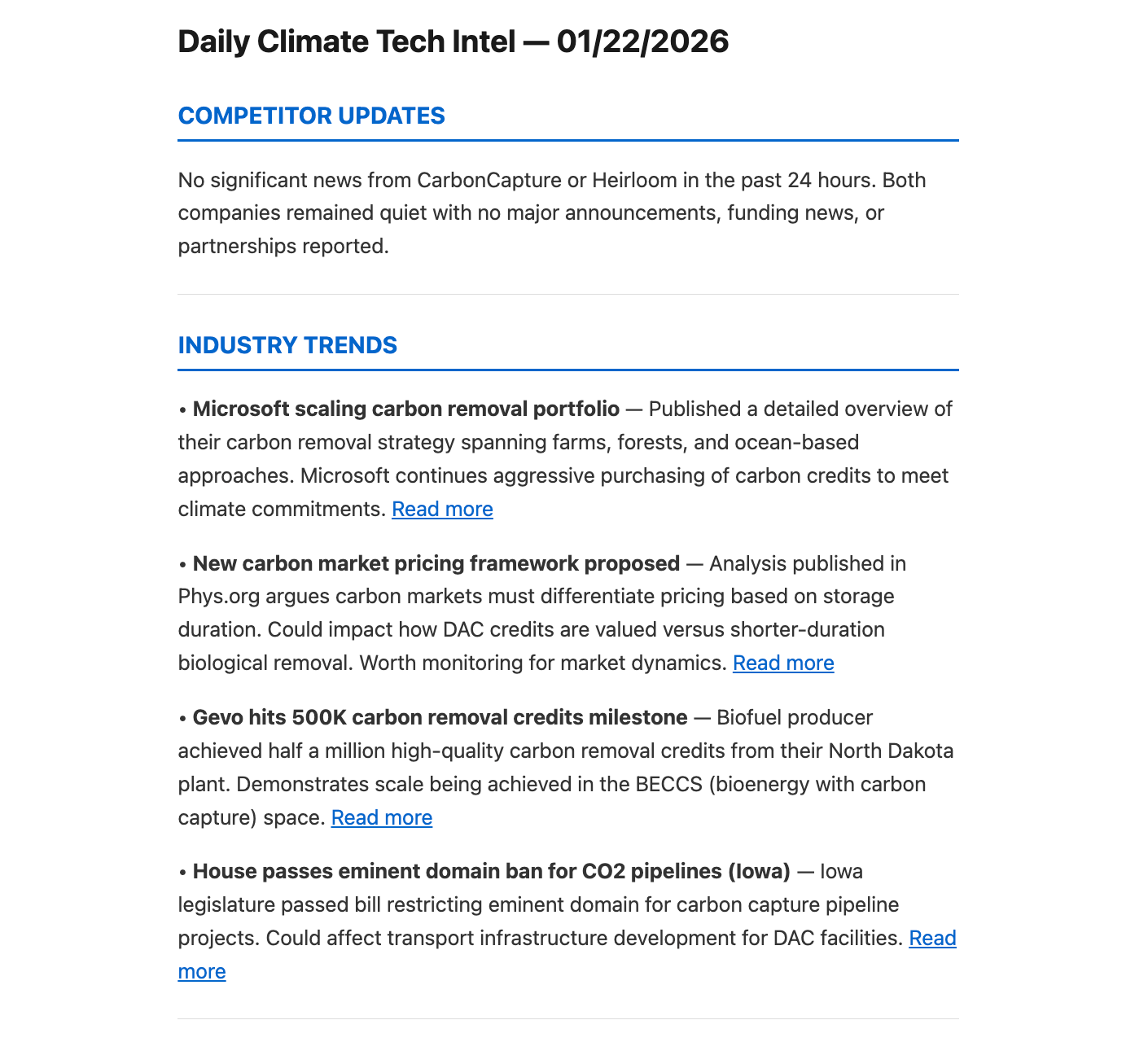
The agent pulled updates from the last 24 to 48 hours, summarised what happened across the tracked companies, and linked directly to the sources.
We then fine-tuned it by just telling it what to change. Keep summaries short. Focus on company-level updates. Avoid low-quality sources.
Each instruction updated the agent instantly. No rebuilding. No redeploying.

We get this update -
If you want to share it with your team or make it public, you can simply hit publish.
Step 5: publishing it
When we hit “Publish,” Appy didn’t just turn the agent on.
It automatically created a hosted interface, secure user access, background scheduling, usage analytics, and optional Stripe billing if we ever want to share or sell it.
There was nothing to deploy and nothing to maintain.
From that point on, the agent just ran. Every morning, the summary landed in our inbox without us doing anything.
The entire competitor tracking agent took roughly ten minutes to build end-to-end.

Other agents you can realistically build the same way
Once we built the competitor radar, it became obvious how many other workflows could be handled in the same way.
Things that usually sit in the “we should automate this someday” bucket suddenly felt approachable.
For example,
lead qualification agents that follow up with inbound leads and tag warm ones before a human ever gets involved.
Meeting recap agents that summarize calls and pull out clear action items.
Founder FAQ agents trained on pitch decks or internal docs so common questions don’t keep landing in your inbox.
Even simple inbox assistants that handle repetitive cold emails without you having to think about them.
All of these follow the same basic pattern. You describe the job in plain language. Appy asks a few clarifying questions. You approve the tools. Then you publish and let it run.
Founders spend a surprising amount of energy on repetitive tasks that don’t actually require founder judgment. Traditionally, the options are to hire someone, ignore the task, or duct-tape a few tools together and hope they don’t break.
Appy introduces a fourth option. You clone the workflow itself.
You’re no longer blocked by engineering bandwidth. You’re only limited by how clearly you can explain what you want done. For small teams, that’s a meaningful shift.
If you’ve ever caught yourself thinking, “I could automate this, but it’s not worth the effort,” this is exactly the kind of use case Appy works well for.
Start with something internal, like competitor tracking. Build it for yourself and use it for a few days. Once you see it running without friction or maintenance, you’ll start noticing other parts of your business that don’t need a human in the loop anymore.
You can start building at appy.ai.
🤝 Partnership With Us
Get your product in front of over 103,000+ audience - Our newsletter is read by thousands of tech professionals, founders, investors and managers worldwide. Get in touch today.
🔴 Share Venture Curator
You currently have 0 referrals, only 5 away from receiving a 🎁 gift that includes 20 different investors’ contact database lists - Venture Curator