
👋 Hey, Sahil here - welcome to today’s edition of Venture Curator, where we break down how great startups grow, how top investors think, and what’s shaping the future of tech.
P.S. Get access to 100+ startup & VC resources, investor databases, fundraising templates, 150+ premium archive posts and exclusive startup research - all in one place.
FROM OUR PARTNER - KAPITALWISE
💹 Your financial goals are personal. Your advisor should be too.

Not every financial advisor is right for every investor. The right fit depends on what you’re building toward, the kind of guidance you need, and where you are financially.
Kapitalwise AdvisorConnect uses AI-powered matching to connect you with vetted financial advisors and planners based on your needs - making it easier to find relevant expertise without spending hours searching and comparing.
Think of it as a smarter starting point for an important financial decision: fewer random options, more relevant matches.
Partnership With Us
Get your product in front of over 125,000+ audience - Our newsletter is read by thousands of tech professionals, founders, investors and managers worldwide. Get in touch today.
📜 DEEP DIVE
Could calling your startup 'AI-Native' be hurting your valuation? The data might surprise you.
I’ve sat in on enough pitch practice sessions this year, and talked to enough investors after they’ve passed on a deal, to notice the same gap showing up every time.
The founder says “AI-native” on slide one with total confidence. The investor, three slides later, is already mentally sorting the company into a bucket the founder doesn’t know exists, and that bucket, not the slide, is what the term sheet gets priced against.
You’ve probably done this without knowing it. You put “AI-native” on your deck eighteen months ago because every operating partner told you to. It worked. It’s still working, on average - but “on average” is hiding the fact that the same three words now sort you into a 3x company or a 30x company, and nothing on your title slide tells you which.
The premium is real; that part hasn’t changed
Start with the number that’s still true. On Carta’s H1 2026 data, AI companies at seed are raising similar cash amounts to non-AI peers but closing at roughly 50% higher valuations - meaningfully less dilution for the same check.
That premium compresses to around 30% right at Series A, the exact round where investors stop taking the label at face value, before widening back out to 193% by Series E+ once a company has actually proven it deserves the tier.
That’s the number every founder I talk to this year has memorised. It’s also the number making a lot of them careless - because the number that’s dropping, not the number that’s still growing, is the one sitting right in front of them at their next round.
The correction is happening underneath the average
Here’s what the aggregate number hides: the AI premium isn’t one number anymore. It’s split into three, and which one applies to you has nothing to do with whether you call yourself AI-native.
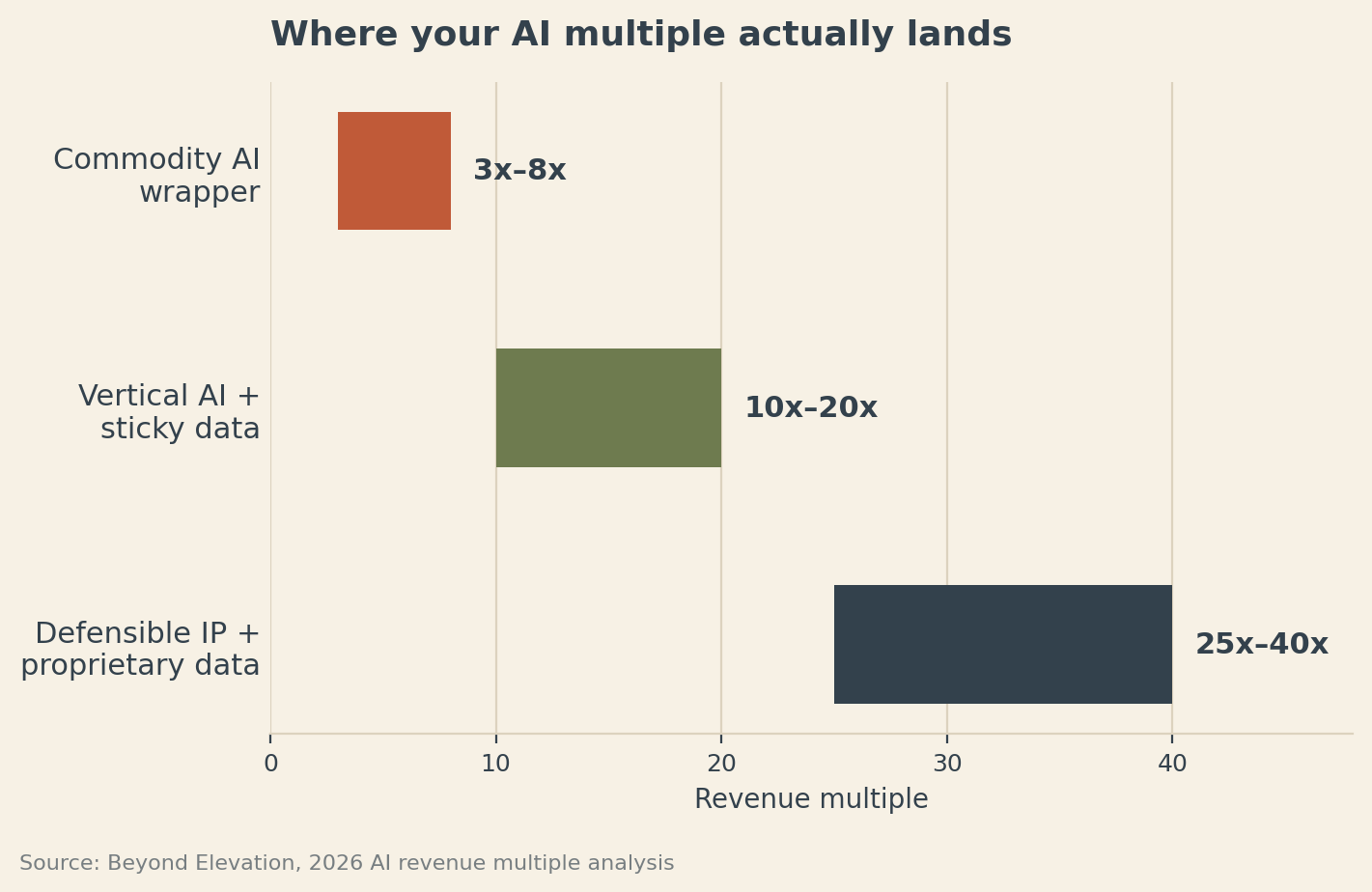
Commodity AI wrappers - thin interfaces on top of a foundation model API, no proprietary data, no defensible workflow - are trading at 3x to 8x revenue.
Vertical AI products with sticky, proprietary data are trading at 10x to 20x.
Companies with real IP plus proprietary data are commanding 25x to 40x. Same label, same slide - a 5x spread in what the market will actually pay.
The compression is worse the further you go. At seed, a startup with no protectable IP is already taking a 20- 30% markdown against a comparable company that has it - the difference between a 22x and a 16x multiple on paper.
By Series A, that penalty widens to 30–40%, because that’s the round where investors stop taking the AI-native label at face value and start running a formal defensibility check on it.
Investors know they’ve been burned doing the opposite.
Fintech investors on record this year have said they’re now actively separating companies that are truly AI-native from ones that bolt on AI tools - the exact distinction that used to be invisible on a pitch deck is now the entire diligence question.
None of this shows up as a rejection. It shows up as a number on a term sheet lower than the one your friend at a comparable company got - and neither of you will ever see the memo that explains why.
What I want to show you next is the actual checklist investors are running to sort you into one of those three buckets, the self-check I built so you can score yourself against it before your next raise, and - the part that actually moves your number - what to go build in the next 90 days to move buckets.
The test nobody shows you
I asked around this quarter - associates at three funds, one partner who runs technical diligence calls specifically to catch thin AI wrappers and the scoring logic is more consistent than founders assume. It isn’t vibes. It’s four weighted categories that produce the multiple your term sheet gets priced against before you’re in the room.