


👋 Hey, Sahil here - Welcome back to Venture Curator, where we explore how top investors think, how real founders build, and the strategies shaping tomorrow’s companies.
Elad Gil’s framework for spotting billion-dollar markets before they look big.
The AI model shift: Vertical AI is taking over.
Reddit marketing for B2B saas founders: a step-by-step guide.
How long does it take for VC funds to return money to LPs?
FROM OUR PARTNER - SEMRUSH
📈 See what drives your competitors’ growth — before they do

Every winning strategy starts with the right data. With Semrush’s Traffic & Market Toolkit, you can uncover exactly where your competitors’ traffic comes from — search, social, or even AI referrals.
Track their top pages, monitor emerging trends, and find the untapped channels fueling their growth. Whether you’re a marketer, agency, or enterprise, you’ll get daily and weekly insights to outpace rivals and lead your market with confidence. Trusted by 10M+ marketers worldwide.
Try the Traffic & Market Toolkit free →
VENTURE CURATORS’ FINDING
📬 My Favourite Finds
Media Posts:
These are the top 30 prompt techniques that actually work in 2026. (Link)
Every Startup accelerator you can apply to right now. (2026) (Link)
Startup legal document pack - essential legal Docs for founders. (Link)
30 tactics working right now to improve free-to-play conversion rates. (Link)
What investors ask and how to answer: A practical Q&A prep kit for founders. (Link)
Reports/Articles:
Google has been releasing a bunch of free AI tools outside of the main Gemini app. Most are buried in Google Labs. (Link)
How to build a PMF machine by a16z. (Link)
The billion-dollar founder study: What 20 years of exits actually say about founding teams. (Link)
Why free trials don’t make sense anymore. (Link)
PARTNERSHIP WITH US
🤝 Get your brand in front of 116,000+ audience.
Our newsletter is read by 116,000+ tech professionals, founders, investors (VCs / Angel Investors) and managers around the world. Get in touch today.
📜 DEEP DIVE
Elad Gil’s framework for spotting billion-dollar markets before they look big.
Startup history is full of companies that looked like bad ideas at the start.
An online marketplace for wedding invitations? Too niche.
A payroll tool in a boring, saturated market? Who cares.
Another file storage app? Too late.
And yet, those “nonobvious” bets became Minted, Gusto, and Dropbox.
Elad Gil, a longtime operator and investor (Stripe, Coinbase, Instacart, Airbnb), has a simple thesis:
Nonobvious markets can lead to hypergrowth, if you know how to spot and validate them.
Based on years of experience and interviews with top founders, Gil breaks down four principles and three market types that help you find overlooked opportunities with real upside.
First, start with the market. Not the idea.
Elad’s approach is clear: Market > Team > Idea.
Why? Because even great teams can’t escape bad markets. But great markets tend to give you multiple shots — even if your first idea stumbles.
“Many great teams get taken out by a terrible market. But if you’re in a great market, the idea itself doesn’t matter as much — there are always other shots on goal.”
– Elad Gil
So before building or investing, study the underlying market structure.
Ask:
Is this a growing market with multiple unmet needs?
Is it structured like a winner-take-all, or more like an oligopoly?
Are existing players actually serving users well?
Most people get this wrong because they fall in love with an idea. Instead, fall in love with the market.
Four Principles to Uncover the Nonobvious
1. Use first principles, not hot takes.
Don’t just be contrarian for the sake of it. That’s lazy.
Use first principles thinking to ask:
Is the “common wisdom” still true?
What’s changed in cost, infrastructure, or tech?
Has the assumption just aged out?
Example: Payments used to be avoided like the plague. “Too much fraud risk.”
But then Stripe happened. Fraud tooling, APIs, and internet trust improved and suddenly it became obvious in hindsight.
2. Scratch your own itch — or go deep on real pain.
Gil’s favorite startups often come from founders solving problems they’ve lived.
Gusto founders had family who struggled with bad payroll tools.
Mailgun was built after the team had to manually rebuild the same email infra over and over.
Gil’s own startup, Color Genomics, was sparked by his cofounder’s family health history.
This kind of insight gives you edge and a compass.
“The key is that it’s a real problem. Not an idea you plucked out of thin air.”
3. Build product-first. Don’t chase vague customer feedback.
“Would you use this?” is a weak signal.
“Would you pay for this right now?” is a real one.
Break into tough markets with a product that works beautifully, even in crowded spaces.
Dropbox beat bigger incumbents by nailing file syncing.
Google flipped the norm by getting users off the site faster, not keeping them longer.
Zeplin built what their designer-engineer team wished already existed.
If customers are nodding but not buying, you don’t have it yet.
4. Look on the fringe. That’s where the future often starts.
New trends start weird. Crypto, social media,and online payments all looked like toys at first.
Gil reminds us:
“Innovation often comes from small communities screwing around with random stuff.”
Pay attention to:
What smart people are tinkering with for fun
What communities are hacking together without outside attention
What you see enthusiasts doing before the mainstream shows up
Three Market Types Worth Digging Into
If you’re looking for overlooked gold, Elad says these are the best hunting grounds:
1. New Tech
Tech that’s early, misunderstood, or still feels like a toy.
The mistake? People underestimate compounding growth.
Ask: Is it doubling year over year? Are costs falling? Is performance improving fast?
Example: In the 1980s, McKinsey told AT&T the total mobile phone market would max out at 900,000 users. That was just off by a few billion.
Tip: Survey your smart friends. What are they playing with or obsessing over?
2. Looks Crowded, But Isn’t
Just because a market is noisy doesn’t mean it’s closed.
Ask: Are the competitors any good? Are users actually satisfied? Is the core product broken?
Gil invested in Checkr and Gusto because he saw startups struggling with those exact things. If you’re being forced to use a broken tool today, that’s a startup opportunity.
Think:
Google, despite AltaVista and Yahoo
Dropbox, despite iCloud and Box
Instagram, despite Myspace and Facebook
The trick is to look where incumbents are weak or slow, then wedge in with a 10x better product.
3. Seems Niche
Gil breaks this down into 4 subtypes:
Too small: Uber started with black cars for rich people. Now it’s infrastructure.
Too boring: Payroll. On-call alerting. File storage. Huge wins, zero sizzle.
Too high-end: Tesla’s $100K Roadster seemed like a toy. Now look.
Too personally unfamiliar: Stitch Fix and Glossier were built from deep user empathy that male investors just didn’t have.
“Your entry market will almost always seem small. But that’s the point — it’s where incumbents aren’t looking.”
One More Layer: Watch for Market Timing
Some ideas are great — just not yet.
Gil warns of two patterns:
False starts: Right idea, bad execution. (Friendster before Facebook)
Boomerangs: Right idea, wrong timing. (Webvan before Instacart)
Don’t just ask “Is this a good idea?”
Ask “Is the infrastructure ready? Are customer habits there yet?”
If not — be patient. Timing kills more ideas than bad execution.
So Overall here’s a useful lens to spot your own nonobvious startup:
What’s a product or tool you hate but are forced to use?
What’s a “boring” problem you or your peers solve manually every month?
What’s something your smart friends are excited about but others roll their eyes at?
That’s where you dig.
“Grab a shovel and dig where it looks weird. That’s usually the spot.”
You can check out a detailed write-up by First Round here.
📃 QUICK DIVES
The AI model shift: Vertical AI is taking over.
For a long time, the assumption in AI was simple: build on top of the best general-purpose models, and differentiate through product, UX, and workflows.
That assumption is starting to break.
Intercom’s latest launch makes this clear. They’ve moved away from relying on frontier models like GPT or Claude for their core system and built their own domain-specific model (Apex) for customer support and it’s outperforming general models on the metrics that actually matter.
What actually improved (and why it matters)
The gains aren’t just incremental; they hit the exact levers businesses care about:
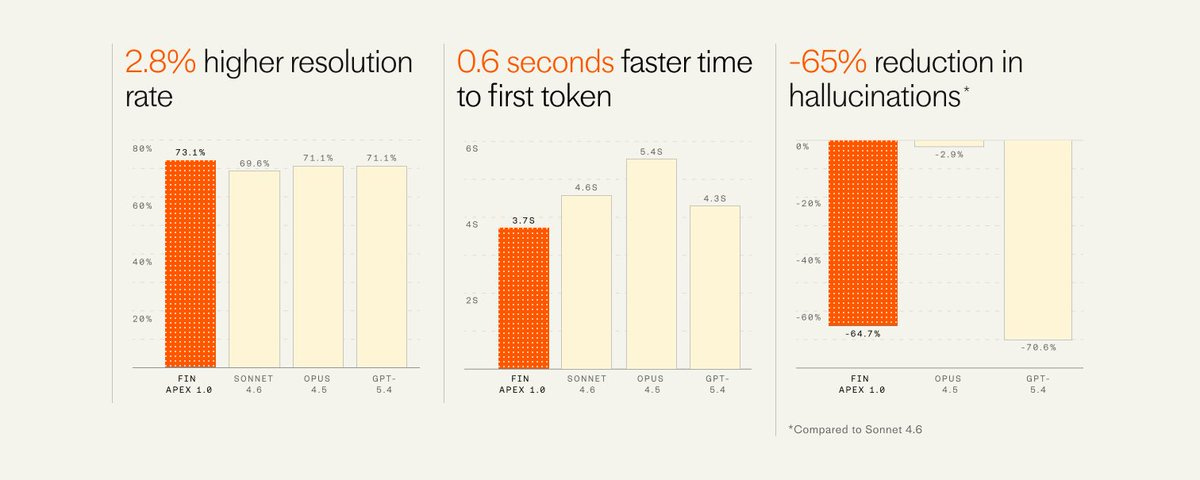
higher resolution rate (more issues solved without human help)
faster responses (lower latency in conversations)
significantly fewer hallucinations
lower cost per interaction
In one case, resolution jumped from 68% → 75% overnight, which translates into a meaningful drop in unresolved tickets.
This is important because in categories like customer support, performance isn’t abstract; it directly ties to cost, customer experience, and headcount.
Why vertical models are suddenly winning
The key shift is not just better models, it’s a better training context.
General-purpose models are trained broadly. But companies now have:
billions of real customer interactions
domain-specific evaluation systems
tightly tuned feedback loops
That creates a compounding advantage.
The model isn’t just “smarter”, it’s more aligned to a specific job. It understands tone, edge cases, workflows, and expectations in a way that general models can’t fully match.
This creates a flywheel: better data → better model → better product → more data
The bigger shift: from horizontal → vertical AI
This is where things get interesting.
General models are becoming good enough and widely available, which means they’re no longer a strong differentiator on their own.
So companies are moving toward:
building their own specialised models
training on proprietary data
optimising for specific use cases (support, coding, legal, etc.)
In simple terms: The value is shifting from “who has the best model” → “who has the best data + post-training.”
What this means for startups and builders
A few clear implications:
If you’re using the same base model as everyone else, differentiation becomes hard
Proprietary data is becoming the biggest moat
Full-stack AI (owning model + product) is becoming the winning approach in large categories
We’re already seeing this in coding (Cursor), customer support (Intercom), and likely soon in other verticals.
What this means for AI labs
This doesn’t kill Frontier Labs, but it changes their position.
General models are still ahead, but:
They often over-serve specific use cases
Open-weight models are catching up
Specialised post-training can outperform them in narrow domains
So the pressure shifts to labs to either:
build vertical models themselves
partner with companies that have strong data
or acquire them
As AI is moving toward “speciation”, instead of one model that does everything, we’ll see many models that do specific things extremely well.
And in that world, the winners won’t just be the ones with the best models.
They’ll be the ones with:
the best data
the tightest feedback loops
and the clearest focus on a specific problem
That’s where the next layer of advantage is being built.
Reddit marketing for B2B saas founders: a step-by-step guide.
If you’re a B2B SaaS founder and not leveraging Reddit, you’re leaving leads on the table.
Here’s why promoting your startup on Reddit is a strategic move:
Massive user growth: In 2024, Reddit hit 97.2M daily active users - a staggering 47% YoY growth. That’s an untapped pool of potential leads.
SEO advantage: Reddit isn’t just a traffic source; it’s an SEO booster. Google even paid $60M for exclusive indexing rights. Every mention of your SaaS on Reddit helps you rank better.
AI visibility: Reddit is one of the most cited sources in LLMs like ChatGPT. In fact, around 40% of AI-generated answers reference Reddit. Meaning: your SaaS can show up when people ask AI tools for recommendations.
I recently came across the Reddit Marketing Guide by Adam Shaw, so I thought to share with you some key points and my opinion with you.
And here’s the kicker: 50% of my leads come from just answering questions on Reddit for less than an hour a day.”
Here’s how you can do it
Step 1: Turn Your Profile into a Landing Page
Your Reddit profile is like a mini landing page. It’s the first place curious users will go after reading your comments or posts. Make sure it’s optimized to convert.

How to set it up:
Choose a username that’s tied to your brand or product.
Write an actionable profile name (e.g., “Helping SaaS Founders Scale”).
Add a CTA to your profile banner (e.g., “Download our Free SaaS Marketing Guide”).
Include your one-line product pitch and CTA in the bio (e.g., “We help SaaS founders grow faster. Subscribe to our newsletter below!”).
Add links to key resources like:
Lead magnets
Newsletter sign-ups
Product demo
Step 2: Find Subreddits Where Your Audience Hangs Out
Reddit is vast, but your audience is likely concentrated in a handful of niche subreddits.

How to find them:
Use Reddit’s search bar to look for your product keywords (e.g., “SaaS,” “startup growth,” etc.).
Use Google to search for “your keywords + Reddit” (pro tip: Google is better at finding Reddit threads than Reddit itself).
Pick subreddits with active, engaged members in your niche.
Pro tip: Use tools like Gummy Search to automate finding relevant subreddits and posts.
Step 3: Prepare a Lead Magnet
Redditors hate being sold to. They love value first approaches.
That’s where a lead magnet comes in. It’s a way to engage your audience without coming across as too salesy.’
Examples of great lead magnets:
In-depth guides tailored to specific problems.
Free trials of your product.
Newsletters with actionable advice (my favorite).
Make it easy for people to commit. For example, I use a newsletter landing page to capture leads. By the time they get there, I’ve already built trust through helpful comments.
Step 4: Start by Commenting, Not Posting
Engage first, post later.
Why? Comments are more personal and allow you to directly connect with people asking for help. You’ll also learn what your audience really needs.
How to comment like a pro:
Answer recent posts (24-48 hours old) for better visibility.
Avoid crowded posts (0-10 comments is the sweet spot).
Add value. Most comments are generic—stand out by being actionable, specific, and helpful.
Step 5: Be the Best Commenter
The secret to success on Reddit? Write better comments than everyone else.
Here’s how:
Be highly relevant—answer only what’s asked.
Be specific—don’t just say “try this.” Explain how to try it.
Go in-depth—assume the person has zero knowledge.
Stay friendly—ignore trolls.
Make your comment stand out visually too:
Use white space for readability.
Add bullet points to organize your thoughts.
Be longer than most comments (Reddit loves thoughtful responses).
Step 6: Post to Curate Conversations
Once you’ve spent a few weeks commenting, you’ll notice patterns in what your audience talks about. That’s when you start posting.
But don’t make the mistake of being self-serving. Redditors can smell that a mile away.
Here’s what works:
Don’t post a blog or self-promo content. Instead, ask questions that spark engagement.
Let the audience share their thoughts and experiences in the comments.
Use their responses to build conversations and authority naturally.
Reddit can be a goldmine for B2B SaaS founders if used the right way. Focus on engagement first, provide value, and let the leads come to you.
How long does it take for VC funds to return money to LPs?
Most people assume VC funds start returning money in a few years.
But that’s not how the asset class is designed to work.
Peter Walker from Carta analysed ~2,900 VC funds, and the data shows something most people underestimate: liquidity in venture is painfully slow.

After around 5 years, things start to move, but not in the way most expect.
~50% of funds have returned at least $1 (some DPI)
But only ~7–8% have returned the full capital (1x DPI)
So yes, money starts coming back… but meaningful returns are still rare.
Even if you go further out, the picture doesn’t change much.
The 2017 vintage, the most mature in the dataset, has a median DPI of just ~0.27x.
That means most funds haven’t even returned 30% of capital after ~7–8 years.
And here’s the part most people get wrong:
Early DPI isn’t always a good sign.
If money comes back in 2-3 years, it’s often from smaller exits
Those returns are sometimes recycled back into the fund
The real outcomes (the ones that matter) take much longer to show up
This is also why Venture behaves the way it does:
Returns follow a power law → a few winners drive the entire fund
Secondary markets are booming ($60B+) to provide early liquidity
Fund timelines are stretching → many now take 15–20 years to fully play out
So Venture isn’t a “wait 3–5 years and cash out” game. It’s a long-duration bet where time is part of the strategy, not a constraint.
TODAY’S JOB OPPORTUNITIES
💼 Venture Capital & Startup Jobs
Most aspiring VCs struggle with interviews, unclear expectations, no structured prep, and generic advice that doesn’t actually help. So we partnered with a leading investor group to build an all-in-one VC Interview Preparation Guide that gives you real clarity and frameworks. (Access Here)
Head of Investor Community - Inovexus | Remote - Apply Here
Communications & Content Manager - b2ventures | Germany - Apply Here
Senior Investment Analyst - Earth Foundry | USA - Apply Here
Senior Scouting Manager - Antler | Australia - Apply Here
Associate - Lightbank | USA - Apply Here
Associate - Climate Venture Fund | USA - Apply Here
Ventures Analyst/Associate - Plug and Play Tech Centre | USA - Apply Here
Research Innovation Program Director - Generator | USA - Apply Here
Investment Analyst Intern - NAV Capital | Dubai - Apply Here
PE & VC Partner Manager - Dealhub | UK - Apply Here
Investment Analyst - Lunicorn Venture | UK - Apply Here
Program Manager - a16z | USA - Apply Here
Venture Fellow - age1 | USA - Apply Here
Venture Capital Associate - Sky9 Capital | USA - Apply Here
Investment Summer Associate - AI Tooling - M13 | USA - Apply Here
Event Marketing Manager - AI Fund | USA - Apply Here
PARTNERSHIP WITH US
🤝 Get your brand in front of 116,000+ audience.
Our newsletter is read by 116,000+ of tech professionals, founders, investors (VCs / Angel Investors) and managers around the world. Get in touch today.
🔴 Share Venture Curator
You currently have 0 referrals, only 5 away from receiving a 🎁 gift that includes 20 different investors’ contact database lists - Venture Curator