


👋 Hey, Sahil here — Welcome back to Venture Curator, where we explore how top investors think, how real founders build, and the strategies shaping tomorrow’s companies.
Elad Gil’s framework for spotting billion-dollar markets before they look big.
The right way to choose your pricing model by Gaurav Vohra, founding team at Superhuman.
The rise of “Offline Outbound”: How to execute your own Offline Outbound.
FROM OUR PARTNER - TALKSHOP
🎓 TalkShop Is Building the First Real-Time Career Guidance System for 50M+ Students
TalkShop connects students with vetted college students, recent grads, and young professionals who are living the majors, programs, and early career roles that high schoolers are trying to understand.

Instead of outdated counselling or expensive private advisors, students get real, experience-based guidance through affordable 1:1 sessions and career content built by their peers.
Why this matters
Americans waste over $200B each year due to poor education and career decisions
1 in 5 high schools don’t have a college counsellor
6,000+ students signed up to mentor in 90 days (zero marketing spend)
1,000+ mentors vetted and onboarded from 300+ schools
TalkShop has built a trusted, peer-led guidance platform Gen Z actually listens to—powered by real conversations, real data, and a supply engine that’s impossible to replicate with AI.
VENTURE CURATORS’ FINDING
📬 My Favourite Finds
Media Posts:
All-in-one resources for aspiring venture capitalists. (Link)
12-page report on the state of generative AI in the enterprise. (Link)
Investor outreach email sequence pack: 20+ proven templates used & approved by VCs. (Link)
40 real startup pitch decks that raised $350M+ (Including leading startups decks) (Link)
Reports/Articles:
Ramp AI Index: Monthly measurement of AI adoption by American businesses. (Link)
A few thoughts on conviction. (Link)
A blueprint for modern product development. (Link)
The skills and habits aspiring CEOs need to build. (Link)
Pricing lessons from working with 30+ seed and series A B2B startups. (Link)
Private capital predictions for 2026. (Link)
🤝 PARTNERSHIP WITH US
Get your product in front of over 103,000+ audience - Our newsletter is read by thousands of tech professionals, founders, investors and managers worldwide. Get in touch today.
📜 DEEP DIVE
Elad Gil’s framework for spotting billion-dollar markets before they look big.
Startup history is full of companies that looked like bad ideas at the start.
An online marketplace for wedding invitations? Too niche.
A payroll tool in a boring, saturated market? Who cares.
Another file storage app? Too late.
And yet, those “nonobvious” bets became Minted, Gusto, and Dropbox.
Elad Gil, a longtime operator and investor (Stripe, Coinbase, Instacart, Airbnb), has a simple thesis:
Nonobvious markets can lead to hypergrowth, if you know how to spot and validate them.
Based on years of experience and interviews with top founders, Gil breaks down four principles and three market types that help you find overlooked opportunities with real upside.
First, start with the market. Not the idea.
Elad’s approach is clear: Market > Team > Idea.
Why? Because even great teams can’t escape bad markets. But great markets tend to give you multiple shots — even if your first idea stumbles.
“Many great teams get taken out by a terrible market. But if you’re in a great market, the idea itself doesn’t matter as much — there are always other shots on goal.”
– Elad Gil
So before building or investing, study the underlying market structure.
Ask:
Is this a growing market with multiple unmet needs?
Is it structured like a winner-take-all, or more like an oligopoly?
Are existing players actually serving users well?
Most people get this wrong because they fall in love with an idea. Instead, fall in love with the market.
Four Principles to Uncover the Nonobvious
1. Use first principles, not hot takes.
Don’t just be contrarian for the sake of it. That’s lazy.
Use first principles thinking to ask:
Is the “common wisdom” still true?
What’s changed in cost, infrastructure, or tech?
Has the assumption just aged out?
Example: Payments used to be avoided like the plague. “Too much fraud risk.”
But then Stripe happened. Fraud tooling, APIs, and internet trust improved and suddenly it became obvious in hindsight.
2. Scratch your own itch — or go deep on real pain.
Gil’s favorite startups often come from founders solving problems they’ve lived.
Gusto founders had family who struggled with bad payroll tools.
Mailgun was built after the team had to manually rebuild the same email infra over and over.
Gil’s own startup, Color Genomics, was sparked by his cofounder’s family health history.
This kind of insight gives you edge and a compass.
“The key is that it’s a real problem. Not an idea you plucked out of thin air.”
3. Build product-first. Don’t chase vague customer feedback.
“Would you use this?” is a weak signal.
“Would you pay for this right now?” is a real one.
Break into tough markets with a product that works beautifully, even in crowded spaces.
Dropbox beat bigger incumbents by nailing file syncing.
Google flipped the norm by getting users off the site faster, not keeping them longer.
Zeplin built what their designer-engineer team wished already existed.
If customers are nodding but not buying, you don’t have it yet.
4. Look on the fringe. That’s where the future often starts.
New trends start weird. Crypto, social media,and online payments all looked like toys at first.
Gil reminds us:
“Innovation often comes from small communities screwing around with random stuff.”
Pay attention to:
What smart people are tinkering with for fun
What communities are hacking together without outside attention
What you see enthusiasts doing before the mainstream shows up
Three Market Types Worth Digging Into
If you’re looking for overlooked gold, Elad says these are the best hunting grounds:
1. New Tech
Tech that’s early, misunderstood, or still feels like a toy.
The mistake? People underestimate compounding growth.
Ask: Is it doubling year over year? Are costs falling? Is performance improving fast?
Example: In the 1980s, McKinsey told AT&T the total mobile phone market would max out at 900,000 users. That was just off by a few billion.
Tip: Survey your smart friends. What are they playing with or obsessing over?
2. Looks Crowded, But Isn’t
Just because a market is noisy doesn’t mean it’s closed.
Ask: Are the competitors any good? Are users actually satisfied? Is the core product broken?
Gil invested in Checkr and Gusto because he saw startups struggling with those exact things. If you’re being forced to use a broken tool today, that’s a startup opportunity.
Think:
Google, despite AltaVista and Yahoo
Dropbox, despite iCloud and Box
Instagram, despite Myspace and Facebook
The trick is to look where incumbents are weak or slow, then wedge in with a 10x better product.
3. Seems Niche
Gil breaks this down into 4 subtypes:
Too small: Uber started with black cars for rich people. Now it’s infrastructure.
Too boring: Payroll. On-call alerting. File storage. Huge wins, zero sizzle.
Too high-end: Tesla’s $100K Roadster seemed like a toy. Now look.
Too personally unfamiliar: Stitch Fix and Glossier were built from deep user empathy that male investors just didn’t have.
“Your entry market will almost always seem small. But that’s the point — it’s where incumbents aren’t looking.”
One More Layer: Watch for Market Timing
Some ideas are great — just not yet.
Gil warns of two patterns:
False starts: Right idea, bad execution. (Friendster before Facebook)
Boomerangs: Right idea, wrong timing. (Webvan before Instacart)
Don’t just ask “Is this a good idea?”
Ask “Is the infrastructure ready? Are customer habits there yet?”
If not — be patient. Timing kills more ideas than bad execution.
So Overall here’s a useful lens to spot your own nonobvious startup:
What’s a product or tool you hate but are forced to use?
What’s a “boring” problem you or your peers solve manually every month?
What’s something your smart friends are excited about but others roll their eyes at?
That’s where you dig.
“Grab a shovel and dig where it looks weird. That’s usually the spot.”
You can check out a detailed write-up by First Round here.
CURATED RESOURCE FOR YOU
🤝 Early-Stage Startup Financial Model Template
Investors expect clean, simple numbers, not overbuilt spreadsheets.
This Excel Financial Model Template helps you build clear projections investors actually understand. Just fill in your numbers, and it does the rest.

What’s inside:
Revenue, cost, and growth projections
Runway, burn rate & funding need calculations
Simple, investor-ready format that works for any early-stage startup
Plug in your data, get investor-ready, and tell your story with numbers that make sense.
📃 QUICK DIVES
The right way to choose your pricing model by Gaurav Vohra, founding team at Superhuman.
One of the most expensive mistakes early-stage startups make isn’t a tech decision — it’s pricing. Teams spend months debating:
“Should we be freemium?”
“Should we do a free trial?”
Or worse — they pick one at random, build around it, and realise later it was the wrong bet.
Gaurav Vohra, part of the founding team at Superhuman, shared one of the clearest frameworks yet for deciding how to price your product and when to stay away from free altogether.
Here’s the breakdown founders should know.
1. Freemium vs. Free Trial: know the difference
Freemium = free access forever, limited functionality
Free trial = free access for a limited time or usage
Freemium changes your entire business model. Free trial is just a funnel experiment. Decide on freemium first; it’s a company-level decision.

2. When to go freemium
Freemium only works under certain strategic conditions:
Competitive pressure: If cheaper or free competitors can steal the market fast, freemium might be necessary. It’s a defensive play to cement users before rivals do. But beware the “price war trap.” Once you and your competitors start undercutting each other, you eventually end up at $0.
Network effects: If your product gets stronger with more users, freemium fuels growth. Slack, Dropbox, and ChatGPT are examples where user scale itself improves value.
Data flywheel: If free users’ data makes your product smarter (like Grammarly or ChatGPT), a free tier is strategic. It feeds model improvement or enables monetization via ads or new revenue streams.
If none of these are true, skip freemium.
3. When to go on a free trial
If you don’t need a permanent free tier, a time- or usage-based free trial might still make sense.
Competitive necessity: If every similar product in your category offers a free trial, you’ll likely need one too. Calm and Headspace are great examples.
Reaching lower-intent customers: Once you’ve saturated high-intent buyers, you may need to expand to lower-intent users. That’s why mature products like Salesforce or Adobe use trials to widen the funnel.
Hard-to-explain value: If your product’s “aha” moment only happens after people use it, free trials help. Example: Readwise — users only see value once they connect highlights and start receiving emails.
Rule of thumb: If you can’t describe the value well, let users experience it first.
4. The hidden costs of “free”
Free is never really free. Every additional user means higher infra and AI usage costs, more support tickets, more edge cases, and more moderation overhead. Especially with AI products power users can destroy your margins fast. Set usage caps early.
5. Freemium vs. Paid — global vs. local optimization
Ask yourself: Is going free a global strategy or a local optimization?
Spotify’s ad revenue (around 12% of total) looks useful, but the real reason they’re freemium is competitive pressure and audience expansion, not ads. Most startup teams confuse small optimizations for strategic moves. Always ask if “free” actually helps you win the market or just distracts from your main product.
6. Evaluating if your pricing decision worked
Free trial vs. pay up front is easier to test. Compare activation (day 1–30) and revenue retention (month 1–3) between groups. You can A/B test it.
Freemium vs. paid is harder because it changes everything — funnel, CAC, engagement, support, even product roadmap. Instead, evaluate hypotheses: Did we beat competitors? Did we create network effects? Did we collect valuable data? If not, “free” wasn’t worth the cost.
7. What Superhuman learned the hard way
Superhuman tested both freemium and free trial. Both backfired.
Freemium experiment: 4x virality inside teams, but less than 25% activation or monetization. Looked great on paper, killed revenue.
Free trial: Users took the product less seriously. Paying up front created stronger behavior change and better retention.
Their conclusion: paying is part of the product experience.
Don’t copy pricing models blindly. Ask three questions before adding “free”:
Does free make my product more valuable (via network, data, or virality)?
Can I afford the cost of free users?
Will customers value it more if they pay first?
Sometimes the fastest way to grow isn’t going free — it’s charging early, proving value, and letting results spread on their own.
The rise of “Offline Outbound”: How to execute your own Offline Outbound.
In a world obsessed with AI and digital automation, some of the sharpest GTM teams are going the other way, offline.
They’re sending doormats, collectables, and cakes to prospects. It’s not nostalgia, it’s strategy.
Joseph Bath calls this new wave Offline Outbound — a modern take on Account Based Marketing built around physical, co-branded gestures that spark real relationships and unforgettable brand moments.
Instead of cold emails and ads, companies are showing up - literally.
Here’s how the best ones are doing it.
1. Delve’s “Doormat Experiment”
YC-backed Delve sent custom doormats reading “Your shoes look good. Do your SOCs 2?” to 100 hot prospects.
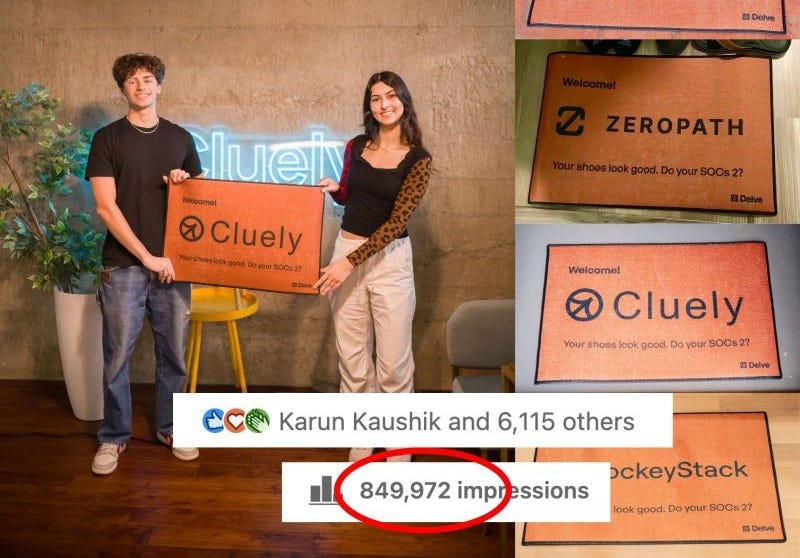
Cost: $6K | Views: 850K | Likes: 6K | Pipeline: $500K
It worked because the object fit the message.
The doormat was symbolic, funny, and relevant to Delve’s SOC 2 compliance product. It broke the digital pattern, sparked posts across LinkedIn, and sat in offices as a lasting reminder.
Lesson: Great offline ideas tie directly to what your product represents.
2. Weave’s “Labubu Run”
Weave (YC W25) wanted to stand out to engineering leaders. They sent collectable Labubu figurines wearing custom company shirts to 42 target accounts and their GTM lead personally ran 42 km across San Francisco to deliver them.
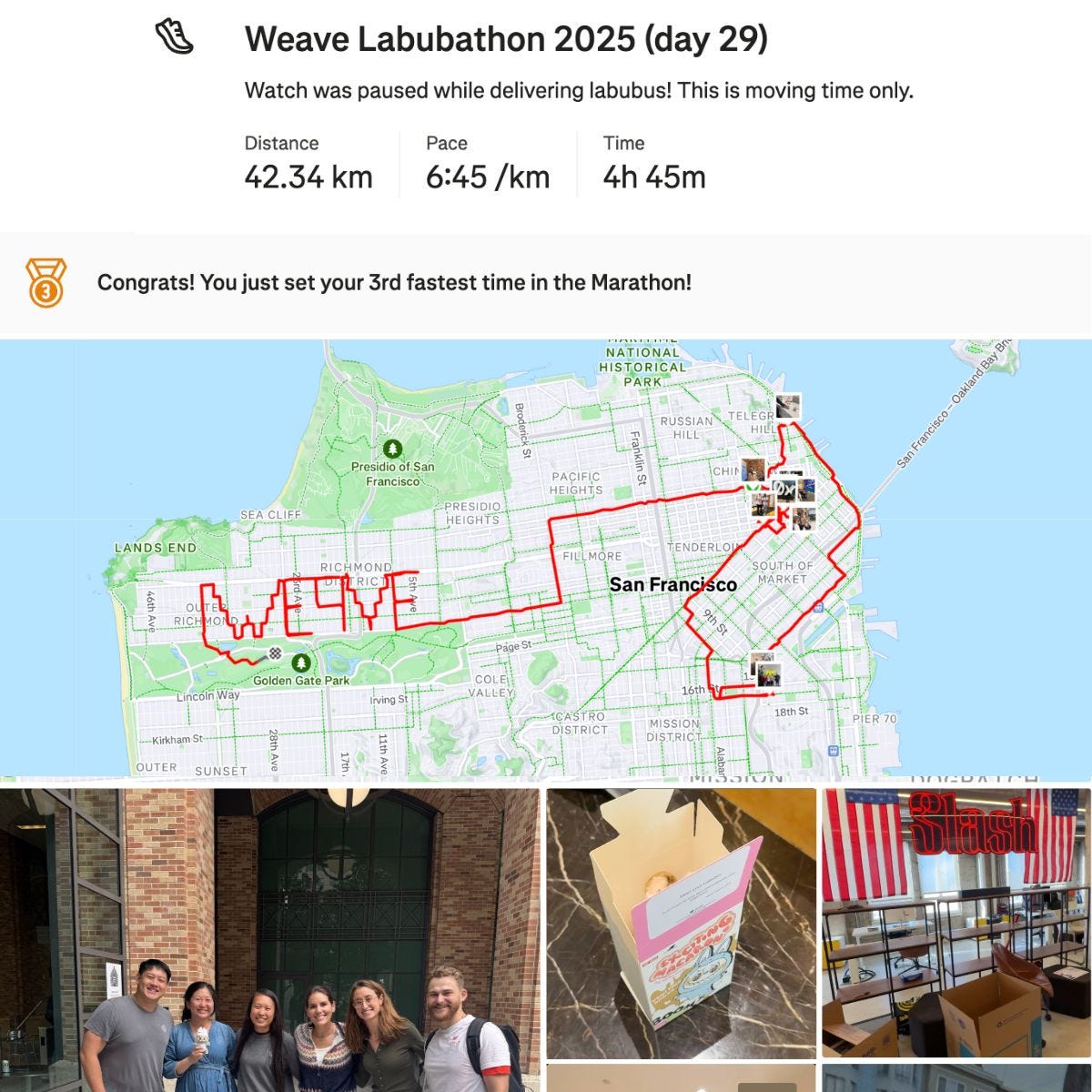
He met 42 CTOs face-to-face, sparked posts from teams like Sierra and Hightouch, and turned a physical stunt into viral digital content.
Lesson: Borrow cultural relevance (Labubus were trending) and turn delivery into performance — an experience people can’t help but share.
3. Artisan’s “Outbound Cakes”
Artisan (YC W24), which builds AI BDRs, sent custom cakes to target prospects. Each was iced with: “Hire Ava, she’ll make outbound a piece of cake.”
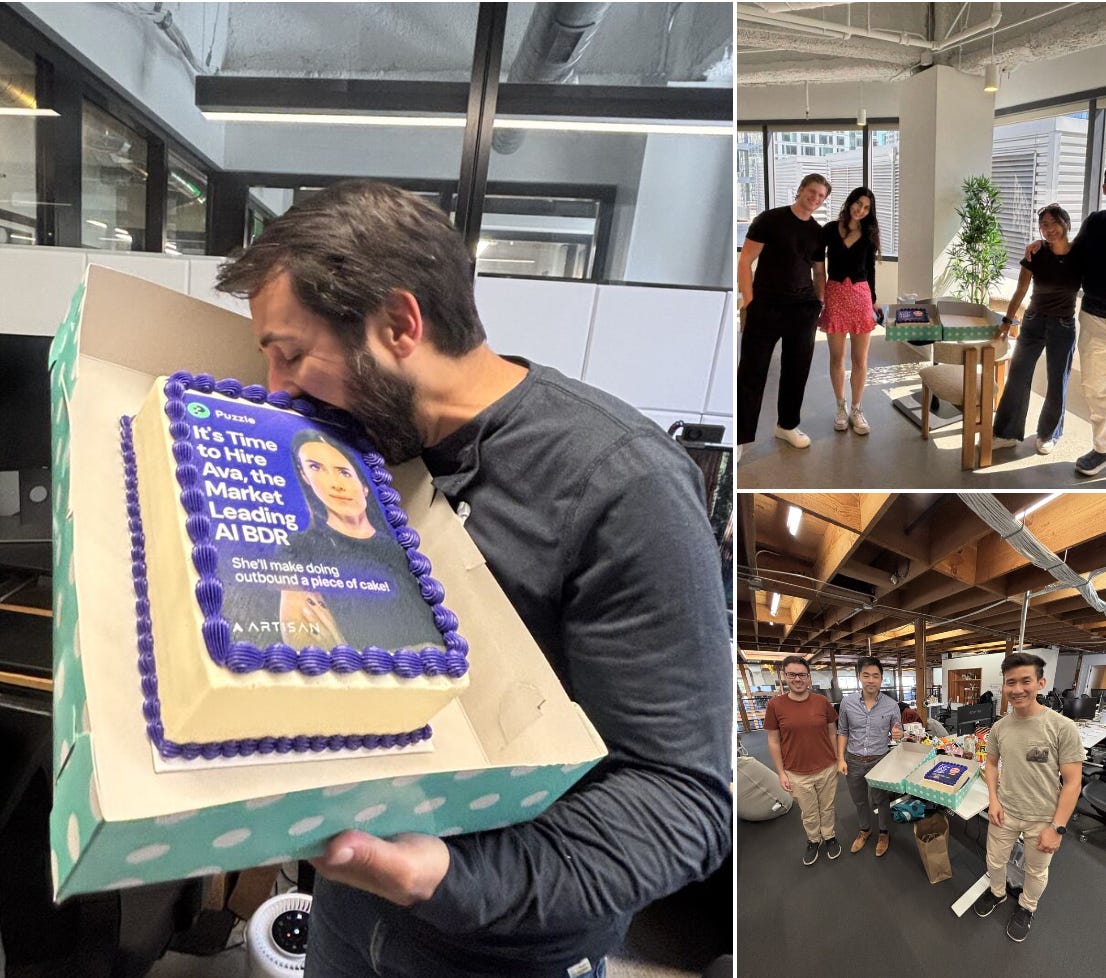
They paired the physical drop with digital follow-ups — automated LinkedIn and email sequences. The mix of human gesture + AI efficiency created warm leads, viral reach, and a sharp brand image.
Lesson: A small, thoughtful drop — combined with smart digital follow-up — beats pure automation every time.
What makes Offline Outbound work
Human connection: You stop being “just another sender.” You become a person — someone who showed up with intent.
Differentiation: Everyone optimizes emails; few dare to break the channel. Going offline is the pattern interrupt.
Longer brand life: A doormat or desk collectible keeps your brand visible for months — not seconds like an ad.
Built-in content: Each drop creates a shareable story, multiplying impressions far beyond the initial gesture.
The trade-off: scalability vs. memorability
Offline Outbound isn’t for blasting 10,000 prospects. It’s for high-ACV, trust-driven deals where personal touch pays off.
It sits between Brand, Demand Gen, and ABM — less scalable than ads, but far more memorable and trust-building.
Why it works (by the numbers):
Estimated CPM: ~$7 (vs. LinkedIn ads at $100–$200)
$6K spend → $500K pipeline (≈ 1:83 ratio)
Longevity: physical impressions last for months
Use it when:
You’re launching, fundraising, or riding momentum
You’re targeting high-fit accounts where one deal moves the needle
You have a story worth sharing both offline and online
How to execute your own Offline Outbound
Find your hook. Pick something timely, intuitive, and shareable.
Co-brand the object. Make it feel like a shared moment, not an ad.
Set your goal. Pipeline? Relationship building? Account activation?
Get personal. Know who you’re sending to — and why.
Capture the content. Film, post, and repurpose — the content is the multiplier.
Offline Outbound isn’t a playbook. It’s a precision strike. Use it sparingly, when story, timing, and fit align.
Because showing up in person — with something worth talking about — still cuts deeper than any automated sequence ever will.
TODAY’S JOB OPPORTUNITIES
💼 Venture Capital & Startup Jobs
All-In-One VC Interview Preparation Guide: With a leading investor group, we have created an all-in-one VC interview preparation guide for aspiring VCs. Don’t miss this. (Access Here)
Senior Analyst - Iconiq Capital | USA - Apply Here
Associate, Secondary Investments - Adam Street Partner | USA - Apply Here
Chief of Staff – DeVC - Z47 | India - Apply Here
Lead, Growth Platform & Communications -Tall Venture | USA - Apply Here
VC Investment Intern - First Momentum Venture | USA - Apply Here
VC Investor - Quamtum Light | UK - Apply Here
Head of Operations - Sagest Capital | USA - Apply Here
Portfolio Management Lead - Yzi Labs | Remote - Apply Here
Office Manager - Seedcamp | USA - Apply Here
Intern, Investor Relations Operations - B Capital Group | Singapore - Apply Here
(Senior) Investment Manager - Finch Capital | USA - Apply Here
Partner - a16z | USA - Apply Here
Investment Associate - Energy Impact Partner | London - Apply Here
VC Intern | lvlp Venture | Remote - Apply Here
Visiting Analyst - Seedcamp | UK - Apply Here
🤝 Partnership With Us
Get your product in front of over 95,000+ audience - Our newsletter is read by thousands of tech professionals, founders, investors and managers worldwide. Get in touch today.
🔴 Share Venture Curator
You currently have 0 referrals, only 5 away from receiving a 🎁 gift that includes 20 different investors’ contact database lists - Venture Curator