👋 Hey, Sahil here - welcome to today’s edition of Venture Curator, where we break down how great startups grow, how top investors think, and what’s shaping the future of tech.
P.S. Get access to 100+ startup & VC resources, investor databases, fundraising templates, 150+ premium archive posts and exclusive startup research - all in one place.
FROM OUR PARTNER - SEMRUSH
Your buyers don’t just search Google anymore.
I’ve been looking at how search is changing, and this is probably the biggest shift marketers need to pay attention to.
People still use Google, but they’re also discovering products through ChatGPT, AI Overviews, and other AI tools. Semrush now lets you track both from one place.
You can see where your brand ranks in search, how often it appears in AI answers, where competitors are gaining visibility, and what may be holding your site back.
Partnership With Us
Get your product in front of an audience of 125,000+ - Our newsletter is read by thousands of tech professionals, founders, investors and managers worldwide. Get in touch today.
📜 DEEP DIVE
How did emerging AI startups get their first customers? An analysis of 50 companies
There’s a question that every founder has: “Where do the first ten customers actually come from?” Not any random customers, but these emerging AI startups.
The honest answer most founders get is a shrug and “just launch.” Post on Product Hunt, do a Show HN, tweet the demo, wait. So they do, and a week later they have 400 signups, three Discord messages, and no revenue. Then they assume the product is the problem.
I wanted to know what the companies that made it actually did, so I did the boring thing again. I took 50 AI companies, mixed across enterprise, developer, and prosumer tools, and consumer and creative, and looked for the specific story of their first paying customers. Founder interviews, podcasts, company blogs, press. The first ten. Where a company’s early channel wasn’t documented anywhere I could find, I dropped it and picked another.
Here’s what we’re covering:
The one chart: the primary first-customer channel across all 50
The launch finding, and why “just launch” is the most expensive advice in AI
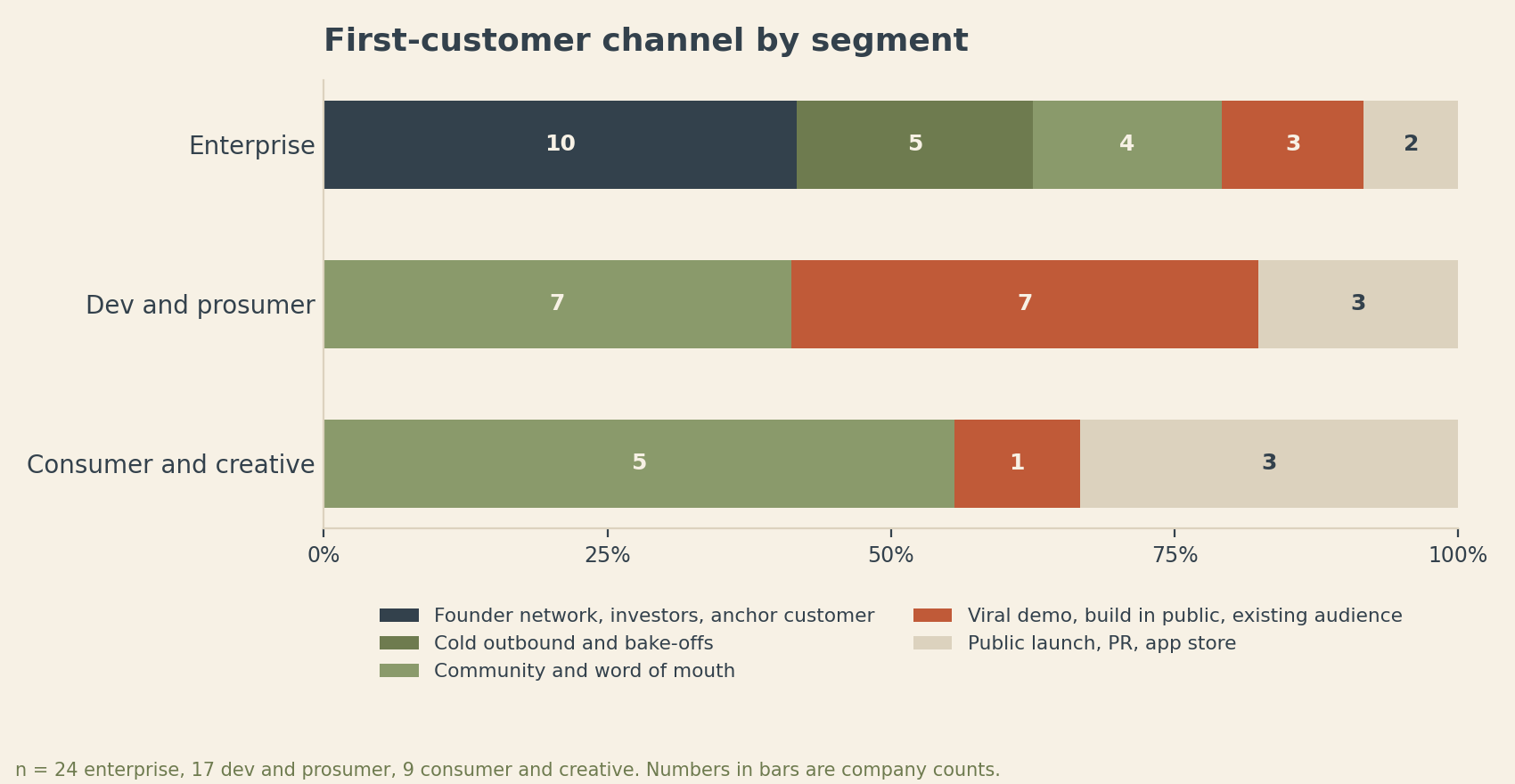
How the pattern changes by segment (enterprise, dev tools, consumer)
The three channels that exist now and didn’t in 2020
The first-ten playbook for each segment, in order
The outreach that actually worked, with the messages
A Claude prompt that builds your first-ten list from your own network
Let’s go.
First, the map
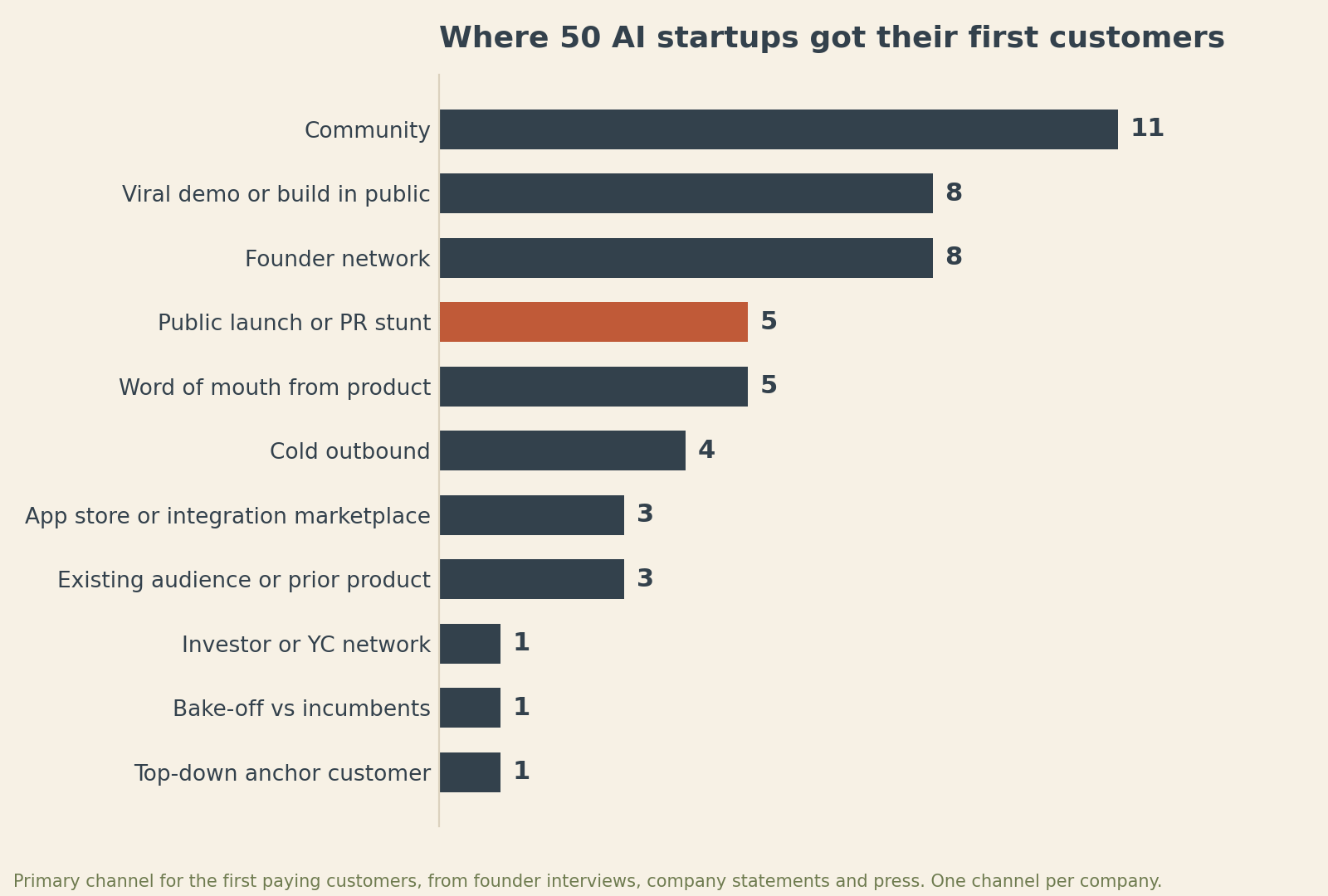
Read the bottom of that chart before the top.
Five of 50 companies got their first paying customers from a public launch. Five. And of those five, four are products you can demo in a single screenshot or a 30-second clip: Lovable, Gamma, Tome, Udio.
The fifth, Artisan, is an enterprise company, and it didn’t get there with a launch. It got there with the “Stop hiring humans” billboards, which is a PR stunt with a sales team behind it.
Now read the top. The biggest bucket is community: Discord servers, subreddits, developer forums, LinkedIn creator circles. Then founder network. Then the viral demo. Those three account for more than half of the 50, and none of them is a launch.
The number one source was the founder’s own network, the number two was cold outbound, and “just launch” was last on his list of seven. That was pre-AI data. The AI companies I looked at follow the same shape, with three new channels added that I’ll get to.
The uncomfortable version of the finding: the launch isn’t a customer acquisition channel for most AI companies. It’s a signup acquisition channel. The first ten paying customers almost always came from somewhere the founder already had trust, or from somewhere the product could be seen working before anyone was asked to pay.
What the best-known stories actually say
Three companies most founders point to as “they just went viral.” None of them did, in the way people think.
Cursor - Bloomberg’s headline was that Cursor drew a million users “without even trying”, with zero marketing spend. True.
But the first users were developers the founders knew, who recommended it to developers they knew, with a Discord as the place they gathered. The company built its early team out of that same Discord. That’s not a launch. That’s a product good enough that its first ten users did the selling.
Harvey - The first customer story is the best cold email in AI. Winston Weinberg, a litigator, ran 100 questions from r/legaladvice through GPT-3, had three attorneys grade the answers, and emailed the results to Sam Altman and OpenAI’s general counsel. That got him early model access and OpenAI as first investor.
Then, instead of starting with small firms, Harvey went straight to Allen & Overy and signed a 4,000-lawyer rollout when the company had four people working out of an Airbnb. Investors told them it was a horrible idea. Harvey’s first two customers were London firms. Nothing about it was inbound.
Decagon - In a category with Sierra, Salesforce and Zendesk, Decagon’s early logos came from winning head-to-head contests against much larger vendors, running its agent against the incumbent’s on the customer’s real tickets and letting the numbers decide. Vapi did the same thing later, beating 40 rivals for Amazon Ring. The bake-off is now a first-customer channel in its own right, and I’ll come back to it.
The pattern across all three: the founder created a situation where the product could be judged on its work before anyone had to trust the company.
A graded proof for OpenAI. A 4,000-seat pilot. A contest on the customer’s own data. The launch skipped that step, which is why it produces signups and not customers.
By segment, it’s three different games