

👋 Hey, Sahil here - welcome to today’s edition of Venture Curator, where we break down how great startups grow, how top investors think, and what’s shaping the future of tech.
P.S. Get access to 100+ startup & VC resources, investor databases, fundraising templates, 150+ premium archive posts and exclusive startup research - all in one place.
📜 DEEP DIVE
How is your seed valuation actually decided? (It has almost nothing to do with your company.)
You have almost certainly been told, “we’re not there on valuation.” Possibly recently. Possibly by someone who seemed to like everything else about the company.
And you probably read it as a verdict. Not enough traction, too early, the story isn’t landing yet. Most founders respond by going back and building a better case for the number.
Here’s what’s usually happening instead.
Say the fund across the table is a $28M fund. Funds that size write cheques of about $600K, and they need to own 6-8% of what they back for the fund to work.
$600K at 7% prices the company at $8.6M. Even at 6%, it’s $10M.
If you were asking $18M, there was never a version of that meeting where the answer was yes.
Not a better deck, not more revenue, not a sharper story. The highest price that fund could pay was fixed before you walked in, and it was half your ask.
Nobody says this out loud. What you hear is “we’re not there on valuation,” which sounds like a judgment about your company and is usually a statement about their spreadsheet.
Your seed valuation is mostly arithmetic, and it starts with the size of the fund across the table.
Fund size sets cheque size.
Cheque size sets how much they need to own.
That sets the highest price they can pay you. All of it, before your deck.
And that arithmetic has quietly stopped working for a lot of the funds you’re pitching.
The market ran away from the model
Carta has median seed post-money at $24M, an all-time high, up from $18M a year earlier.
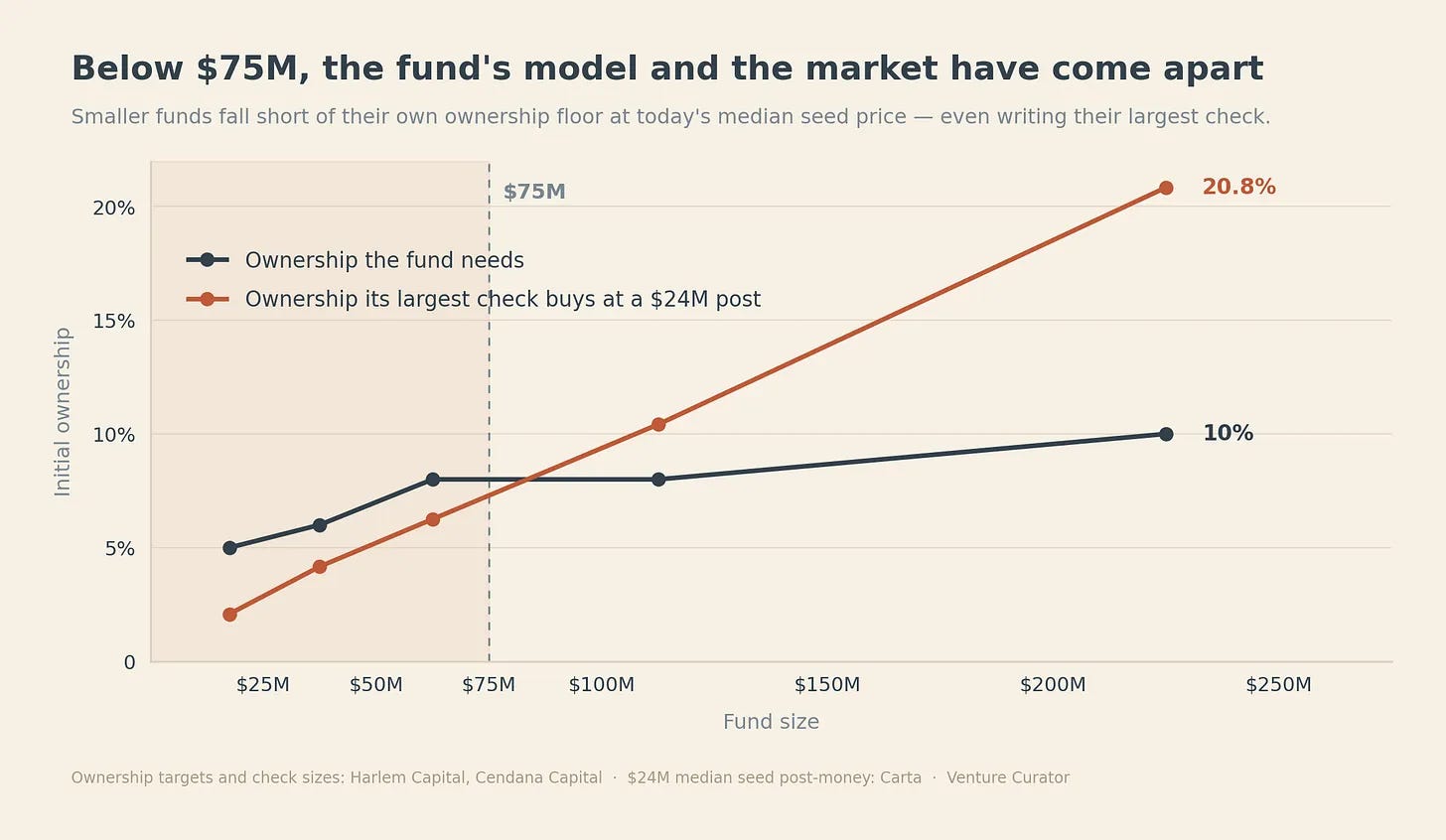
Now put that next to how funds are built. A $50M fund writes cheques of roughly $750K to $1.5M, and needs 8–10% ownership. That’s not a guess - it falls straight out of the standard fund model.
At a $24M post, a $1.5M cheque buys 6.2%.
They’re short of their own minimum while writing the biggest cheque they have. Not because you’re asking too much. Because prices went up and the fund model didn’t move with them.
Run that across the whole range, and the line lands somewhere specific: below about $75M in fund size, a fund can’t hit its ownership target at today’s market price at all. A chunk of your target list is structurally unable to lead you. And none of them will say so. They’ll say it’s too early, or they need to see more traction.
The cost isn’t one lost deal. It’s six weeks in rooms where the arithmetic had already closed the door, and a founder walking out convinced the problem was his traction.
The three inputs and the one everyone prepares for aren’t among them
Three things set the number at seed:
The fund’s arithmetic: The binding constraint, and the one founders never see.
The partner’s personal comp set: Not the market. The twenty to forty deals that specific partner has looked at in your category over the last six months, and what those closed at. This is why quoting Carta’s median in a meeting rarely works.
Whether a second term sheet exists: The only input you meaningfully control, and the only one that reliably moves the price.
What isn’t on the list: your TAM slide, your five-year projections, comparable exits in your space, or how much money you’ve calculated that you need.
Founders spend their prep on the second list.
What’s inside today’s deep dive
The chain, worked end to end. Five steps from fund size to the highest post-money they can accept and the two heuristics that let you run it in your head.
The 2026 lookup table. Fund size against check, ownership target, the price where their math works, and what their check actually buys at today’s median.
The $75M line, and the three things funds below it do about it - each of which changes whether they can lead you.
Where to find any fund’s size in four minutes, using a public filing most founders don’t know exists.
The reframe: you set your valuation when you named your round size, not when you named your valuation.
The pool shuffle that quietly costs more than the pre-money you’re negotiating.
What to say when their number is below your ask, and the one question on the first call that saves six weeks.
Plus the pre-meeting worksheet, and why pre-seed works completely differently.
Let’s get into it.