

👋 Hey, Sahil here - welcome to this edition of Venture Curator, where we break down how great startups grow, how top investors think, and what’s shaping the future of tech.
P.S. Get access to 100+ startup & VC resources, investor databases, fundraising templates, 150+ premium archive posts and exclusive startup research - all in one place.
📜 DEEP DIVE
How to automate your startup fundraising with Claude (And avoid this autopilot trap).
I recently spoke with a VC who invests exclusively in pre-seed and seed rounds, and he sounded almost tired talking about his inbox. Most of what lands now, he said, splits into two piles within seconds - genuinely worth a reply, or something he’s learned to move past without finishing the sentence.
What surprised me wasn’t the split. It was what actually separated the two piles.
I talked to a handful of founders raising right now - same AI tools, same market, wildly different outcomes. One closed her round in under two weeks. Another sent sixty personalised-looking investor emails, a deck that looked polished but said nothing specific, and follow-ups that referenced numbers from an old version of his own model and heard back from exactly one, a polite pass, with a mention that his message had “that AI smell.”
It wasn’t a writing problem. It wasn’t even a design problem - the deck looked fine on its own. Something else was different, and it wasn’t creativity.
That gap is the whole story right now, and it starts with what’s actually happening to the money.
The money is real. The odds aren’t.
$300 billion flowed into roughly 6,000 startups globally in Q1 2026 - an all-time high, up more than 150% quarter over quarter and year over year. That single quarter absorbed close to 70% of everything venture investors deployed in all of 2025.
Read the fine print and the picture changes fast. Seed funding did rise 31% year over year to $12 billion - but the number of seed deals fell 30% over the same period, down to roughly 3,800. More dollars.
Fewer winners. The money isn’t spread thinner; it’s stacked higher on fewer companies.
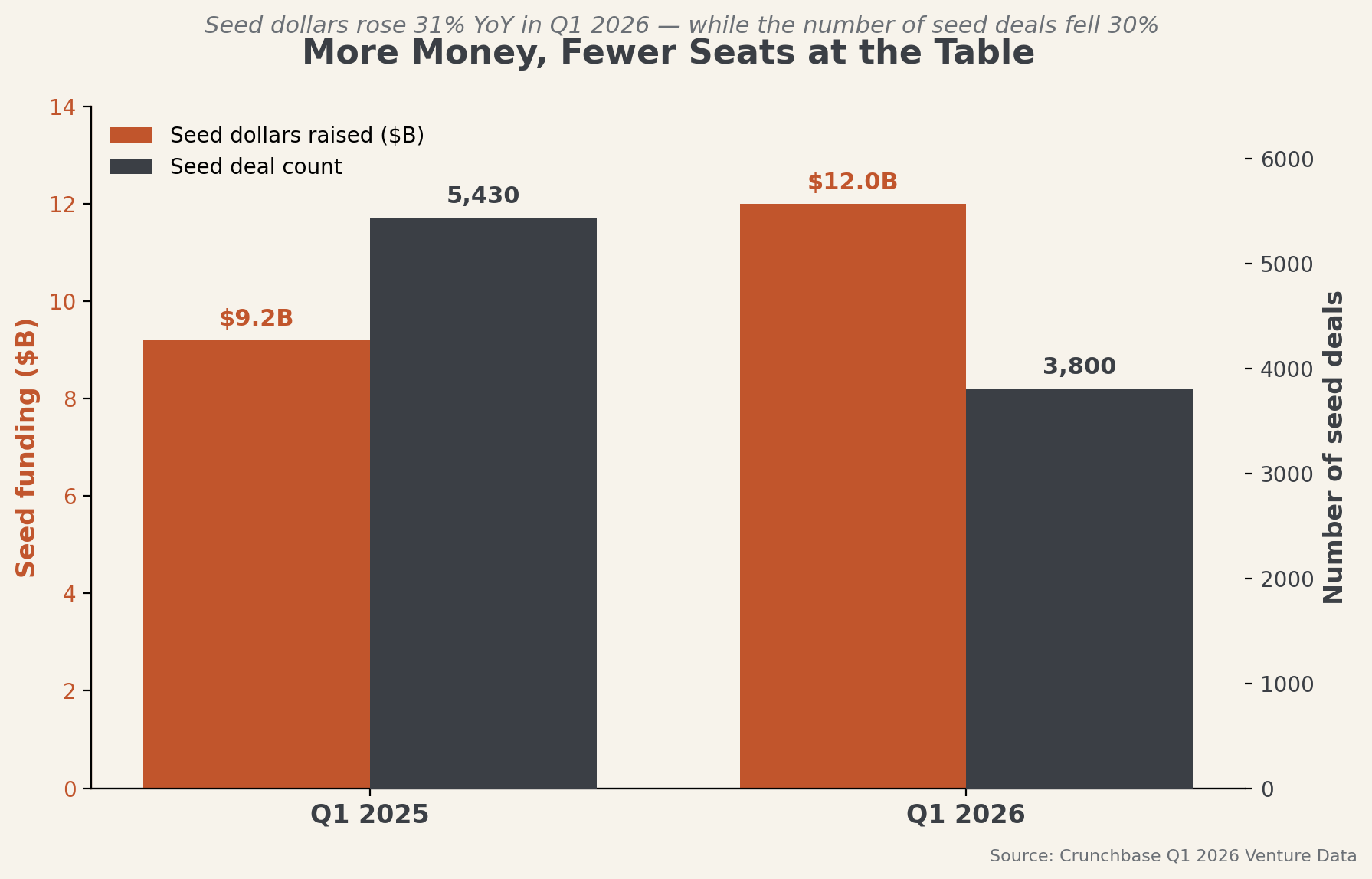
That’s the environment you’re raising into right now:
A market with record capital and a shrinking number of seats at the table. Which is exactly why so many founders have started reaching for AI to widen their odds - better investor research, faster decks, outreach at a scale no human could type by hand.
Here’s the part almost nobody’s telling them.
The same automation that’s winning rounds is getting other founders quietly blacklisted
AI-assisted investor matching is producing real results for the founders using it well - some platforms building on this approach report meeting rates well above what cold, unassisted outreach typically converts at, simply because the targeting is sharper and the research that used to take a week now takes an afternoon.
Investor inboxes have adjusted just as fast. Investors can now spot a templated AI email - one that name-drops a portfolio company in an obviously generic way - within seconds. The good ones flag it and move on. The frustrated ones mention it to other investors, and a founder’s name starts showing up in group chats and “pass on this one” flags between funds, in places they’ll never see.
Nobody sends you a rejection email that says “this felt automated.” You just... stop hearing back. From everyone. At once.
And here’s what makes this harder to navigate: the fundraising tool market has exploded. Deck generators, investor-matching platforms, outreach CRMs, call-prep assistants - a new one launches almost weekly, most promising to “automate your raise.” Some of that is genuinely useful.
Some of it is the exact mechanism getting founders quietly flagged, and the tools rarely tell you which is which.
And a lot of founders end up paying for these tools before they’ve even closed the round they’re trying to automate - burning scarce pre-funding cash on subscriptions meant to save them money later. That’s backwards, and it’s avoidable.
The good news: most of what actually needs automating doesn’t need a new tool at all - Claude, which you’re probably already using, does it in a plain conversation. No new subscription, no black box deciding what “personalised” means.
Here’s the framework I give founders raising in this market:
Not everything in fundraising should be automated. Some of it should be automated completely.
The trick is knowing which is which - and building the version of “AI does my fundraising” that gets you meetings instead of getting you flagged.
There’s a right way to do this - what to fully automate, what to never touch, and exactly how to build pitch deck content, follow-ups, and outreach the right way, using Claude.
Here’s what we’re going to cover:
Which fundraising tasks should you hand to Claude completely? (Copy-Paste Prompts).
What’s the prompt that turns 40+ investor databases into a ranked shortlist in minutes?
Where do deck generators, investor-matching tools, and outreach CRMs actually fit, and which one should you trust least?
Why doesn’t “sound more human” fix an AI-smelling outreach email, and what actually does?
What’s the follow-up cadence that keeps you top of mind without looking automated?
Is your own outreach already setting off alarms? (Run this checklist and find out.)
How do you pressure-test your pitch before a real investor does it for you?
How do you turn this into a one-time Claude Project so it’s ready for the rest of your raise?
(Subscribe to Venture Curator Premium and get 25% off forever.)