


👋 Hey, Sahil here — Welcome back to Venture Curator, where we explore how top investors think, how real founders build, and the strategies shaping tomorrow’s companies.
How to build an Investor CRM (with a template).
Why do VCs care so much about who’s leading your round?
SEO isn’t dead; founders are just misreading the data.
FROM OUR PARTNER - SEMRUSH
📈 See what drives your competitors’ growth — before they do

Every winning strategy starts with the right data. With Semrush’s Traffic & Market Toolkit, you can uncover exactly where your competitors’ traffic comes from — search, social, or even AI referrals.
Track their top pages, monitor emerging trends, and find the untapped channels fueling their growth. Whether you’re a marketer, agency, or enterprise, you’ll get daily and weekly insights to outpace rivals and lead your market with confidence. Trusted by 10M+ marketers worldwide.
Try the Traffic & Market Toolkit free →
VENTURE CURATORS’ FINDING
📬 My Favourite Finds
Media Posts:
Startup legal document pack – essential legal Docs for founders. (Link)
Churn and retention in the era of AI. (Link)
Lessons from building financial agents for financial services (Link)
When to raise vc. (Link)
40 real startup pitch decks that raised $350M+ (Including leading startups decks) (Link)
All-in-one resources for aspiring Venture Capitalists. (Link)
Reports/Articles:
Y-Combinator Spring Requests for startups. (Link)
Vimeo’s Slow Fade: An Engineer’s Front-Row Seat to the Fall of a Web Icon. (Link)
What Early Stage Founders Should Know About Comp: The Rules To Break (And A Few You Should Actually Follow). (Link)
What investors ask and how to answer: A practical Q&A prep kit for founders. (Link)
How AI makes for better software (& companies). (Link)
Learn, build, judge, ship: What to look for in your first (AI) marketer. (Link)
Brand strategy framework for startups. (Link)
🤝 PARTNERSHIP WITH US
Get your product in front of over 103,000+ audience - Our newsletter is read by thousands of tech professionals, founders, investors and managers worldwide. Get in touch today.
📜 DEEP DIVE
How to build an Investor CRM (With a template).
Our controversial take: A great fundraising process is only 20% about pitching. The other 80% is all about organisation.
Yep, you heard that right.
Your pitch, the thing you’ve spent weeks refining and rehearsing, is only a small part of successful fundraising.
“What the heck do y’all mean by the organisation?” - you, probably
If you’re talking to dozens (or even hundreds) of investors, keeping track of who they are, what stage they’re at, and what you last discussed is impossible to do from memory. That’s where an investor CRM (Customer Relationship Management) system comes in.
Some founders use tools like HubSpot, Salesforce, or Pipedrive, but you don’t need fancy software. A simple Google Sheet can do the job. What matters is that it helps you track key details, follow-ups, and next steps, so no potential investor falls through the cracks.
Walking through an investor CRM

This spreadsheet may look like a lot at first. But a CRM is way simpler than you might think.
Basic contact info

To kick things off, add the names and email addresses of the investors that you already know.
Then add the names and email addresses of prospective investors that you would like to build stronger relationships with.
Type of Investor
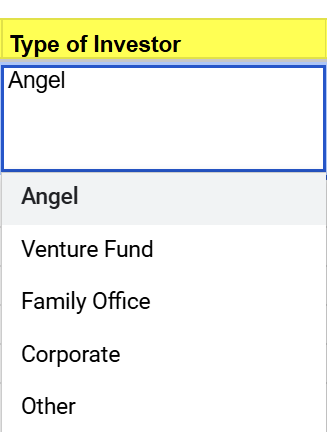
In the next column, label what type of investor they are (angel investor, venture fund, etc). This will help you tailor your messaging accordingly.
Referrer

The referrer is the person who introduced you to the investor listed in your CRM.
So if ABC sent an email to introduce me to an investor, ABC is the referrer in this example?
This is crucial because your team can see where your leads are coming from. Plus if the introduction is a mutually beneficial one, we get a chance to reach out to the referrer again to say thanks.
Add their names in the next column and let’s keep moving.
Stage

What stage are they at in terms of considering an investment in your company?
These stages can be customized to your situation… but for simplicity, let’s define the stages that most funds used during our fundraising process.
Lead – When someone offers to refer somebody new to you but you haven’t made contact yet.
First Contact – This stage is the first time you both have been able to officially engage. Someone might have sent an email introduction and they may have reciprocated back saying, “Yes, let’s meet!”
First Pitch – This is the first meeting you have with them to pitch your company.
Due Diligence – This comes after the pitch when they’re considering investing. It’s normal for investors to ask to see more materials to help them make a decision.
Soft Commit – This is when they are interested in investing and have given you a dollar amount they want to put towards your company. This is purely a verbal commitment, nothing official, but a positive sign to move them into the next stage.
Signed – This is when the confetti drops from the ceiling because you have received a full commitment from this investor. Whooot!!! 🎊
Rejected and Ghosted – These are the stages where they reject your pitch or never return your messages. But remember, it’s not over yet. There’s still an opportunity to maintain the relationship or even invite them to your biweekly/monthly investors update. They may convert into investors down the road.
Committed

If they have given you a verbal commitment of a certain amount they want to invest, include this number in the Committed column.
Above, you can see three investors committing a combined total of $300,000 as an example.
Notes

The Notes section is the most critical part of the CRM.
It summarizes what you talked about during your calls or emails. Add as many notes as you can along with the dates of each interaction.
These notes are crucial because fundraising is a team sport.
Tracking everything helps your team understand the context of the relationship. So when they interact with this person, they know where each investor is in the process, and can pick up right where their teammate left off.
Closed and Next Contact

Next, we have a Closed column to show how much money you have closed.
This is your time to celebrate your hard work being paid off. Launch the confetti. Take out a bottle of champagne. You deserve it.
Ok, time to get back to work. The last part of the CRM is the Next Contact column. This is a reminder for yourself on when you should reach out to this person again.
So if you’re still in the due diligence or soft commit phases, set a clear date here on when you should follow up.
If people have committed, we recommend getting aggressive and following up every two or three days. This shows that you’re committed to making this work and are certain you have given them all the materials they need to feel unblocked on making a decision.
For the people who have rejected or ghosted you, you should keep reaching out.
Remember a rejection is never truly a rejection until you get a hard “no”.
So your investor CRM is a critical tool for successful fundraising.
All your contacts are in one place with detailed information
All the interactions your team has had with each person are tracked so everyone is on the same page
It tracks where everyone is in the fundraising process and gives reminders on when to follow up.
Start your investor CRM as soon as possible. Like, now.
There are paid CRM tools out there to track opens and clicks on emails. But to keep things simple, we recommend starting with a basic spreadsheet.
Here’s a template you can use for your fundraising journey.
Also, if you are looking for a verified investor contact database, fundraising guide & cap table guide, check out here to access all resources.
📃 QUICK DIVES
Why do VCs care so much about who’s leading your round?
This is one of the most annoying questions founders hear on a pitch: “Who else is investing?”
It often feels like code for “I’ll decide after someone smarter goes first.” But the data suggests it’s not just lazy signalling, it’s structural.
This insight comes from Peter Walker (Head of Insights at Carta), based on Carta data covering 13,000+ Seed and Series A rounds (2019–2025).
Here’s what’s actually happening beneath the surface.

Over the last few years, lead investors have been taking a bigger share of rounds, while the number of funds willing to lead has gone down.
In many recent Seed and Series A rounds, the lead is now taking 60–75%+ of the entire round, compared to ~50–55% a few years ago. At the same time, more funds are participating just not leading.
That changes incentives.
For a non-lead investor writing a smaller check, the identity of the lead suddenly matters a lot more. They’re implicitly underwriting the lead’s conviction, judgment, and future behaviour.
A few practical realities behind that question:
If one fund owns most of the round, they effectively control the outcome
Their ability (or willingness) to lead the next round becomes critical
If they don’t follow on, it sends a strong negative signal to future investors
Their domain expertise (or lack of it) affects how helpful they’ll be post-check
From the founder side, this explains why strong leads still unlock momentum, even in markets where VCs claim to be “independent thinkers.” The first check is still celebrated, but the right first check matters more than ever.
The real takeaway for founders isn’t “optimise for name-brand VCs.” It’s this:
Be deliberate about who you let lead
Understand how much of the round they’re taking ownership shapes power
Anticipate follow-on questions and signaling effects early
Realize that today’s market structurally favors fewer, more dominant leads
So yes, some investors ask this question for the wrong reasons. But in a world where leads increasingly own the round, “who’s leading?” is no longer a soft question it’s a risk question.
That’s the shift founders need to internalise.
SEO isn’t dead; founders are just misreading the data.
For the last two years, the loudest narrative in marketing has been simple: LLMs are killing search.
ChatGPT crosses 800M+ weekly users. AI Overviews show up in Google, and HubSpot traffic drops. Cue the panic.
But a new large-scale analysis from Graphite tells a much less dramatic story, and it’s one that founders should pay attention to.
The headline? Organic traffic isn’t collapsing. It’s slightly down.
Here’s what the data actually says.
The big claim vs. the actual numbers
A lot of popular reports claim SEO traffic is down 25-60%.
Graphite analysed 40,000 of the largest US sites using panel data (not surveys). The result:

Organic search traffic is down -2.5% YoY
Google traffic is up +0.8% in 2025
Visitors to Google are flat to slightly up (+1.35% in Q4 2025 vs. 2024)
90% of Google clicks still go to organic, 10% to ads
That’s not a collapse. That’s stability with minor shifts.
The difference between -2.5% and -25% isn’t a rounding error. It’s a completely different strategic conclusion.
Why does everyone feel like SEO is dying
This is where it gets interesting.
Graphite argues that the “SEO is dead” narrative is driven by:
Small samples (19 sites ≠ on the internet)
Survey data (self-reported usage is unreliable)
Anecdotes from tech-heavy circles
Availability bias (“Everyone I know uses ChatGPT”)
If you’re in a VC/Twitter/AI-native bubble, your perception of behaviour is massively skewed.
Your friends may use ChatGPT instead of Google. The US population at scale? Not nearly as much.
Founders need to separate perception shifts from market shifts.
What about AI Overviews killing clicks?
Yes, AI Overviews reduce CTR by ~35%.
But two important caveats:
They appear ~30% of the time (not 50%)
They mostly affect informational queries
80% of those SERPs previously had Featured Snippets, which already reduced CTR
So this isn’t a brand-new phenomenon. It’s an evolution of Google’s zero-click behaviour, not a total rewrite.
And crucially: High-intent commercial queries are largely unaffected.
If your business depends on informational blog traffic with no monetization layer, yes you’re more exposed.
If you rank for buying keywords, the impact is smaller than the headlines suggest.
The real pattern hiding in the data
The biggest decline wasn’t universal.
The top 10 sites increased traffic (+1.6%)

Many small sites increased
The decline was concentrated in mid-sized sites (top 100–10,000)

That’s a competitive compression, not an extinction event.
In other words, Strong brands and large authority sites are fine. Weak middle-tier content sites are feeling pressure.

That’s not AI destroying search. That’s consolidation.
The mistake founders are making
The wrong conclusion: “SEO is dead, stop investing in search.”
The smarter conclusion: “Low-quality, undifferentiated SEO is dying.”
Search behaviour isn’t disappearing. It’s fragmenting.
Some discovery is shifting to LLMs
Some informational clicks are declining
Commercial search intent remains strong
Organic still dominates ads 9:1
If anything, the bar is rising. Overall -
Prioritise commercial intent: AI Overviews hit informational queries harder. Transactional keywords remain resilient.
Build defensible authority: The top players are gaining share. Weak, middle-tier sites are losing it.
Diversify distribution: Yes, LLM optimisation matters. But it complements search, it doesn’t replace it (yet).
Watch your own data: Large-scale panel data matters more than anecdotes. Look at your GSC trends before reacting.
TODAY’S JOB OPPORTUNITIES
💼 Venture Capital & Startup Jobs
Most aspiring VCs struggle with interviews, unclear expectations, no structured prep, and generic advice that doesn’t actually help. So we partnered with a leading investor group to build an all-in-one VC Interview Preparation Guide that gives you real clarity and frameworks. (Access Here)
Venture Partner - Erez Capital | USA - Apply Here
Platform Lead - Co Ventures | Australia - Apply Here
Analyst - Llama Venture | USA - Apply Here
Associatie - Root Venture | USA - Apply Here
Director - NICE | USA - Apply Here
Partner 16 - a16z | USA - Apply Here
Investor Relations - SC Founders Fund | India - Apply Here
VC Analyst - Alstin Capital | Germany - Apply Here
Analyst - Infrastructure & Real Assets - Stepstone Group | Australia - Apply Here
Social Media Freelancer - Initialised Capital | USA - Apply Here
Analyst / Associate - Saints Capital | USA - Apply Here
Investment Analyst Intern - NAV Capital | Dubai - Apply Here
PE & VC Partner Manager - Dealhub | UK - Apply Here
VC Platform & Events Manager - 1001 VC | USA - Apply Here
MBA Venture Capital Intern - Cerity Partners | USA - Apply Here
🤝 Partnership With Us
Get your product in front of over 95,000+ audience - Our newsletter is read by thousands of tech professionals, founders, investors and managers worldwide. Get in touch today.
🔴 Share Venture Curator
You currently have 0 referrals, only 5 away from receiving a 🎁 gift that includes 20 different investors’ contact database lists - Venture Curator