


👋 Hey, Sahil here — Welcome back to Venture Curator, where we explore how top investors think, how real founders build, and the strategies shaping tomorrow’s companies.
How to Build an Investor CRM (With a Template).
Why 95% of Enterprise AI Investments Fail (And What the Successful 5% Do Differently).
The Four Product Discovery Models: Where Your Company Really Operates.
FROM OUR PARTNER - SUPERPOWER
🔥 A new way to take control of your health — with Superpower
You’ve never had a health check like this. Venture Daily Digest has partnered with Superpower to give you access to advanced health testing that goes 5x deeper than a routine check-up.

Every Superpower membership begins with a simple blood draw that tests 100+ biomarkers to detect early signs of 1,000+ conditions.
This is just the beginning of your health journey.
VENTURE CURATORS’ FINDING
📬 My Favourite Finds
Media Posts:
Investor Data Room Superpack: Everything you need to build a VC-ready data room (Guide/Templates) (Link)
6 uncommon pitch mistakes made by founders (Link)
Kevin Benoit on the biggest mistake founders make in the 1st meeting (Link)
Natia Kurdadze shares solutions to common startup problems (Link)
Hubert Thieblot on the founder trap (Link)
Startup Legal Document Pack – Essential Legal Docs for Founders. (Link)
Reports/Articles:
The tech debt elephant: A product perspective. (Link)
Agile brand strategy: how to build emotional relevance efficiently. (Link)
AI bubbles to unicorns, European late-stage markets in fantasy land? (Link)
The moat of the search index. (Link)
Why does every AI coding tool get pricing wrong? (Link)
🤝 PARTNERSHIP WITH US
Get your product in front of over 103,000+ audience - Our newsletter is read by thousands of tech professionals, founders, investors and managers worldwide. Get in touch today.
📜 DEEP DIVE
How to Build an Investor CRM (With a Template).
Our controversial take: A great fundraising process is only 20% about pitching. The other 80% is all about organisation.
Yep, you heard that right.
Your pitch, the thing you’ve spent weeks refining and rehearsing, is only a small part of successful fundraising.
“What the heck do y’all mean by the organisation?” - you, probably
If you’re talking to dozens (or even hundreds) of investors, keeping track of who they are, what stage they’re at, and what you last discussed is impossible to do from memory. That’s where an investor CRM (Customer Relationship Management) system comes in.
Some founders use tools like HubSpot, Salesforce, or Pipedrive, but you don’t need fancy software. A simple Google Sheet can do the job. What matters is that it helps you track key details, follow-ups, and next steps, so no potential investor falls through the cracks.
Walking through an investor CRM

This spreadsheet may look like a lot at first. But a CRM is way simpler than you might think.
Basic contact info

To kick things off, add the names and email addresses of the investors that you already know.
Then add the names and email addresses of prospective investors that you would like to build stronger relationships with.
Type of Investor
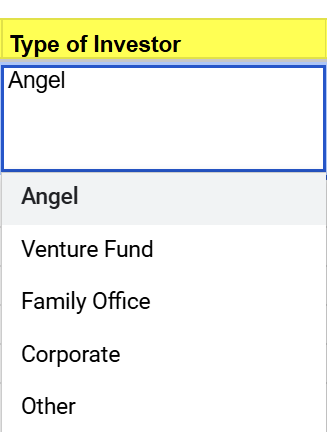
In the next column, label what type of investor they are (angel investor, venture fund, etc). This will help you tailor your messaging accordingly.
Referrer

The referrer is the person who introduced you to the investor listed in your CRM.
So if ABC sent an email to introduce me to an investor, ABC is the referrer in this example?
This is crucial because your team can see where your leads are coming from. Plus if the introduction is a mutually beneficial one, we get a chance to reach out to the referrer again to say thanks.
Add their names in the next column and let’s keep moving.
Stage

What stage are they at in terms of considering an investment in your company?
These stages can be customized to your situation… but for simplicity, let’s define the stages that most funds used during our fundraising process.
Lead – When someone offers to refer somebody new to you but you haven’t made contact yet.
First Contact – This stage is the first time you both have been able to officially engage. Someone might have sent an email introduction and they may have reciprocated back saying, “Yes, let’s meet!”
First Pitch – This is the first meeting you have with them to pitch your company.
Due Diligence – This comes after the pitch when they’re considering investing. It’s normal for investors to ask to see more materials to help them make a decision.
Soft Commit – This is when they are interested in investing and have given you a dollar amount they want to put towards your company. This is purely a verbal commitment, nothing official, but a positive sign to move them into the next stage.
Signed – This is when the confetti drops from the ceiling because you have received a full commitment from this investor. Whooot!!! 🎊
Rejected and Ghosted – These are the stages where they reject your pitch or never return your messages. But remember, it’s not over yet. There’s still an opportunity to maintain the relationship or even invite them to your biweekly/monthly investors update. They may convert into investors down the road.
Committed

If they have given you a verbal commitment of a certain amount they want to invest, include this number in the Committed column.
Above, you can see three investors committing a combined total of $300,000 as an example.
Notes

The Notes section is the most critical part of the CRM.
It summarizes what you talked about during your calls or emails. Add as many notes as you can along with the dates of each interaction.
These notes are crucial because fundraising is a team sport.
Tracking everything helps your team understand the context of the relationship. So when they interact with this person, they know where each investor is in the process, and can pick up right where their teammate left off.
Closed and Next Contact

Next, we have a Closed column to show how much money you have closed.
This is your time to celebrate your hard work being paid off. Launch the confetti. Take out a bottle of champagne. You deserve it.
Ok, time to get back to work. The last part of the CRM is a Next Contact column. This is a reminder for yourself on when you should reach out to this person again.
So if you’re still in the due diligence or soft commit phases, set a clear date here on when you should follow up.
If people have committed, we recommend getting aggressive and following up every two or three days. This shows that you’re committed to making this work and are certain you have given them all the materials they need to feel unblocked on making a decision.
For the people who have rejected or ghosted you, you should keep reaching out.
Remember a rejection is never truly a rejection until you get a hard “no”.
So your investor CRM is a critical tool for successful fundraising.
All your contacts are in one place with detailed information
All the interactions your team has had with each person are tracked so everyone is on the same page
It tracks where everyone is in the fundraising process and gives reminders on when to follow up.
Start your investor CRM as soon as possible. Like, now.
There are paid CRM tools out there to track opens and clicks on emails. But to keep things simple, we recommend starting with a basic spreadsheet.
Here’s a template you can use for your fundraising journey.
Also, if you are looking for a verified investor contact database, fundraising guide & cap table guide, check out here to access all resources.
📃 QUICK DIVES
Why 95% of Enterprise AI Investments Fail (And What the Successful 5% Do Differently).
Most companies spent the last two years racing to “add AI.” The result? A staggering 95% of enterprise GenAI investments have produced zero measurable business impact. Not because the models are weak, but because the organisation wasn’t ready for AI to actually do real work.
Meanwhile, the successful 5% didn’t “deploy tools.” They rebuilt workflows, re-architected their business around AI, and shifted from prompt-based tools to agentic systems that execute work autonomously.

Here’s the real story behind the divide (shared by Sudeep Teki) and what every founder, operator, and leader must understand.
The Real Culprit: The “Learning Gap”
Most enterprise tools break down because they don’t learn, adapt, or fit into the messy reality of daily operations. Employees try them once, hit friction, and never return.
Common failure patterns include:

Weak or absent C-suite ownership
AI as an “IT experiment” rather than a business transformation
No clear financial objective or ROI target
Siloed teams building solutions no one uses
Poor data quality and weak infrastructure
This is why 95% of pilots never reach production. Not because the model is bad—but because the organisation isn’t ready.
Inside the Shadow AI Economy
While enterprise systems fail, employees quietly solve their own problems. Nearly 90% use personal AI tools like ChatGPT for work but hide it from IT.
Why this matters:
Employees are already extracting value from AI
Leaders underestimate usage by 3–4×
The shadow usage reveals the exact workflows where AI is most needed
Companies ignore this at their own cost
This “hidden productivity” is a roadmap for where enterprise AI would succeed—if deployed correctly.
Why Only Tech & Media See Real Transformation
Two industries, tech and media, are capturing most of GenAI’s economic value because their output is inherently digital: code, content, text, assets.
For everyone else, value requires a shift in mindset:
Manufacturing must treat processes as information flows
Healthcare must structure records for agentic decision-making
Banks must re-architect compliance and risk workflows
It’s not the industry that limits AI impact—it’s the willingness to redesign processes.
What the Successful 5% Do Differently
Companies that cross the GenAI Divide share a similar pattern: they don’t implement AI, they rebuild around it.
They succeed because:
The CEO, not IT, owns the transformation
Workflows are redesigned end-to-end
AI is tied directly to financial outcomes
Business + engineering operate as one team
Typical results include:
35,000+ annual work hours saved
Multi-hour workflows reduced to minutes
Millions unlocked in labour efficiency or revenue lift
They don’t chase “cool demos.” They fix specific bottlenecks that matter to the P&L.
The Rise of Agentic AI
The biggest shift underway is moving from passive tools to autonomous agents.
Agents don’t wait for prompts—they:
Understand context
Break down tasks
Use tools and APIs
Collaborate with other agents
Learn from mistakes
This is how companies automate entire workflows, not isolated tasks.
Instead of asking an LLM, “Write this email,” leaders now ask agents: “Manage the full onboarding workflow.”
Emails, CRM updates, scheduling, and documentation, fully handled.
Why Small Language Models (SLMs) Are Winning
The future of enterprise AI isn’t one giant model; it’s many specialised ones.
SLMs win because they are:
10–30× cheaper to run
Easier to fine-tune
Faster, more predictable, and more secure
Perfect for task-specific agents
Deployable on-prem or at the edge
A swarm of SLM-powered agents beats a single mega-LLM for most enterprise workloads.
Why Scaling Fails: The Pilot-to-Production Chasm
Even when pilots succeed, scale collapses without:
Strong data governance
MLOps infrastructure
Cross-functional teams
Change management
Clear accountability
Technology alone doesn’t scale. Organisations do.
The 12–18 Month Window: Architectural Choices That Lock You In
MIT highlights an urgent reality: Enterprises have 12–18 months to choose the foundations of their AI stack.
The wrong decision leads to:
Costly vendor lock-in
Inflexible architecture
Slow adoption of new agent standards
Leaders now evaluate vendors not on demos, but on interoperability, transparency, and agent readiness.
The Agentic Web: The Next Internet
A new layer of the internet is forming where agents communicate and collaborate.
Key emerging standards include:
MCP (Model Context Protocol): teaches agents how to use tools
A2A Protocol: universal agent-to-agent communication
NANDA Framework: identity, discovery, trust, reputation for agents
This will change how software is built, used, and composed.
How Leaders Should Cross the GenAI Divide
The path forward is clear:
Set a bold AI North Star Not “use AI,” but “reinvent how we create value.”
Target one workflow and completely redesign it Start small, but go deep.
Bring shadow AI into the open Your employees have already identified what works.
Build cross-functional AI pods Business + engineering + design + ops.
Invest in process data This becomes your most valuable, defensible moat.
The GenAI Divide isn’t a technology problem—it’s a leadership and operating model problem. Companies that move decisively will define the next decade. Those who hesitate will stay stuck in pilot purgatory.
The winners will be the ones who embrace agents, adopt SLMs, redesign workflows, and act fast in this narrowing 18-month window.
The Four Product Discovery Models: Where Your Company Really Operates.
Every company is “doing product discovery” (to understand customer needs and validate that a product idea solves a real problem before building it), but most fall into it accidentally. Some default to founder-driven decisions, others rely too heavily on bottom-up creativity, and many jump between the two without real structure.
Itamar Gilad’s 2×2 gives a simple but powerful way to understand what model you are using today, what’s going wrong, and what model you should aim for.

The grid is based on two axes:
Centralised vs. Empowered → Who makes decisions?
Opinion-based vs. Evidence-guided → How are decisions made?
From these, four discovery models emerge.
1. Centralized + Opinion-Based: Command-and-Control
This is the default model for early startups and many traditional companies.
Leaders define the roadmap based on intuition, experience, or personal taste. Teams execute. Everything flows top-down.
Why companies adopt it:
Clear ownership
Fast decisions
Feels safe and predictable
But real-world drawbacks appear quickly:
Founders become bottlenecks
Teams stop thinking and wait for orders
Many decisions are made with limited context
Innovation slows and morale drops
This model works only when the company is small, and the founder has the best insight. It collapses as complexity grows.
2. Empowered + Opinion-Based: Creative Chaos
This model celebrates bottom-up creativity. Teams propose and build ideas freely, with minimal approval.
Examples include early Google with 20% projects, hackathons, and side-project cultures. Gmail and Slack both came from this energy.
What works well:
Very high creativity
New ideas emerge organically
Engineers and designers feel ownership
What breaks down:
No strategic coherence
Too many experiments, not enough validation
Massive waste of time and resources
Teams often drift away from company goals
This model only works when the company has exceptional talent density and can afford the inefficiency. Most companies cannot.
3. Centralised + Evidence-Guided: Benevolent Dictatorships
This model mixes strong top-down leadership with a real commitment to data, testing, and being proven wrong.
Steve Jobs is often misunderstood here. While he had strong opinions, he changed his mind often when evidence was shown. Many iconic Apple features started bottom-up and were accepted only after experiments validated them.
Why companies use this:
Vision + experimentation feels powerful
Leaders stay close to critical decisions
Good for big, high-risk bets
Limitations:
Doesn’t scale beyond a few major initiatives
Dependent on unusually capable leaders
Still centralises too much power
Prone to “big vision failures” (e.g., Amazon Fire Phone, Meta Metaverse)
It works only when leadership is exceptional at both judgment and humility. Rare in the real world.
4. Empowered + Evidence-Guided: The Product Operating Model
This is the model used by high-performing product companies.
Leadership sets strategy and gives teams measurable goals. Teams then explore multiple solutions, test prototypes, gather evidence, and ship what actually works.
Key characteristics:
Ideas come both top-down and bottom-up
All ideas face the same validation process
Evidence, experiments, and user insight drive decisions
Teams own outcomes, not tasks
Leaders guide but do not micromanage
Why this model succeeds:
Bad ideas die fast
Winning ideas grow fast
Teams move faster with more clarity
Innovation compounds over time
Engineers feel connected to outcomes, not orders
Challenges to adopting it:
Requires a strong strategy and clear goals
Requires a cultural shift away from “I already know”
Needs research capability and analytics maturity
Requires trust and empowerment across all levels
Most companies start moving toward this model, but get stuck halfway. The breakthrough comes when evidence becomes the default and opinions only guide early hypotheses.
How to use this model as a founder
Step 1: Identify your quadrant
Ask yourself:
Does the leadership or I make most decisions?
Or do teams decide their own solutions?
Do we rely on gut and intuition?
Or do we rely on testing, evidence, and learning?
Most startups land in: Centralised + Opinion-Based, which works early but plateaus quickly.
Step 2: Define where you want to be
If you want speed, accuracy, innovation, and fewer bottlenecks, the goal is almost always: Empowered + Evidence-Guided
Step 3: Watch for the natural slide
If you do nothing, your company gradually moves toward Command-and-Control because:
founders get busier
approvals accumulate
evidence is hard, opinions are easy
teams fear making mistakes
Awareness of this drift is crucial.
Step 4: Diagnose common symptoms
The quadrant model helps interpret what’s happening inside your team:
If everything waits for you → Command-and-Control
If you have many ideas but little impact → Creative Chaos
If you test ideas but leadership decides everything → Benevolent Dictator
If teams run experiments and ship validated outcomes → Product Operating Model
Step 5 : Use it as a roadmap
Startups typically move like this: Command-and-Control → Benevolent Dictatorship → Product Operating Model
Few companies get to the last stage without intentional investment in culture, discovery, research, and clear strategy.
So there’s no perfect model for every stage, but for any company that wants to scale without burning out founders or killing innovation, the Product Operating Model (Empowered + Evidence-Guided) is the only sustainable path.
TODAY’S JOB OPPORTUNITIES
💼 Venture Capital & Startup Jobs
All-In-One VC Interview Preparation Guide: With a leading investor group, we have created an all-in-one VC interview preparation guide for aspiring VCs. Don’t miss this. (Access Here)
Senior Principal - Newsbreak Venture | USA - Apply Here
Head of Investor Relations - Sagest Capital | Singapore - Apply Here
Investment Analyst - Cornell University | USA - Apply Here
Accountant - AI Fund | USA - Apply Here
Associate - Venture Capital - Artha Venture Fund | India - Apply Here
VP of Fundraising - Scale Asia Venture | Japan - Apply Here
Investment Intern - Nexea | USA - Apply Here
Head of Atlassian Ventures - Atlassian Venture | USA - Apply Here
Program & Events Manager - Plug and Play Tech Centre | USA - Apply Here
Associate - Allocator One | UK - Apply Here
Chief of Staff – DeVC - Z47 | India - Apply Here
VC Investment Intern - First Momentum Venture | USA - Apply Here
Portfolio Management Lead - Yzi Labs | Remote - Apply Here
Office Manager - Seedcamp | USA - Apply Here
🤝 Partnership With Us
Get your product in front of over 95,000+ audience - Our newsletter is read by thousands of tech professionals, founders, investors and managers worldwide. Get in touch today.
🔴 Share Venture Curator
You currently have 0 referrals, only 5 away from receiving a 🎁 gift that includes 20 different investors’ contact database lists - Venture Curator