


👋 Hey, Sahil here — Welcome back to Venture Curator, where we explore how top investors think, how real founders build, and the strategies shaping tomorrow’s companies.
How to do user research without users: the synthetic user guide.
What 1,000 ChatGPT enterprise customers tell us about enterprise AI adoption in 2025.
Unicorns are back: what founders must understand right now.
FROM OUR PARTNER - ROCKET
🤝 Why Rocket.new’s Precision Mode is the AI Builder We’ve Been Waiting For

We’ve tested every major AI builder. They all share the same fundamental flaw: they make you adapt to AI instead of AI adapting to you.
You learn prompt engineering. You write carefully. You retry constantly. You debug AI mistakes. That’s not building. That’s negotiating.
Rocket’s Precision Mode eliminates this entirely. Over 100 structured commands that execute exactly what you specify. “Fix mobile layout” repairs responsive issues. “Add Stripe integration” builds payment flows. “Optimise images” compresses and converts. “Update pricing table” modifies content.
No interpretation. No guessing. No retries. Just precise execution. This is what professional AI building looks like.
Try Precision Mode at rocket.new →
VENTURE CURATORS’ FINDING
📬 My Favourite Finds
Media Posts:
Startup legal document pack – essential legal Docs for founders. (Link)
Themes from my recent week in Silicon Valley. (Link)
There is some correlation between “hot” deals and whether they raised a Series A, however. (Link)
Excel template: early-stage startup financial model for fundraising. (Link)
The therapist model of seed VC: analyse, diagnose, then fund. (Link)
Reports/Articles:
Why startups fail due to Co-Founder conflict and how to fix it. (Link)
State of the VC market from LP summit. (Link)
Why competition is so bitter in SaaS: oligopolies and dominant strategy equilibria. (Link)
AI agent market map 2025. (Link)
Designers should look to Demis Hassabis. Not Jony Ive.(Link)
AI now creates more articles than humans. (Link)
Bitter lessons building AI products. (Link)
🤝 PARTNERSHIP WITH US
Get your product in front of over 95,000+ audience - Our newsletter is read by thousands of tech professionals, founders, investors and managers worldwide. Get in touch today.
📜 DEEP DIVE
How to do user research without users: the synthetic user guide.
When you’re building an MVP or raising your first round, you usually don’t have the luxury of long research cycles or access to dozens of users. But you still need clarity: Who exactly are you building for? What do they care about? How do they behave?
This is where AI-generated personas become incredibly useful.
Instead of spending weeks interviewing users, tools like ChatGPT can create realistic, behaviour-driven personas based on your ideal customer profile. These aren’t just demographic sketches; they simulate a user’s motivations, fears, habits, workflows, and buying triggers.
Researchers even point out that generative AI can speed up persona creation without sacrificing user-centred thinking, helping teams align faster and make sharper product decisions early on.
Of course, AI personas don’t replace real users. But for founders moving fast, they’re a powerful way to:
pressure-test product ideas
refine messaging
uncover blind spots
and build team alignment around one clear customer archetype.
Crafting personas with ChatGPT (Prompt Templates)
ChatGPT can generate rich, realistic personas from just a few inputs, but the quality depends on what you ask for. The goal is not to create a demographic sketch; it’s to capture the user’s goals, motivations, behaviours, frustrations, and decision triggers.
That’s the information that actually guides product and UX decisions.
A simple rule: Demographics tell you who they are. Motivations tell you what they’ll do.
Core Prompt Template (Generate Persona)
You can start with a structure like this:
Create a detailed user persona for [ROLE or user segment] of our
[PRODUCT/SERVICE]. Include their background, goals, motivations, and main pain points or frustrations related to [problem domain].

Focus on how and why they would use the product.
This forces the AI to go beyond surface-level traits and gives you a persona you can actually design for.
For example, if you ask for a “Marketing Manager who struggles with data privacy in finance apps,” ChatGPT will produce a persona with:
job context
daily tasks
goals
fears and blockers
Why this problem matters to them
How they evaluate tools or switch products
These are the elements that matter, not their age or whether they drink cold brew.
Add more detail when needed
You can refine the persona by adding parameters like:
industry
team size
technical comfort
typical workflow
Tools they already use
Or by asking follow-ups like:
“What daily frustrations does this user face?”
“Describe their typical workflow from morning to evening.”
“What alternatives are they currently using and why?”
This iteration turns a basic persona into an actionable one.
Another example prompt
Create a persona for a Sales Business Development Representative using a CRM app. Frame the persona around their goals, motivations, and behaviors. Include their main pain points and how they currently use similar tools.

Do not list demographic information unless it directly shapes their decisions.
This approach mirrors how modern UX teams work: personas built around roles, tasks, context, and decision drivers, not superficial details.
The goal: an actionable persona
A good persona should help you answer:
What are they trying to get done?
What stops them from doing it?
What do they value in tools like yours?
When and how will they use your product?
If your persona clarifies these four things, you’ve got something you can design, build, and pitch around.
Simulate a user interview
Once you’ve built a persona, the next step is to talk to them or at least simulate the conversation. ChatGPT can role-play as your target user and answer questions the way a real person in that role might. This is one of the fastest ways to stress-test assumptions before you speak to actual users.
Set the stage with a role-play prompt
Start by telling ChatGPT exactly who it should become. Give it the persona’s name, context, and behaviours, then frame the interview scenario.
Example setup:
You are [NAME], a [brief persona description] who regularly uses [PRODUCT/CATEGORY]. I am a product manager interviewing you to understand your needs, experiences, and frustrations. Stay fully in character and respond as [NAME] would.Adding a couple of guidelines helps ChatGPT respond more realistically:
“You should role-play as a real user with clear goals, preferences, and frustrations.”
“You have experience with [competitor/product type] and will give honest feedback.”
This primes the model to think and speak like a real user rather than a generic chatbot.
Ask open-ended, conversational questions
From here, treat it like a real interview. Ask questions that encourage depth, not yes/no answers. For example:
“Can you walk me through how you currently handle [task]?”
“What’s the most frustrating part of that process?”
“What tools have you tried before, and why did you switch?”
“What would an ideal solution look like to you?”
Because ChatGPT stays in character, its responses feel like genuine user feedback, complete with emotions, reasoning, and tradeoffs.
Use ChatGPT to analyse the conversation
After the role-play, you can shift modes and ask:
“Summarise the key pain points from this interview.”
“List the top jobs-to-be-done for this persona.”
“Highlight the strongest buying triggers or objections.”
This gives you a quick synthesis that mirrors what you would produce after a real user interview.
Why this works
Simulated interviews won’t replace real conversations, but they help founders:
Catch flawed assumptions early
discover angles they hadn’t considered
refine messaging and feature priorities
prepare better questions for real users
In a fast MVP cycle, these simulations act like a rehearsal: low cost, fast feedback, and surprisingly insightful.
Get feedback on ideas & messaging
Once your persona is defined, you can use it as a filter to evaluate your product ideas, landing page copy, feature descriptions, or even early UX flows. This gives you fast, persona-aligned feedback before you test with real users.
Ask the persona to react to your concept
You can prompt ChatGPT to “think” like the persona and tell you how they would respond to your idea or messaging.
Example prompt:
Imagine you are [Persona Name]. Here is our product concept/messaging: [insert idea, copy, or landing page]. How would you react to this? What would you like, dislike, or find confusing? Stay in character and respond as [Persona Name] would.This usually surfaces:
unclear value props
jargon that doesn’t fit the persona
missing benefits
objections or concerns
It’s a quick way to see how your message lands with the user you’re designing for.
Ask for targeted improvements
You can also ask for focused, persona-driven suggestions:
“As a [Persona], what would you improve about this feature description?”
“What would make this onboarding flow easier for you?”
“What benefits matter most to you here?”
ChatGPT will respond from within the persona’s mindset, giving you feedback grounded in their motivations, frustrations, and decision-making style.
If something stands out, go deeper:
“Why would that bother you?”
“Can you explain what feels unclear?”
“What would you expect instead?”
This turns a basic reaction into rich insight, like a real user interview.
Role-play design or flow evaluations
You can even test specific moments in the experience:
“Describe how you would feel going through this signup process on your phone.”
“As this persona, what questions would you ask after hearing this feature pitch?”
“What part of this dashboard would be most confusing to you and why?”
These role-plays often reveal usability issues, emotional reactions, and missing clarity that founders typically catch only after shipping.
Your only rule: keep ChatGPT in character
Always remind the model:
“Please answer as [Persona Name] would.”
This keeps the feedback consistent, grounded, and aligned with the persona’s worldview.
Stress-test features or pricing
Personas aren’t just for interviews; you can use them to pressure-test your roadmap and pricing decisions. By putting the persona in buying mode, you can quickly see how they might evaluate tradeoffs, question pricing, or prioritise features.
Test reactions to a specific feature or price
Use a simple role-play setup to understand perceived value:
You are [Persona] (a [brief description]). We’re considering releasing Feature X at price $Y. What questions or concerns would you have? Would this feel worth the cost? Please answer as [Persona] would.This helps surface things like:
expectations around value
price sensitivity
missing benefits
objections before purchase
reasons they might hesitate or churn
It’s not about predicting real budgets, it’s about understanding how your ideal user thinks about value.
Compare priorities between features
You can also push the persona to evaluate tradeoffs:
Act as [Persona]. Which of these two feature sets matters more to you, and why: [Feature A] vs. [Feature B]?This forces ChatGPT to reason like the persona, revealing:
what they care about most
What feels “nice-to-have” vs. “must-have”
outcomes they prioritise
Features they would drop if pricing increases
What you learn
Since the model stays in character, you get insight into how this type of user might:
justify paying more
Reject pricing that feels misaligned
Request additional value
push back on complexity
choose between competing features
For example, the persona might say things like:
“I’d expect more automation before paying extra.”
“Feature Y feels unnecessary — I’d remove it if it increases the price.”
Use these reactions to validate or challenge your assumptions before locking in scope or pricing.
When to use synthetic personas vs. real interviews
AI personas are most helpful in the early stages, when you’re ideating, aligning the team, or quickly pressure-testing assumptions. They’re great for brainstorming (“How would our target user react to this?”), and they help teams rally around a shared picture of the user. They can also sharpen your real research: a synthetic interview often reveals what questions you should ask human users next.
But they’re not a replacement for real conversations. AI can summarise motivations, goals, and frustrations, but it often misses nuance and emotional depth. ChatGPT can predict reactions, it can’t replicate lived experience. Think of its output as hypotheses, not conclusions.
Put simply: Use AI personas as a practice run. Use real users to make real decisions.
As soon as you have a product concept or MVP, switch to actual interviews to validate what matters. The strongest approach is a blend: use ChatGPT to draft personas, explore ideas, rehearse interviews, then go out and talk to users and compare the insights.
Blending AI insights with real feedback
The strongest approach is a mix of AI-generated insights and real user data. For example, you can take interview transcripts or survey quotes and feed them into ChatGPT for fast synthesis.
Builders like Shavin from Buildspace have shown that giving ChatGPT raw customer quotes can instantly generate themes, job stories, and problem statements that normally take hours.

It’s a great way to accelerate analysis, as long as you double-check everything.
ChatGPT sometimes makes confident but incorrect conclusions, so always validate AI output against the source data. If the model suggests a new pain point, check whether it truly appeared in interviews.
A simple loop works well:
Draft a persona or interview script in ChatGPT.
Talk to a few real users and see what aligns or diverges.
Feed the real answers back into ChatGPT to extract themes or refine personas.
Update your product or messaging using both sources.
This lets you move fast while staying grounded. AI helps you explore and structure ideas; real users ensure accuracy and nuance.
Red flags: bias, hallucinations, overconfidence
Be cautious about where AI can go wrong. ChatGPT can hallucinate, inventing details, competitors, or statistics that sound real but aren’t. Research has documented this pattern, and it’s one of the top concerns with AI personas. It can also amplify bias, creating personas that feel overly polished or missing uncomfortable truths.
Avoid confirmation bias by using neutral prompts.
Don’t ask “Does this idea make sense?” Ask “What might be confusing or risky about this idea?” When accuracy matters, keep the temperature low to reduce randomness.
Most importantly, never act on AI-generated insights without evidence. If ChatGPT says, “Users would love Feature X,” ask: Do I have any proof? Cross-check with mentors, data, or real interviews. AI isn’t thinking, it’s predicting patterns, so you must stay critical.
Case examples from founders and teams
Many teams use AI personas to speed up early product work:
Fast persona creation. At Traders Eco, a PM used ChatGPT to generate detailed personas from a simple target audience description, helping her team quickly align on “who our user is.”
Rapid mockups and idea testing. Hootsuite’s GM, Partho Ghosh, shared that his team uses ChatGPT plus image tools to prototype landing pages and concepts quickly, allowing them to explore ideas without engineering time.
Accelerated feedback analysis. Canny’s co-founder Sarah uses ChatGPT to scan support conversations, surface feature requests, and group similar user messages — saving hours.

Another PM built a pipeline to cluster raw reviews and then used GPT to summarise each cluster’s pain points.
In all cases, founders emphasise the same point: AI made them faster, not smarter than real users. They still validate everything with actual conversations before committing to decisions.
So - AI personas and simulated interviews are powerful for early-stage founders: they help you ideate faster, stress-test ideas, and align your team before talking to real users. With clear prompts and careful iteration, ChatGPT becomes a valuable brainstorming partner not a replacement for user research.
Use it to explore possibilities, reveal blind spots, and draft hypotheses. Then go validate those hypotheses with real conversations. That combination is where AI actually shines: giving you speed without losing the human insight your product depends on.
📃 QUICK DIVES
What 1,000 ChatGPT enterprise customers tell us about enterprise AI adoption in 2025.
Henley Wing Chiu scraped every detectable ChatGPT Enterprise and Teams customer using Bloomberry’s real-time B2B purchase data. OpenAI claims explosive enterprise growth this year, but Henley’s analysis shows a more grounded picture of how AI is actually being adopted inside organisations.
Most large companies still aren’t using it. Only about 5 per cent of the Fortune 500 have adopted ChatGPT Enterprise.

Even companies that banned ChatGPT last year still haven’t reversed course. Apple, Amazon, JPMorgan, and Spotify, all remain absent. And none of the world’s ten largest tech companies appear as paying customers. Privacy fears, regulatory pressure, and internal AI strategies all slow adoption.
But where speed matters, adoption is much higher. Tech companies lead with 8.2 per cent penetration, followed by fast-moving fintechs at 6.6 per cent.
Startups use ChatGPT Enterprise twice as often as public companies because they don’t have procurement bottlenecks, political risk, or complex security reviews. They just move faster.
Here are the clearest patterns Henley found:

Tech + fintech industries lead adoption
Industrials, utilities, and energy barely use it
Startups are twice as likely to purchase as public companies
US companies adopt faster than the EU and Canada
Government adoption is nearly zero due to compliance and data laws

One unexpected insight: ChatGPT Enterprise usage is not reducing hiring. In fact, companies using it posted roughly the same number of new job openings as last year.

Non-customers saw a decline of about 7 per cent. If AI is replacing workers, it’s not showing up in hiring data yet.
Another counterintuitive trend: companies not using ChatGPT Enterprise are hiring AI talent much faster. They increased AI-related job postings by 120 percent. ChatGPT Enterprise customers only grew AI hiring by 27 per cent.
The cleaner explanation is that non-customers are building internal AI tools and need engineers. Customers are effectively outsourcing that layer to OpenAI instead of staffing those teams.
There are also signs that even slow, conservative industries aren’t ignoring AI entirely. Three of the Big Four accounting firms — PwC, KPMG, and EY — are already active ChatGPT Enterprise customers. Audit prep, tax analysis, policy reviews, and research-heavy workflows map perfectly to LLMs.
What it means for operators and founders:
ChatGPT Enterprise isn’t mainstream yet, but early adoption is accelerating
Startups and tech-first organisations are leading the curve
Slow-moving enterprises won’t switch until privacy, compliance, and data retention guardrails feel airtight
Companies choosing not to buy ChatGPT Enterprise often compensate by building internal AI stacks
AI isn’t eliminating jobs yet — but it’s reshaping where companies invest talent
Unicorns are back: what founders must understand right now.
Jason Lemkin shared new Crunchbase data showing something we haven’t seen in 3+ years: unicorn creation is accelerating again.
October 2025 alone added 20 new unicorns and $44.5B in value, the strongest month since early 2022. The energy founders are feeling isn’t imaginary. The market is reopening, but in a very specific way: capital is concentrating around AI-native winners, not spread across the ecosystem like 2021.
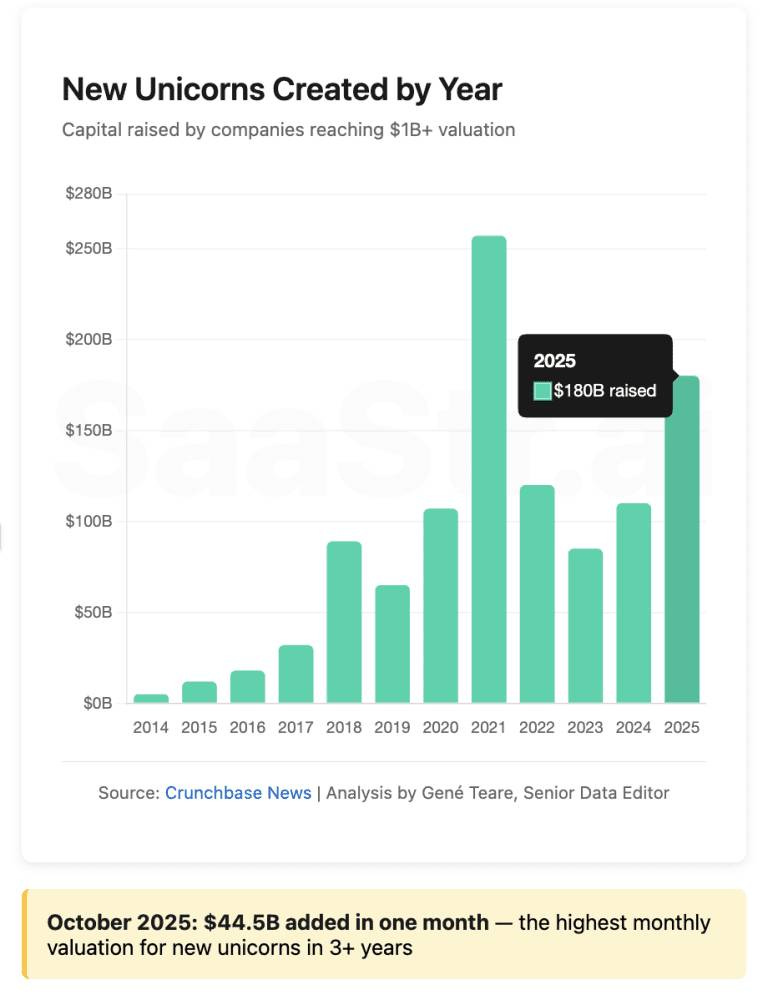
For B2B SaaS founders, the important part isn’t the unicorn count, it’s what the underlying pattern reveals.
The funding environment is stabilising. Not frothy, but functional. If you’re at $2M-$5M ARR, with strong net retention and sane CAC payback, there is money available again.

Investors are quietly re-engaging in growth rounds, particularly where the fundamentals appear solid.
AI-native companies are now in their own tier. VCs are no longer rewarding “AI features.” They’re rewarding AI as the operating system of the product. That means:
AI workflows that materially reduce costs
AI automations that replace old processes
AI capabilities that competitors cannot bolt on
If your product uses AI, you’re one of many. If your product is made possible because of AI, you’re in the group getting unicorn-level attention.
The bar is higher—far higher—but the upside is back. Twenty unicorns in a month sounds huge, but thousands of companies raised rounds in October. The conversion rate remains extremely low. That’s why this wave is different from the 2021 bubble: it’s not momentum-driven; it’s performance-driven.
Here’s what this means practically, if you’re building now:
You need unmistakable traction: prove your product works at scale
You need AI advantage, not AI flavour
You need efficiency, not burn-your-way-to-growth storytelling
You need to show defensibility, not just early adoption
Investors are rewarding companies that look durable, not just “hot.”
The next wave of unicorns is being formed right now. The market didn’t snap back; it healed enough for the best teams to break out again. If you’re building something real, this is the window. If you’re average, the market will ignore you.
The wave is here. Whether you catch it depends entirely on execution and whether your AI advantage is real, not cosmetic.
TODAY’S JOB OPPORTUNITIES
💼 Venture Capital & Startup Jobs
All-In-One VC Interview Preparation Guide: With a leading investor group, we have created an all-in-one VC interview preparation guide for aspiring VCs. Don’t miss this. (Access Here)
Head of Investor Relations - Fortuna Future Venture | Remote - Apply Here
Visiting Investment Analyst - Join Capital | USA - Apply Here
AI Tech Lead - Core Innovation Capital | USA - Apply Here
Investment Analyst - Caanan | USA - Apply Here
Investment Associate - Prologies Venture | India - Apply Here
VC Associate UK - Breega | UK - Apply Here
Analyst - Investments - Blackhill Fund | India - Apply Here
Venture Analyst - PSV | Hybrid - Apply Here
Senior Principal - Newsbreak Venture | USA - Apply Here
Investment Analyst - Cornell University | USA - Apply Here
Associate - Venture Capital - Artha Venture Fund | India - Apply Here
VP of Fundraising - Scale Asia Venture | Japan - Apply Here
Head of Atlassian Ventures - Atlassian Venture | USA - Apply Here
Associate - Allocator One | UK - Apply Here
🤝 Partnership With Us
Get your product in front of over 95,000+ audience - Our newsletter is read by thousands of tech professionals, founders, investors and managers worldwide. Get in touch today.
🔴 Share Venture Curator
You currently have 0 referrals, only 5 away from receiving a 🎁 gift that includes 20 different investors’ contact database lists - Venture Curator
https://engine40-demo.vercel.app/