


👋 Hey, Sahil here - Welcome back to Venture Curator, where we explore how top investors think, how real founders build, and the strategies shaping tomorrow’s companies.
How to do user research without users: the synthetic user guide.
The unit economics Excel sheet template every founder should use.
Is freemium right for your SaaS product? Ask these 3 questions.
Why do VCs care so much about who’s leading your round?
FROM OUR PARTNER - FRONTIER BIO
🧬 The end of animal testing? - Investors are backing this biotech building human tissues for testing and organ repair
Frontier Bio is developing engineered human tissues designed to replace unreliable animal testing and eventually enable lab-grown organs for transplant.

Today, ~90% of drugs that pass animal testing fail in human trials, while more than 100,000 patients in the U.S. are waiting for organ transplants. Frontier Bio is building human tissue models that help companies test therapies more accurately and advance regenerative medicine.
Why investors are paying attention:
$5.5M+ in cumulative sales
Partnered with Mayo Clinic, Stanford, and Intuitive Surgical
Scientific backing from Harvard geneticist Dr. George Church
Targeting markets including $2.1B tissue models and $15B vascular grafts
The company is already generating revenue from tissue models used in research while advancing toward implantable vascular grafts and future organ engineering.
As demand grows for more accurate therapeutics testing and new transplant solutions, Frontier Bio is positioning itself at the intersection of biotech, regenerative medicine, and drug discovery.
VENTURE CURATORS’ FINDING
📬 My Favourite Finds
Media Posts:
Every Startup accelerator you can apply to right now. (2026) (Link)
Startup legal document pack – essential legal Docs for founders. (Link)
I’ve spent over $1M on tech launches in the past year. Here’s everything I know. (Link)
Where a former OpenAI employee is working. (Link)
Developer productivity has surged over the past year, according to the FT. If your competitors aren’t shipping with Claude Code yet, they will be by Q2. (Link)
Great essay on the importance of being original in business. (Link)
Reports/Articles:
The end of fragmentation. (Link)
What do early-stage VCs look for? (Link)
Can you describe—exactly—the problem you’re solving? (Link)
Column: Jensen Huang doesn’t need a new chip. He needs a new moat. (Link)
Check out these 50 Claude Code tips and best practices for daily use. (Link)
🤝 PARTNERSHIP WITH US
Get your product in front of over 115,000+ audience - Our newsletter is read by thousands of tech professionals, founders, investors and managers worldwide. Get in touch today.
📜 DEEP DIVE
How to do user research without users: the synthetic user guide.
When you’re building an MVP or raising your first round, you usually don’t have the luxury of long research cycles or access to dozens of users. But you still need clarity: Who exactly are you building for? What do they care about? How do they behave?
This is where AI-generated personas become incredibly useful.
Instead of spending weeks interviewing users, tools like ChatGPT can create realistic, behaviour-driven personas based on your ideal customer profile. These aren’t just demographic sketches; they simulate a user’s motivations, fears, habits, workflows, and buying triggers.
Researchers even point out that generative AI can speed up persona creation without sacrificing user-centred thinking, helping teams align faster and make sharper product decisions early on.
Of course, AI personas don’t replace real users. But for founders moving fast, they’re a powerful way to:
pressure-test product ideas
refine messaging
uncover blind spots
and build team alignment around one clear customer archetype.
Crafting personas with ChatGPT (Prompt Templates)
ChatGPT can generate rich, realistic personas from just a few inputs, but the quality depends on what you ask for. The goal is not to create a demographic sketch; it’s to capture the user’s goals, motivations, behaviours, frustrations, and decision triggers.
That’s the information that actually guides product and UX decisions.
A simple rule: Demographics tell you who they are. Motivations tell you what they’ll do.
Core Prompt Template (Generate Persona)
You can start with a structure like this:
Create a detailed user persona for [ROLE or user segment] of our
[PRODUCT/SERVICE]. Include their background, goals, motivations, and main pain points or frustrations related to [problem domain].

Focus on how and why they would use the product.
This forces the AI to go beyond surface-level traits and gives you a persona you can actually design for.
For example, if you ask for a “Marketing Manager who struggles with data privacy in finance apps,” ChatGPT will produce a persona with:
job context
daily tasks
goals
fears and blockers
Why this problem matters to them
How do they evaluate tools or switch products
These are the elements that matter, not their age or whether they drink cold brew.
Add more detail when needed
You can refine the persona by adding parameters like:
industry
team size
technical comfort
typical workflow
Tools they already use
Or by asking follow-ups like:
“What daily frustrations does this user face?”
“Describe their typical workflow from morning to evening.”
“What alternatives are they currently using and why?”
This iteration turns a basic persona into an actionable one.
Another example prompt
Create a persona for a Sales Business Development Representative using a CRM app. Frame the persona around their goals, motivations, and behaviors. Include their main pain points and how they currently use similar tools.

Do not list demographic information unless it directly shapes their decisions.
This approach mirrors how modern UX teams work: personas built around roles, tasks, context, and decision drivers, not superficial details.
The goal: an actionable persona
A good persona should help you answer:
What are they trying to get done?
What stops them from doing it?
What do they value in tools like yours?
When and how will they use your product?
If your persona clarifies these four things, you’ve got something you can design, build, and pitch around.
Simulate a user interview
Once you’ve built a persona, the next step is to talk to them or at least simulate the conversation. ChatGPT can role-play as your target user and answer questions the way a real person in that role might. This is one of the fastest ways to stress-test assumptions before you speak to actual users.
Set the stage with a role-play prompt
Start by telling ChatGPT exactly who it should become. Give it the persona’s name, context, and behaviours, then frame the interview scenario.
Example setup:
You are [NAME], a [brief persona description] who regularly uses [PRODUCT/CATEGORY]. I am a product manager interviewing you to understand your needs, experiences, and frustrations. Stay fully in character and respond as [NAME] would.Adding a couple of guidelines helps ChatGPT respond more realistically:
“You should role-play as a real user with clear goals, preferences, and frustrations.”
“You have experience with [competitor/product type] and will give honest feedback.”
This primes the model to think and speak like a real user rather than a generic chatbot.
Ask open-ended, conversational questions
From here, treat it like a real interview. Ask questions that encourage depth, not yes/no answers. For example:
“Can you walk me through how you currently handle [task]?”
“What’s the most frustrating part of that process?”
“What tools have you tried before, and why did you switch?”
“What would an ideal solution look like to you?”
Because ChatGPT stays in character, its responses feel like genuine user feedback, complete with emotions, reasoning, and tradeoffs.
Use ChatGPT to analyse the conversation
After the role-play, you can shift modes and ask:
“Summarise the key pain points from this interview.”
“List the top jobs-to-be-done for this persona.”
“Highlight the strongest buying triggers or objections.”
This gives you a quick synthesis that mirrors what you would produce after a real user interview.
Why this works
Simulated interviews won’t replace real conversations, but they help founders:
Catch flawed assumptions early
discover angles they hadn’t considered
refine messaging and feature priorities
prepare better questions for real users
In a fast MVP cycle, these simulations act like a rehearsal: low cost, fast feedback, and surprisingly insightful.
Get feedback on ideas & messaging
Once your persona is defined, you can use it as a filter to evaluate your product ideas, landing page copy, feature descriptions, or even early UX flows. This gives you fast, persona-aligned feedback before you test with real users.
Ask the persona to react to your concept
You can prompt ChatGPT to “think” like the persona and tell you how they would respond to your idea or messaging.
Example prompt:
Imagine you are [Persona Name]. Here is our product concept/messaging: [insert idea, copy, or landing page]. How would you react to this? What would you like, dislike, or find confusing? Stay in character and respond as [Persona Name] would.This usually surfaces:
unclear value props
jargon that doesn’t fit the persona
missing benefits
objections or concerns
It’s a quick way to see how your message lands with the user you’re designing for.
Ask for targeted improvements
You can also ask for focused, persona-driven suggestions:
“As a [Persona], what would you improve about this feature description?”
“What would make this onboarding flow easier for you?”
“What benefits matter most to you here?”
ChatGPT will respond from within the persona’s mindset, giving you feedback grounded in their motivations, frustrations, and decision-making style.
If something stands out, go deeper:
“Why would that bother you?”
“Can you explain what feels unclear?”
“What would you expect instead?”
This turns a basic reaction into rich insight, like a real user interview.
Role-play design or flow evaluations
You can even test specific moments in the experience:
“Describe how you would feel going through this signup process on your phone.”
“As this persona, what questions would you ask after hearing this feature pitch?”
“What part of this dashboard would be most confusing to you and why?”
These role-plays often reveal usability issues, emotional reactions, and missing clarity that founders typically catch only after shipping.
Your only rule: keep ChatGPT in character
Always remind the model:
“Please answer as [Persona Name] would.”
This keeps the feedback consistent, grounded, and aligned with the persona’s worldview.
Stress-test features or pricing
Personas aren’t just for interviews; you can use them to pressure-test your roadmap and pricing decisions. By putting the persona in buying mode, you can quickly see how they might evaluate tradeoffs, question pricing, or prioritise features.
Test reactions to a specific feature or price
Use a simple role-play setup to understand perceived value:
You are [Persona] (a [brief description]). We’re considering releasing Feature X at price $Y. What questions or concerns would you have? Would this feel worth the cost? Please answer as [Persona] would.This helps surface things like:
expectations around value
price sensitivity
missing benefits
objections before purchase
reasons they might hesitate or churn
It’s not about predicting real budgets, it’s about understanding how your ideal user thinks about value.
Compare priorities between features
You can also push the persona to evaluate tradeoffs:
Act as [Persona]. Which of these two feature sets matters more to you, and why: [Feature A] vs. [Feature B]?This forces ChatGPT to reason like the persona, revealing:
what they care about most
What feels “nice-to-have” vs. “must-have”
outcomes they prioritise
Features they would drop if pricing increases
What you learn
Since the model stays in character, you get insight into how this type of user might:
justify paying more
Reject pricing that feels misaligned
Request additional value
push back on complexity
choose between competing features
For example, the persona might say things like:
“I’d expect more automation before paying extra.”
“Feature Y feels unnecessary — I’d remove it if it increases the price.”
Use these reactions to validate or challenge your assumptions before locking in scope or pricing.
When to use synthetic personas vs. real interviews
AI personas are most helpful in the early stages, when you’re ideating, aligning the team, or quickly pressure-testing assumptions. They’re great for brainstorming (“How would our target user react to this?”), and they help teams rally around a shared picture of the user. They can also sharpen your real research: a synthetic interview often reveals what questions you should ask human users next.
But they’re not a replacement for real conversations. AI can summarise motivations, goals, and frustrations, but it often misses nuance and emotional depth. ChatGPT can predict reactions, it can’t replicate lived experience. Think of its output as hypotheses, not conclusions.
Put simply: Use AI personas as a practice run. Use real users to make real decisions.
As soon as you have a product concept or MVP, switch to actual interviews to validate what matters. The strongest approach is a blend: use ChatGPT to draft personas, explore ideas, rehearse interviews, then go out and talk to users and compare the insights.
Blending AI insights with real feedback
The strongest approach is a mix of AI-generated insights and real user data. For example, you can take interview transcripts or survey quotes and feed them into ChatGPT for fast synthesis.
Builders like Shavin from Buildspace have shown that giving ChatGPT raw customer quotes can instantly generate themes, job stories, and problem statements that normally take hours.

It’s a great way to accelerate analysis, as long as you double-check everything.
ChatGPT sometimes makes confident but incorrect conclusions, so always validate AI output against the source data. If the model suggests a new pain point, check whether it truly appeared in interviews.
A simple loop works well:
Draft a persona or interview script in ChatGPT.
Talk to a few real users and see what aligns or diverges.
Feed the real answers back into ChatGPT to extract themes or refine personas.
Update your product or messaging using both sources.
This lets you move fast while staying grounded. AI helps you explore and structure ideas; real users ensure accuracy and nuance.
Red flags: bias, hallucinations, overconfidence
Be cautious about where AI can go wrong. ChatGPT can hallucinate, inventing details, competitors, or statistics that sound real but aren’t. Research has documented this pattern, and it’s one of the top concerns with AI personas. It can also amplify bias, creating personas that feel overly polished or missing uncomfortable truths.
Avoid confirmation bias by using neutral prompts.
Don’t ask “Does this idea make sense?” Ask “What might be confusing or risky about this idea?” When accuracy matters, keep the temperature low to reduce randomness.
Most importantly, never act on AI-generated insights without evidence. If ChatGPT says, “Users would love Feature X,” ask: Do I have any proof? Cross-check with mentors, data, or real interviews. AI isn’t thinking, it’s predicting patterns, so you must stay critical.
Case examples from founders and teams
Many teams use AI personas to speed up early product work:
Fast persona creation. At Traders Eco, a PM used ChatGPT to generate detailed personas from a simple target audience description, helping her team quickly align on “who our user is.”
Rapid mockups and idea testing. Hootsuite’s GM, Partho Ghosh, shared that his team uses ChatGPT plus image tools to prototype landing pages and concepts quickly, allowing them to explore ideas without engineering time.
Accelerated feedback analysis. Canny’s co-founder Sarah uses ChatGPT to scan support conversations, surface feature requests, and group similar user messages — saving hours.

Another PM built a pipeline to cluster raw reviews and then used GPT to summarise each cluster’s pain points.
In all cases, founders emphasise the same point: AI made them faster, not smarter than real users. They still validate everything with actual conversations before committing to decisions.
So - AI personas and simulated interviews are powerful for early-stage founders: they help you ideate faster, stress-test ideas, and align your team before talking to real users. With clear prompts and careful iteration, ChatGPT becomes a valuable brainstorming partner, not a replacement for user research.
Use it to explore possibilities, reveal blind spots, and draft hypotheses. Then go validate those hypotheses with real conversations. That combination is where AI actually shines: giving you speed without losing the human insight your product depends on.
📃 QUICK DIVES
The unit economics Excel sheet template every founder should use.
Most founders talk about growth. Few can clearly show how each new customer makes or loses them money. That’s why running a unit economics model early matters; it tells you if your business will compound or collapse.

Here’s how to use the sheet I’ve shared:
1. Map your revenues
Enter your average revenue per unit (subscription, fee, or transaction).
Decide if it’s recurring (monthly/annual) or one-time.
Pro tip: if you don’t know exact numbers yet, start with estimates and refine over time.
2. Add cost of sales (COGS)
Enter costs as a % of revenue (hosting, delivery, support).
The sheet calculates your gross margin per unit automatically.
3. Plug in churn + growth assumptions
Set billing cycle (monthly = 1, annual = 12).
Add churn % (customers who drop each cycle).
Add expected annual margin growth (e.g., 5%).
The model uses these to estimate the average customer lifetime.
4. Add acquisition + retention costs
Enter your CAC (cost to acquire one customer).
Add optional retention/expansion costs if relevant.
5. Review key outputs
LTV (Lifetime Value): how much a customer is worth over their lifecycle.
LTV/CAC ratio: >3 is usually healthy.
CAC payback period: months it takes to earn back the acquisition spend.
Cumulative cash flows: show when you turn profitable per customer.
6. Stress-test scenarios
Increase churn by 30%.
Drop your AOV (average order value) by 20%.
Raise CAC by 50%.
See how fast LTV/CAC breaks. This is where most founders get surprised.
Why this matters
Investors use this as a quick sanity check.
It forces you to confront pricing, churn, and acquisition head-on.
A business with shaky unit economics will break no matter how good the growth story sounds.
Download the sheet, plug in your numbers, and run 3 scenarios: best case, expected case, worst case. You’ll instantly see whether your idea scales or needs fixing.
Is freemium right for your SaaS product? Ask these 3 questions.
Deciding whether to offer a freemium model is a common dilemma for founders. Many try out freemium strategies, but not all SaaS companies can replicate the success of Dropbox or Typeform.
Done wrong, freemium can end up cannibalising your paid user base while also draining your company’s precious engineering and customer support resources.
So how can you determine if it’s the right move for your company?
The most reliable way to find out is through A/B testing. However, getting solid results can take a long time, especially if you’re looking at the impact on virality and your viral cycle is six months or longer.
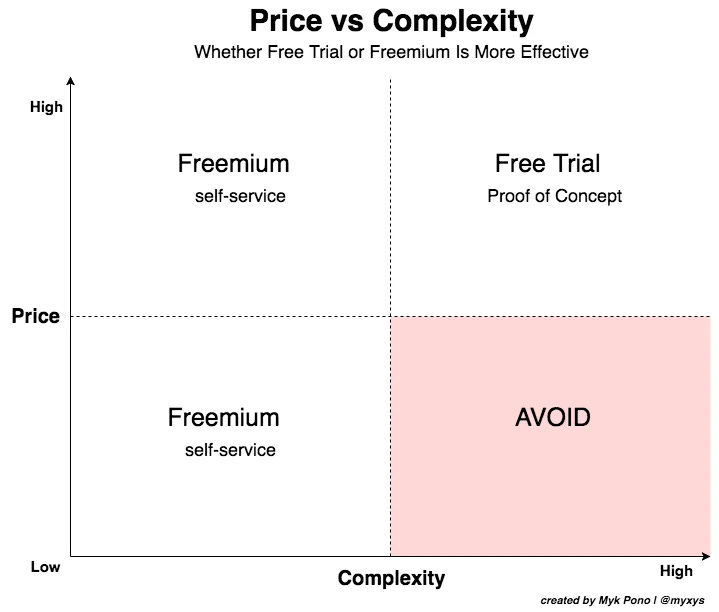
If you can’t wait that long or aren’t set up for a full A/B test, consider these “Three Factors for Freemium Strategy”:
Does your paid plan have a gross margin of 80–90%?
If you have a lower gross margin — for example, because your product is not fully self-service, requires extensive customer support or is extremely costly in terms of tech infrastructure — freemium will probably not work for you.Does your free plan attract the right audience?
If your free users are too different from your paying users, your free-to-paying conversion will be low, and you’ll risk developing your product for the wrong audience.Is your product inherently viral?
If your answer is no, that doesn’t make it a complete no-go, but it does mean that it’s much less likely that freemium is right for you.
In the end, freemium only makes sense if a certain percentage of your free users do one of three things:
Eventually, convert to paid,
Refer paying customers, or
Provide the kind of valuable feedback that will improve your product.
A freemium product that fails to achieve any of these effects will merely saddle you with extra costs and distract you from servicing your most important users.
Also, check out this interesting article on why companies fail with freemium. I highly recommend it, definitely worth a read.
Why do VCs care so much about who’s leading your round?
This is one of the most annoying questions founders hear on a pitch: “Who else is investing?”
It often feels like code for “I’ll decide after someone smarter goes first.” But the data suggests it’s not just lazy signalling, it’s structural.
This insight comes from Peter Walker (Head of Insights at Carta), based on Carta data covering 13,000+ Seed and Series A rounds (2019–2025).
Here’s what’s actually happening beneath the surface.

Over the last few years, lead investors have been taking a bigger share of rounds, while the number of funds willing to lead has gone down.
In many recent Seed and Series A rounds, the lead is now taking 60–75%+ of the entire round, compared to ~50–55% a few years ago. At the same time, more funds are participating just not leading.
That changes incentives.
For a non-lead investor writing a smaller check, the identity of the lead suddenly matters a lot more. They’re implicitly underwriting the lead’s conviction, judgment, and future behaviour.
A few practical realities behind that question:
If one fund owns most of the round, they effectively control the outcome
Their ability (or willingness) to lead the next round becomes critical
If they don’t follow on, it sends a strong negative signal to future investors
Their domain expertise (or lack of it) affects how helpful they’ll be post-check
From the founder side, this explains why strong leads still unlock momentum, even in markets where VCs claim to be “independent thinkers.” The first check is still celebrated, but the right first check matters more than ever.
The real takeaway for founders isn’t “optimise for name-brand VCs.” It’s this:
Be deliberate about who you let lead
Understand how much of the round they’re taking ownership shapes power
Anticipate follow-on questions and signaling effects early
Realize that today’s market structurally favors fewer, more dominant leads
So yes, some investors ask this question for the wrong reasons. But in a world where leads increasingly own the round, “who’s leading?” is no longer a soft question it’s a risk question.
That’s the shift founders need to internalise.
TODAY’S JOB OPPORTUNITIES
💼 Venture Capital & Startup Jobs
Most aspiring VCs struggle with interviews, unclear expectations, no structured prep, and generic advice that doesn’t actually help. So we partnered with a leading investor group to build an all-in-one VC Interview Preparation Guide that gives you real clarity and frameworks. (Access Here)
Partner 20, Applied ML - a16z | USA - Apply Here
Junior Operations & Community Manager - CV VC - Apply Here
Associate - Novo Venture | Singapore - Apply Here
Senior Scouting Manager - Antler | Australia - Apply Here
Head of Investor Community - Inovexus | Remote - Apply Here
Associate - Lightbank | USA - Apply Here
Ventures Analyst/Associate - Plug and Play Tech Center | USA - Apply Here
Research Innovation Program Director - Generator | USA - Apply Here
Investment Analyst Intern - NAV Capital | Dubai - Apply Here
PE & VC Partner Manager - Dealhub | UK - Apply Here
Investment Analyst - Lunicorn Venture | UK - Apply Here
Program Manager - a16z | USA - Apply Here
Venture Fellow - age1 | USA - Apply Here
Venture Capital Associate - Sky9 Capital | USA - Apply Here
Investment Summer Associate - AI Tooling - M13 | USA - Apply Here
Event Marketing Manager - AI Fund | USA - Apply Here
🤝 Partnership With Us
Get your product in front of over 115,000+ audience - Our newsletter is read by thousands of tech professionals, founders, investors and managers worldwide. Get in touch today.
🔴 Share Venture Curator
You currently have 0 referrals, only 5 away from receiving a 🎁 gift that includes 20 different investors’ contact database lists - Venture Curator
Absolutely love this! 🚀 The synthetic user approach is a game changer for understanding needs without direct access. And that Excel sheet? A must-have for every founder! Can’t wait to dive into these insights! Thanks for sharing, @theventurecrew