


👋 Hey, Sahil here - welcome to today’s edition of Venture Curator, where we break down how great startups grow, how top investors think, and what’s shaping the future of tech.
P.S. Get access to 100+ startup & VC resources, investor databases, fundraising templates, 150+ premium archive posts and exclusive startup research - all in one place.
FROM OUR PARTNER - FINLESS FOODS
Investors are backing Finless Foods, and the timing makes sense. 🐟
Wild bluefin tuna is one of the most prized ingredients in the world, and also one of the most at risk. Decades of overfishing have pushed populations to a fraction of their historic levels. Add contamination concerns and the hard limits of ocean-based supply chains, and you’ve got a $2B premium market that can’t sustain the demand being placed on it.
Finless Foods is building a new path: sushi-grade tuna, cultivated without the catch. They’re starting with bluefin for premium sushi restaurants, where quality standards are the highest, and the market is willing to pay for it, and expanding from there into the broader $360B+ global seafood market, plus adjacent categories like protein, collagen, and functional foods.
Why investors are paying attention:
FDA review is already underway for Finless sashimi-grade tuna product
Patent-pending technology that can expand across other seafood categories
Backed by Draper Associates, SOSV/IndieBio, At One Ventures, and Sustainable Ocean Alliance
First US cell-cultured seafood company, founded in 2017, with nearly a decade of R&D behind them
As ocean ecosystems face more pressure and global demand for premium seafood keeps climbing, the case for cultivated seafood gets a lot stronger. Finless Foods has spent years building toward this moment.
Invest in Finless Foods on Republic →
WORK WITH US
🤝 Partnership With Us
Get your product in front of over 125,000+ audience - Our newsletter is read by thousands of tech professionals, founders, investors and managers worldwide. Get in touch today.
📜 DEEP DIVE
How to get investors interested months before you raise (with the exact emails that get replies).
Two founders. Same sector, same stage, nearly identical metrics. Both start their seed raise the same month.
The first closes in nineteen days - two term sheets, clean terms, a lead who “already gets it.” The second spends four months in market, takes forty meetings, and signs the one offer that shows up: lower number, heavier liquidation preference, a board seat he didn’t want to give.
The second founder wasn’t worse. His numbers were arguably better the week they both started.
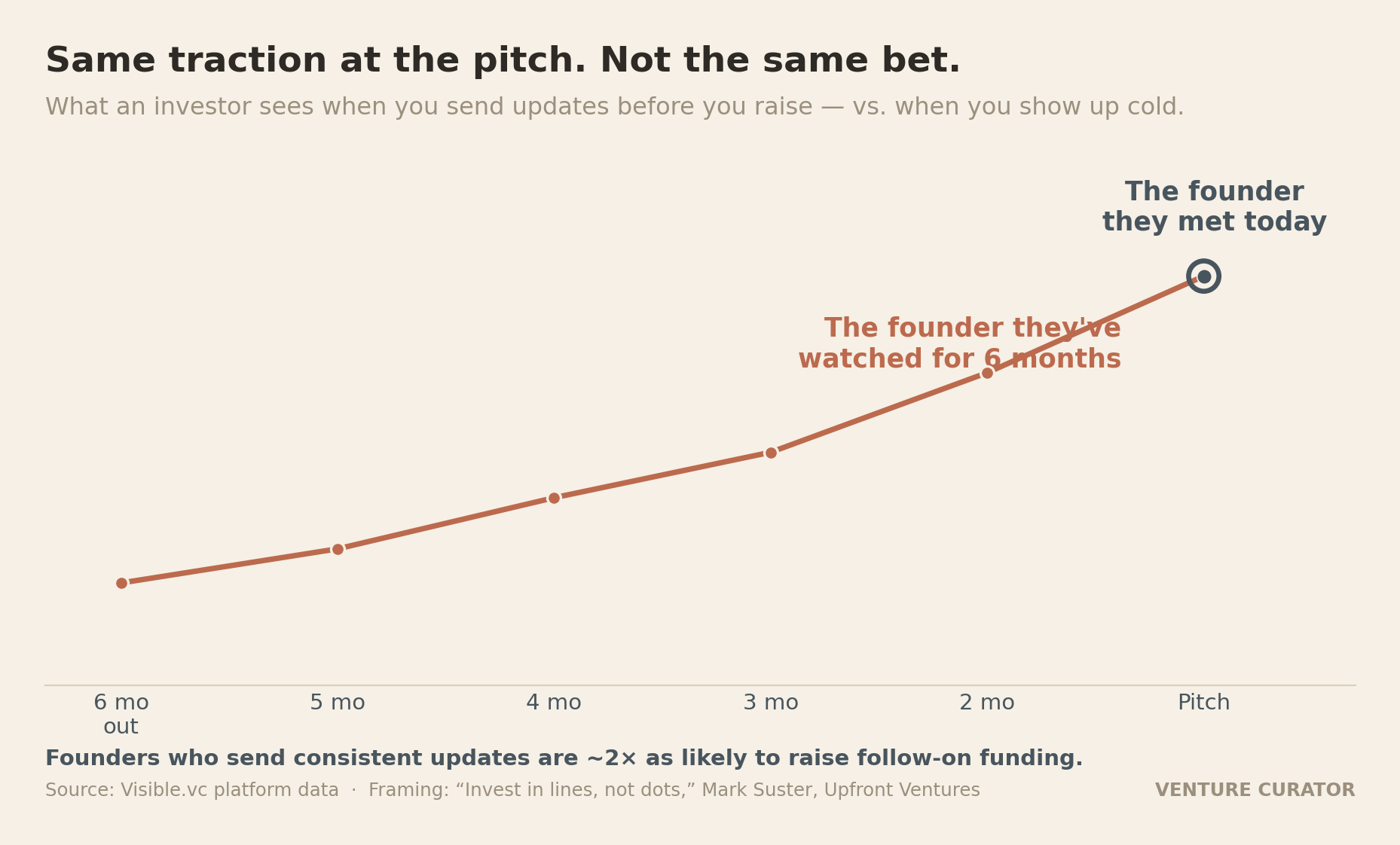
The difference had already happened, months before either of them pitched. When the first founder sent his “we’re raising” email, the partner had been watching the company grow for half a year - six updates, six data points, a slope. The second founder was a stranger with a good month.
That’s “lines, not dots” - Mark Suster’s line from 2010 (he’s a managing partner at Upfront Ventures). The first time an investor meets you, you’re a single point. They can’t tell if you were higher last quarter or lower, so they price that uncertainty into everything: the valuation, the terms, the speed of the yes. Give them six months of data first, and the bet stops feeling like a bet.
And the update isn’t just “keeping you top of mind.” A good one gets forwarded - dropped into the firm’s deal tracker, raised in a Monday meeting as “one to watch.” By the time you formally raise, you’re not cold inbound triaged against fifty others. You’re a name three people already recognise.
The data backs it: Visible.vc finds founders who send consistent updates are roughly twice as likely to raise follow-on funding - their own platform data, not a peer-reviewed study, so weight it accordingly. But it’s exactly what Suster described, and it costs about an hour a month.
So why doesn’t every founder do this? Two reasons, both quiet killers.
They wait until they need the money. They go silent until runway gets short, then show up cold - exactly when they have the least leverage and look the most desperate. Dig the well before you’re thirsty. One founder I know raised $1.2M, went dark for fourteen months, and when he resurfaced low on cash, nearly every investor he’d wanted ignored the email.
They don’t know what to send. Most founders know they should do this - so they Google “investor update template,” and they find the same recycled, generic, five-years-stale formats written by people who have never sat on the other side of the table. So they send fluff. “We’re excited and working hard!” and train the exact investors they’re courting to skim right past them.
The system below is the opposite: built from the investor’s side of the inbox - what gets read, what gets forwarded, what moves you into the “one to watch” pile, and the exact emails that do it.
Today’s deep dive covers:
How to build a qualified pre-raise investor list - not a 500-row spreadsheet that wastes everyone’s time, but the 50–100 names actually worth warming
The tiering and segmentation system that decides who gets a warm intro first and who never slips through the cracks
Why the associate - not the partner - is usually your best entry point, and how to use that
The Permission Email: the exact cold note that gets a “sure, go ahead” from an investor you’ve never met (full copy-paste template)
The pre-raise update that gets forwarded: the section-by-section structure, plus a complete real-world example you can model line for line
How to flip six months of updates into an actual raise = the transition-to-” ask” scripts that make the pitch feel inevitable instead of cold
The five mistakes that quietly torch all of this, ranked by how often they kill founders
The 6-Month Pre-Raise Runway - a week-by-week checklist you can start this week, whether your raise is next quarter or next year
The whole thing runs on about an hour a month. Here’s the system, starting with the list you build before you write a single email.