

👋 Hey, Sahil here — Welcome back to Venture Curator, where we explore how top investors think, how real founders build, and the strategies shaping tomorrow’s companies. Today’s edition features even more carefully curated content.
Big idea + report of the week :
How trillion-dollar giants are widening their moat.
How to plan headcount as an investor will judge it.
Pitchbook Data: Is an MBA still worth it if you want to make it in VC?
Frameworks & insightful posts :
Cluely’s thesis: how virality really works (and when it doesn’t).
GEO is the new SEO: What founders need to know.
B2C startup idea validation framework.
Don’t price your product based on costs. Why?
Is freemium right for your SaaS product? Ask these 3 questions.
FROM OUR PARTNER - ROCKET
🤝 Rocket Raises $15M to Pioneer “Vibe Solutioning”

Rocket, based in India, has secured $15 million in seed funding co-led by Salesforce Ventures and Accel, along with Together Fund.
In just 15 weeks from launch the platform has gained over 400,000 users across 180+ countries who have produced more than 500,000 apps.
Unlike first-generation vibe coding tools focused on mockups and prototypes, Rocket calls itself the first true “vibe solutioning” platform, solving not only Day 1 startup problems but also Day 0 (problem framing and context) and Day 2 (iterating, integrating, deploying).
By generating production-grade apps with backend logic, enterprise-scale architecture, and real integrations, Rocket tackles tech debt and makes AI-native development practical.
Check out Rocket.new →
🤝 PARTNERSHIP WITH US
Get your product in front of over 95,000+ audience - Our newsletter is read by thousands of tech professionals, founders, investors and managers worldwide. Get in touch today.
START WITH
🧠 Big idea + report of the week
How trillion-dollar giants are widening their moat.
US tech giants — Alphabet, Amazon, Apple, Meta, Microsoft, and Nvidia — earned nearly $2T in revenue in 2024 (up 15% YoY). Together, they’re now worth more than 3x the entire unicorn ecosystem. After a wave of layoffs, hiring is back (+7% average headcount growth in 2024). The next chapter of their growth story? AI.
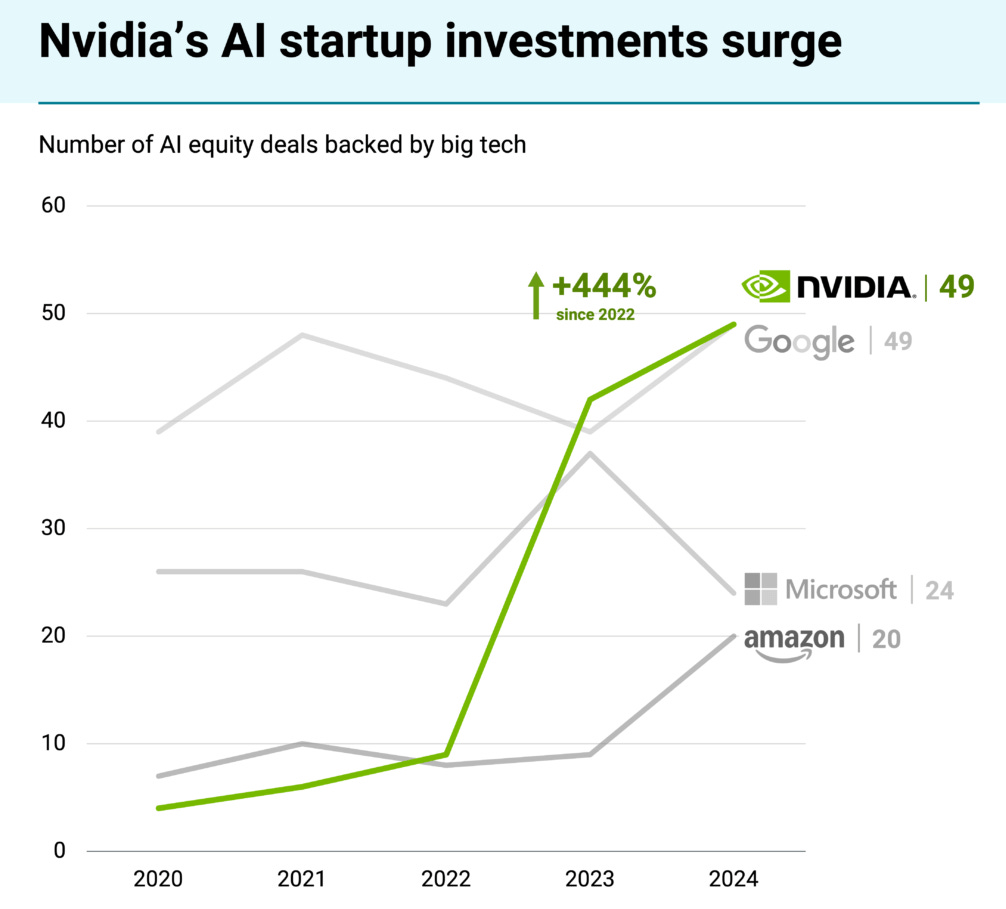
Capex surge: Amazon, Microsoft, and Google each plan to spend $75B–$100B in 2025 on AI-driven data centers. Scale itself is becoming a strategic advantage.
Cloud + AI demand: Azure grew 31% last quarter (13 points from AI). Google Cloud is struggling to keep pace as compute demand outstrips supply.
M&A comeback: Alphabet’s $33B Wiz acquisition signals that AI will fuel the next big wave of deals. Nvidia, meanwhile, is hoovering up startups to lock in chip demand.
Physical AI bets: Humanoid robotics pilots (Apptronik, Agility, Figure) show how deep pockets let incumbents test entire new categories.
Agent race: Microsoft, Google, and Amazon are embedding AI agents into workflows, where distribution + infra advantage ensures they dominate early use cases.
AI isn’t leveling the playing field — it’s reinforcing the moat. Big tech can pour hundreds of billions into infra, scoop up talent and startups, and expand into frontier bets like humanoids. For startups, the play isn’t to outspend them, but to find niches they can’t (or won’t) move fast enough to own. (Read full report here)
How to plan headcount as an investor will judge it.
Carta’s new 2025 guide frames headcount planning as more than a budget exercise — it’s one of the clearest signals to investors about whether a startup is disciplined or reckless.
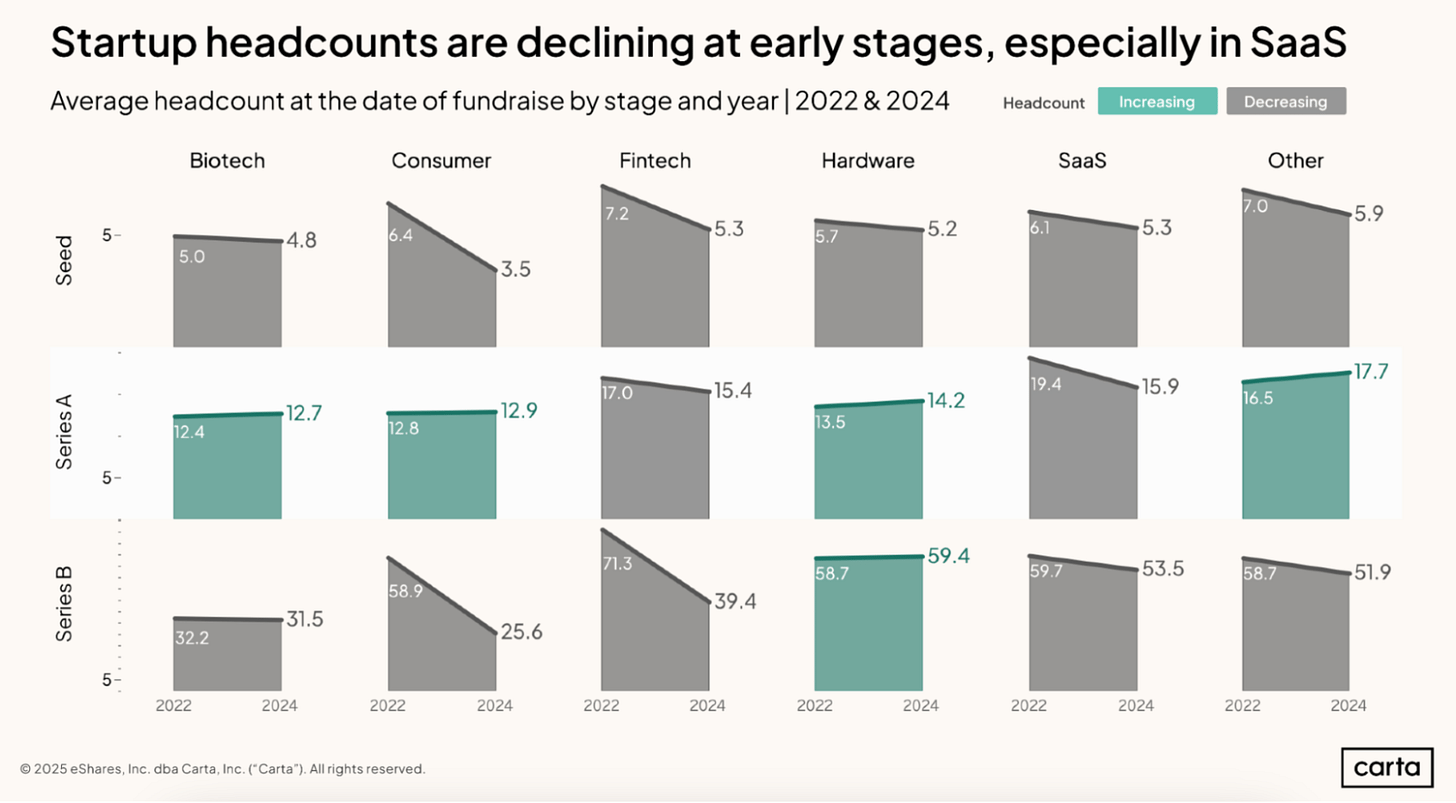
Equity and ownership impact: Every hire costs cash and equity. Carta stresses that each grant reshapes your cap table, so sloppy hiring can compound dilution quickly.
Retention and alignment: By March 2025, only 65% of employees hired in 2023 were still in-role. That stat underlines why roles must tie directly to clear milestones (product launches, ARR targets, compliance) instead of “we’ll figure it out later.”
Forecasting the true cost: The strongest startups forecast 12–18 months ahead and model not just salaries, but the ownership cost of each hire. Carta’s tools now let founders see dilution in real time — useful for board reviews and investor conversations.
A headcount plan isn’t just ops hygiene. It’s a strategic roadmap linking hiring, ownership, and outcomes. Founders who tie every role to a milestone and model dilution avoid costly, reactive mistakes — and build far more investor confidence.
Pitchbook Data: Is an MBA still worth it if you want to make it in VC?
For decades, Stanford, Harvard, and Wharton MBAs were a near-guarantee to break into venture. But PitchBook’s recent analysis shows that the advantage is fading fast.
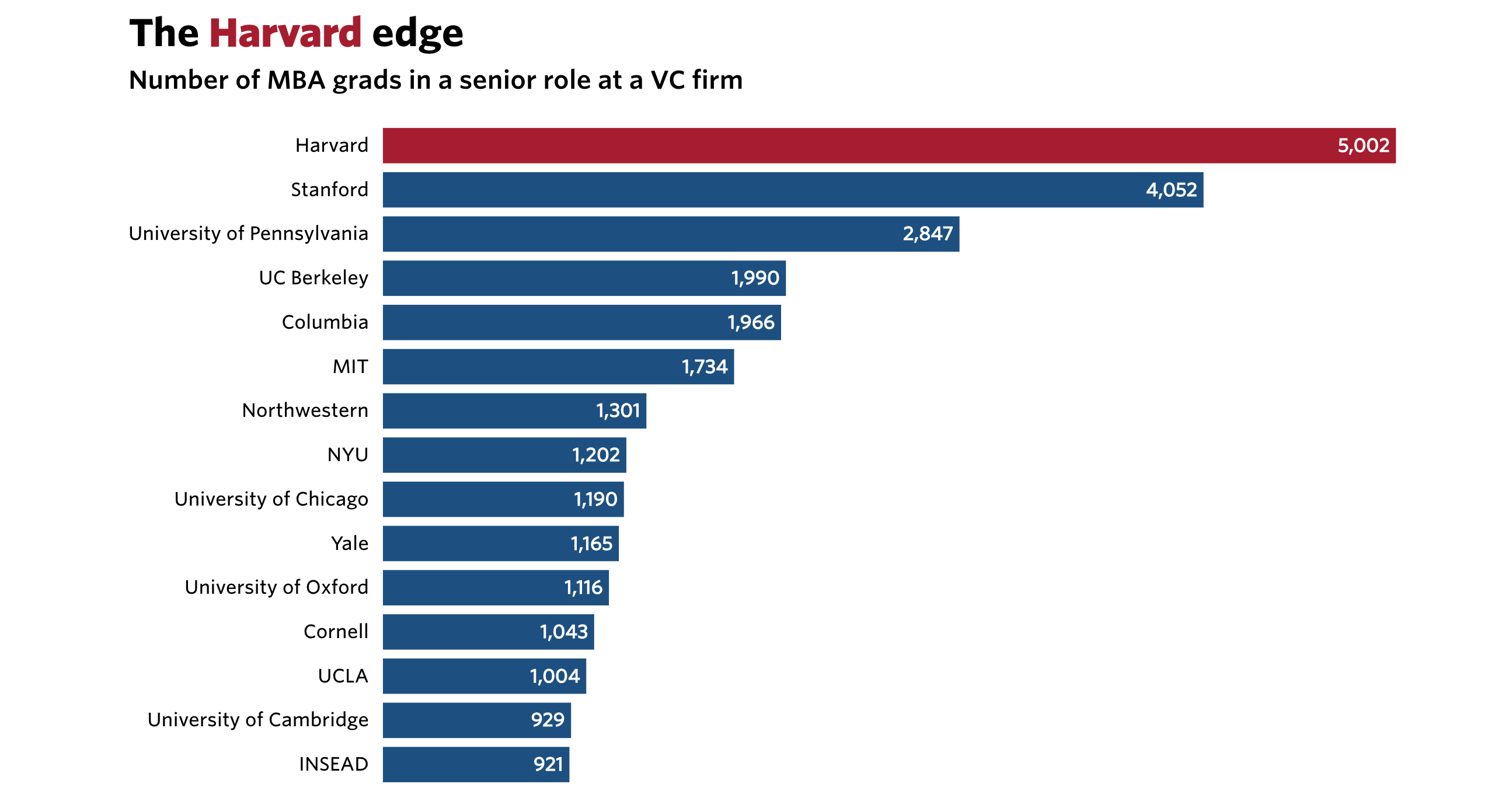
The numbers: Around 50 Harvard MBAs and 30 Stanford MBAs joined VC firms last year, with a median starting salary of $177,500. Yet the share of new VCs with MBAs has dropped from 44% in the early 2000s to ~32% today.
The shift: Firms now prize “builders” from places like OpenAI, SpaceX, and Palantir over B-school résumés. These hires bring direct operating experience and strong founder networks.
Still a signal: Certain schools (Stanford, Harvard, Wharton, LBS, Columbia, Kellogg) show a statistical boost in investment performance, according to new research. Alumni networks also continue to drive deal flow.
The tradeoff: An MBA can still open doors, but it comes with a ~$200K opportunity cost. Meanwhile, AI is replacing many junior VC tasks, narrowing entry-level roles.
The MBA badge is no longer the default path into venture. It may help at specific firms and networks, but increasingly, operating at a breakout startup is the stronger credential.
TOOL FOR FOUNDERS
📑 Startup Legal Pack: VC-Ready Docs in One Place
Messy or missing legal docs slow founders down and turn off investors.
The Startup Legal Document Pack gives you everything you need to incorporate, protect equity, and raise confidently.

What’s inside:
Incorporation docs & founder agreements
SAFE notes, term sheets, cap tables
Employment, IP, and advisor agreements
NDAs, privacy policies & customer contracts
Built with startup attorneys and VC teams. Investor-ready. Easy to use.
SOMETHING MORE
🧩 Frameworks & insightful posts
Cluely’s thesis: how virality really works (and when it doesn’t).
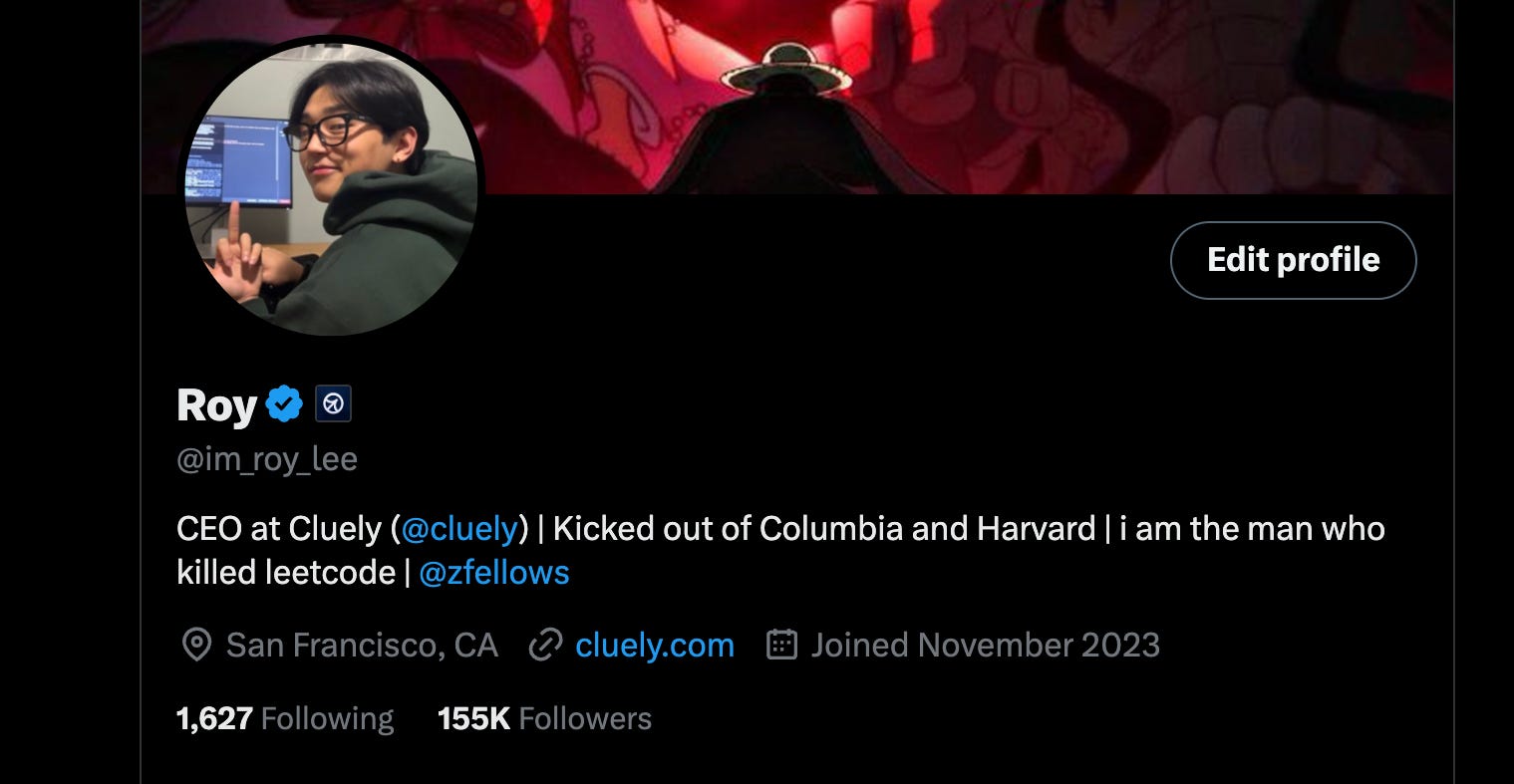
In six months, Cluely grew to 150k followers and hundreds of millions of views. Roy Lee shared what he’s learned about virality — how it really works, when it matters, and why hype alone won’t build a company.
1. The law of X virality
A tweet that deserves to go viral will go viral, if it crosses the threshold of a few thousand views.
Follower count beyond ~10k matters less than you think; the algorithm is ruthlessly content-dependent.
Virality sense doesn’t turn bad content into good. It only takes a good post from 200k views to 2M+.
Focus on creating content worth sharing — virality is an amplifier, not a crutch.
2. Virality ≠ growth
Cluely saw memes rack up 50M+ views with fewer than 100 downloads.
Virality only matters if it converts: top-of-funnel is useful for testing, user feedback, and brand awareness — but product quality drives retention.
If your product isn’t close to the best in its category, mindshare won’t save you.
Don’t confuse reach with traction. Measure conversions, not views.
3. When virality helps — and when it doesn’t
Useful when:
You’re post-PMF and need growth.
You’re pre-PMF and need feedback loops.
Not useful when: you already have enough feedback but are still iterating. At that stage, building beats acquiring.
Virality accelerates a solid product — it doesn’t replace one.
4. The Cluely playbook in action
Cluely is post-PMF in some segments (interviews, enterprise workflows), but still iterating for broader consumer markets.
The goal: create magic moments across all user types, not just niche use cases.
Virality is a lever to test markets quickly, but their long-term bet is product-led growth.
Use virality as a spark — but make sure your product can sustain the fire.
Read the original article here.
GEO is the new SEO: What founders need to know.
For 20+ years, if you wanted people to find your company online, you learned the rules of SEO: keywords, backlinks, rankings. You played the Google game. And that worked, until now.
In 2025, the game is changing. Fast.
Search isn’t happening on browsers the way it used to. It’s happening inside models. People are asking ChatGPT, Claude, and Perplexity instead of Google. Apple is baking AI-native search into Safari. That’s a tectonic shift.
And with it comes a new playbook: Generative Engine Optimisation (GEO).
SEO helped you rank.
GEO helps you get remembered.
Classic SEO was about getting on the first page of search results. GEO is about getting mentioned in the answer itself, the paragraph ChatGPT gives your potential customer when they ask, “What’s the best waterproof winter jacket?”
In that response, is your brand even mentioned? If not, you’re invisible.
Where SEO is optimised for Google’s algorithm, GEO is optimised for how LLMs think, how they synthesise, cite, and share information from across the internet.
LLMs don’t list. They reason. They remember. They compress. So instead of fighting to rank on page one, you’re now fighting to become part of the model’s memory.
GEO ≠ Gaming the system
This isn’t about hacks or stuffing keywords. It’s about building content and presence that earns you a place in the AI layer.
And here’s where the model era is different:
LLMs are paywalled, not ad-driven.
They’re personalised, not one-size-fits-all.
They summarise, not paginate.
That means brands need to think differently. You’re not bidding for ad slots or traffic. You’re trying to become a trusted reference, something the model brings up organically because you’re seen as legit.
So what matters in GEO?
You want to be cited by the model. That means:
Creating dense, well-structured content that models can parse.
Using summary formats, bullet points, and context-rich explanations.
Being referenced in authoritative sources and public knowledge bases.
This is about model relevance, not search rank.
We’re seeing the rise of platforms like Profound, Daydream, and Goodie that help brands understand how they’re showing up in model outputs and why.
Some startups are even fine-tuning their own mini-LLMs to simulate how major models think, allowing them to test prompts at scale and adjust content strategy accordingly.
Canada Goose did this. They weren’t just looking at traffic. They wanted to know:
“Does the model think of us when someone asks about premium winter jackets?”
That’s the new game: unaided model awareness.
From clicks to citations
You don’t need 10 blue links anymore. You need one line in the AI’s answer.
New metrics are emerging:
Reference Rate: how often you’re cited by LLMs.
Sentiment Memory: how you’re framed in model outputs.
Competitive Share of Voice in AI-generated responses.
Ahrefs has already launched Brand Radar to track mentions inside AI Overviews. Semrush is building an AI toolkit to monitor and improve your visibility in generative platforms.
This is SEO 2.0 but deeper, more dynamic, and closer to the conversion moment.
Early-stage? This is your edge.

For founders and growth teams, GEO is a first-mover opportunity.
Just like Adwords in 2003 or Facebook targeting in 2013, this is a new channel. The difference? The channel is the model.
And the model is becoming the new front door to commerce. If your startup isn’t present there, if the model doesn’t remember you, you’re not just missing traffic. You’re missing trust.
The startups that win will:
Understand how to create GEO-friendly content
Use new tools to monitor model perception
Adapt quickly as LLM behaviour evolves
GEO isn’t static. Every model update may change the rules. Just like Google updates used to wreck SEO rankings overnight, you’ll need to keep testing, tracking, and iterating.
This isn’t just about visibility. GEO is a wedge into something bigger:
Real-time brand management inside LLMs
Autonomous marketing loops that optimise messaging daily
Full-stack platforms that own the loop from monitoring to creation to response
The companies that get this right won’t just sell insights. They’ll become the channel itself.
Just like Shopify became more than a tool for e-commerce, the GEO winners will become the system of record for brand-model interaction.
In a world where AI answers everything, the real question for your startup is: “Will the model remember you?”
Because if it doesn’t, your next customer might not either. Read the original article here.
B2C startup idea validation framework.
Most ideas, especially in B2C, get validated in one of four ways:

This framework defines the differences between each path to validation.
Signal Aggregation
Founders should test an idea’s viability through small experiments that provide evidence (signals) of potential success before building a full product.
Common signals include landing page sign-ups, social media engagement, ad click-through rates, and customer interview feedback.
Strong Beta
Achieving strong early traction with a beta product is another popular validation approach for founders. Success metrics vary across industries, e.g., high user numbers and retention for consumer social apps, and healthy revenue for B2C marketplaces.
The process typically starts with a hypothesis for solving a problem. The founder builds a basic version to test the hypothesis. Beta products are often rudimentary, lacking polish, due to the emphasis on speed over perfection. This approach aligns with the lean methodology of launching quickly and iterating based on feedback.
True Fans
This approach is similar to the Strong Beta approach, as it involves launching a beta product. However, instead of focusing on significant traction metrics like revenue or user acquisition, the founder seeks to identify a small group of fanatic users who deeply love the product despite its limited features. The key is finding 20-50 users who would be disappointed if the product were to go away. These passionate fans, rather than large user numbers, serve as the validation signal.
Visionary
This approach is the least common among the founders interviewed, as it requires a clear vision and plan for the product from the outset. Typically, the founder has a close personal connection to the problem being solved and a strong understanding of what needs to be done to address it.
Don’t price your product based on costs. Why?
Founders often struggle with pricing their products correctly early on. Many make the mistake of setting prices based on their costs, especially in non-software startups. While this might seem logical, it’s not the best approach. Here’s why you should consider “unreasonable” pricing instead:

The Problem with Cost-Based Pricing
It doesn’t account for the value you’re providing to customers.
It can limit your growth potential and ability to invest in improving your product.
It may attract price-sensitive customers who aren’t your ideal target market.
The Benefits of “Unreasonable” Pricing
Identifying Your Ideal Customer Profile (ICP)
High initial prices help you quickly identify customers who feel the pain point most acutely.
These customers are willing to pay more for a solution, even if it’s not perfect yet.
Validating Market Demand
If people are willing to pay a premium, it confirms there’s a strong need for your product.
This validation can save weeks of experiments and help you focus on the right target audience.
Accelerating Product Development
Higher initial revenue allows you to invest more in improving your product faster.
You can build specifically for your ICP, ensuring product-market fit.
Real-World Example
I see a lot of founders launch a website, with:
A logo that was just an emoji
An onboarding flow using Typeform
A database in Airtable
Also, set the initial price on the higher end. Despite this - they have seen good outcomes of getting a few people onboard 5-6, why? They felt the pain point so strongly that they wanted it solved at all costs.
The Inverse Relationship
There’s an inverse relationship between how painful a problem is and how “perfect” the product needs to be:
More painful problem = less perfect product + higher willingness to pay
Less painful problem = needs to be perfect + price sensitivity
When to Launch
Once your product is 70-80% ready for your ICP, they will likely convert. If not, it may indicate that the problem isn’t worth investing more time into, as the product will be hard to grow.
Long-Term Strategy
While starting with “unreasonable” pricing can be beneficial, it’s important to note that this approach isn’t permanent. As you grow and expand your market, you may need to adjust your pricing strategy. However, the initial high pricing helps validate the market, identify your ICP, and provide capital leverage for faster growth.
Remember, don’t let perfect be the enemy of good. If you’re solving a truly painful problem, your early adopters will be willing to pay a premium for an imperfect solution.
Even in one of the previous writeups, we have shared 5 frameworks that can help you to find the best pricing strategy for your startup.
Is freemium right for your SaaS product? Ask these 3 questions.
Deciding whether to offer a freemium model is a common dilemma for founders. Many try out freemium strategies, but not all SaaS companies can replicate the success of Dropbox or Typeform.
Done wrong, freemium can end up cannibalizing your paid user base while also draining your company’s precious engineering and customer support resources.
So how can you determine if it’s the right move for your company?
The most reliable way to find out is through A/B testing. However, getting solid results can take a long time, especially if you’re looking at the impact on virality and your viral cycle is six months or longer.
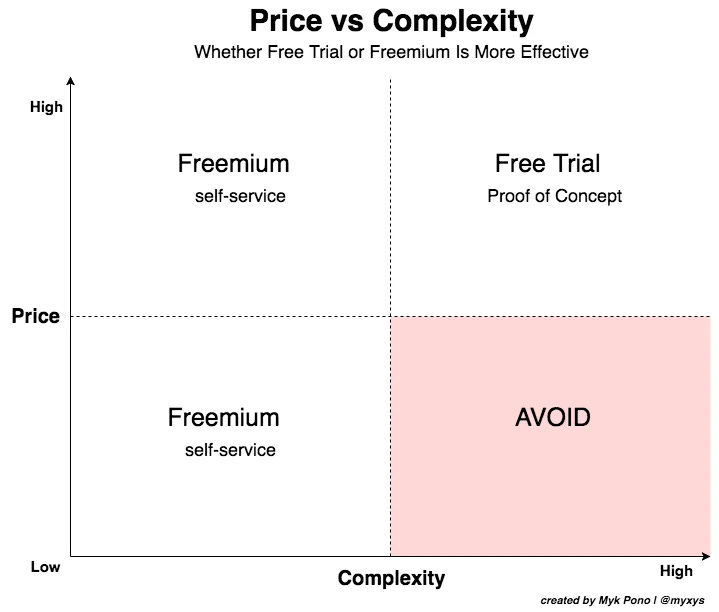
If you can’t wait that long or aren’t set up for a full A/B test, consider these “Three Factors for Freemium Strategy”:
Does your paid plan have a gross margin of 80–90%?
If you have a lower gross margin — for example because your product is not fully self-service, requires extensive customer support or is extremely costly in terms of tech infrastructure — freemium will probably not work for you.Does your free plan attract the right audience?
If your free users are too different from your paying users, your free-to-paying conversion will be low — and you’ll risk developing your product for the wrong audience.Is your product inherently viral?
If your answer is no, that doesn’t make it a complete no-go, but it does mean that it’s much less likely that freemium is right for you.
In the end, freemium only makes sense if a certain percentage of your free users do one of three things:
Eventually, convert to paid,
Refer paying customers, or
Provide the kind of valuable feedback that will improve your product.
A freemium product that fails to achieve any of these effects will merely saddle you with extra costs and distract you from servicing your most important users.
Also, check out this interesting article on why companies fail with freemium. I highly recommend it — definitely worth a read.
EXPLORE MORE
💡 Reports, Articles and a few interesting stuffs
Why investors don’t care about your business. (Link)
The Mac App Flea Market. (Link)
The quality of AI-assisted software depends on the unit of work management. (Link)
Why does our website look like an operating system? (Link)
The AI agent revenue race — September’s top earners. (Link)
0-$5M: How to Identify Your ICP — Lessons from Vanta, Clay, Retool. (Link)
NEWS RECAP
🗞️ This week in startups & VC
New In VC
YC introduced a new track called Early Decision, letting students apply and get funded while in school but defer participation until after graduation. (Link)
Archetype, a NYC-based early-stage crypto venture capital firm, closed its third fund, Archetype III, at over $100m. (Link)
BNVT Capital, a global venture capital firm, launched its debut $150M fund. The vehicle will invest in AI-first and technology-driven companies solving humanity’s most pressing challenges. (Link)
New Startup Deals
WeTravel, a San Francisco, CA-based operating system for multi-day travel businesses, raised $92M in Series C funding. (Link)
Synthesized, London, UK-based agentic AI-native test infrastructure and test data company for enterprises, raised $20M in Series A funding.(Link)
Greptile, a San Francisco, CA-based AI code reviewer, raised $25M in Series A funding. (Link)
Filevine, a Salt Lake City, UT-based provider of a legal operating intelligence system, has raised $400M in an all-equity financing. (Link)
Tilt, a Miami, FL-based provider of an AI-powered direct indexing platform, raised $7.1M in Seed funding. (Link)
Unit221B, a NYC-based company that delivers actionable threat intelligence and cybersecurity solutions, raised $5M in Seed funding. (Link)
TODAY’S JOB OPPORTUNITIES
💼 Venture capital & startup jobs
All-In-One VC Interview Preparation Guide: With a leading investor group, we have created an all-in-one VC interview preparation guide for aspiring VCs. Don’t miss this. (Access Here)
Senior Analyst - Iconiq Capital | USA - Apply Here
VP - Marketing & Communications - Transition VC | India - Apply Here
Investment Analyst - Miras Investment | Dubai - Apply Here
Associate - Iconiq Capital | USA - Apply Here
Program Manager - Tenity | UK - Apply Here
Investor Relations Analyst - Griffin Gaming Partner | USA - Apply Here
Associate - OMERSE Venture | USA - Apply Here
Investment Analyst - Caanan | USA - Apply Here
VC Associate UK - Breega | UK - Apply Here
Investment Team - Noba Capital | UK - Apply Here
Venture Capital Analyst Intern - DRW Venture Capital | USA - Apply Here
Investor, SF Launch - Entrepreneur First | USA - Apply Here
PARTNERSHIP WITH US
Get your product in front of over 95,000+ audience - Our newsletter is read by thousands of tech professionals, founders, investors and managers worldwide. Get in touch today.
🔴 Share Venture Curator
You currently have 0 referrals, only 5 away from receiving a 🎁 gift that includes 20 different investors’ contact database lists - Venture Curator