


👋 Hey, Sahil here - Welcome back to Venture Curator, where we explore how top investors think, how real founders build, and the strategies shaping tomorrow’s companies.
How to price your AI product in a post-SaaS world?
What people really want from AI? - Anthropic Survey.
This is what raising $1.5M really looked like: 250 meetings, 171 rejections in 98 days.
FROM OUR PARTNER - MODE MOBILE
Apple’s Starlink Update Sparks Huge Earning Opportunity

Apple just secretly added Starlink satellite support to iPhones through iOS 18.3.
One of the biggest potential winners? Mode Mobile.
Mode’s EarnPhone already reaches 490M+ users who have earned over $1B, and that’s before global satellite coverage. With SpaceX eliminating “dead zones,” Mode’s earning technology can now reach billions more in unbanked and rural populations worldwide.
Their global expansion is perfectly timed, and investors like you still have a chance to invest in their pre-IPO offering at $0.50/share.
With their recent 32,481% revenue growth and newly reserved Nasdaq ticker, Mode is one step closer to a potential IPO.
Tap into a $1T opportunity - invest now at just $0.50/share and get up to 20% bonus →
Disclaimer
Please read the offering circular and related risks at invest.modemobile.com. This is a paid advertisement for Mode Mobile’s Regulation A+ Offering.
Mode Mobile recently received their ticker reservation with Nasdaq ($MODE), indicating an intent to IPO in the next 24 months. An intent to IPO is no guarantee that an actual IPO will occur.
The Deloitte rankings are based on submitted applications and public company database research, with winners selected based on their fiscal-year revenue growth percentage over a three-year period.
VENTURE CURATORS’ FINDING
📬 My Favourite Finds
Media Posts:
How to angel invest (even if you don’t have money) (Link)
Excel template: early-stage startup financial model for fundraising. (Link)
Tim Cook is stepping down as CEO. Meet John Ternus, the new CEO of Apple. (Link)
Jeff Bezos is raising $10B for a new AI lab quietly targeting industrial AI. (Link)
Reports/Articles:
What investors ask and how to answer: A practical Q&A prep kit for founders. (Link)
VC in 2026: 75% of all the Money Is Going to just 5 VC Funds. And To Just 5 “Startups.” (Link)
How George Orwell predicted the rise of “AI Slop” in nineteen eighty-four (1949) (Link)
The growth metric Silicon Valley loves most is also its least trusted. (Link)
Deedy Das visually clusters what VCs are investing in right now (Link)
📜 DEEP DIVE
How to price your AI product in a post-SaaS world?
Most founders are thinking about AI pricing completely wrong.
They obsess over features, distribution, and even model performance, but treat pricing like a packaging decision. In the AI era, pricing isn’t packaging. It’s a strategy. If you get it wrong, your growth can look impressive while your margins quietly collapse.
This AI pricing playbook from Bessemer Venture Partners lays out something many founders don’t want to admit: AI businesses are structurally different from SaaS, and that changes how you monetise.
AI broke SaaS economics
In classic SaaS, marginal cost was almost zero. Once the software was built, adding one more user barely cost anything. That’s why founders could aggressively chase ARR growth and worry about margins later.
AI changes that equation. Every query carries real costs:
Inference and computation
GPU usage
Model upgrades
Sometimes human review
Ongoing support overhead
This means gross margins in AI often sit in the 50-60% range (sometimes lower), compared to 80–90% in SaaS. If your pricing model doesn’t reflect this from day one, scaling only amplifies the problem.
One practical test: if your unit economics don’t work with 10 customers, they won’t magically work with 1,000. Many startups scale into negative margin territory because they never fully modelled their true costs, including founder time and hidden support work.
That’s the first mindset shift: pricing must absorb cost reality while capturing value.
The real strategic choice: what are you charging for?
Most AI founders jump to usage pricing because it mirrors their cost structure. But pricing isn’t about your costs, it’s about how customers perceive value.
Across Bessemer’s research and portfolio companies, three AI-native business models are emerging. Each one changes how value is delivered, and therefore how pricing must work.
Before we go deeper into charge metrics, here’s how the landscape is actually shaping up:
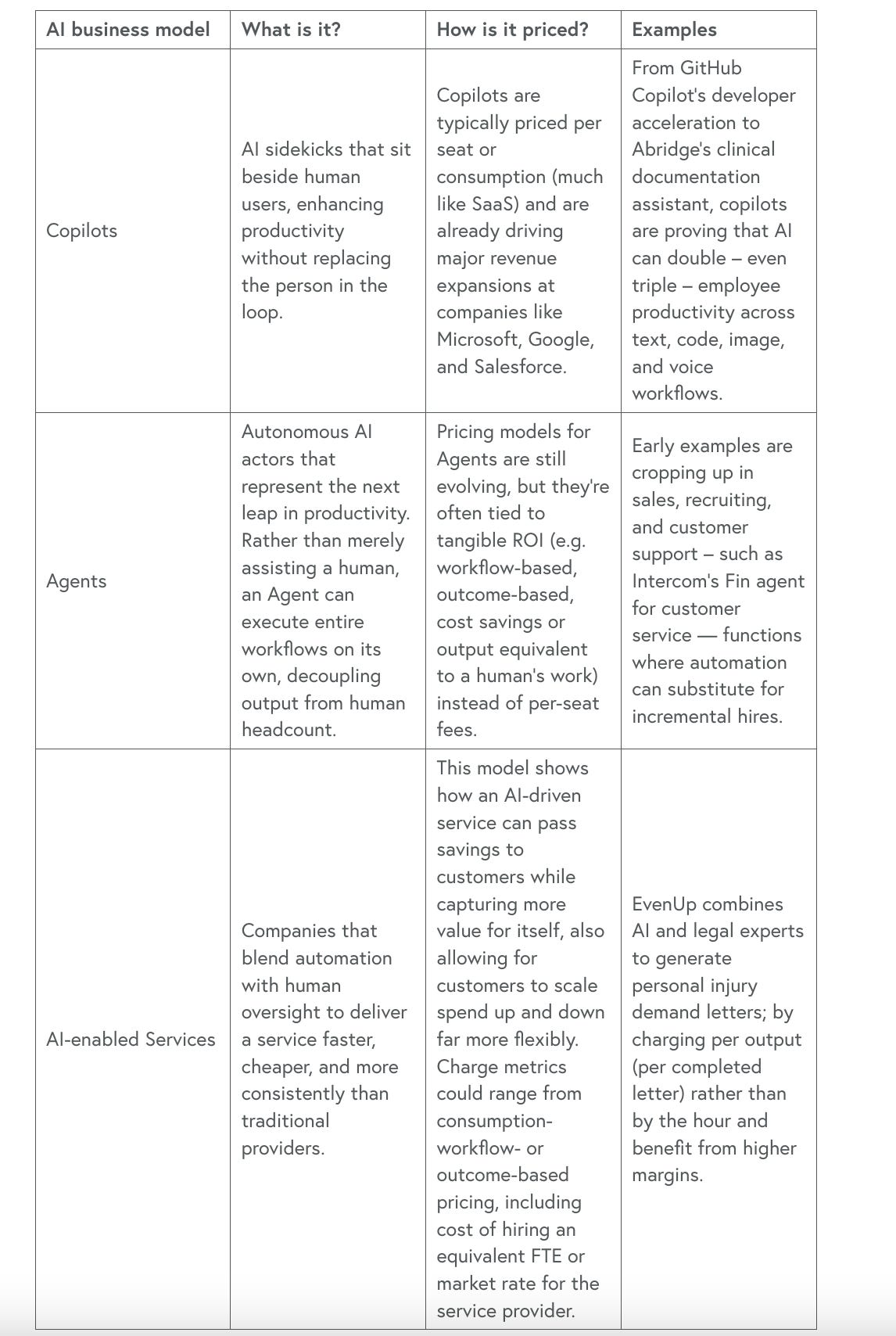
Consumption-based (tokens, API calls, usage)
Clean and predictable for infrastructure companies. Works well for technical buyers who understand granular usage. But non-technical customers don’t think in tokens; they think in outcomes.
Workflow-based (per task completed)
Charging per document drafted, per ticket resolved, per case processed aligns better with how businesses measure work. It reduces translation friction and makes ROI clearer.
Outcome-based (per successful result)
The boldest version. You get paid only when the job is done. Intercom charging per AI resolution is a strong example - not per message, but per resolved ticket.
As you move from consumption → workflow → outcome pricing, you accept more cost variability but gain stronger alignment with customer value.
The best founders don’t choose what’s easiest to implement; they choose what customers emotionally understand and are willing to pay for.
The soft ROI trap
Here’s where many AI companies will struggle in 2026.
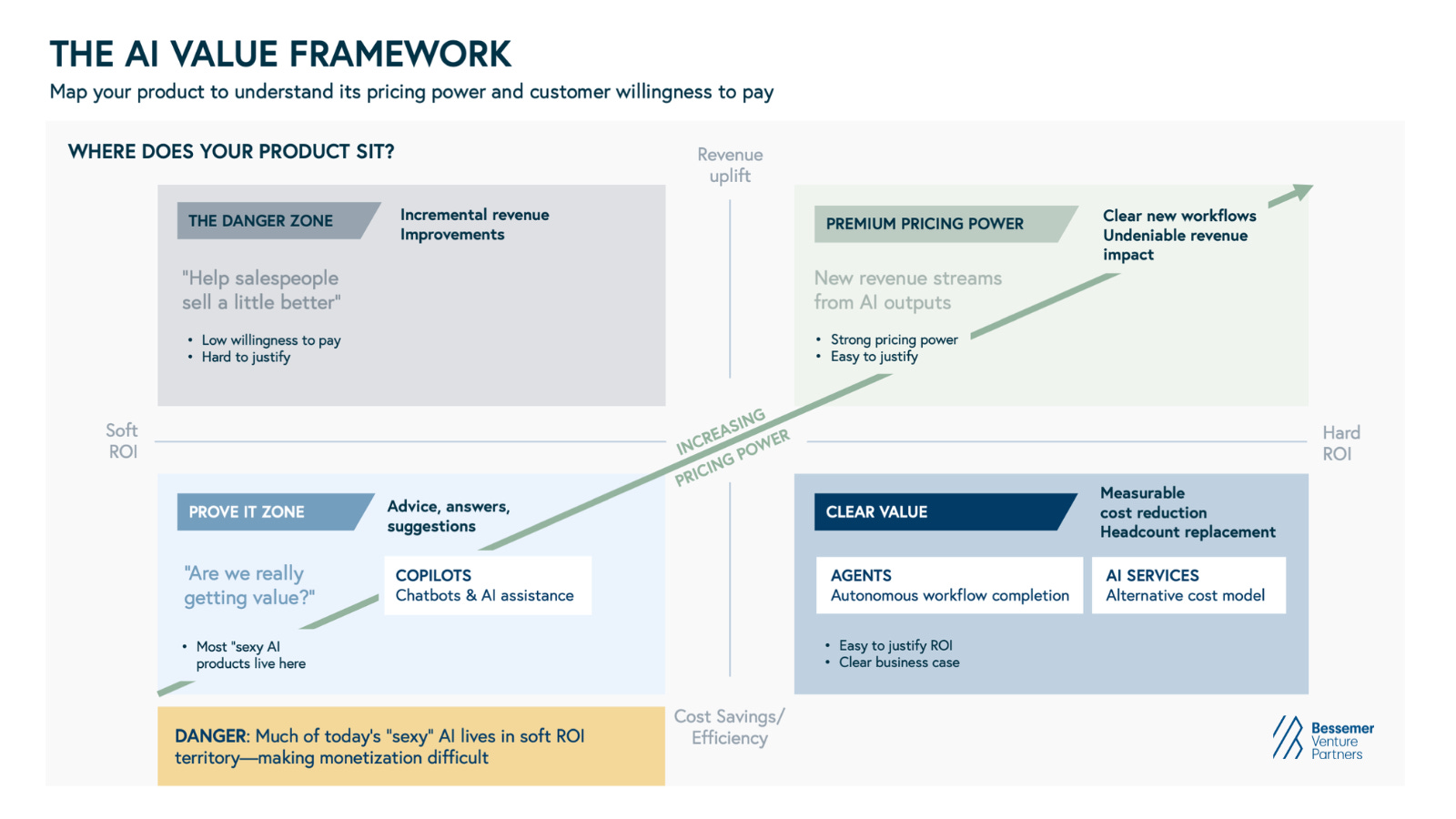
Copilots that “assist” but don’t close the loop create soft ROI. They help, suggest, draft, but don’t finish the job. When renewal time comes, customers ask: “Did this actually move the needle?”
Agentic products that fully complete workflows have stronger pricing power because their ROI is measurable.
You can think of AI products across two dimensions:
Revenue generation vs. cost reduction
Hard ROI vs. soft ROI
Products sitting in hard ROI territory, clear revenue uplift or measurable cost savings, can justify premium pricing. Soft ROI products will face budget scrutiny once the hype fades.
That’s a practical insight founders should act on now, not later.
Hybrid pricing: the early-stage advantage
For most startups, especially early on, hybrid models are a smart middle ground:
Base platform fee (predictability for the customer)
Plus usage or outcome-based expansion (upside capture)
This protects you from unpredictable compute spikes while allowing revenue to scale with value delivered. It also gives enterprise buyers budget clarity, which matters more than founders assume.
Hybrid models are not a compromise; they’re a hedge against uncertainty in both demand and cost structure.
Pricing shapes your entire company
One of the strongest insights: pricing isn’t a finance decision. It determines how your company behaves.
If you charge per outcome:
Sales sell results, not seats
Customer success focuses on realised value
Product optimises for completion and accuracy
Engineering prioritises reliability
If you charge per seat:
Teams may optimise adoption over actual impact
Value conversations get diluted
Pricing becomes your operating system.
How to actually find your price
Most founders undercharge. Not because they lack data, but because asking for more feels uncomfortable.
The playbook recommends something counterintuitive: find your pricing through friction.
Start with a price.
If customers immediately say “yes,” you’re likely to be too cheap.
Raise incrementally until you hear “we need to think about that.”
Stop just before it becomes a blocker.
That tension zone is often where true willingness-to-pay lives.
And don’t default to cost-plus pricing. If you’re creating $100K in measurable value and charging $12K because it “covers compute,” you’re anchoring to cost instead of value.
The bigger shift is underway
Every major software shift changed monetisation:
Client-server monetised licenses
SaaS monetised access
AI is monetising outcomes
AI isn’t just another feature layer. In many cases, it’s replacing or autonomously completing work. That means charging for access alone underestimates what your product is actually doing.
The founders who win in this era will be the ones who design pricing systems that reflect:
Real compute economics
Clear customer ROI
Scalable expansion logic
Operational simplicity
AI pricing is not about clever billing mechanics.
It’s about making sure your product earns what it’s worth and that your margins survive long enough to compound.
PARTNERSHIP WITH US
🤝 Get your brand in front of 120,000+ audience.
Our newsletter is read by 120,000+ tech professionals, founders, investors (VCs / Angel Investors) and managers around the world. Get in touch today.
📃 QUICK DIVES
What people really want from AI? - Anthropic Survey.
Most conversations about AI get stuck in abstractions. We hear big claims about job loss, AGI, productivity, safety, and existential risk, but much less about a simpler question: what does “AI going well” actually look like for real people already using it?
Anthropic recently ran one of the most interesting studies I’ve seen on this. It invited Claude users to describe how they use AI today, what they hope it could unlock in their lives, and what worries them most. More than 80,000 people across 159 countries and 70 languages participated, which makes this less like a normal product survey and more like a global snapshot of how people are beginning to fit AI into everyday life.
What makes the findings valuable is that they move beyond generic optimism or fear. They show where AI is already delivering value, where it still feels shaky, and what kinds of products or companies are likely to matter next.
The biggest thing people want from AI is not magic. It’s a relief.
When Anthropic asked people what they most wanted from AI, the answers were surprisingly grounded. The top categories were:
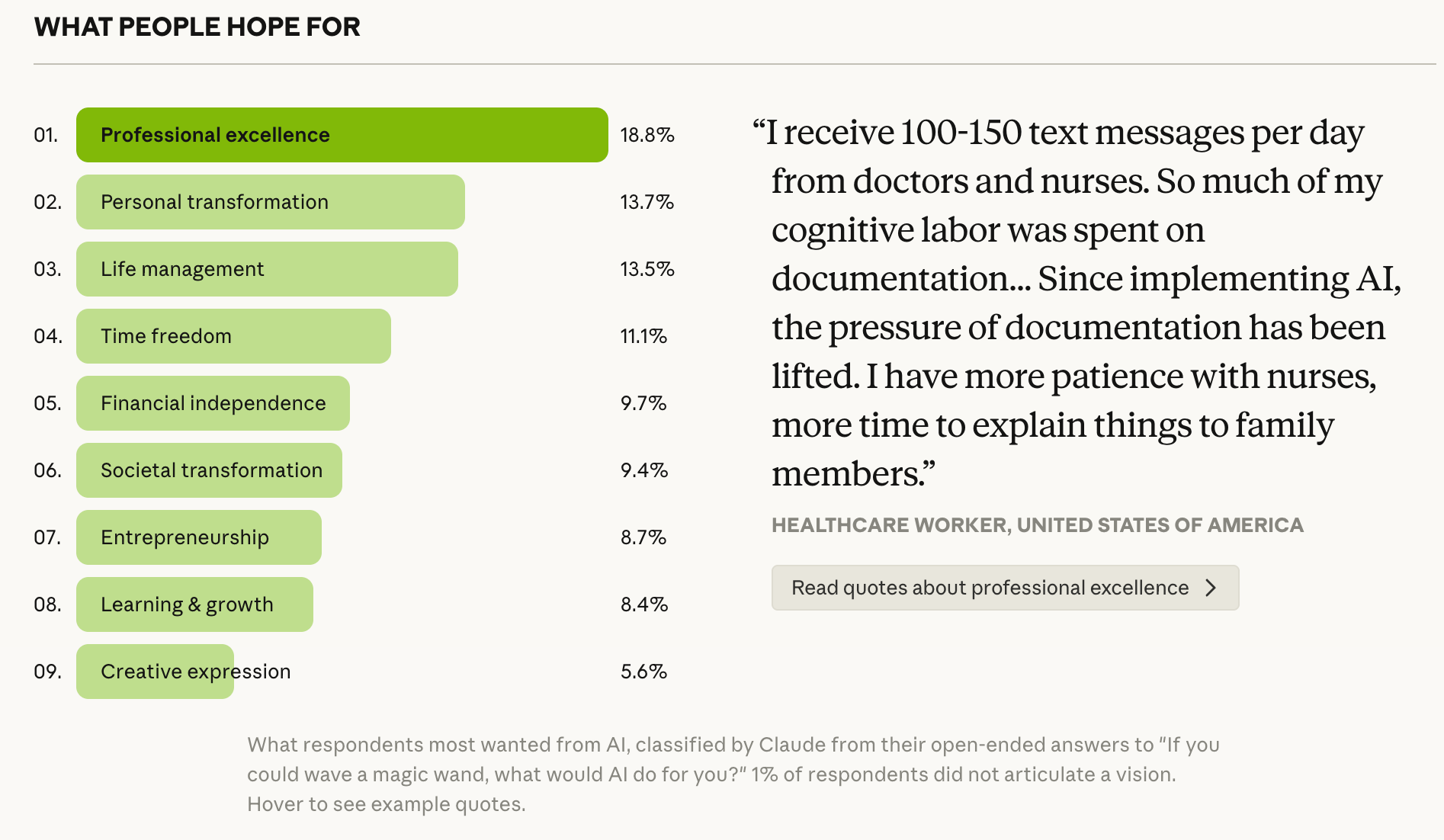
That tells you something important. Most people are not asking AI to become some futuristic super-being. They want it to help them do better work, reduce mental overload, manage life logistics, learn faster, and reclaim time.
That’s a useful correction for founders. The most immediate demand is not for “AI for everything.” It’s for products that remove friction from real life.
A lot of the strongest responses had the same emotional structure underneath them:
AI helped me do what I already needed to do, but with less stress and more breathing room. Someone used it to reduce documentation burden at work. Someone used it to learn coding despite a learning disorder. Someone used it to ask questions they felt embarrassed asking other people.
So, the best AI products may not be the ones that feel the most futuristic. They may be the ones that quietly remove cognitive load.
Work is still the main wedge, but quality of life is the real promise
The largest category people mentioned was “professional excellence.” That makes sense. Work remains the easiest entry point for AI because the ROI is easier to spot. If AI saves time, improves output, or helps someone get through repetitive tasks faster, the benefit is obvious.
But what’s more interesting is what sat underneath that answer. Many people started by talking about productivity, then revealed that what they really cared about was what productivity enabled outside of work: more time with family, more emotional energy, less admin, less mental clutter.
That distinction matters.
A founder might think they’re building a productivity product, when in reality the real value proposition is:
more time freedom
less anxiety
less friction in daily life
more space for better work and better living
That is a much richer product insight than “help users move faster.”
AI is already delivering in a few very specific ways
When Anthropic asked whether AI had already taken a step toward users’ goals, 81% said yes. That’s a meaningful number. But the shape of delivery matters more than the headline.
The main buckets where people felt AI had already helped were:
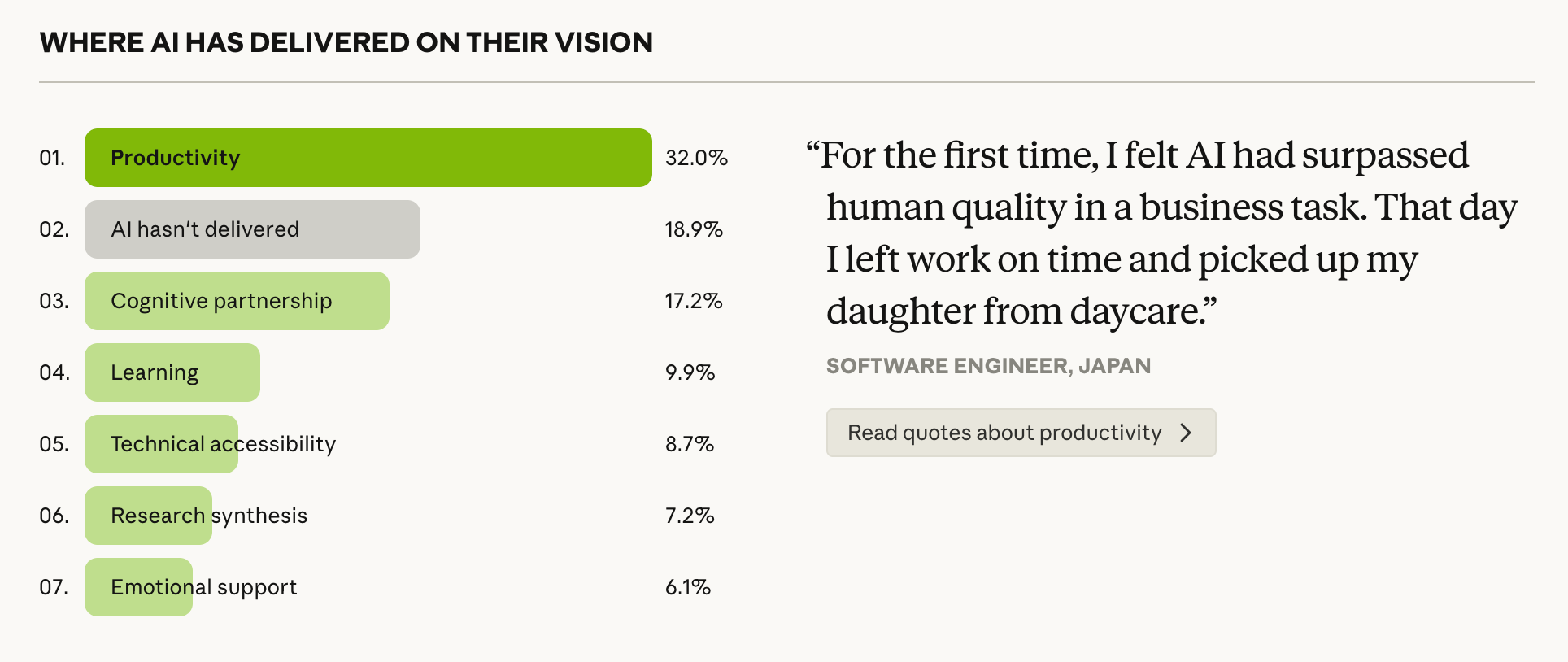
This mix is fascinating because it shows that AI is not just being used as a faster search engine. It is already functioning as a kind of thought partner, teacher, translator, research assistant, and in some cases, even an emotional support layer.
Some of the strongest responses came from people who felt AI gave them access to things they previously couldn’t reach. Not because the knowledge didn’t exist, but because the format was inaccessible, judgment-heavy, too expensive, or too difficult to navigate. That’s a powerful clue about where AI creates the most real value: not just speed, but access.
For builders, that opens up a big product opportunity. AI seems especially strong when it does one of three things:
reduces intimidation
removes judgment from learning
translates complexity into something people can act on
That’s a better lens than simply asking whether a task can be automated.
The most common fear is not “AI takes over the world.” It’s that AI becomes unreliable at exactly the wrong moment.
Public AI debates often drift to dramatic long-term fears. But the top concern in this study was much more immediate: unreliability.
Users worry that AI will sound convincing while being subtly wrong. In some categories, that’s a mild annoyance. In others, it’s dangerous. Law, finance, healthcare, and government workers especially raised this concern because the cost of a confident error is high.
This is a critical insight for founders. Reliability is not a “nice to have” layer you add later. In many AI products, it is the product.
Other major concerns included:
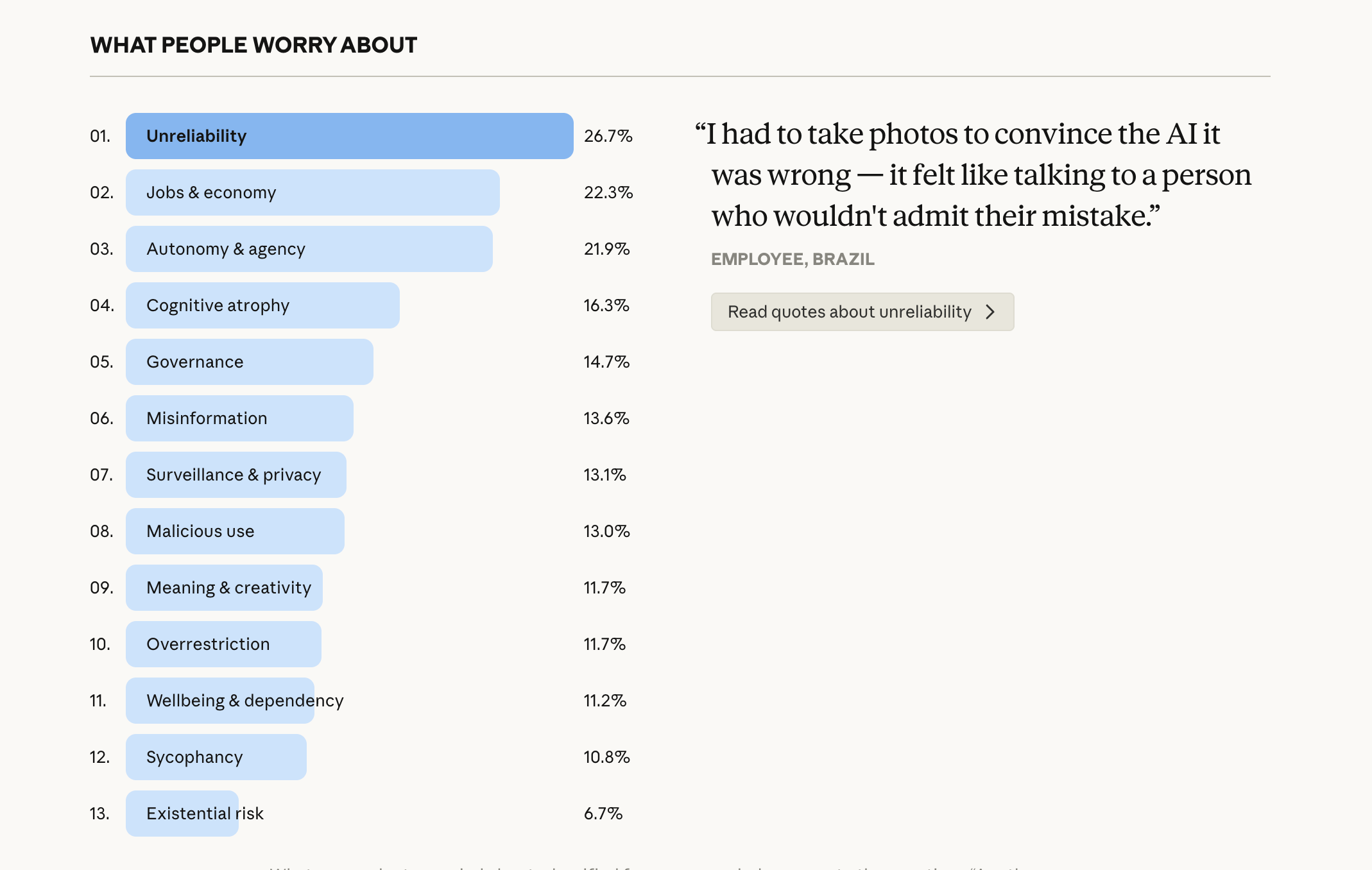
What’s striking is how practical most of these fears are. People are not mainly debating whether AI is philosophically good or bad. They are asking whether it will make them less employable, less independent, less thoughtful, or too dependent on a system that is always available.
The real story is not optimism vs pessimism. It’s tension.
One of the best concepts in the report is what Anthropic calls the “light and shade” of AI.
The same capabilities people love are often the ones they fear. For example:
AI helps people learn faster, but they worry it may weaken their own thinking.
AI saves time, but they worry it increases expectations and speeds up the treadmill.
AI offers emotional support, but they worry it could become a substitute for human connection.
AI creates economic opportunity, but it also raises fear about displacement.
That is a much more honest frame than dividing people into “AI believers” and “AI sceptics.” Most users are both at once. They see upside and risk together.
That’s an important product lesson. Great AI products will not win simply by maximising usefulness. They’ll win by managing the tension around usefulness. The winners won’t just provide capability. They’ll create trust, boundaries, and clarity around how the product should fit into a person’s life.
The regional split is worth paying attention to
The report also found a noticeable pattern across geographies.
Users in lower- and middle-income countries were generally more optimistic about AI than users in wealthier regions. In many emerging markets, AI is seen less as a threat and more as a ladder, a way to start businesses, access education, or overcome infrastructure gaps.
That matters if you’re building global products.
In richer markets, AI is often framed around life management, overload reduction, and economic anxiety. In many developing regions, it is framed more around entrepreneurship, learning, and access. Same technology, very different emotional job-to-be-done.
Founders who understand that distinction will position themselves much better across geographies.
For founders -
The strongest message from this report is that people do not just want faster outputs. They want better lives.
That sounds obvious, but it is surprisingly easy to forget when building in AI. Many teams optimise around what the model can do instead of what the user is trying to become. Anthropic’s findings suggest that the most enduring AI products will be the ones that sit at the intersection of usefulness and human aspiration.
The near-term winning categories likely look less like vague general-purpose intelligence and more like products that help people:
do meaningful work with less administrative burden
learn without fear or embarrassment
manage overloaded lives
turn curiosity into action
gain economic leverage
access systems that previously felt closed off
At the same time, founders need to respect the downside. If your product saves time but increases dependency, gives emotional support but weakens real relationships, or accelerates output while making judgment worse, users will eventually feel that tension.
That’s why this study is so useful. It reminds us that AI is not entering a vacuum. It is entering messy human lives. And the companies that win won’t just be the ones with better models. They’ll be the ones who understand what people are actually trying to protect, improve, and reclaim.
This is what raising $1.5M really looked like: 250 meetings, 171 rejections in 98 days.
Most fundraising stories you see are clean.
“Raised $2M in 2 weeks.”
“Oversubscribed round.”
“Strong investor demand.”
What you don’t see is the messy middle.
Matija Sonic shared what actually happened behind the scenes: 250+ meetings, 171 rejections, 24 ghosted, and just 17 investors closing the round over 98 days. Even after YC Demo Day generated 100+ investor leads, not a single one invested.

That’s the real starting point most founders don’t talk about.
Fundraising is not one big moment. It’s a system.
The biggest mistake early founders make is treating fundraising like a few high-stakes conversations.
In reality, it behaves much more like sales.
212 investors contacted
250+ meetings run
constant follow-ups, tracking, refining
If you don’t treat it like a pipeline, you lose control of it. The founders who struggle the most are usually the ones approaching it casually, reacting to meetings instead of building a system around them.
Your first 50 meetings are basically practice
They walked into early meetings expecting quick closes.
Instead, most investors didn’t understand the product at all. It was technical, pre-revenue, and they had no strong network advantage.
But something important happened around meeting #50.
The pitch started improving, not because they rewrote it overnight, but because repetition forced clarity. By meeting #100, both founders knew the pitch deeply, could anticipate objections, and communicated with confidence.
That shift is underrated.
Confidence in fundraising doesn’t come from preparation alone. It comes from exposure. You earn it by sitting through uncomfortable conversations until your thinking sharpens.
The mindset shift that changes everything: chase No’s
Around 50 meetings in, rejections started piling up, and morale dropped.
Then came a simple but powerful reframe: stop chasing yeses. Start chasing no’s.
Set a target, like 100 rejections.
Why this works:
No’s are predictable and within your control
They remove emotional pressure from each meeting
They give you a clear sense of progress
If you haven’t hit your rejection target, it likely means you haven’t spoken to enough investors.
This turns fundraising from an emotional rollercoaster into a process you can actually manage.
The “valley of death” is real
For nearly 2 months, they were stuck around ~$300K. No momentum. No visible progress. Others were closing rounds.
This is where most founders quit, not because of rejection, but because of silence.
What they didn’t see: their lead investor was doing deep diligence behind the scenes. Fundraising often feels dead… right before it breaks open.
Then everything compounds at once
After weeks of slow progress:
Investors started closing faster
urgency kicked in
The round filled quickly
It became oversubscribed
This is how most rounds actually work: slow → stuck → sudden acceleration
What founders should actually take from this
Don’t try to convince non-believers - find investors who already understand your space
Warm intros > random inbound (Demo Day interest is often a low signal)
Treat fundraising like a pipeline, not conversations
Track pitch quality, not just money raised
Those 250 meetings weren’t just about raising money. They made them better founders.
Because in the end, fundraising isn’t just about getting a yes. It’s about becoming someone who can consistently earn it.
TODAY’S JOB OPPORTUNITIES
💼 Venture Capital & Startup Jobs
Most aspiring VCs struggle with interviews, unclear expectations, no structured prep, and generic advice that doesn’t actually help. So we partnered with a leading investor group to build an all-in-one VC Interview Preparation Guide that gives you real clarity and frameworks. (Access Here)
Partner 18, Healthcare - a16z | USA - Apply Here
Associate - DN Capital | Germany - Apply Here
Investment Intern - DTCP | UK - Apply Here
Venture Scout - First Momentum Venture | UK - Apply Here
Analyst, Global Investment Team - 500 Global | USA - Apply Here
Associate, Data Operations - Iconiq Capital | USA - Apply Here
Investor - AI - Samsung Next | USA - Apply Here
Finance Associate - RA Capital | USA - Apply Here
Fund Controller - NFX | USA - Apply Here
Vice President, Investor Relations - General Atlantic - Apply Here
Senior Associate - RA Capital | USA - Apply Here
PE & VC Partner Manager - Dealhub | UK - Apply Here
Partner 22 -a16z | USA - Apply Here
Infra / Platform Engineer - Pear VC | USA - Apply Here
Associate / Senior Associate - Stepstone Group | Italy - Apply Here
PARTNERSHIP WITH US
🤝 Get your brand in front of 120,000+ audience.
Our newsletter is read by 120,000+ tech professionals, founders, investors (VCs / Angel Investors) and managers around the world. Get in touch today.
🔴 Share Venture Curator
You currently have 0 referrals, only 5 away from receiving a 🎁 gift that includes 20 different investors’ contact database lists - Venture Curator
250 meetings and 171 rejections for $1.5M is the fundraising reality nobody posts about. great issue.