👋 Hey, Sahil here - welcome to today’s edition of Venture Curator, where we break down how great startups grow, how top investors think, and what’s shaping the future of tech.
P.S. Get access to 100+ startup & VC resources, investor databases, fundraising templates, 150+ premium archive posts and exclusive startup research - all in one place.
FROM OUR PARTNER - FRAMER
Framer’s AI agents can now help build, edit, and manage your website

Framer is the AI website builder for teams that care about every detail. Agents work directly in the canvas, helping design pages, manage CMS content, write copy, add SEO, and audit sites.
Build faster: Create, refine, and publish production-ready pages in minutes.
Scale confidently: Manage content, localisation, and metadata across your site.
Stay in control: Review every change, collaborate in real time, and publish when ready.
Trusted by teams at Miro and Perplexity.
Partnership With Us
Get your product in front of an audience of 125,000+ - Our newsletter is read by thousands of tech professionals, founders, investors and managers worldwide. Get in touch today.
📜 DEEP DIVE
Inside the VC backchannel: how investors really reference-check founders.
It’s one of the most common stories in venture, and almost nobody gets the real explanation.
A founder walks out of a partner meeting convinced it’s done. The room was warm. The lead partner said “we’re excited” - twice. By the time he’s home, he’s modelling the post-money.
Then: eleven days of silence. Not a pass. Not a term sheet. Just a polite “still working through our process”.
Every week, founders come out the other side of this window, some with a term sheet, some with a pass that makes no sense given how well the meetings went. And the ones who get passed on rarely learn why. The email says “not the right fit at this time.” The real answer is sitting in the firm’s deal file, two lines long, written after a phone call the founder never knew happened.
Here’s what actually goes on during those silent days.
The associate who’d been friendly in every meeting was on the phone with a former employee the founder hadn’t spoken to in three years. The partner had texted two investors who passed on the seed round. Someone on the team had found the ex-cofounder - the one who left in year one, the one who isn’t mentioned anywhere in the deck.
The deal didn’t stall. It went underground.
In what really happens in the 48 hours after your pitch, I walked you through the internal machine that starts running the moment you leave the room - the deal memo, the sponsor dynamic, the Monday partner meeting. That piece ended at the moment the partnership says “let’s move forward.”
This one covers what happens next. Because between “let’s move forward” and a signed term sheet sits the least understood, least visible, and most fatal stage of the entire fundraising process: the reference check. And unlike your pitch, you don’t get to be in the room for it.
Today’s deep dive covers:
The real scale of VC reference-checking and the data showing it starts earlier than you think
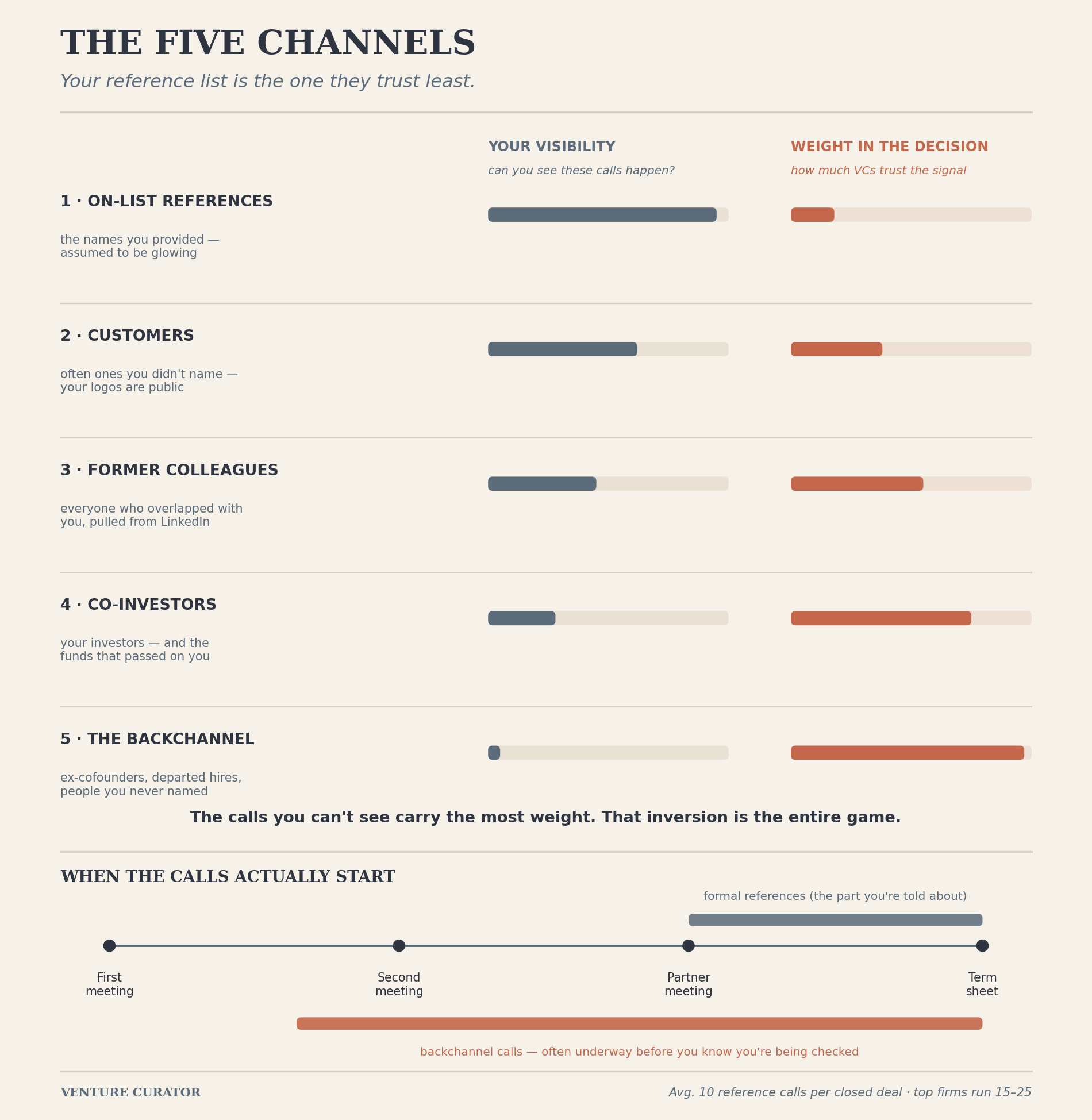
The five channels VCs use to check you out (only one involves the list you gave them)
The exact questions investors ask on these calls - including the forced-ranking questions designed to make polite people say revealing things
The kill decoder: the seven answer patterns that end deals, and why “he was great” can be a death sentence depending on how it’s said
How to pre-run your own backchannel before any VC does - the exposure-mapping exercise that takes 90 minutes and has saved real rounds
The reference prep kit: exactly how to brief your on-list references, with the script
How to flip the backchannel and run it on your investor before you sign
The 72-Hour Backchannel Audit - a checklist you can run this week, mid-raise or before one
Let’s get into it.
The diligence you never see
Start with the numbers, because they’re bigger than most founders assume.
The largest study ever run on VC decision-making - a survey of 885 institutional VCs across 681 firms by Gompers, Gornall, Kaplan, and Strebulaev - found that for every deal a VC closes, they spend an average of 83 days from first contact to close, invest 118 hours in due diligence, and make roughly 10 reference calls.
Ten calls. Think about your reference list for a second. You probably gave them three names, maybe four.
The gap between the list you handed over and the calls that actually happen is the backchannel. And at the top of the market, the gap is wider: top-tier firms routinely run 15 to 25 reference calls per deal, with backchannel sources - people you never named and will never know were contacted - treated as the highest-signal category.
One more number that explains why all this effort goes into checking you specifically. In the same study, 95% of VCs named the founding team as an important factor in their investment decision, and 47% ranked it as the single most important factor - ahead of product, ahead of market, ahead of traction. VCs also attributed eventual success or failure more to the team than to the business itself.
Follow the logic. If the team is the thesis, then diligence on the team is the diligence. Your metrics get an afternoon in a spreadsheet. Your character gets two weeks of phone calls.
The five channels (your list is only one of them)
VC reference work isn’t random. Across firms, it runs through five distinct channels, and understanding them tells you exactly where your exposure lives: