

👋 Hey, Sahil here — Welcome back to Venture Curator, where we explore how top investors think, how real founders build, and the strategies shaping tomorrow’s companies. Today’s edition features even more carefully curated content.
Big idea + report of the week :
The productivity paradox of AI coding assistants.
LPs have more negotiating power than ever before.
Pitchbook Data: Why serial founders dominate VC fundraising in 2025.
Frameworks & insightful posts :
OpenAI just revealed billion-dollar AI markets: OpenAI’s 1.5M chat study.
How to navigate PMF in Vertical SaaS (stage by stage).
Why do VCs pass on profitable startups and chase hype instead?
What are the right metrics to measure generative AI’s success?
Where to post your startup and get first users.
FROM OUR PARTNER - 1PASSWORD
🤝 The $115,000 mistake your team can easily avoid

The 2025 Verizon DBIR found that SMBs are increasingly being targeted by cybercriminals in ransomware and credential-based attacks.
The good news: there are seamless, cost-effective tools any team can use to reduce both the risks and inconveniences of managing credentials.
Join 1Password for a discussion on how lean teams can keep cybersecurity affordable and achievable. Register to learn about:
The biggest risks facing SMBs
Security tools to reduce friction for growing teams
How can you secure authentication in hours
Register for the live webinar →
🤝 PARTNERSHIP WITH US
Get your product in front of over 95,000+ audience - Our newsletter is read by thousands of tech professionals, founders, investors and managers worldwide. Get in touch today.
START WITH
🧠 Big idea + report of the week
The productivity paradox of AI coding assistants.
Many founders assume adding AI coding assistants (like Cursor, Copilot, Claude Code) will 10x developer output. The reality is more complicated.
Here’s what research and real teams are finding:
Speed vs. perception
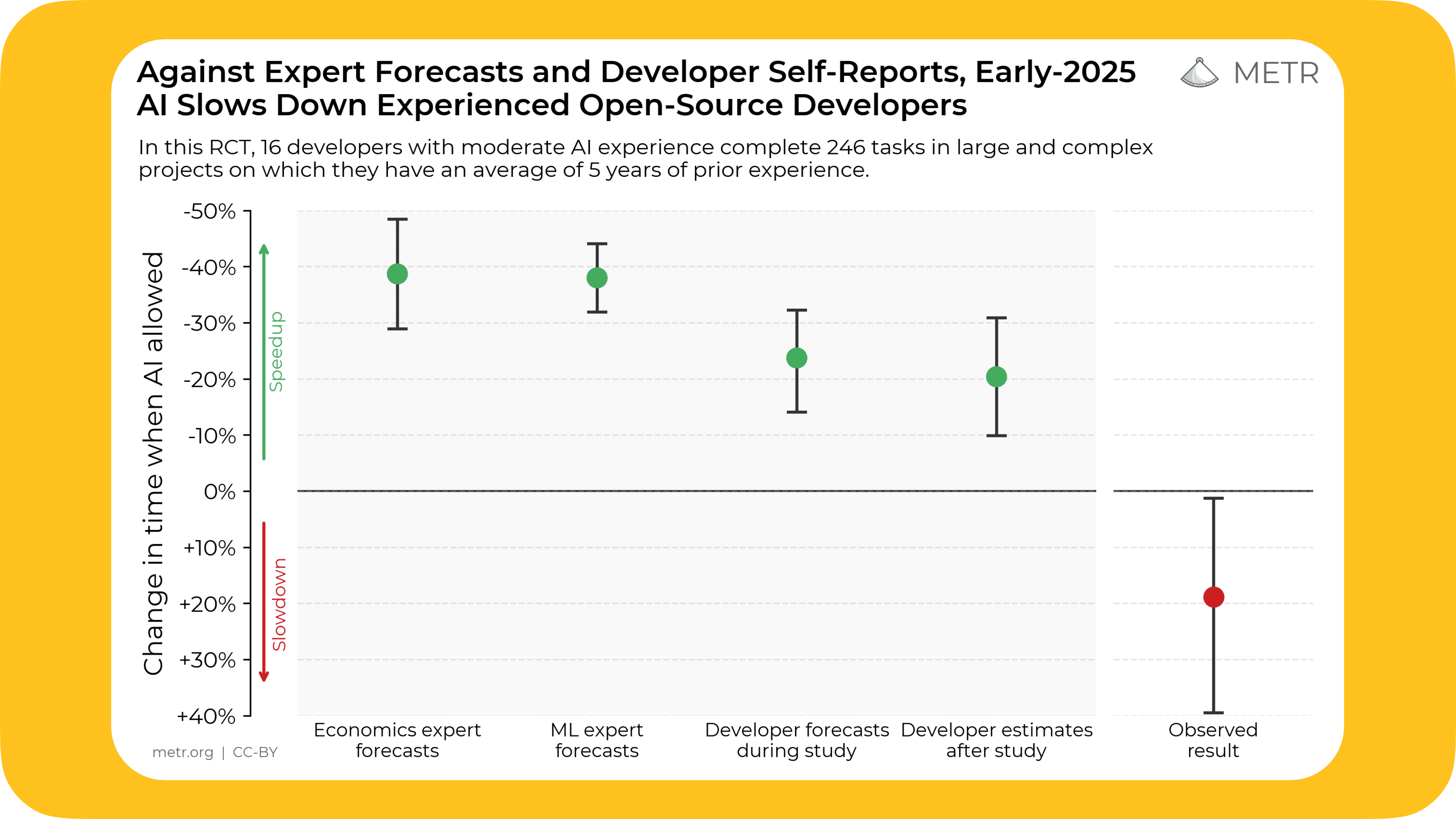
METR’s July 2025 trial: developers with AI were actually 19% slower on OSS tasks, but they felt 20% faster.
The dopamine loop of instant code makes it feel productive, even when review/debug cycles erase the gains.
The quality trap
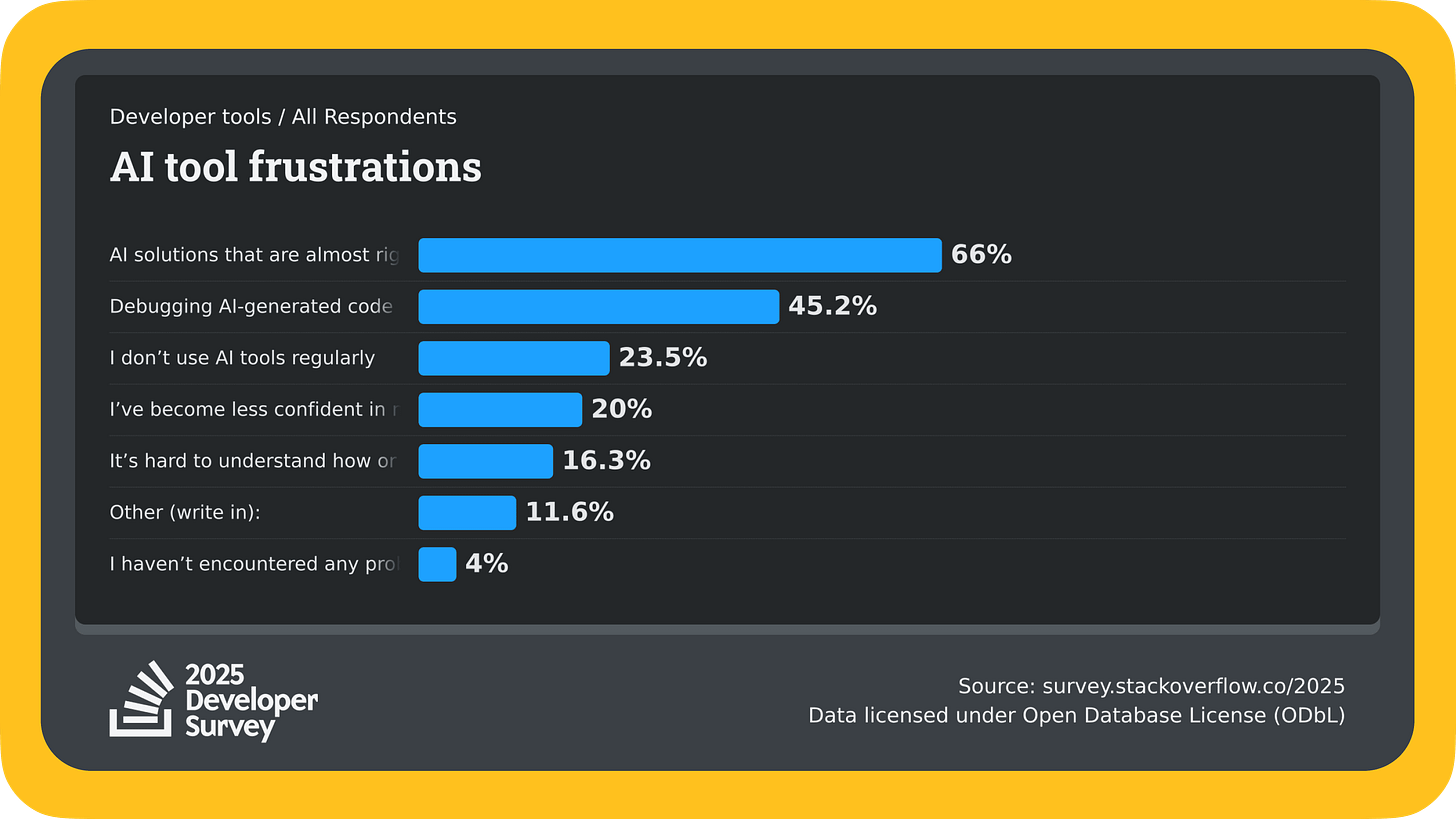
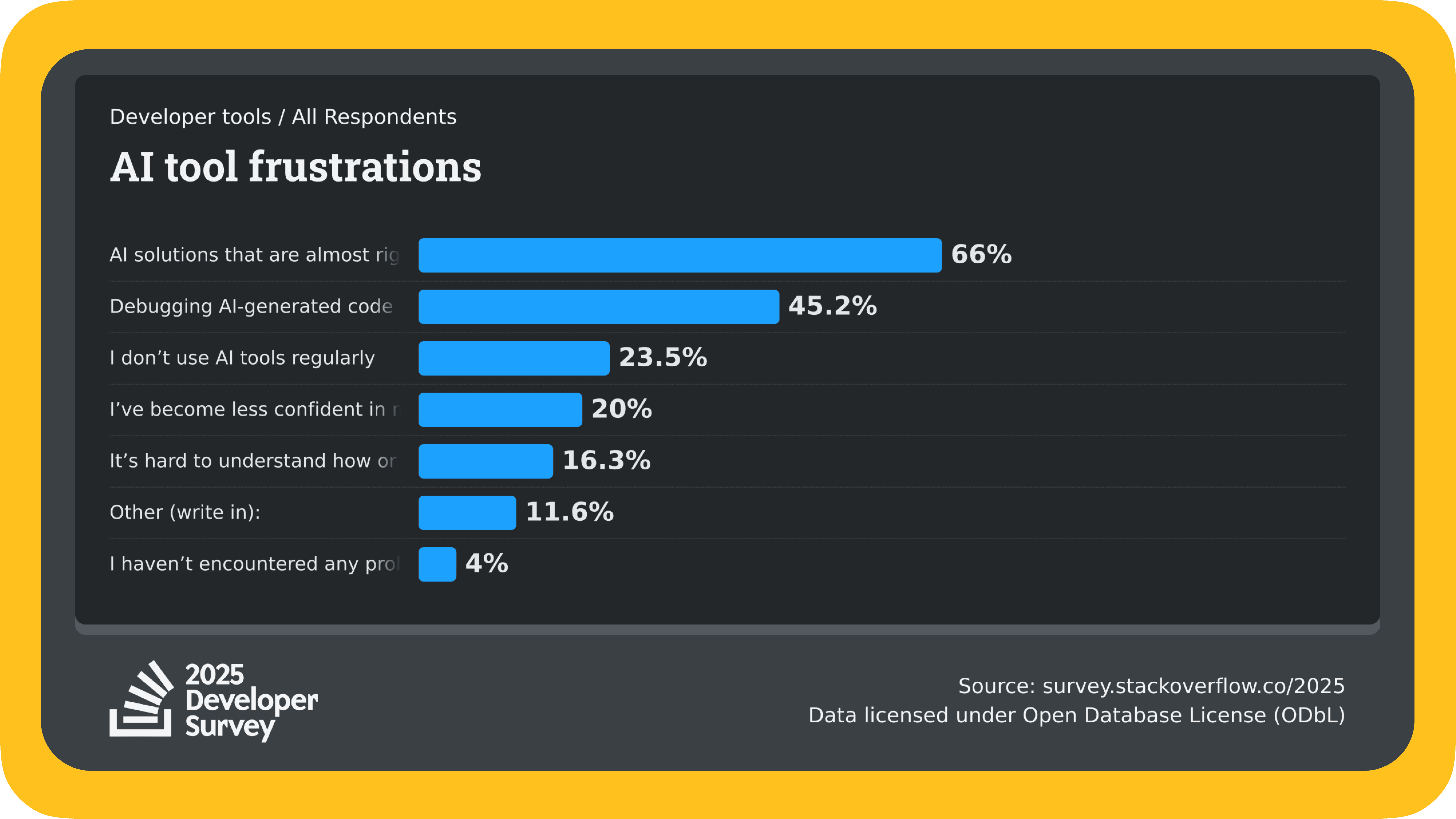
66% of devs in the 2025 Stack Overflow survey said AI outputs are “almost right but not quite.”
More context = more irrelevant noise. Senior engineers often spend more time fixing AI code than writing it from scratch.
Security & compliance risks
Apiiro’s 2024 study: AI-generated code had 322% more privilege escalation paths and 153% more design flaws.
Secrets exposure rose 40%, often due to hard-coded credentials. For SOC2/GDPR/HIPAA companies, this is a real compliance red flag.
The 70% problem
AI gets you to a demo fast (70%), but the last 30%—edge cases, tests, production readiness—is still human-intensive.
For juniors, AI scaffolding feels magical. For seniors, it often slows them down.
Business vs. dev reality
Leaders love the “10x” pitch, but real bottlenecks are design reviews, QA, system dependencies—not typing speed.
Expect incremental wins in boilerplate and onboarding, not exponential leaps.
Why this matters for founders
Don’t over-index on AI as a productivity silver bullet.
Use AI assistants for prototypes, docs lookup, or junior onboarding.
For core product and security-sensitive code, invest in solid engineering practices first.
AI coding assistants are accelerators for demos and MVPs, but not replacements for senior engineering or rigorous review. Treat them as scaffolding, not shortcuts.
LPs have more negotiating power than ever before.
If you’re raising funds in 2025, prepare for the slowest, toughest fundraising cycle in recent memory.
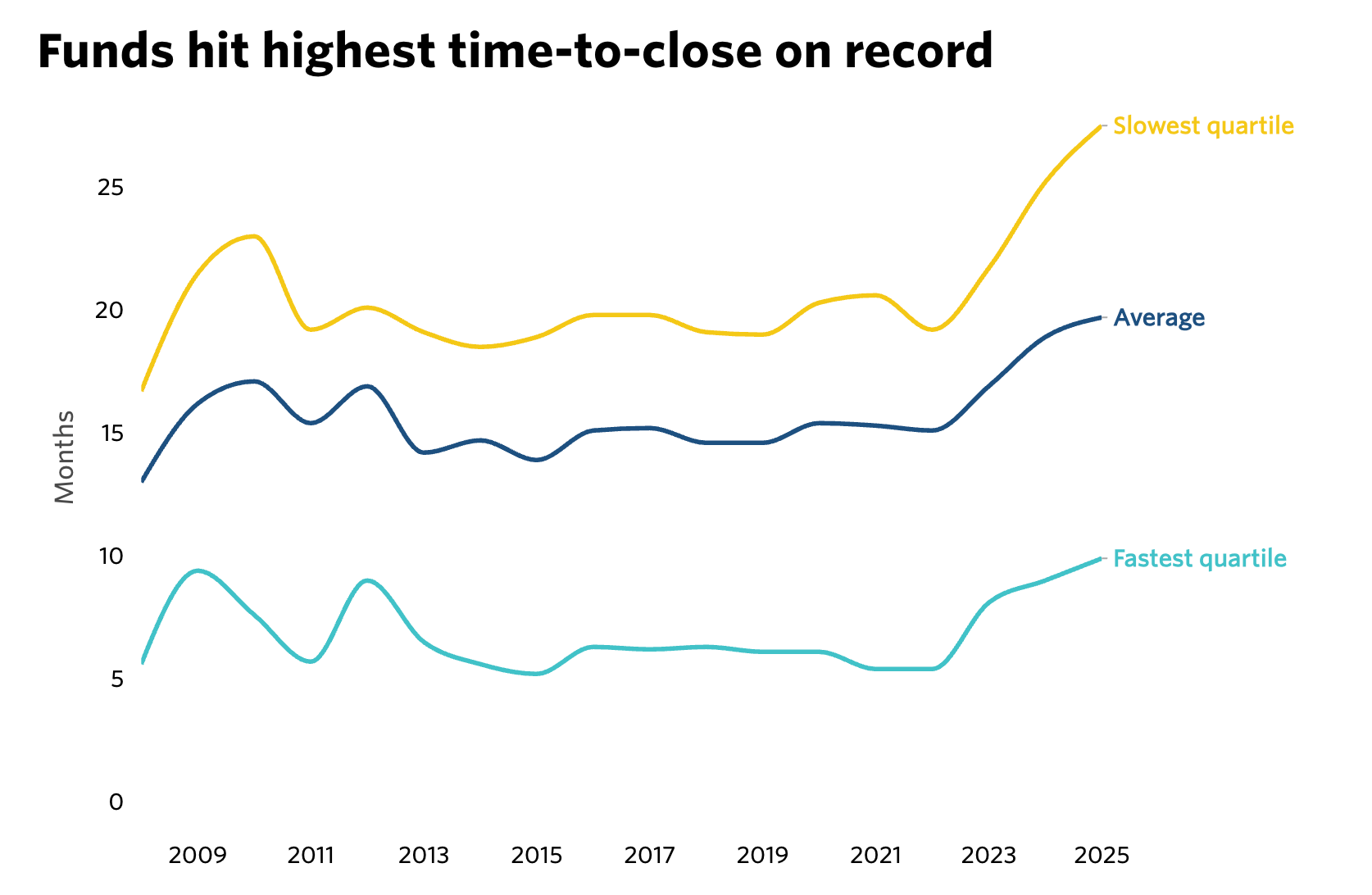
Time-to-close keeps climbing: PitchBook’s Q2 2025 report shows the average private capital fund now takes 19.7 months to close, up from 18.9 months in 2024 and 14.6 months in 2019. Managers are being told to expect to still be in the market a year after first close.
LPs are dictating terms: Zero management fees, guaranteed co-investment rights, board seats, and LPAC representation are all on the table. Instead of rushing into first close, LPs now wait for the final close — even paying late interest fees — so they can see half the portfolio before writing a check.
Liquidity crunch is fueling caution: With exits delayed, distributions are drying up, leaving LPs with less fresh capital to reallocate. GPs are resorting to continuation vehicles or portfolio company loans to buy time until market conditions improve.
The pendulum has swung firmly to LPs. Transparency, creative structuring, and patience are mandatory — the old playbook of quick closes and standard 2/20 economics won’t cut it in this market. (Read the full report here by Pitchbook)
Pitchbook Data: Why serial founders dominate VC fundraising in 2025
PitchBook data shows repeat founders have a clear fundraising edge — and the gap is only widening.
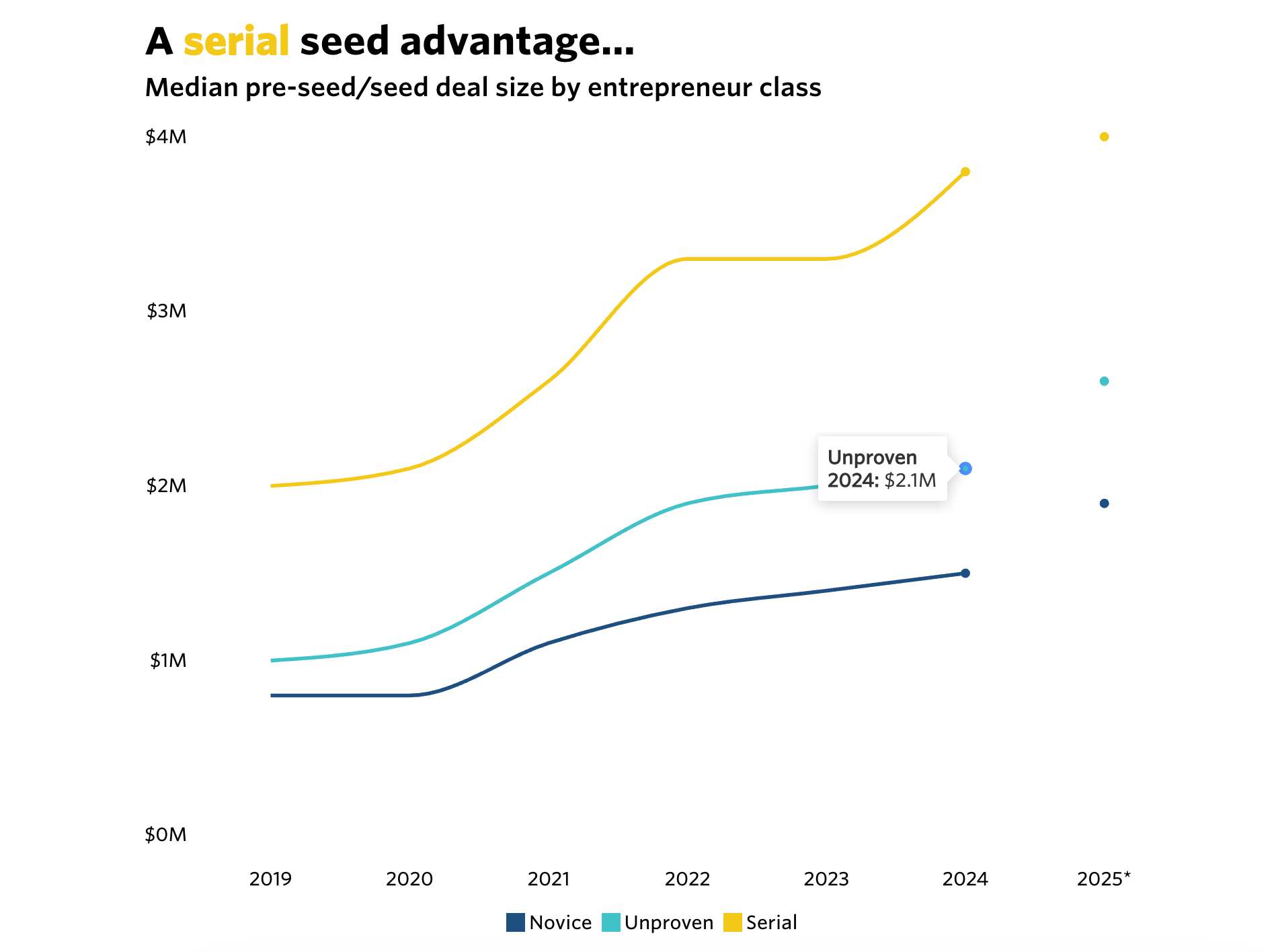
Valuation premium: Startups led by serial entrepreneurs are valued 2–3x higher than those led by first-timers, across every stage. The gap starts early and compounds as companies scale.
Deal size advantage: VCs are writing bigger checks to repeat founders, even if their prior companies didn’t have blockbuster exits. Investors call it a “flight to safety” — track record matters more than novelty.
Macro pressures amplify bias: Uncertainty around trade policy, rising AI build costs, and a still-tight liquidity environment push investors toward founders they see as “known quantities.” Serial entrepreneurs fit that bill.
Why this matters:
For first-time founders, the bar is higher than ever — investors want proof you can deploy capital efficiently. The upside? You’re less constrained by playbooks and can take bolder bets.
For investors, the “flight to safety” might backfire. As Chris Neumann warns: chasing serial founders reduces variance but also reduces potential fund outperformance.
In today’s market, fundraising is tilted toward repeat founders. First-timers will need sharper narratives, early traction, or unique technical edges to stand out.
TOOL FOR FOUNDERS
📑 The VC-Ready Data Room Kit Every Founder Needs
Most founders mess up when investors ask for a data room—either oversharing too early or scrambling last minute. Both kill momentum.
The Investor Data Room Superpack fixes this. It includes:

Ready-to-use templates (pitch deck, traction docs, cap tables, legal files)
A 2-stage structure that investors actually expect
Best practices + mistakes to avoid
🎁 Bonus: Investor Q&A prep guide
Built by founders & VCs, no fancy tools needed—just Notion or Drive.
SOMETHING MORE
🧩 Frameworks & insightful posts
OpenAI just revealed billion-dollar AI markets: OpenAI’s 1.5M chat study
OpenAI + Harvard just analysed 1.5M conversations (May 2024–July 2025) — the largest dataset ever on ChatGPT consumer usage. The takeaway? Every bar in the chart is basically a vertical SaaS/AI startup waiting to be built.
Some highlights worth zooming in on:
Tutoring & teaching (10.2%)
AI tutors that remember context, adapt to learning styles, and nudge daily progress could become the holy grail of EdTech.How-to advice (8.5%)
From resumes to Shopify stores, these “help me figure it out” queries map to micro-SaaS vertical coaches (legal, HR, sales, PR).Personal writing + editing (18% combined)
Emails, edits, critiques, translations — the winners here won’t be general chatbots but workflow-native copilots embedded into specific tools.Health, fitness, self-care (5.7%)
Consumers already trust AI with their bodies. Huge opening for vertical AI coaches layered with human accountability.Purchasable products (2.1%)
Tiny share, massive upside. People literally ask “what should I buy?” Whoever nails the AI shopping layer = the new SEO/affiliate giant.
Macro signals:
77% of usage = info-seeking, guidance, writing
46% of all convos are from 18–25 year-olds
Adoption in low-income countries is growing 4x faster than in wealthy ones
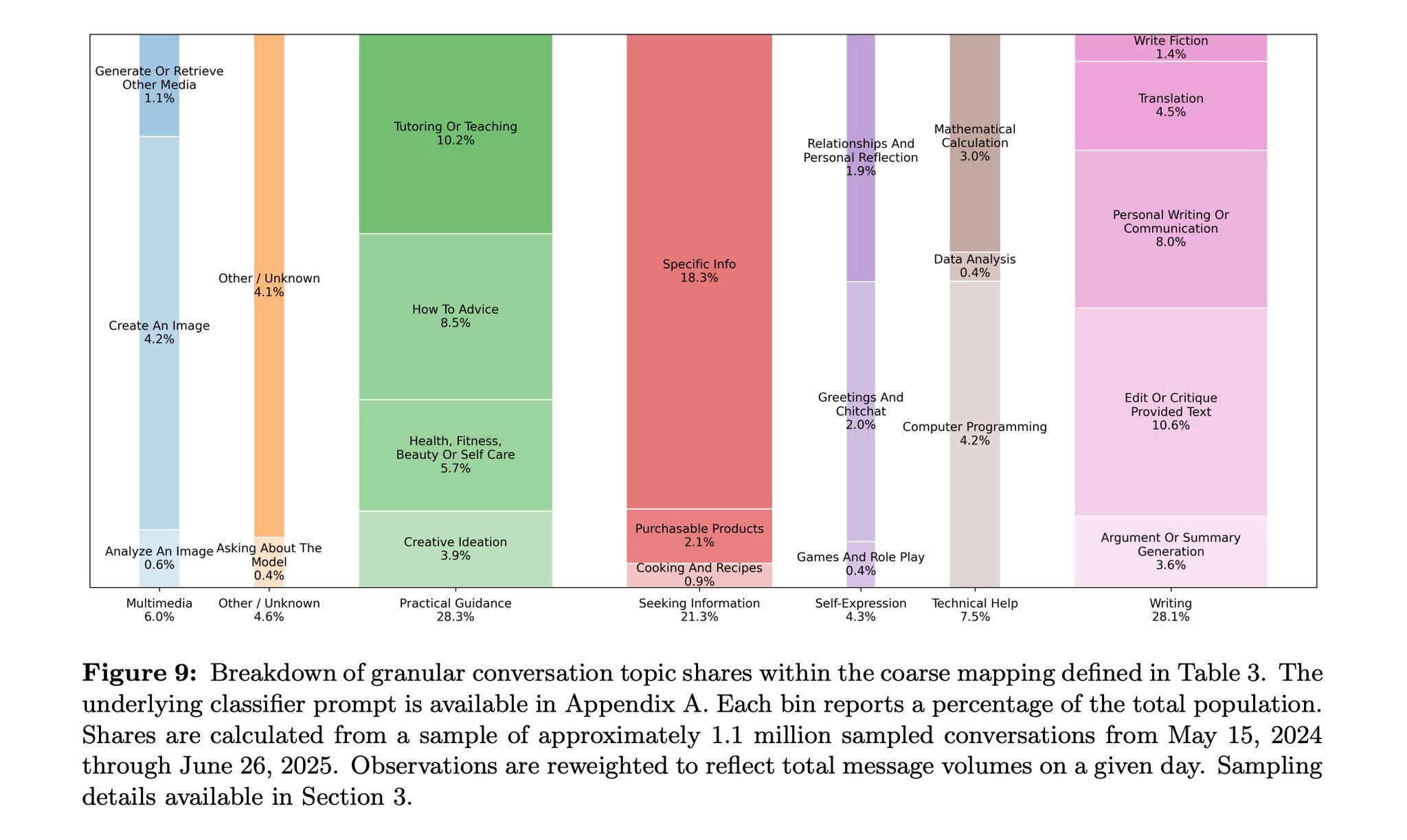
OpenAI just handed founders a heatmap of where consumers already show intent. Each usage slice can be verticalized into a trust-rich AI product — the playbook is to go narrow, contextual, and embedded.
How to navigate PMF in Vertical SaaS (stage by stage).
Most founders think of product-market fit as a binary “you have it or you don’t.” But in vertical SaaS, PMF is more like a spectrum — you move through urgency, repeatability, and scalability in layers.
Here’s a stage-by-stage playbook based on the Healthy Vertical SaaS PMF by Stage framework (Shared by Euclid Venture):

Level 1 – Pre-Revenue (Inception / Pre-Seed)
What matters: Finding urgent demand, not just “logical demand.”
Practical move: Talk to design partners and confirm the hair-on-fire problem in your ICP. Don’t sell a product — uncover a job-to-be-done.
Level 2 – First Customers (Pre-Seed / Seed)
What matters: Urgency validated, early customers willing to pay.
Practical move: Focus on 2–3 early adopters who are standard-bearers in your vertical. Don’t chase every use case — double down where urgency is highest.
Level 3 – Signs of Traction (Seed)
What matters: Repeatability — early customer wins that look similar.
Practical move: Founder-led sales should now shift into a crude but working GTM. Hire an “industry evangelist” who speaks your customer’s language and can open doors.
Level 4 – Early Growth (Seed / Series A)
What matters: High retention + referrals = proof of pull.
Practical move: Codify the sales motion. Start exploring expansion products or segments but only after you’ve nailed your ICP. The first adjacent product should prove you can be more than a feature.
Level 5 – Scaling (Series A+)
What matters: Scalability — customers spread you via word-of-mouth, CAC drops, ARPU grows.
Practical move: Leverage early success into building a platform. Layer in new products, customer segments, and distribution models that widen your moat.
Most vertical SaaS failures don’t die because the product was bad. They die because founders confused early validation with repeatability, or mistook logical ROI for urgent demand. This framework helps avoid that trap by matching PMF levels with the right founder focus at each funding stage.
Why do VCs pass on profitable startups and chase hype instead?
Every founder has felt it: that sting of watching a hype-fueled startup with no product and no revenue raise millions, while your cash-flow-positive, growing business struggles to even get a meeting.
It feels unfair. And it is.
But there’s a deeper logic behind it. One that has little to do with how “good” your business is and everything to do with how venture capital works.
Recently, Steve Blank broke down why so many real businesses with customers, revenue, and even profits often fail to attract VC attention. The core idea? Venture capital isn’t built to fund good businesses. It’s built to fund massive ones.
Most founders misunderstand what investors are actually looking for. They assume that solid traction and profitability should be enough.
But venture capital follows a different playbook entirely.
Here’s what many founders miss:
VCs are in the business of power-law outcomes. They need 10x–100x returns to make their math work. A steady-growing $20M company might be a great business but it’s not the billion-dollar rocket ship they’re hunting for.
Your startup is a financial instrument. The moment you raise venture money, your company becomes part of a portfolio. Investors aren't just betting on your growth they’re betting on a future exit (IPO, acquisition, or secondary sale) within 7-10 years.
Perception drives value. Especially now, when IPOs are rare and secondaries are a popular liquidity path, what matters is how compelling your company looks to the next investor in line. The story you’re telling has to be big, bold, and believable.
This is also why certain sectors become hot overnight. Once a few top-tier firms back AI companies, everyone wants in. The result?
Floods of capital chase a handful of “hot” categories
Even questionable ideas get funded if they have the right narrative
Meanwhile, proven but “unsexy” companies get ignored
And secondaries have quietly changed the game. With fewer public exits, many investors are making money by selling their stakes to other funds. These aren’t new shares, they’re early investors cashing out while the company is still private.
But this only works if the startup’s perceived value keeps rising so hype and optics matter more than ever.
So what can you do?
Understand the game. Your business may be amazing, but that doesn’t mean it’s venture-scalable. And that’s okay.
Match your story to the investor. Some funds chase trends. Others back overlooked gems. Know which one you’re pitching.
Don’t assume they’ll “get it.” You have to show them why your company can be massive and do it in a way that aligns with their timelines, incentives, and risk appetite.
Because once you take VC money, their model becomes your reality. If you don’t fit what they’re looking for or don’t know how to frame your business in a way that does you’ll keep hearing “no” for reasons that have nothing to do with the actual quality of what you’re building.
And if you do have the kind of story they’re chasing? Now’s the time to go big. Just remember: what they want isn’t a business. It’s a breakout.
What are the right metrics to measure generative AI’s success?
Every time a new platform emerges, we scramble to measure its impact. But early on, it’s rarely clear what to measure or why it matters.
We saw this with the early internet. In the 90s, people tracked things like “internet hosts” or “hits”, which just counted how many files your browser downloaded from a web server. More GIFs meant more hits. Not exactly insightful.
Then came the smartphone wave, and the confusion shifted to installed base vs. unit sales vs. ARPU.
Social media added its evolution: first it was “registered users,” then MAU, then DAU/MAU ratios. Each wave had its metrics, often chosen to make a company look good, not to reflect actual value.
We’re at that same messy phase with generative AI.

Benedict Evans recently broke this down brilliantly. He pointed out that many of today’s AI metrics sound impressive but don’t tell us much.
“Tokens generated” charts from Google or Microsoft are like 1990s internet bandwidth graphs;, something is growing, but we can’t tell what or why.

“Weekly active users” (WAU) is another one nice to report, but weak. If someone’s using ChatGPT once a week, is that meaningful? Probably not.
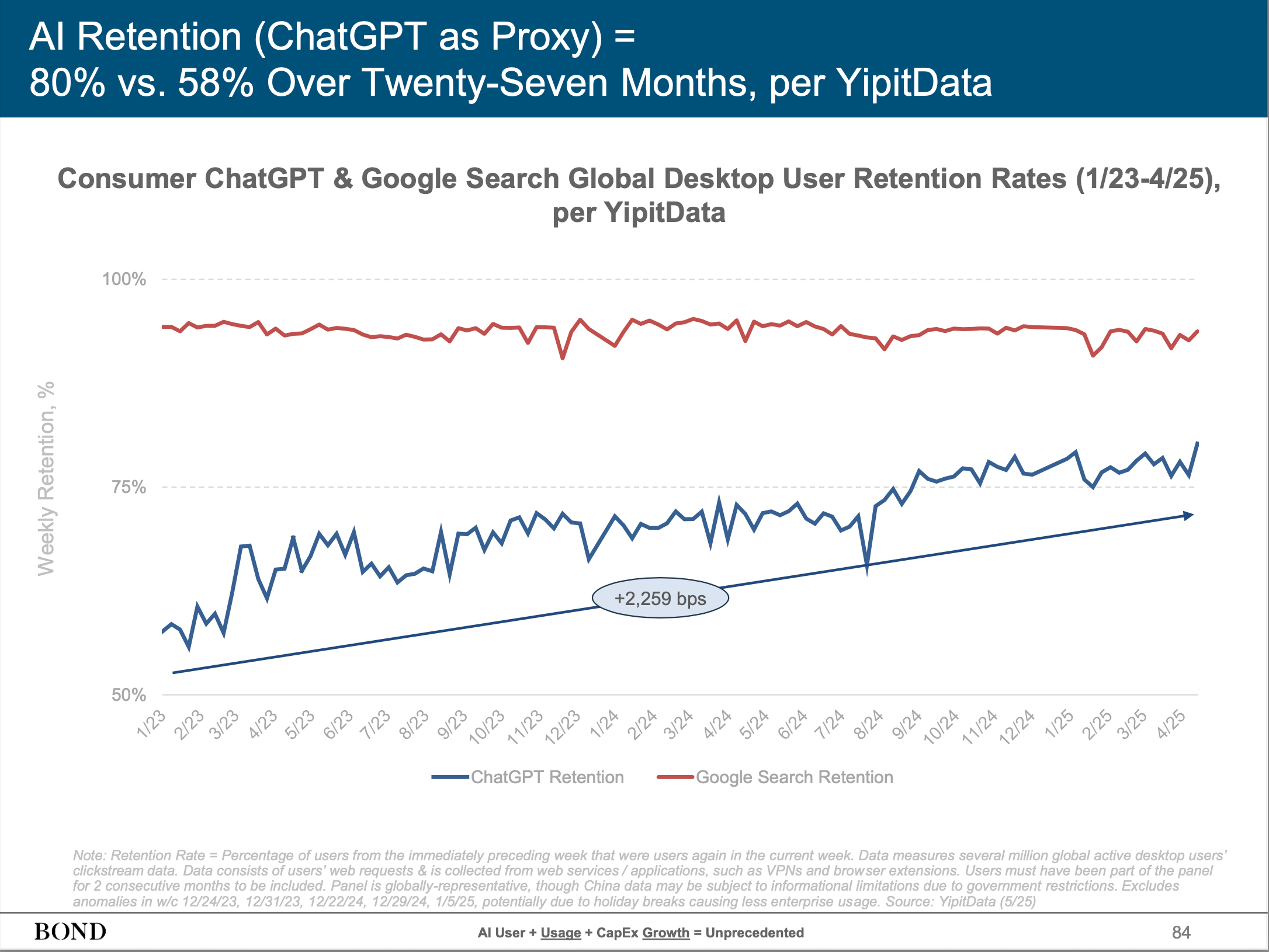
Many surveys ask people, “Have you used AI?” but what does that even mean anymore? Are we counting Snapchat filters or full-blown enterprise LLM workflows?
Even when the numbers are specific, they often lack clarity:
If a model becomes more efficient, the same task needs fewer tokens, so are we seeing a drop in usage or just better technology?
On the flip side, agents and media tools burn more tokens per request, so growth might reflect heavier workloads, not more users.
And we’re still guessing at what generative AI will become. That makes choosing the “right” metric nearly impossible.
Will it mostly remain as user-facing chatbots? Or will it quietly integrate into everything, like SQL or cloud compute?
If it becomes infrastructure used everywhere but rarely seen, then asking “how many people use AI?” is as pointless as asking “how often do you use a database?”
So what should we be tracking?
Engagement quality – not just logins, but how deep and meaningful the interaction is.
Retention over time – are people coming back, and are they using it more meaningfully?
Task replacement – what jobs or workflows are users abandoning in favor of AI tools?
Behavioural feedback – are people satisfied on the first try, or do they constantly?
Enterprise integration depth – is it casual use by the marketing team or core to ops?
Other things like how companies like Google and Meta measure deeper signals: reformulated searches, bounce rates, completion behaviour. These are second and third-order indicators that show what’s working, and they often feed back into making the product better.
Right now, generative AI lacks those feedback loops. If you ask an LLM a question and don’t try again, was the answer perfect? Or did you give up and switch to Google? No one can tell.
At the end of the day, all metrics eventually resolve to money and time. That’s where clarity will come from, only once we know what generative AI is truly for. Until then, we’re still counting hits. (You can read the original article here.)
Where to post your startup and get first users.
If you're building something new, one of the hardest (and most underestimated) parts is getting your first users.
You’ve spent days, maybe weeks, writing code, designing the UI, and pushing features live. But when it's time to share it with the world, you're stuck wondering:
Where do I even post this? Who’s going to care?
The truth is: distribution matters as much as the product, especially in the early days. And you don’t need a growth team to get started. What you do need is a list of places where early adopters, builders, and curious users hang out and where sharing your startup can actually move the needle.
Here’s a practical breakdown of where to post your startup from launch platforms to niche communities to software directories that can help you go from invisible to discovered.
Launch platforms:
Great for buzz, validation, and early adopters who love trying new tools.
ProductHunt - use this guide to plan your launch
Software directories:
Think of these as long-term SEO and trust-building channels. Great for credibility.
Lifetime deals platforms & groups:
Useful if you want early cash, rapid feedback, and distribution all at once.
Subreddits (always check the rules before posting anything):
Not for everyone, but if you post with context and care, it’s a goldmine. You can even check out our guide on how to use Reddit to onabrod customers for your startup.

You can find more startup listing ideas here. Also, if you’re running an AI startup, you can check out this list.
EXPLORE MORE
💡 Reports, Articles and a few interesting stuffs
Wilmer Terrero on the one change that increased conversion by 15% (Link)
Cody Schneider on how personal brand building impacts fundraising (Link)
Greg Isenberg on the clearest path to building a $100k MRR mobile app (Link)
The DeepSeek Hype Was Made Up. (Link)
Are you selling agents the way customers want to buy? (Link)
Garry Tan’s advice for early-stage startup founders. (Link)
Jensen Huang’s advice for founders raising their first round. (Link)
NEWS RECAP
🗞️ This week in startups & VC
New In VC
VoLo Earth Ventures, a Snowmass, CO-based investment firm, closed its second fund at $135M. (Link)
T.Rx Capital, a Boston, MA and San Francisco, CA-based venture capital firm focused on early-stage healthcare innovation, closed its inaugural fund at $77.5m. (Link)
Aspire11, a Prague-based venture capital firm, launched its debut fund with €500 million in committed capital. (Link)
Alt Capital, a solo-run venture firm founded by Jack Altman, has raised a new $275 million early-stage fund in just one week. (Link)
New Startup Deals
Figure, the San Jose, CA-based AI robotics company, exceeded more than $1 Billion in committed capital through its Series C financing round, at a post-money valuation of $39 Billion. (Link)
Severo Health, a NYC-based virtual neurology company, raised $39M in Series B funding. (Link)
Ultralytics, a London, UK-based company which specializes in vision AI at the edge, raised $30M Series A funding. (Link)
Aleph, a NYC-based AI-native FP&A platform provider, raised $29M in Series B funding. (Link)
Modern Animal, a Los Angeles, CA-based veterinary company dedicated to improving pet care, raised $46M in funding. (Link)
Eve Security, an Austin, TX-based provider of an agentic AI observability and policy enforcement platform, raised $3M in Seed funding. (Link)
TODAY’S JOB OPPORTUNITIES
💼 Venture capital & startup jobs
All-In-One VC Interview Preparation Guide: With a leading investor group, we have created an all-in-one VC interview preparation guide for aspiring VCs. Don’t miss this. (Access Here)
Investor, SF Launch - Entrepreneur First | USA - Apply Here
Senior Analyst - Iconiq Capital | USA - Apply Here
VP - Marketing & Communications - Transition VC | India - Apply Here
Investment Analyst - Miras Investment | Dubai - Apply Here
Associate - Iconiq Capital | USA - Apply Here
Program Manager - Tenity | UK - Apply Here
Senior Analyst - Iconiq Capital | USA - Apply Here
VP - Marketing & Communications - Transition VC | India - Apply Here
Investment Analyst - Miras Investment | Dubai - Apply Here
Associate - Iconiq Capital | USA - Apply Here
Program Manager - Tenity | UK - Apply Here
Investor Relations Analyst - Griffin Gaming Partner | USA - Apply Here
Associate - OMERSE Venture | USA - Apply Here
Investment Analyst - Caanan | USA - Apply Here
VC Associate UK - Breega | UK - Apply Here
Investment Team - Noba Capital | UK - Apply Here
Venture Capital Analyst Intern - DRW Venture Capital | USA - Apply Here
PARTNERSHIP WITH US
Get your product in front of over 95,000+ audience - Our newsletter is read by thousands of tech professionals, founders, investors and managers worldwide. Get in touch today.
🔴 Share Venture Curator
You currently have 0 referrals, only 5 away from receiving a 🎁 gift that includes 20 different investors’ contact database lists - Venture Curator
Great curation. Love this..