

👋 Hey, Sahil here — Welcome back to Venture Curator, where we explore how top investors think, how real founders build, and the strategies shaping tomorrow’s companies.
Big idea + report of the week :
The AI categories VCs are overpaying for right now.
Why unicorns are staying private for much longer.
VCs pull back from China AI investment - why?
Frameworks & insightful posts :
Why do VCs care so much about who’s leading your round?
How investors value pre-revenue startups with an Excel sheet.
Has building software quietly become 10× cheaper overnight?
Why do AI companies hire fewer juniors and more seniors?
FROM OUR PARTNER - SEMRUSH
🤝 See what drives your competitors’ growth — before they do

Every winning strategy starts with the right data. With Semrush’s Traffic & Market Toolkit, you can uncover exactly where your competitors’ traffic comes from — search, social, or even AI referrals.
Track their top pages, monitor emerging trends, and find the untapped channels fueling their growth. Whether you’re a marketer, agency, or enterprise, you’ll get daily and weekly insights to outpace rivals and lead your market with confidence. Trusted by 10M+ marketers worldwide.
Try the Traffic & Market Toolkit free →
🤝 PARTNERSHIP WITH US
Get your product in front of over 103,000+ audience - Our newsletter is read by thousands of tech professionals, founders, investors and managers worldwide. Get in touch today.
START WITH
🧠 Big idea + report of the week
The AI categories VCs are overpaying for right now.
PitchBook’s 2026 Artificial Intelligence Outlook flags a clear warning: some of the most hyped AI subsectors today are also the most vulnerable to capital destruction.
The common pattern across these areas isn’t a lack of demand; it’s too much sameness.
What’s overheating right now

AI code generation
So-called “vibe coding” startups built on top of large language models have exploded in traction and funding. Cursor hit $100M ARR in just 12 months.
Cognition doubled revenue in a single quarter. That success pulled in waves of copycats, many offering marginal improvements on the same underlying models. As more capital chases the same workflow, differentiation collapses fast.
Autonomous driving software
Self-driving AI remains capital-intensive, slow to commercialize, and heavily regulated. Despite years of progress, timelines remain uncertain and competition is brutal. For many startups, the burn curve is steep while defensibility is thin.
Generative engine optimisation (GEO)
Startups optimising how brands appear inside ChatGPT or Claude resemble early SEO plays but with far less control.
Platforms can change ranking logic overnight, wiping out product value. Analysts see this as especially fragile infrastructure.
Precision medicine AI
AI-driven genomics and diagnostics promise breakthroughs, but face long validation cycles, regulatory risk, and complex go-to-market paths. Capital is flowing faster than clinical proof.
Why this matters
PitchBook analysts point out that these sectors share a dangerous trait:
lots of startups, little structural differentiation, and heavy dependence on foundation models they don’t control.
When markets crowd this tightly, outcomes don’t average out they skew toward a few winners and widespread losses.
For founders & VCs
AI isn’t overheated everywhere. But in crowded, obvious categories, the window for undifferentiated entrants is closing fast. Future winners will be defined less by “AI inside” and more by distribution, proprietary data, workflow lock-in, and real switching costs.
In the next cycle, value won’t be destroyed quietly; it will be written down all at once.
Why unicorns are staying private for much longer.
A recent analysis by Stanford GSB’s Ilya Strebulaev shows a clear shift in how long unicorns remain private. The takeaway is simple but important: private capital has reduced the urgency to exit, and public markets are no longer the default endgame.

What the data shows:
2011 cohort: About 51% of unicorns founded in 2011 are still private. These are companies more than a decade old that have chosen to delay IPOs or acquisitions.
2021 cohort: Roughly 77% of unicorns founded in 2021 remain private, highlighting how slow the liquidity path has become for recent high-growth startups.
Even older companies linger: Among unicorns founded in 2004, around 27% have still not exited nearly 20 years later.
What’s driving this trend:
Deep private markets mean late-stage capital can replace public listings.
Founders and investors can optimize for control, timing, and valuation rather than speed to IPO.
Market volatility has made staying private a safer option than testing public markets early.
Why this matters:
Liquidity timelines are stretching across every vintage, not just recent ones.
LPs wait longer for distributions.
IPOs are becoming a strategic choice, not a milestone.
Unicorn outcomes are no longer tied to quick exits. Private capital has reshaped the startup lifecycle, turning “staying private” into a long-term strategy rather than a temporary phase.
VCs pull back from China AI investment - why?
China’s AI giants are delivering strong public-market returns, but venture capital tells a different story. According to PitchBook, only $6B has been invested across 574 AI deals in 2025, a steep drop from last year’s totals.

Global contrast: US AI funding has surged 61.5% YoY to $174.6 billion, while Europe is up 19% to nearly $22B.
Fewer mega-rounds: This year’s largest China AI deals, MiniMax ($300M) and Leju Robotics ($200M), highlight the shrinking scale of private capital deployment.
Capital constraints: Chinese VC fundraising is now less than one-fourth of 2024’s levels, which were already the weakest in nearly a decade.
Foreign capital pullback: Dealmaking involving international investors dropped to 112 deals worth $2.1B in H1 2025, as geopolitical tensions intensify and the US tightens chip export controls.
Policy response: In March, Beijing launched a 1 trillion yuan ($140B) government-backed tech fund to bridge the funding gap and maintain competitiveness.
Despite the funding freeze, China continues to lead globally in AI research output and patents, according to Stanford’s 2025 AI Index Report. But for now, venture dollars are flowing elsewhere, as investors weigh geopolitics, regulation, and the rising cost of AI scale.
FROM OUR PARTNER - ARTISAN TROPIC
🥑 From $52M revenue to national domination: why investors are backing Artisan Tropic
Artisan Tropic is a fast-growing, clean snack brand that creates better-for-you tropical snacks made with real, whole ingredients, including its top-selling plantain strips, cassava chips, and organic grain-free crackers.
After generating $52M+ in lifetime revenue, they’re now opening up to outside investors for the first time.

Here’s why investors are excited:
$10M+ in revenue over the past 12 months with 40%+ gross margins
6,000+ points of sale, including Whole Foods, Target, Sprouts, Costco, Wegmans
New organic grain-free crackersare already in 1,500 stores nationwide
Top-selling plantain and cassava chips at Whole Foods for 5 years in a row
Scaling toward $50M+ in revenue by 2030 with a strategic rebrand launching in 2026
With a proven footprint in retail, category-leading products, and a strong brand foundation, Artisan Tropic is positioned for breakout growth and this is a rare opportunity to get in early before their 2026 institutional raise.
SOMETHING MORE
🧩 Frameworks & insightful posts
Why do VCs care so much about who’s leading your round?
This is one of the most annoying questions founders hear on a pitch: “Who else is investing?”
It often feels like code for “I’ll decide after someone smarter goes first.” But the data suggests it’s not just lazy signalling, it’s structural.
This insight comes from Peter Walker (Head of Insights at Carta), based on Carta data covering 13,000+ Seed and Series A rounds (2019–2025).
Here’s what’s actually happening beneath the surface.

Over the last few years, lead investors have been taking a bigger share of rounds, while the number of funds willing to lead has gone down.
In many recent Seed and Series A rounds, the lead is now taking 60–75%+ of the entire round, compared to ~50–55% a few years ago. At the same time, more funds are participating just not leading.
That changes incentives.
For a non-lead investor writing a smaller check, the identity of the lead suddenly matters a lot more. They’re implicitly underwriting the lead’s conviction, judgment, and future behaviour.
A few practical realities behind that question:
If one fund owns most of the round, they effectively control the outcome
Their ability (or willingness) to lead the next round becomes critical
If they don’t follow on, it sends a strong negative signal to future investors
Their domain expertise (or lack of it) affects how helpful they’ll be post-check
From the founder side, this explains why strong leads still unlock momentum, even in markets where VCs claim to be “independent thinkers.” The first check is still celebrated, but the right first check matters more than ever.
The real takeaway for founders isn’t “optimise for name-brand VCs.” It’s this:
Be deliberate about who you let lead
Understand how much of the round they’re taking ownership shapes power
Anticipate follow-on questions and signaling effects early
Realize that today’s market structurally favors fewer, more dominant leads
So yes, some investors ask this question for the wrong reasons. But in a world where leads increasingly own the round, “who’s leading?” is no longer a soft question it’s a risk question.
That’s the shift founders need to internalise.
How investors value pre-revenue startups with an Excel sheet.
Even with $0 in sales, your startup can have a strong valuation if you understand the levers investors pull. Valuation isn’t just about money coming in; it’s about perceived potential, team credibility, and the size of the opportunity.
Pre-revenue reality:
You don’t have revenue yet, but investors still see value in the story you’re building.
Early credibility builds trust with partners and makes it easier to attract top talent.
Market perception plays a big role, how you’re seen will influence deal terms and equity split.
The common methods investors use:
Berkus Method: Values five areas (idea, team, product, market, launch) at up to $500K each, capping most valuations at ~$2.5M.
Scorecard Method: Benchmarks your startup against similar ones, adjusting for strengths, weaknesses, and competitive landscape.
VC Method: Starts from a projected exit revenue, applies profit multiples, and works backwards to match investor ROI targets.
Risk Factor Method: Rates 12 risk categories from team quality to market size, adding or subtracting value based on each.
Boosting your valuation before revenue:
Build an MVP to prove you can deliver.
Showcase a strong, credible founding team with relevant track records.
Choose market comps that work in your favour.
Land early sales or pilots before fundraising to show momentum.
We’ve included a detailed breakdown of each method, plus an Excel valuation calculator for each method, in our full guide: Valuation Guide
Has building software quietly become 10× cheaper overnight?
Agentic coding isn’t just about making developers faster. It’s collapsing the implementation cost of software in a way we haven’t seen since open source or cloud first showed up.
For nearly two decades, software costs barely moved down.

Open source helped. Cloud shifted capex to opex. But complexity exploded with microservices, CI/CD, infra orchestration, frontend stacks, so total effort stayed high. Most of the cost was never typing code anyway. It was coordination, reviews, setup, waiting, and rework.
What’s different now is that agentic coding removes the human coordination tax.
Instead of:
multiple engineers,
handoffs between frontend/backend,
weeks of setup, reviews, and test writing,
a small team (sometimes one developer + an agent) can:
scaffold APIs, services, and data access,
generate large test suites,
ship internal tools in days instead of weeks.
The thinking time hasn’t changed. The execution time has collapsed.
A few practical implications (by Martin Alderson), founders and builders should internalise:
The real savings come from labour compression, not cheaper infrastructure.
Agents don’t just autocomplete they execute entire chunks of work that previously required multiple people and meetings.
Smaller teams beat larger teams now.
Brooks’s Law flips. Less headcount means less coordination drag, faster iteration, and fewer failure points.
Internal tools are the biggest unlock.
At $50k, only mission-critical tools get built.
At ~$5k (AI + human in the loop), latent demand explodes. Expect thousands of Excel workflows to quietly turn into apps.

Domain knowledge becomes the moat.
The value shifts from “who can code this” to “who understands the problem deeply enough to guide the agent well.” Bad specs still produce bad software just faster.
Software becomes disposable.
Wrong direction? Throw it away and rebuild. The hard work is deciding what to build, not implementing it.
This doesn’t mean “YOLO vibe coding” wins. Agents still need babysitting. But a strong domain expert paired with a capable developer is starting to look like the mythical 10× engineer, except it’s a system, not a superhero.
The bigger risk isn’t job loss. It’s the team that assumes this change is incremental.
People said similar things about mobile in 2007. The tools were bad. The networks were slow. The use cases felt narrow. Then the curve bent.
It’s bending again.
If you’re building, hiring, or planning roadmaps for 2026, the real question isn’t “Will AI reduce costs?”
It’s “What are we not building today because we still think software is expensive?”
Why do AI companies hire fewer juniors and more seniors?
Matt Schulman (CEO, Pave) shared an interesting org-chart analysis comparing “top AI companies” with traditional tech companies. The signal isn’t about layoffs or job losses; it’s about who companies are choosing to hire.
The data shows a clear pattern: AI-first companies are structurally more senior.
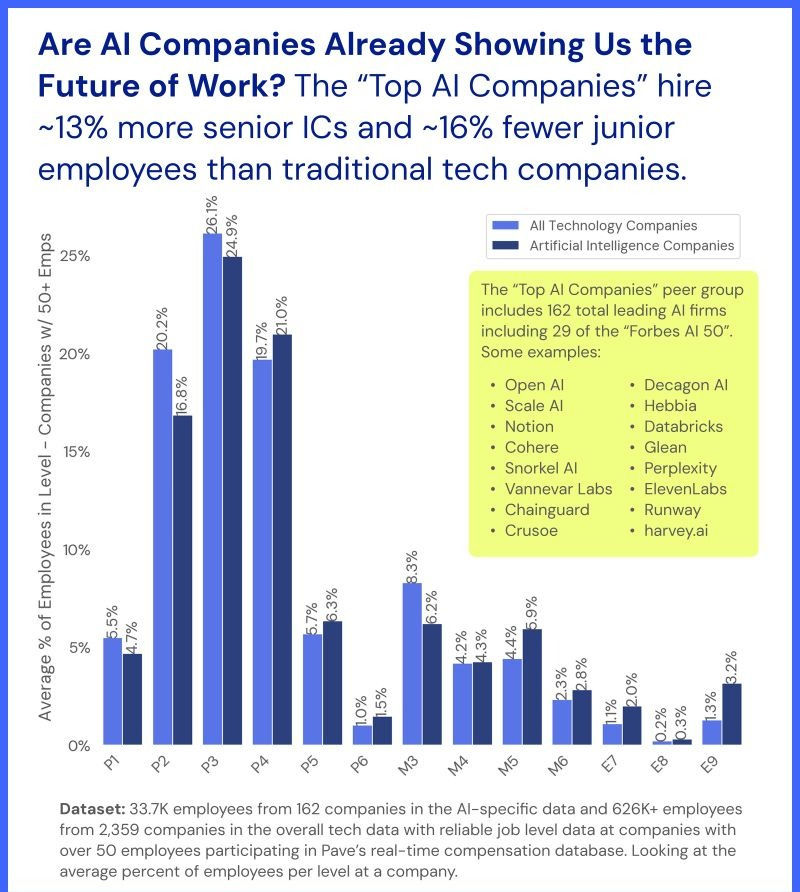
Top AI companies employ about 13% more senior ICs (P4–P6) and 16% fewer junior ICs (P1–P2) compared to traditional tech firms. In simple terms, their teams are flatter, leaner, and built around experienced operators rather than entry-level execution.
Why this matters is subtle but important. Early AI companies are aggressively using GenAI tools to automate routine work, the kind of work that historically trained junior engineers, SDRs, and support reps. As a result, they’re optimising for people who can:
define problems clearly
operate with minimal supervision
make high-leverage decisions
ship outcomes, not just tasks
This doesn’t mean juniors disappear overnight. It means the path into companies is changing.
Instead of large junior cohorts learning on the job, AI-first orgs are betting on smaller teams of senior ICs amplified by tooling. AI is acting like a force multiplier, compressing the bottom of the org chart while increasing expectations at the top.
What founders and operators should take away
If you’re building with AI, ask whether you need more people or more leverage per person
Junior roles aren’t gone, but they’re no longer the default hiring layer
Training, apprenticeship, and upskilling will matter more than raw headcount
The future org chart likely looks flatter, with fewer handoffs and more ownership per role
What this signals long-term
AI probably won’t “replace jobs” in a clean way. Instead, it reshapes org design, pushing companies toward senior-heavy teams and raising the bar for entry-level roles.
The real disruption isn’t AI vs humans. It’s AI vs low-leverage work.
EXPLORE MORE
💡 Reports, Articles and a few interesting stuffs
This mega prompt will make you viral on social media. (Link)
Why does startup leadership feel so lonely? (Link)
The only question that predicts startup success. (Link)
Big Ideas 2026 by a16z. (Link)
Debunking the hype of innovation and continuous growth. (Link)
Investor Outreach Email Sequence Pack: 20+ Proven Templates Used & Approved by VCs. (Link)
NEWS RECAP
🗞️ This week in startups & VC
New In VC
Integrity Growth Partners, a Los Angeles, CA-based growth‑equity firm focused on founder‑owned, growth‑stage technology companies, closed its $220m fund. (Link)
Fitz Gate Ventures, a Houston, TX-based early-stage venture capital firm, closed its third venture capital fund. (Link)
Holly Ventures, a San Francisco, CA-based newly formed venture capital firm, announced the launch of its $33M debut fund. (Link)
Kabir Narang, co-founder of B Capital and key Asia lead, has exited the $9B global firm to launch a new investment platform in 2026. (Link)
New Startup Deals
Serval, a San Francisco, CA-based provider of an AI-native IT service management (ITSM) platform, raised $75m in Series B funding, achieving a $1 billion valuation. (Link)
On Me, a San Francisco, CA–based personalised digital gifting platform provider, raised $6m in seed funding. (Link)
Bobyard, a San Francisco, CA-based provider of an AI platform helping contractors perform construction takeoffs and estimates, raised $35M in Series A funding. (Link)
EpilepsyGTx, a London, UK-based biotechnology company focused on research and development of gene therapies to treat refractory epilepsy, raised $33m in Series A financing. (Link)
Bon Credit, a San Francisco, CA-based provider of an AI platform focused on Generation Z credit and debt management, raised $3.5M in funding. (Link)
Haven Energy, a Los Angeles, CA-based energy tech company, raised $40M in funding. (Link)
TODAY’S JOB OPPORTUNITIES
💼 Venture capital & startup jobs
All-In-One VC Interview Preparation Guide: With a leading investor group, we have created an all-in-one VC interview preparation guide for aspiring VCs. Don’t miss this. (Access Here)
Investment Associate - Uphonest Capital | USA - Apply Here
Head of Atlassian Ventures - Atlassian Venture | USA - Apply Here
Program & Events Manager - Plug and Play Tech Centre | USA - Apply Here
Associate - Allocator One | UK - Apply Here
AI Lead / Technical Builder - Pan Adria Partner | USA - Apply Here
Associate, Secondary Investments - Adam Street Partner | USA - Apply Here
Chief of Staff – DeVC - Z47 | India - Apply Here
VC Investment Intern - First Momentum Venture | USA - Apply Here
VC Investor - Quamtum Light | UK - Apply Here
Head of Operations - Sagest Capital | USA - Apply Here
Portfolio Management Lead - Yzi Labs | Remote - Apply Here
Office Manager - Seedcamp | USA - Apply Here
(Senior) Investment Manager - Finch Capital | USA - Apply Here
Partner - a16z | USA - Apply Here
Investment Associate - Energy Impact Partner | London - Apply Here
VC Intern | lvlp Venture | Remote - Apply Here
PARTNERSHIP WITH US
Get your product in front of over 95,000+ audience - Our newsletter is read by thousands of tech professionals, founders, investors and managers worldwide. Get in touch today.
🔴 Share Venture Curator
You currently have 0 referrals, only 5 away from receiving a 🎁 gift that includes 20 different investors’ contact database lists - Venture Curator