

👋 Hey, Sahil here - welcome to today’s edition of Venture Curator, where we break down how great startups grow, how top investors think, and what’s shaping the future of tech.
P.S. Get access to 100+ startup & VC resources, investor databases, fundraising templates, 150+ premium archive posts and exclusive startup research - all in one place.
FROM OUR PARTNER - UNITARD
The 2021 hangover has a leaderboard now….

Some people YOLO’d into crypto in 2021. Tiger Global, SoftBank and BlackRock did it with unicorns: billion-dollar valuations, done over a weekend, priced as the party would never end. It ended.
440+ startups once worth $1 billion and more have fallen below the line, and about $1.46 trillion of paper value went with them.
Meet the Unitard Index, where every fallen unicorn is tracked: the peak, the drop, and who wrote the check. Check your fund before your LPs do.
Partnership With Us
Get your product in front of an audience of 125,000+ - Our newsletter is read by thousands of tech professionals, founders, investors and managers worldwide. Get in touch today.
📜 DEEP DIVE
Can you raise on a vibe-coded product?
Somewhere in the last eighteen months, “I built it myself” stopped meaning what it used to. A product that would have taken a technical cofounder and three months now takes a weekend and a Lovable subscription. Roughly four in five Lovable users are non-technical. A quarter of one recent YC batch had codebases that were 95% written by AI, and those founders were all engineers.
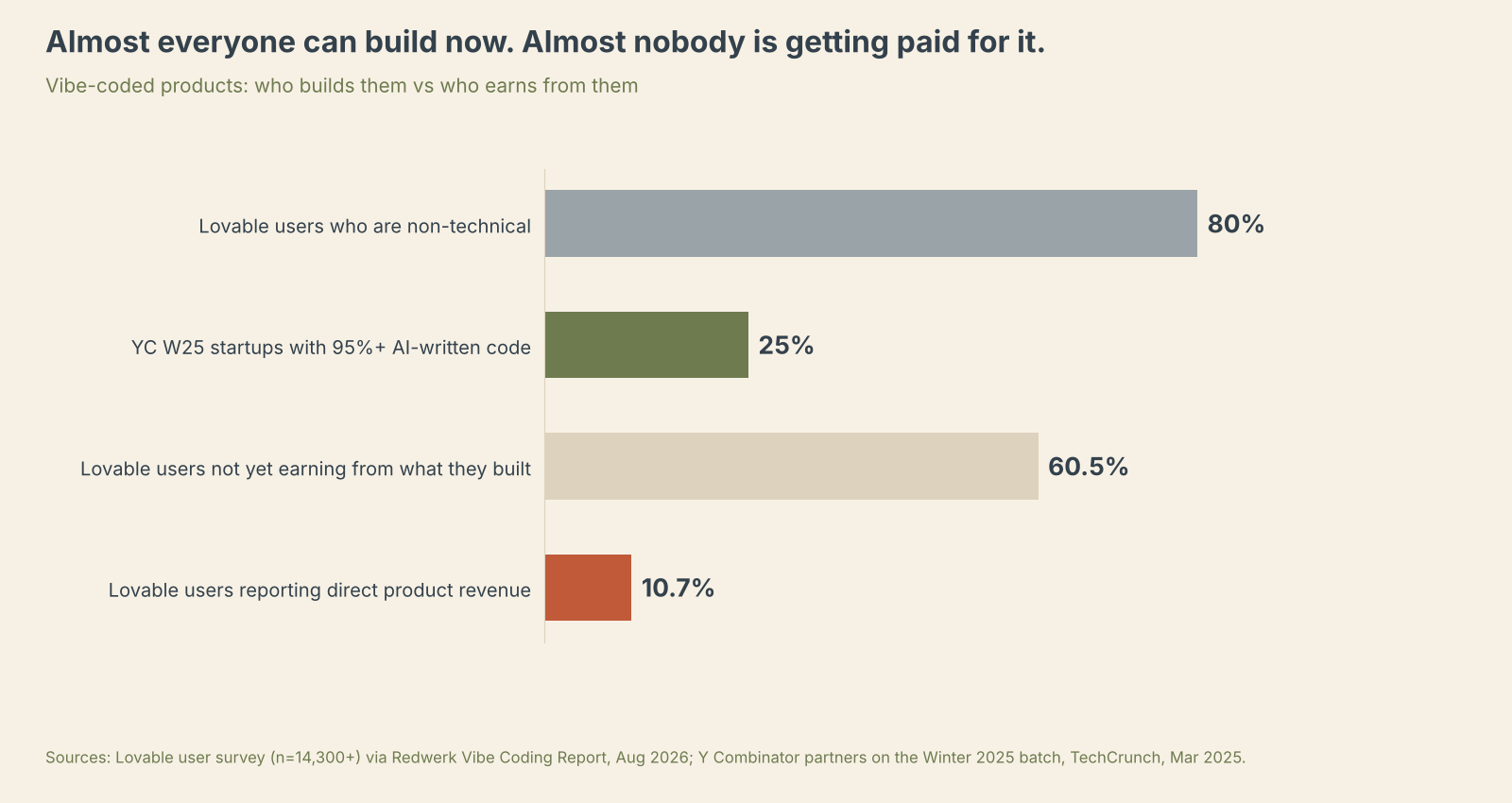
The building part is solved. The getting-paid part isn’t: in Lovable’s own survey of 14,000 users, only about one in ten reported direct revenue from what they’d built. Raising sits somewhere between those two numbers, and that’s the gap this piece is about.
So the question I get more than any other right now, from founders who’ve built something real without writing much code, is some version of this: will an investor fund it, or will they laugh me out of the room the moment they ask who wrote the backend?
The honest answer is that both happen. If you haven’t read the piece on what investors check in your financial model, this is the same idea applied to your code: there is a hidden check, and you can pass it if you know it exists, and the difference isn’t luck. I went looking for every company I could find that built its first product with a vibe-coding tool and then raised money, and I read what the investors who backed them said about why.
I also put the question to a few investors I know who write seed cheques, and their answers surprised me. Not one of them said AI-written code was a problem. Every one of them described a specific thing they check that most founders fail.
I’ll give you the data, the companies, what the audits find, and the eight questions that decide it.
Here’s what we’re covering:
Who has actually raised on a vibe-coded product, and how much?
Why don’t investors care that the code was AI-written, and what do they care about instead?
What does a technical audit find in a vibe-coded app? (The numbers are worse than you’d guess.)
At what stage does a vibe-coded product stop being enough: pre-seed, seed, Series A, or enterprise?
The eight questions investors ask, with what a pass and a fail look like for each
When should you rebuild, and what does it cost if you wait?
How do you position a vibe-coded product in the deck and the first meeting?
The pre-raise checklist: the fixes that take a weekend, the ones that take a month, and the ones that need an engineer
Vibe-coded companies are raising, and from serious funds
Let’s start with what’s actually happened, because most of the discourse on this is opinion.
Roadrunner is building AI-native configure-price-quote software. Its CEO, Joubin Mirzadegan, is a Kleiner Perkins partner. Mamoon Hamid, also at Kleiner, told Fortune that Mirzadegan walked into a one-on-one and said he’d “vibe-coded this over the weekend.” Kleiner led the seed. Founders Fund led the Series A. Total raised: $27M, and the first seven-figure customer deal closed within three months of the prototype.
Peec AI monitors how brands show up in ChatGPT, Perplexity and Gemini. The team built the first prototype in Vercel’s v0 in about a day and a half. It raised an $8M seed led by 20VC and then a $21M Series A led by Singular, and crossed $10M ARR about 16 months after launch.
Brickwise is an AI property manager that takes tenant calls. Built on Lovable, it got into YC’s Fall 2025 batch and has raised more than $3M.
Anything, a vibe-coding tool itself, hit $2M ARR two weeks after launch and raised $11M at a $100M valuation from Footwork, Uncork and Bessemer.
Plinq, a Brazilian safety app for women, built its first web version in Lovable in 45 days and raised R$1.3M, with Lovable’s own CEO Anton Osika among the angels.
Lumoo, a fashion imagery tool, started as a Lovable experiment and raised SEK 6M from angels.
That’s five companies spanning pre-seed to Series A, with Kleiner, Founders Fund, Singular, Bessemer and YC on the cap tables. The idea that vibe-coded means unfundable is dead.
But look closer at the list, and a pattern shows up.
Roadrunner’s prototype was a demo for CROs, not the product.
Peec’s technical team rebuilt the real product in about six weeks after the v0 prototype proved demand.
Anything built its own backend infrastructure in-house rather than relying on Supabase like its competitors.
Lumoo added an engineer to harden the backend.
In every case that got past seed, the vibe-coded version was the beginning of the story, not the thing that got funded at Series A.
Investors don’t care that AI wrote it. They care about something else.
When Business Insider asked seed and growth investors about vibe coding last year, the answers were consistent.
Bob Thomas at Oxx said investors are “shifting away from backing purely technical founders” and that AI fluency at seed is a plus.
Zoe Qin at Dawn Capital said she doesn’t grill CTOs on AI use, because the skill “should be evident in the depth and breadth of the product they’ve built.”
Yashwanth Hemaraj at BGV said the thing he looks for is an “architect mindset,” meaning systems-level thinking, not typing speed.
YC’s partners said something sharper when they disclosed the 95% figure.
Diana Hu: “You have to have the taste and enough training to know that an LLM is spitting bad stuff or good stuff.”
Garry Tan: the first versions of reasoning models “are not good at debugging,” so founders must understand what’s happening in the product in depth. Tan has since said YC treats a founder’s public repo as the audit trail for agency.
The investors I spoke with for this piece said the same thing in plainer terms. One put it like this: the question isn’t whether AI wrote the code, it’s whether anyone on the team can explain it. If the founder can walk through the auth flow and say what happens when two users are logged in at once, the AI question goes away. If the answer is “Lovable set that up,” the meeting is effectively over, whatever the demo looked like.
That’s the whole game at the pitch stage. But the pitch isn’t where vibe-coded products actually fail. They fail later, when someone opens the code.
And when someone does open it, the results are bad. In one audit of 26 AI-built apps this summer, 22 failed outright, and none passed cleanly. Across more than 5,600 deployed vibe-coded apps, researchers found over 2,000 serious vulnerabilities. The good news is that the failures cluster in the same few places, every time, which means you can find them before an investor does.
Below the line:
What an investor’s technical audit actually finds in a vibe-coded app, with the numbers from four separate studies
Where vibe-coded gets you and where it stops: pre-seed, seed, Series A and enterprise, with the companies at each rung
The eight questions investors ask about a vibe-coded product, with what a pass and a fail look like
When to rebuild, what it costs, and why month four is the cheapest point
How to position it in the deck and the first meeting, including the one line that turns it from a weakness into a signal
The pre-raise checklist, split into weekend fixes, month fixes and hire-an-engineer fixes