
👋 Hey, Sahil here — Welcome back to Venture Curator, where we explore how top investors think, how real founders build, and the strategies shaping tomorrow’s companies. Today’s edition features even more carefully curated content.
Big idea + report of the week :
The secretive VC firm behind Elon Musk’s empire.
How AI agent startups hit $500M ARR in 2 years.
Vibe Analysis: AI is about to change how we work with data.
Frameworks & insightful posts :
ESOP Value Calculator Template: How to communicate ESOP value to your team.
Tom Bilyeu’s $100,000 validation test before you build anything.
The 5-step cold email playbook every founder should copy.
Step-by-step GTM funnel to close your first 10 B2B deals.
How YC startups design LLM prompts that behave like agents.
INVESTMENT OPPORTUNITY FOR YOU
🧬 The Skin Cancer Screening Solution the World’s Been Waiting For - Why Investors Are Backing SkinBit.
SkinBit is building the first full-body AI skin scanner to deliver life-saving cancer detection in just 60 seconds. With a $15B market and millions of Americans left waiting for appointments, the need couldn’t be clearer.

Now, a proven team with over $1.5M already raised is bringing early detection to everyone, starting with two flagship clinics in Beverly Hills and San Francisco.
Why investors are excited:
Validated demand: 4 LOI signed, representing 55,000 patients, 3,000+ patients on waitlist
Proprietary 50,000-image dataset and Stanford dermatology backing
Projected $1M revenue per scanner/year with zero upfront clinic cost
FDA 510(k) filing in progress, with clinics launching in 2026
SkinBit combines hardware, AI, and clinical workflows into a single platform to accelerate early detection of skin cancer.
🤝 PARTNERSHIP WITH US
Get your product in front of over 95,000+ audience - Our newsletter is read by thousands of tech professionals, founders, investors and managers worldwide. Get in touch today.
START WITH
🧠 Big idea + report of the week
The secretive VC firm behind Elon Musk’s empire.
Vy Capital might be the most unconventional and effective investment firm in tech.
With a tiny team and almost zero public footprint, they’ve quietly become one of Elon Musk’s biggest backers, funding SpaceX, xAI, Neuralink, and Twitter/X, and producing results that most VCs only dream of.

Here’s how they operate and why they matter:
Lean team, massive returns: Vy runs with just 4 core investors and about 20 total staff, split between California, London, and Dubai. Despite this, they’ve managed $15B AUM and posted an average 28% annual return over 10 years, doubling the S&P 500.
All-in on Musk: They’re not just passive investors. Vy backed SpaceX at a $15B valuation (now ~$400B), put $700M into Twitter/X, and has large stakes in Neuralink and xAI. Some estimates suggest over half of Vy’s portfolio is tied to Musk-led ventures.
Minimalist by design: Their website is a single page. No media interviews. No pitch decks. Just quiet, outsized results.
Closed to outsiders now: After compounding billions, Vy recently told its LPs it won’t raise more outside capital. They’re now investing their own money, a rare move in venture.
Not just US bets: Vy was also an early investor in Zomato and Urban Company in India, as well as fintech company Upgrade, AI chipmaker Cerebras, and cyber-insurance firm Coalition.
What makes Vy different? They operate more like a high-trust family office than a traditional VC. Back the right people early. Keep the team small. Skip the noise. And ride long-term conviction to outsized outcomes. (Read here)
How AI agent startups hit $500M ARR in 2 years.
AI agent startups aren’t just raising billions; they’re turning into real revenue engines.
A new CB Insights report reveals that 42% of the top players are already commercialising or scaling. Some are pulling in $100M+ ARR just 2–3 years after founding.
What’s driving this growth?
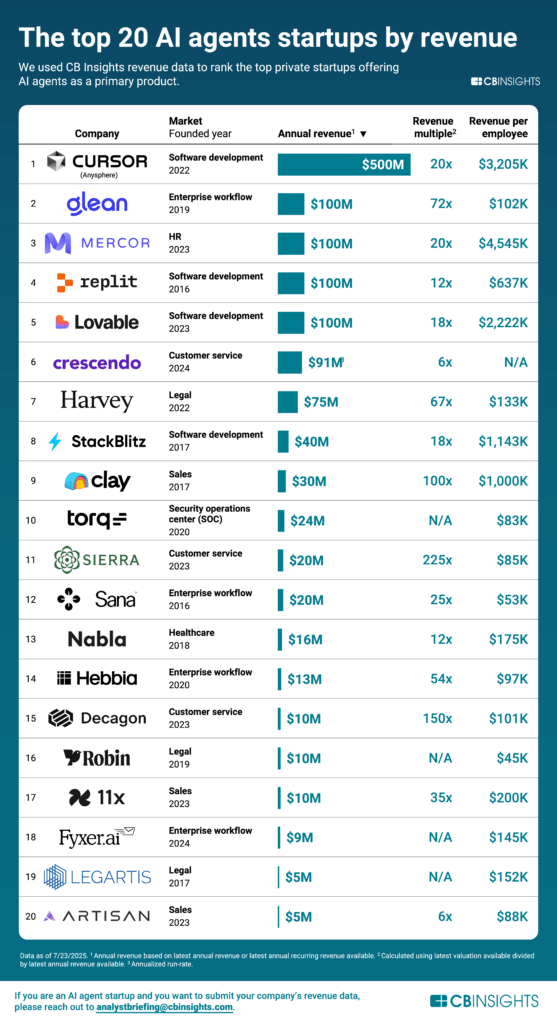
Workflow-focused agents win early: Startups targeting engineering, customer support, and internal enterprise workflows are scaling fastest. These use cases show immediate ROI and are easy for companies to adopt.
$13B+ in 2025: Enterprise AI agents & copilots are projected to grow from $5B (2024) to $13B ARR by the end of 2025, with companies like Cursor ($500M ARR), Mercor ($100M ARR), and Lovable ($100M ARR) leading the pack.
Insane efficiency: Cursor ($3.2M per employee) and Mercor ($4.5M per employee) are outpacing Microsoft and Meta in revenue per head. They’re operating at big tech levels, but with startup speed.
Valuation gaps show investor belief: Customer service AI agents are being valued at 127x revenue, far above the average 52x across the top 20. Why? Investors expect AI to rapidly replace support teams across the board.
Defensibility still unclear: The challenge ahead: Can these startups hold their position? As giants like Microsoft, Google, and OpenAI enter the space, moats will depend on: Proprietary data, Deep vertical focus, and switching costs via deep integrations
AI agents aren’t just the future; they’re already rewriting how fast software companies can monetise.
Vibe Analysis: AI is about to change how we work with data.
We’ve seen AI help write code. But what about analysis?
Dan Hockenmaier shared a write-up on Vibe Analysis — the moment when you stop running queries manually and start “talking” to your data.
Instead of analysts bouncing between SQL, Excel, dashboards, and reports, the future is a single AI-powered interface that understands your company’s data, answers tough questions, and even creates charts, all in one go.
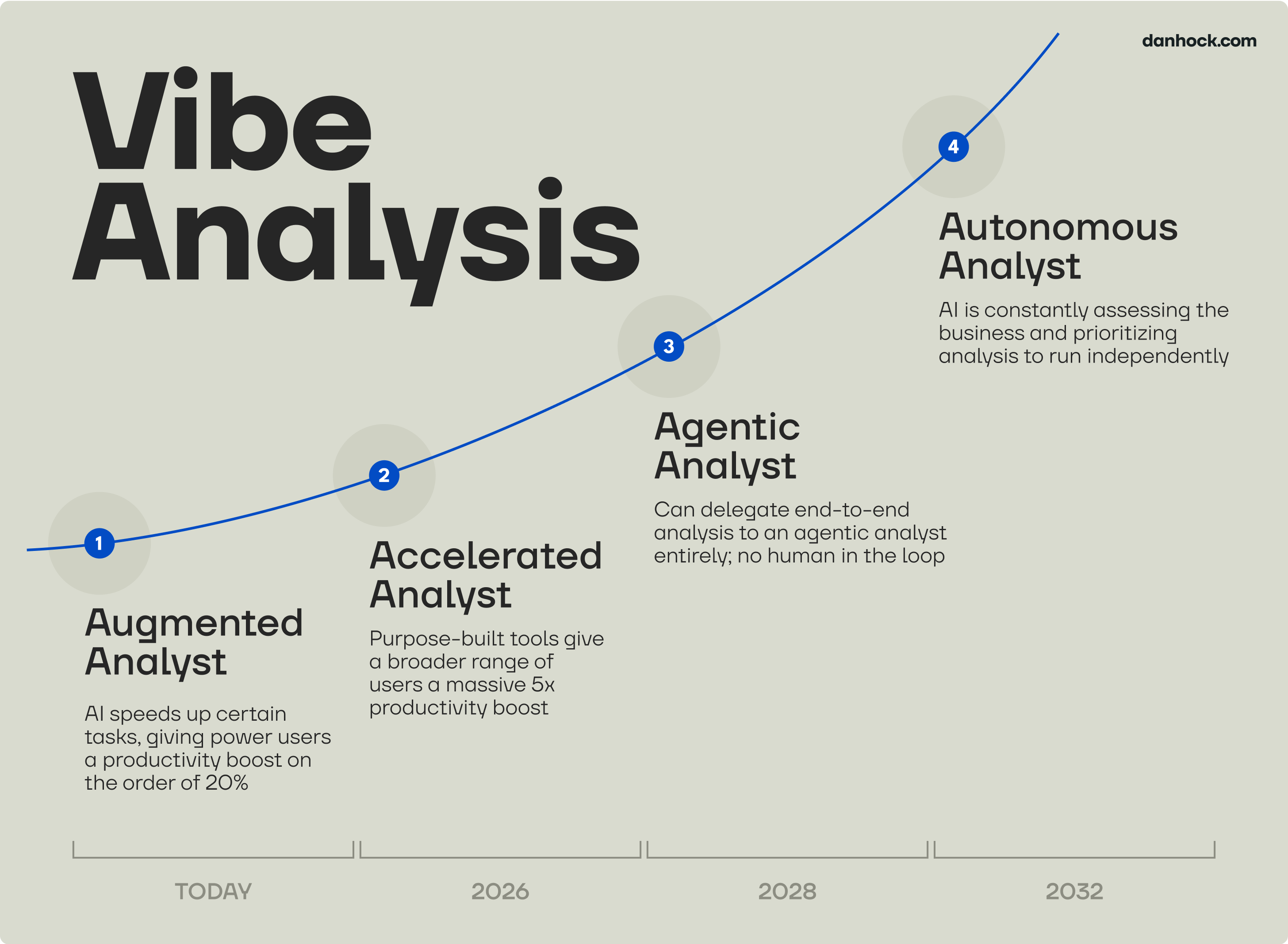
Here's the progression Dan outlines:
Today (Augmented Analyst): AI helps with cleaning, querying, and drafting faster. Think ~20% productivity gains.
Next (Accelerated Analyst): Full-stack tools emerge that compress analysis time by 5x and let anyone, not just analysts, get insights on their own.
Soon (Agentic Analyst): AI agents will handle end-to-end analysis with zero human help for simpler tasks.
Future (Autonomous Analyst): AI that proactively runs analysis, spots trends, and suggests decisions before you even ask.
Why this matters:
Analysts will be hired less for SQL skills and more for judgment, intuition, and the ability to ask good questions.
Tools like Looker and Mixpanel tried to “democratise” data before, but AI will finally make it real, even your CEO or sales rep could pull meaningful insights instantly.
This doesn’t eliminate analysts. It amplifies them. Like going from horse to motorbike.
A stat that says it all:
Cursor ($500M ARR) and Mercor ($4.5M per employee) are already more capital-efficient than Microsoft or Meta.
The big takeaway? Vibe analysis is a new way of thinking with data. And it might be the fastest lever for company growth over the next 5 years.
SOMETHING MORE
🧩 Frameworks & insightful posts
ESOP Value Calculator Template: How to communicate ESOP value to your team.
Most employees undervalue their ESOP because no one explains it well. Founders often say things like “you’re getting x% of the company” or “this is worth $40K”, but that sets false expectations and creates more confusion than clarity.
Here’s how to fix it:
Start early: explain ESOP terms clearly during the offer and onboarding, exercise price, vesting schedule, and exit conditions
Don’t frame equity in dollar terms; instead, give a basic scenario model showing what outcomes might look like at different exit values
Run ESOP explainer sessions for the full team: what it is, why it exists, how it works
Use forecasting tools to show employees how equity compounds over time
Update regularly on valuation changes, exit planning, and how that affects the value of their shares
Share the actual plan rules, total shares, option pool size, cliff period, and what happens when they leave
The goal isn’t to hype up equity, it’s to make it understandable. When employees get it, they start thinking like owners. (Read full post here)
Also, you can check out the Airtree VC ESOP Value calculator:

Tom Bilyeu’s $100,000 validation test before you build anything.
Before you write a single line of code, ask: Can 1,000 people pay $100 for this?
If the answer’s fuzzy, you’re not building a business, you’re prototyping a hobby. This test cuts through the noise.
Here's how to pressure-test your idea:
Define your buyer narrowly: Not “busy professionals”, but “marketing managers at 50-person SaaS companies who make Friday reports manually and hate it”
Clarify the result: Not “save time”, but “get Friday afternoons back and look like a data genius to your CEO”
Map your distribution: Not “social media”, but “LinkedIn groups, SaaS Slack communities, and industry newsletters they read”
Model the math: Not “lots of traffic”, but “1,000 visitors × 15% opt-in × 20% booking × 30% close × $100 = $9,000/month”
This is how you avoid a 6-month build that leads to zero buyers.. You don’t need branding, followers, or a website. You need clarity on buyers, value, reach, and conversion math. (Read full post here)
The 5-step cold email playbook every founder should copy.
It took 2–3 months and multiple tests to refine this. But now it’s a repeatable, scalable framework for startup founders doing outbound.
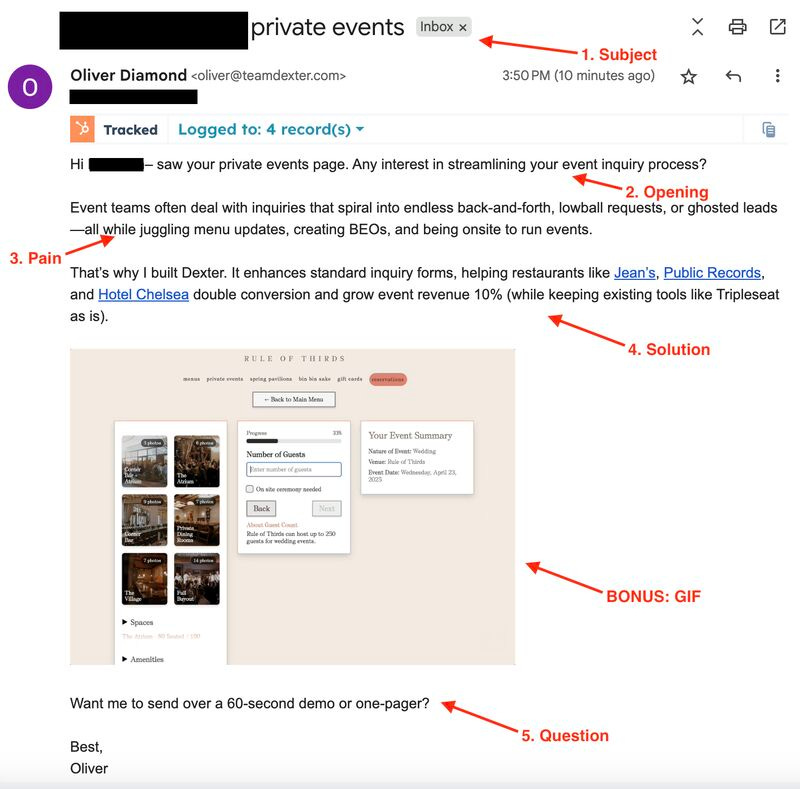
Here’s the breakdown that worked:
Subject
Keep it ultra-relevant and close to the customer’s world. Use a combo like Company Name + Service to make it feel specific, not generic.
Opening
Use a short personalised line that references what they do. You don’t need deep research, find one shared pattern (like “saw your events page”) and connect it to your service with a simple question.
Pain
Call out a real frustration they likely deal with daily. The more vivid and true it feels, the more they’ll read.
Solution
Share who you are, what your tool solves, and a simple result (“grew conversions by 10%”). If you’re the founder, mention it; people respond better to founders than SDRs.
Question
End with an easy A/B choice: “Want a one-pager or a quick 60s demo?” Avoid generic yes/no.
One visual (like a product GIF) can boost replies too; use sparingly in small batches. (Read full post here)
Step-by-step GTM funnel to close your first 10 B2B deals.
Michel Lieben shared a detailed GTM funnel he’d use if starting from zero again, one that helped him grow to $5M+ ARR. Here's the playbook broken down for founders looking to get their first clients without spending big.

Start with visibility over budget
Go for low-cost, high-effort channels early on:
LinkedIn posts
Blog content
YouTube videos
Engaging in niche communities
These helped him build brand visibility fast.
Turn visibility into conversion
Send traffic to a single clear destination, either your website or an optimised LinkedIn profile.
Use a short video sales letter
Add a lead magnet for email capture
Use visitor ID tools to track anonymous traffic
Tools: Instantly, Vector, Midbound
Re-engage warm leads manually
He suggests writing the first 50 outbound messages by hand to sharpen your offer and improve messaging.
Focus on quality before automating
Reach out via email, LinkedIn, or even WhatsApp
Tools: lemlist, Expandi, Woodpecker
Stick with it for at least 3 months
This approach isn’t complex, but it takes consistency. Stick to this loop of visibility → landing → re-engagement, and you’ll eventually close your first 10 deals.
How YC startups design LLM prompts that behave like agents.
Forget clever one-liners—top AI startups now treat prompts like onboarding docs. Think 6+ page instructions, role clarity, step-by-step flows, and embedded tags. Why? Because that’s what makes LLMs reliable and agent-like.
Here’s what they’re doing differently:

Assign a clear role upfront
Don’t just say “Answer this.” Instead: “You are a senior support manager overseeing tool approvals.” A strong role sets the tone, reasoning style, and response format.
Break tasks into steps
LLMs fumble vague prompts. Give them an explicit plan: “Step 1: Review the tool name. Step 2: Check policy match. Step 3: Approve or reject.”
Use structured output formats
Parahelp uses XML-style tags like <manager_verify>accept</manager_verify>. Tags make outputs easy to parse and debug.
Meta-prompting = self-improvement
These startups feed their own prompts and outputs back into the LLM to ask: “How can I improve this?” The LLM often gives better rewrites than humans.
Add real examples (few-shot prompting)
Especially for complex tasks. Jazzberry gives examples of tough bug reports and expected responses. Accuracy goes up.
Teach it to say “I don’t know”
Escape hatches are crucial. It’s better to admit uncertainty than to hallucinate confidently. Helps with trust.
Thinking traces and evals matter
Ask the LLM to explain why it made a decision. Combine that with prompt test cases (evals) to stress test reliability. Many founders say evals are more valuable than the prompt itself.
This structured prompting is how top teams move from “cool demo” to “reliable agent.” Watch the full YC talk: State-of-the-Art Prompting for AI Agents. Also, check out this document for more info.
EXPLORE MORE
💡 Articles and a few interesting stuffs
Yurii Rebryk on the one-minute pitch that makes investors say yes. (Link)
Y-Combinator Fall 2025 request for startups. (Link)
Breaking into VC? These 150+ fellowships (free & paid) can help you get started. (Link)
The CRM template every founder needs before starting their fundraise. (Link)
State of digital health Q2’25 report by CBInsights. (Link)
NEWS RECAP
🗞️ This week in startups & VC
New In VC
Connecticut Innovations (CI), a New Haven, CT-based state’s strategic venture capital arm, announced it invested $45.8N million in 67 companies and venture funds. (Read)
BlackWood Ventures, a Copenhagen, Denmark-based early-stage firm focused on European founders, closed its debut USD25m fund. (Read)
Verified Capital, a San Francisco, CA-based venture capital firm that backs tech companies at any stage of their journey, closed its debut fund at $175m. (Read)
New Startup Deals
Fable Security, a San Francisco, CA-based modern human risk management platform, raised $31m in funding. (Read)
OpenAI is reopening fundraising for its $40 billion round, with $30 billion still to be secured—$22.5B expected from SoftBank and $7.5B from other investors. (Read)
Julius AI, a San Francisco, CA-based AI-powered data analyst for knowledge workers, raised $10m in seed funding. (Read)
LakeFS, a NYC-based provider of a “git-for-data” version control system for enterprise data and AI initiatives, raised $20M in growth funding. (Read)
Caspian, a San Francisco, CA-based provider of an AI-driven customs compliance startup, raised $5.4M in Seed funding. (Read)
Salient, a San Francisco, CA-based provider of AI-powered financial services technology, raised USD60M in funding. (Read)
Caseflood.ai, a San Francisco, CA-based human-assisted AI intake team for law firms, raised $3,2M in funding. (Read)
TODAY’S JOB OPPORTUNITIES
💼 Venture capital & startup jobs
Financial Analyst Volta Circle | USA - Apply Here
Investor Relations Analyst TCV | USA - Apply Here
Associate - M Venture Partners | India - Apply Here
Chief of Staff to Founding Partner - One Way Venture | USA - Apply Here
Investment Fellow - Indian Fund | India - Apply Here
NFX TechBio Fellows 2025-2026 - NFX | USA - Apply Here
Corporate Development & Strategy - Figma Venture | USA - Apply Here
Value Creation - Cadeumen Capital | Spain - Apply Here
Associate - Mighty Capital | USA - Apply Here
Investment Analyst - Beas Capital | India - Apply Here
Head of Platform - Pledge Venture | UK - Apply Here
Chief of Staff - Penny Jar Capital | USA - Apply Here
Associate - Iconique Capital | USA - Apply Here
Associate - OMERSE Venture | USA - Apply Here
Associate Telescope Partner | USA - Apply Here
Healthcare Analyst - General Investment Management | UK - Apply Here
Investor (AI) - Samsung next | USA - Apply Here
Investment Analyst - Miras Investment | Dubai - Apply Here
PARTNERSHIP WITH US
Get your product in front of over 95,000+ audience - Our newsletter is read by thousands of tech professionals, founders, investors and managers worldwide. Get in touch today.
🔴 Share Venture Curator
You currently have 0 referrals, only 5 away from receiving a 🎁 gift that includes 20 different investors’ contact database lists - Venture Curator