

👋 Hey, Sahil here — Welcome back to Venture Curator, where we explore how top investors think, how real founders build, and the strategies shaping tomorrow’s companies.
Big idea + report of the week :
The hidden downside of high valuation seed rounds.
Pitchbook Data: Is an MBA still worth it if you want to make it in VC?
Frameworks & insightful posts :
Should you hire an AI engineer?: Linktree’s surprising results.
AI tools used by a16z partner Olivia Moore.
31 ways to grow your startup fast in 2026.
Turning VC into a network-effect business.
FROM OUR PARTNER MENDLY
🧬 Mendly is fixing the $3.6T+ misdiagnosis problem with AI & DNA, and investors want in -
Mendly is the first virtual-care platform that brings DNA-powered diagnosis into everyday telehealth. Before every doctor’s visit, based on the patient’s symptoms, the patient’s genome is analysed in minutes, a true DNA-first approach.

This could finally end the diagnostic odyssey, where patients spend 5 years, see 17 doctors, and rack up $120,000+ before getting the right diagnosis. It can deliver an 8×–30× savings for self-insured employers.
Built on a patent-pending DNA Hyper-Sharding™ technology, Mendly keeps your genome fully encrypted while enabling a lifetime of instant genetic testing.
🤝 PARTNERSHIP WITH US
Get your product in front of over 103,000+ audience - Our newsletter is read by thousands of tech professionals, founders, investors and managers worldwide. Get in touch today.
START WITH
🧠 Big idea + report of the week
The hidden downside of high valuation seed rounds.
PitchBook’s latest analysis digs into a question every early-stage investor is wrestling with:
Are these $30M–$40M seed valuations still worth it, or are we just paying for hype?

Here’s what the data shows:
The historical premium is fading
For years, “consensus deals”, the hottest seed rounds at the highest prices, were worth the markup. They failed less, produced more 10x winners, and helped concentrated portfolios catch the outliers.
But rising valuations now come with shrinking upside: Top-decile seed rounds are now priced around $40M pre-money, roughly 3× the market median, and the math is breaking:
Ownership shrinks with every follow-on round
Dilution compounds faster
Exit timelines have stretched to 11.5 years on median
Distributions are delayed, dragging down IRR
Only managers with deep reserves can protect their stake
Return multiples are compressing hard
For portfolios concentrated in these premium-priced seeds, the shift is dramatic:
Simulated results show the 75th percentile return multiple dropping from 7.7x to 3.8x for recent cohorts.
Same “quality,” half the payoff.
Signals at the seed stage are weaker than ever
Early traction no longer signals long-term quality; it simply attracts more investors, creating bidding wars.
AI has intensified this. A handful of startups get swarmed by funds chasing allocation, pushing valuations higher without materially changing fundamentals.
The new risk: Paying for hype, not quality
When valuations drift too far above intrinsic progress, the hurdle rate becomes unrealistic. Investors aren’t just buying access; they’re buying a longer, thinner, slower path to liquidity.
High-valuation seed rounds used to be the smart bet for catching power-law outcomes. In today’s market, they look more like a trade-off:
Less ownership, slower exits, lower multiples and no guarantee the premium reflects true quality.
Pitchbook Data: Is an MBA still worth it if you want to make it in VC?
For decades, Stanford, Harvard, and Wharton MBAs were a near-guarantee to break into venture. But PitchBook’s recent analysis shows that the advantage is fading fast.
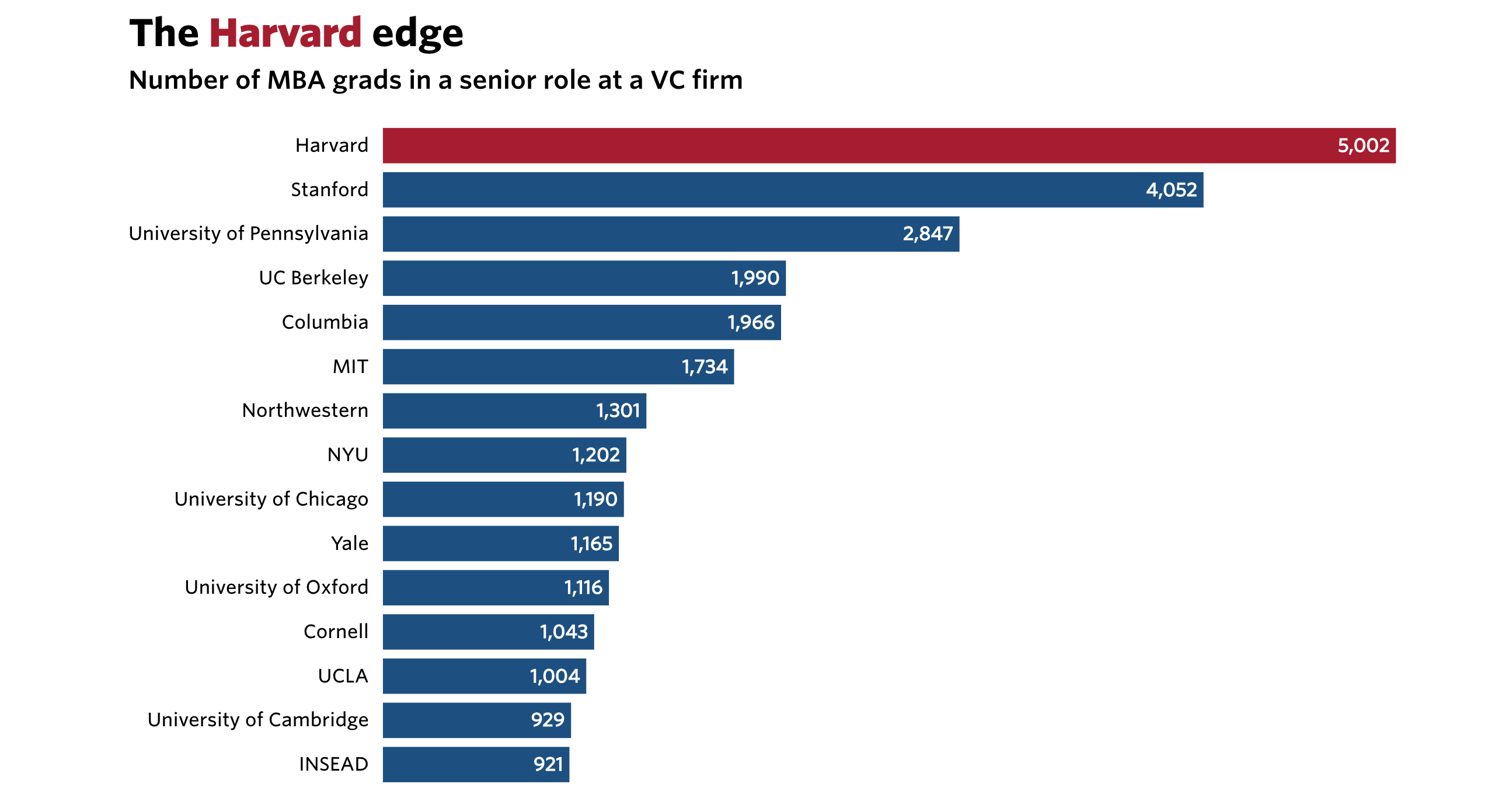
The numbers: Around 50 Harvard MBAs and 30 Stanford MBAs joined VC firms last year, with a median starting salary of $177,500. Yet the share of new VCs with MBAs has dropped from 44% in the early 2000s to ~32% today.
The shift: Firms now prize “builders” from places like OpenAI, SpaceX, and Palantir over B-school résumés. These hires bring direct operating experience and strong founder networks.
Still a signal: Certain schools (Stanford, Harvard, Wharton, LBS, Columbia, Kellogg) show a statistical boost in investment performance, according to new research. Alumni networks also continue to drive deal flow.
The tradeoff: An MBA can still open doors, but it comes with a ~$200K opportunity cost. Meanwhile, AI is replacing many junior VC tasks, narrowing entry-level roles.
The MBA badge is no longer the default path into venture. It may help at specific firms and networks, but increasingly, operating at a breakout startup is the stronger credential.
FROM OUR PARTNER - VENTURE CREW
🎨 Venture Curator Opens 3 Slots to Help Founders Build Pitch Deck
Decks get you meetings. Without meetings, you have no shot at getting funded. Investor meetings get you funded.

But most founders fail to impress investors through their pitch deck.
Many make mistakes by adding the wrong content and including too many - around 10-15 - slides. Investors don’t like that.
If you’re feeling confused while building a pitch deck, we can help. We’ve created an internal team of experts, designers, and investors to build and review your pitch deck.
Schedule a call with us today →
SOMETHING MORE
🧩 Frameworks & insightful posts
Should you hire an AI engineer?: Linktree’s surprising results.
Most founders hit a point where shipping velocity slows, and the default reaction is: hire more engineers. However, adding headcount also introduces complexity — including culture shifts, coordination overhead, and increased burn. An alternative that’s starting to look real: treat AI agents like junior hires.
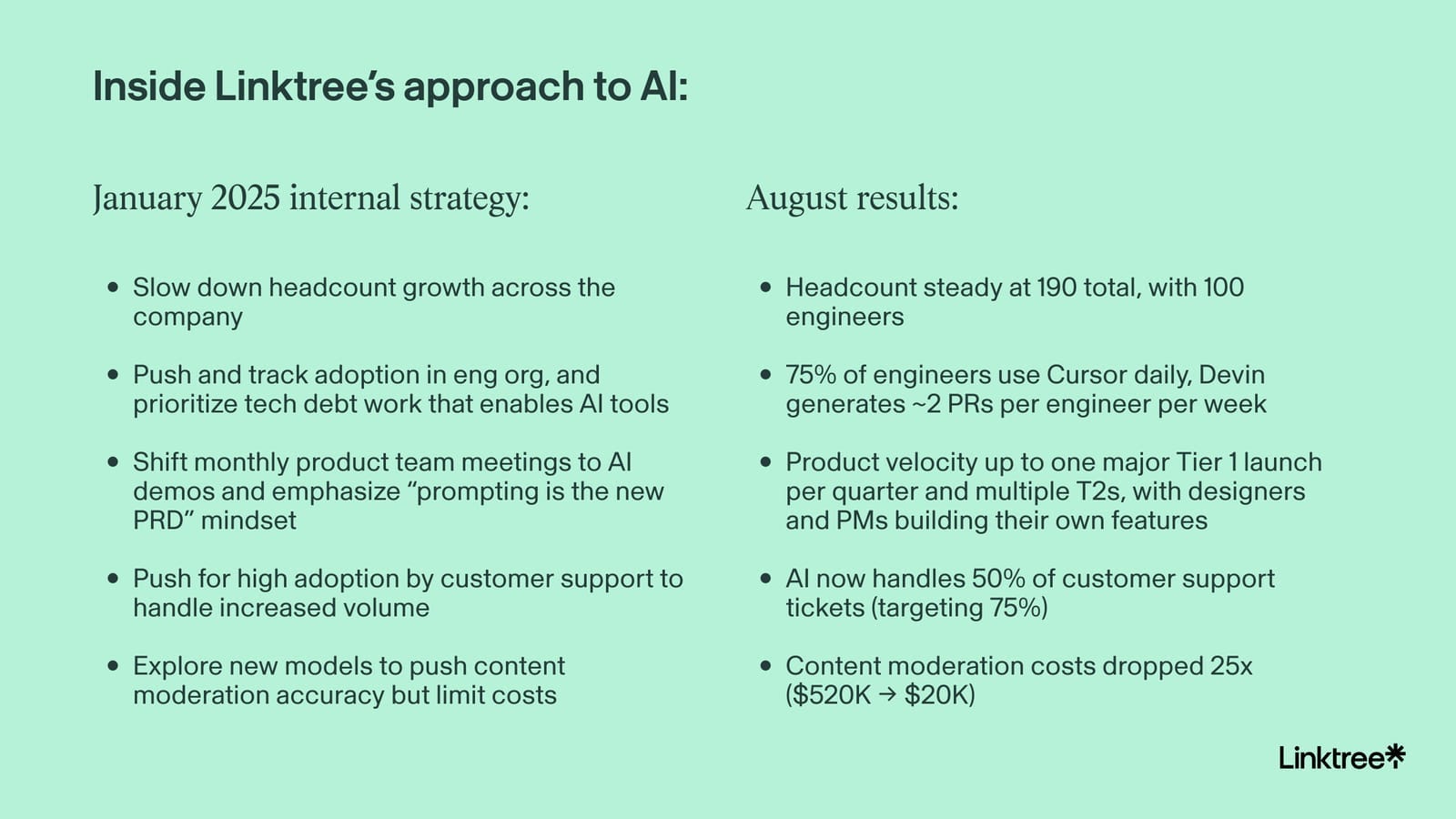
That’s exactly what Linktree did. Going into 2025 planning, they faced pressure to scale their engineering team beyond 100 people. Instead, they froze hiring at ~190 total employees and leaned hard into AI. Here’s what they found:
Where it delivered value
Repetitive engineering tasks: Their AI agent (Devin) now contributes ~2 PRs per engineer per week, especially for dependency upgrades, bug fixes, and debugging.
Faster prototyping: Engineers use it to quickly spike new features or test fixes — not production-ready, but good for grounding discussions and estimation.
Security scanning: AI helps detect and patch vulnerabilities across repos, saving the small security team countless hours.
Where it failed
Complex or messy systems: Inconsistent schemas and tech debt confused the AI, making outputs worse. The team had to clean up naming conventions, event schemas, and APIs first.
Over-ambitious projects: Attempts to auto-generate pixel-perfect pages failed. AI is powerful, but not a replacement for high-craft work.
The real cost
AI adoption didn’t “just happen.” The CTO tracked usage dashboards, nudged laggards, reframed AI as a junior teammate to manage, and created social pressure (AI demo meetings, “Wins and Whoopsies” Slack channel).
The takeaway: Hiring an AI agent is worth it — but only if you:
Point it at repetitive, low-leverage work.
Clean your tech debt so it has good patterns to learn from.
Actively drive adoption across the team.
For Linktree, the payoff was clear: more launches without more hires, 25x cheaper moderation, and customer support scaling 80% with AI. For most startups, that’s a strong case to at least experiment with “hiring” an AI teammate. (Read detailed report here)
AI tools used by a16z partner Olivia Moore.
Many people wonder what top investors actually use AI tools for in their day-to-day life, not just for making better investment decisions, but also for staying productive.
Olivia Moore, an AI Partner at Andreessen Horowitz, tests dozens of products every week, but only a handful make it into her daily AI stack.
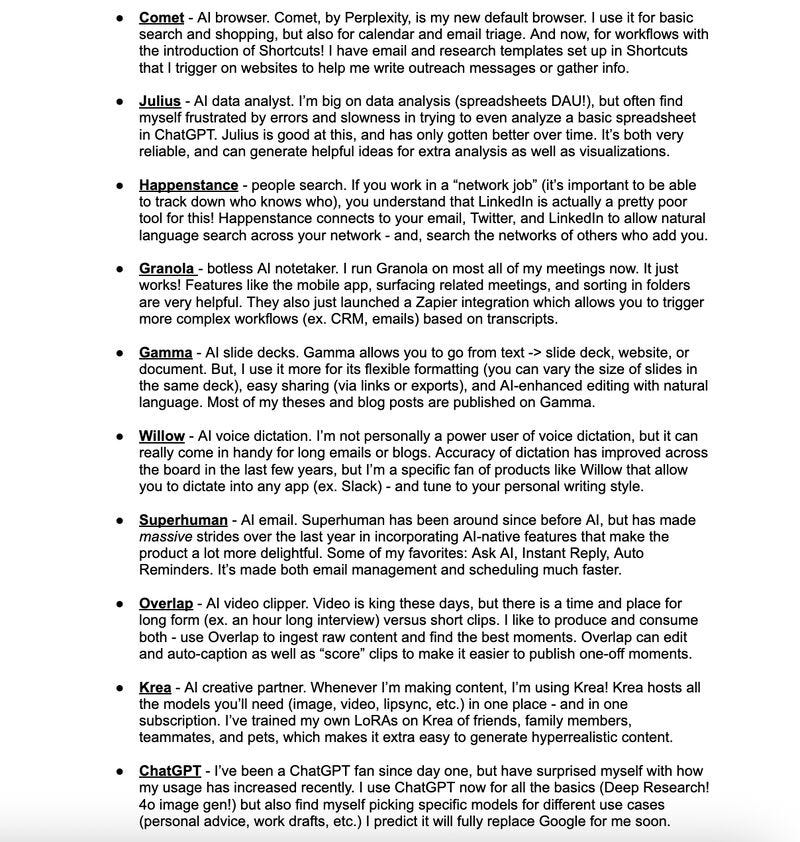
Here’s what she relies on:
Comet (Perplexity): Default AI browser for research, calendar/email triage, and automated outreach workflows.
Julius AI: A quick, accurate AI data analyst for spreadsheet insights and visualizations.
Happenstance: AI-powered people search across email, LinkedIn, and Twitter to map networks.
Granola: AI meeting notes with smart triggers for post-meeting workflows.
Gamma: AI slide decks, docs, and websites, with flexible formatting and sharing.
Willow: AI voice dictation tuned to personal writing style.
Superhuman: AI-enhanced email with Ask AI, Instant Reply, and Auto Reminders.
Overlap: AI video clipping and auto-captioning for long-form content.
Krea: AI creative partner for generating hyperrealistic visuals.
ChatGPT: For deep research, personal advice, and drafting.
She’s also experimenting with Serif (AI email assistant), Tako (trusted data + graphics), and SnapCalorie (AI nutrition tracker).
Even at the centre of AI investing, the tools that stick are the ones that fit seamlessly into existing workflows and deliver daily value, not just novelty.
31 ways to grow your startup fast in 2026.
Most founders try every growth tactic they see on the internet. The fastest-growing SaaS companies don’t. They sequence their growth — using the right 3–5 levers at the right revenue stage. ICONIQ, Founderpath, and hundreds of SaaS founders keep repeating the same thing: growth is not about working harder, it’s about picking leverage that compounds.
Below is a cleaner, practical breakdown you can follow no matter where you are shared by Nathan Latka :

Stage 1: Bootstrap to $1M Revenue — Speed and Cash First
At this stage, anything slow is a distraction. You want distribution loops, cheap awareness, and anything that directly converts attention into revenue.
What works best
Virality loops Add sharing triggers like “Powered by…”, referral rewards, and shared dashboards. This is how tools like Typeform and Dropbox grew without ads.
Webinars that sell Run tight, niche sessions with a strong CTA. Founders who are good storytellers convert faster because webinars collapse trust cycles.
Product Hunt launches. One strong PH push = thousands of new users. Relaunch often, test different angles, collect emails.
Cold outreach with personalisation, Loom videos + targeted lists outperform templates. Even 100 great emails can get your first $10K–$20K MRR.
Influencer marketing (micro-creators only) Bottom-up trust works better than polished brand ads. Partner with niche creators who feel “native” to your audience.
What founders should remember At <$1M, your job is to find one repeatable way to acquire users cheaply. Most founders stall because they chase too many channels instead of doubling down on one.
Stage 2: $1M–$3M ARR — Build Compounding Inbound + Partnerships
This is where the engine needs more predictability. Founders who grow 300%+ yearly build content systems, partner loops, and scalable inbound.
Plays that work consistently
Free tools Calculators, templates, grading tools — these index extremely well and convert better than blog posts. Shopify scaled free tools into billions.
Newsletter Publishing weekly builds authority, lowers CAC, and compounds trust. At this stage, the founder voice is still the strongest asset.
Co-marketing with partners Joint webinars, shared ebooks, mutual case studies. This drives warm leads at almost zero cost.
Affiliate programs Think of it as a distributed sales team that only gets paid on performance. Stripe and Zapier used this extremely early.
Compare pages and programmatic SEO “X vs Y” pages rank fast for high-intent queries and consistently pull in users without spending.
Founder reminder Your time shifts from raw selling → building repeatable acquisition flywheels.
Stage 3: $3M–$5M ARR — Paid Growth + Acceleration
Now you have a working engine. The question becomes: how do we scale what already works while keeping CAC under control?
High-impact tactics
Retargeting Target people who already touched your product — demo viewers, free trials, website visitors.
Lookalike ads Feed Meta/Google a list of your top 500 users. This performs better than any cold targeting.
LinkedIn + short-form video ads Works well for B2B if messaging focuses on revenue triggers, not features.
Acquisitions (small ones) Buy small tools, Chrome extensions, or utilities that give you more distribution or features instantly.
Founder reminder Paid acquisition works when your retention is strong. If churn is weak, nothing in this stage will scale.
Stage 4: $5M+ ARR — Build Moats That Defend Your Category
At this point, growth comes from trust, brand presence, and ecosystem dominance. These plays are slow but incredibly durable.
Moats that actually work
Review site dominance G2, Capterra, and TrustRadius. Enterprise buyers care more about peer validation than ads.
App marketplace distribution: Salesforce, HubSpot, Zapier — marketplaces can become passive growth channels.
Books + podcasts + events These aren’t vanity — they’re how you cement a category narrative and attract higher-ticket buyers.
Live events + communities You build a tribe around your brand. Companies like Notion and Figma built defensibility with community long before they had revenue.
Founder reminder At scale, your advantage is no longer speed. It’s authority, relationships, and the ecosystems you control.
You don’t need all 31 tactics. You need the right ones for your stage. The best founders don’t hustle harder, they sequence smarter — and they resist the temptation to mix Stage 1 tactics with Stage 4 tactics. That’s how companies go from $0 to $10M without burning themselves out.
Turning VC into a network-effect business.
Most founders think great VCs win because they have money, brand, or a famous GP. David Booth’s insight is sharper: the next decade of VC will be dominated by firms that operate like network platforms, not service providers.
And this matters because the VC you choose directly affects how fast your startup compounds.
Why traditional VC hits a ceiling
The old model is intimacy-driven: partner time, partner intros, partner advice. But that model collapses at scale. Every new investment dilutes attention. Founders feel it immediately: fewer intros, slower help, weaker leverage.
This is why VC historically does not behave like a network-effect business.
The shift: preferential attachment
Marc Andreessen calls it the core mechanic of startup success: when you’re winning, everything starts attaching to you, talent, customers, capital, media, momentum.
VC firms themselves can harness the same mechanism. The ones that build systems, not just relationships, start compounding.
What a “network-effect VC” actually looks like
Not events. Not fancy platform decks. Not “value-add” slogans. A real networked VC looks like this:
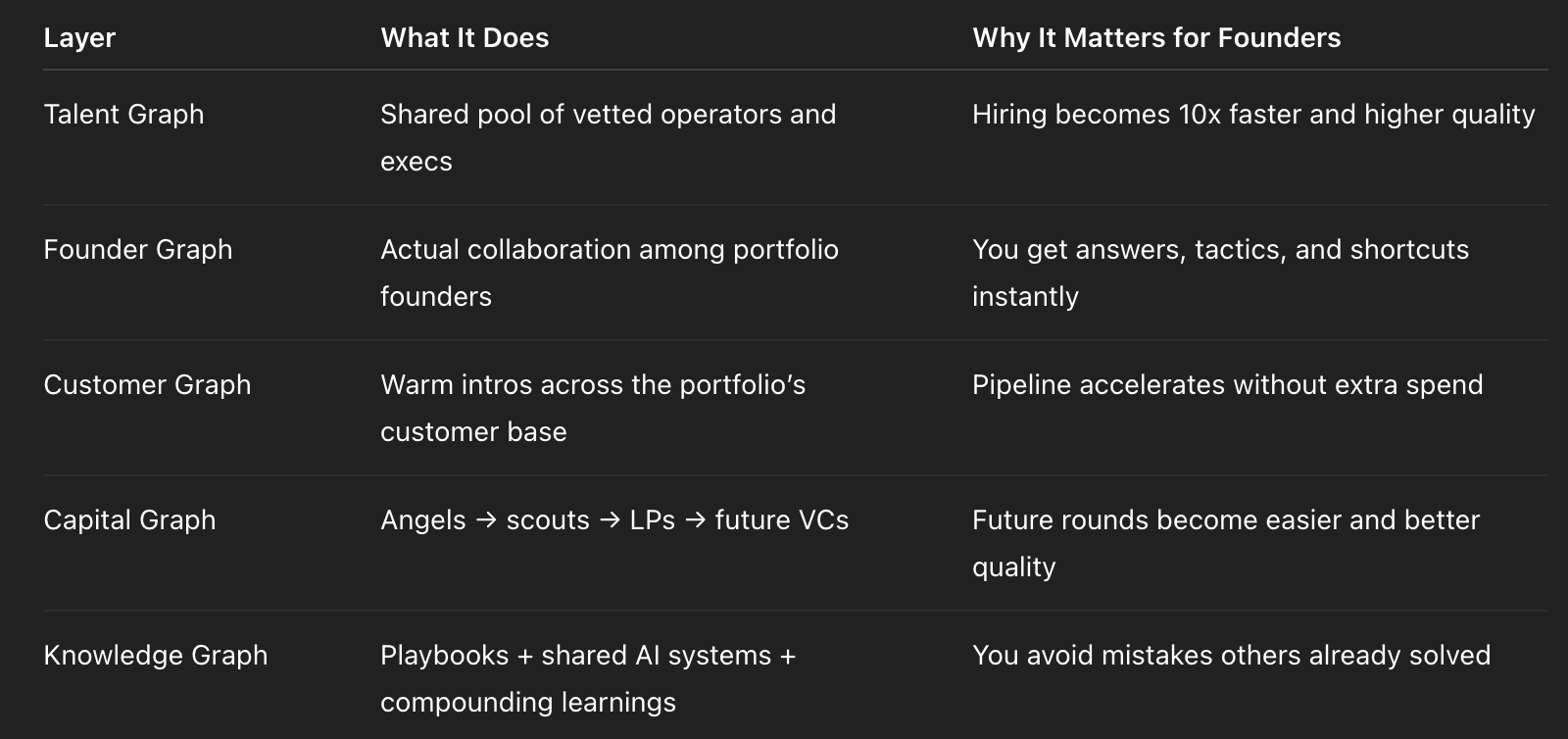
A firm with these layers doesn’t add value linearly; it compounds with every new founder who joins.
What a16z got right (and others are now trying to copy)
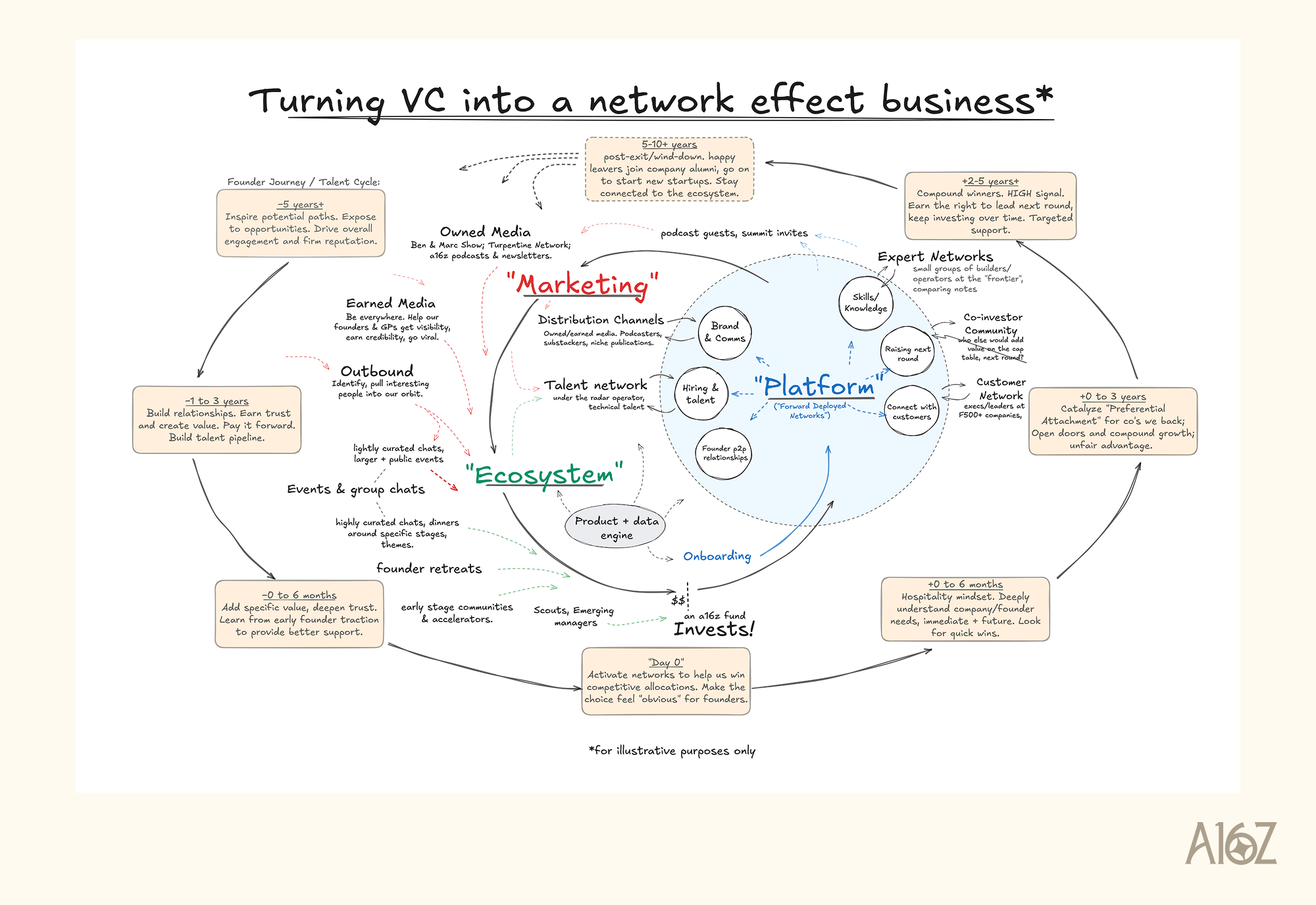
They built the “pit crew” behind the GP. Yes, the partner wins the deal. Yes, the partner advises you at critical moments.
But the actual advantage comes from the invisible infrastructure:
talent pipelines continuously flowing into portfolio companies
customers and execs moving between companies
alumni founders becoming angels for new founders
internal tools, research, and distribution that everyone can access
vertical GPs + horizontal networks that multiply over time
This turns a VC firm from “GP attention divided across 40 companies” into: “A system where each company makes the next one stronger.”
Why does this matter when choosing your investor
Founders often focus on: Which GP is nice?, Who has the biggest brand?, Who writes the fastest check?
The better question is: Which firm gives me access to a network that compounds?
Look for signals like:
Do portfolio founders collaborate or live in silos?
Does talent circulate within the network naturally?
Is there real customer flow, or just promises?
Does joining this firm instantly increase your surface area of luck?
Because at seed and Series A, you don’t need capital, you need acceleration.
For founders: You’re not just raising money. You’re plugging into an operating system. A traditional VC gives you credibility. A network-effect VC gives you momentum, which is far more valuable.
NEWS RECAP
🗞️ This week in startups & VC
New In VC
Superorganism, a U.S.-based VC firm focused on biodiversity startups, has raised a $25.9M debut fund backed by Cisco Foundation, AMB Holdings, Builders Vision, and a16z’s Jeff Jordan. (Link)
The University of Pennsylvania, BioNTech, and Osage University Partners launched a $50m Penn-BioNTech Innovative Therapeutics Seed Fund (PxB Fund). (Link)
Andreessen Horowitz raised $15 billion across five new funds, bringing its total AUM to over $90 billion. (Link)
New Startup Deals
Meet Caria, a NYC-based AI-native recruitment software company, which raised $1M in Pre-Seed funding. (Link)
VoiceRun, a Cambridge, MA-based provider of an enterprise platform for Voice AI, raised $5.5M in Seed funding. (Link)
Ammobia, a San Francisco, California-based developer of low-cost ammonia production technology, raised $7.5 million in seed funding. (Link)
Nodu, a London, UK-based stablecoin infrastructure startup, raised $1.45M in pre-seed funding. (Link)
Neuramint, a Denver, CO-based Web3 AI company developing an AI agent platform, raised $5M in Seed funding. (Link)
i10X, a Singapore-based unified AI platform, closed a USD$1m pre-seed funding round. (Link)
Onsetto, a Minneapolis, MN-based provider of a fintech platform for banks and credit unions, raised $2.2M in Seed funding. (Link)
TODAY’S JOB OPPORTUNITIES
💼 Venture capital & startup jobs
All-In-One VC Interview Preparation Guide: With a leading investor group, we have created an all-in-one VC interview preparation guide for aspiring VCs. Don’t miss this. (Access Here)
Associate, Corporate Venturing - NRG Venture Fund | USA - Apply Here
VC Analyst Intern Wind | France - Apply Here
Investment Associate - Opmistic Venture | USA - Apply Here
Summer Fellowship 2026 - Coastanova Venture | USA - Apply Here
Portfolio Management Intern - LVL1 Accelerator | India - Apply Here
Associate, Growth Equity - Adam Street Partner | USA - Apply Here
Venture Relations Associate - Angellist | USA - Apply Here
Due Diligence Fellow - Velocity Digital | USA - Apply Here
Investment Principal - Aramco Venture | USA - Apply Here
VC Fellowship - 1752 VC | USA - Apply Here
Executive Assistant - RET Venture | USA - Apply Here
Analyst - Griffin Gaming Partner | USA - Apply Here
VC Associate - Proglobal Search | UAE - Apply Here
Intern - Prologis Venture | USA - Apply Here
VC Graduate Internship Summer 2026 - Apply Here
Investment Summer Associate - B. Next | USA - Apply Here
PARTNERSHIP WITH US
Get your product in front of over 102,000+ audience - Our newsletter is read by thousands of tech professionals, founders, investors and managers worldwide. Get in touch today.
🔴 Share Venture Curator
You currently have 0 referrals, only 5 away from receiving a 🎁 gift that includes 20 different investors’ contact database lists - Venture Curator
loved the fast ways to grow section