
👋 Hey, Sahil here - welcome to today’s edition of Venture Curator, where we break down how great startups grow, how top investors think, and what’s shaping the future of tech.
P.S. Get access to 100+ startup & VC resources, investor databases, fundraising templates, 150+ premium archive posts and exclusive startup research - all in one place.
FROM OUR PARTNER - FRAMER
Framer’s AI agents can now help build, edit, and manage your website

Framer is the AI website builder for teams that care about every detail. Agents work directly in the canvas, helping design pages, manage CMS content, write copy, add SEO, and audit sites.
Build faster: Create, refine, and publish production-ready pages in minutes.
Scale confidently: Manage content, localisation, and metadata across your site.
Stay in control: Review every change, collaborate in real time, and publish when ready.
Trusted by teams at Miro and Perplexity.
📜 DEEP DIVE
Is being a solo founder why investors keep passing? The complete guide to raising alone.
Building alone has never been easier. One person with Claude Code and a Stripe account can ship a product, sell it, and support it in a way that took a team of four in 2019.
The data agrees: solo founders were 17% of new startups ten years ago. Carta has them at 36% of companies founded in 2025 and 36 to 37% of new companies joining in 2026, and Stripe Atlas says 63% of the C corps it incorporated in Q2 2026 were started by one person. Raising alone hasn’t got easier at the same rate, and that’s the part nobody writes about honestly. The usual take is either “VCs hate solo founders” or “just get a cofounder.” Both are lazy, and both are wrong in the way that costs founders rounds.
I kept hearing from solo founders who’d been passed on and assumed it was the solo thing. So I sat down with a few who’d actually raised, and with a VC friend who has backed a couple of solo founders and passed on a lot more. What came out was not “solo founders can’t raise.”
It was that most solo founders who fail to raise are running the wrong process, with the wrong investors, saying the wrong sentence about why they’re alone. The VC put it in a way that stuck: “I’ve never passed on someone for being solo. I’ve passed on a lot of people for not having an answer to the question solo raises.”
Then I looked at the data, and the one thing everyone assumes about solo founders- that they raise at a discount- turned out to be the wrong place to look.
Here’s what we’re covering:
The data
How big is the gap between solo founders starting companies and solo founders raising?
Is there actually a solo discount on valuation or dilution?
Who is actually writing solo cheques, and where is the gate opening fastest?
What investors are really asking
What are the four objections an investor runs on a solo founder, and which one is new?
What did the solo founders who raised have that the ones who didn’t lacked?
How to raise
How do you position being solo so it reads as a thesis, not a gap? (The sentence that works and the one that kills you)
What proof replaces a cofounder? (The bench, the bus-factor answer, the bandwidth evidence)
Who do you raise from first, and in what order?
How big should the round be, and what is it for?
What are the seven mistakes that get solo founders passed?
Are you ready to raise alone?
Solo founders doubled. Only 1 in 4 funded companies has one founder.
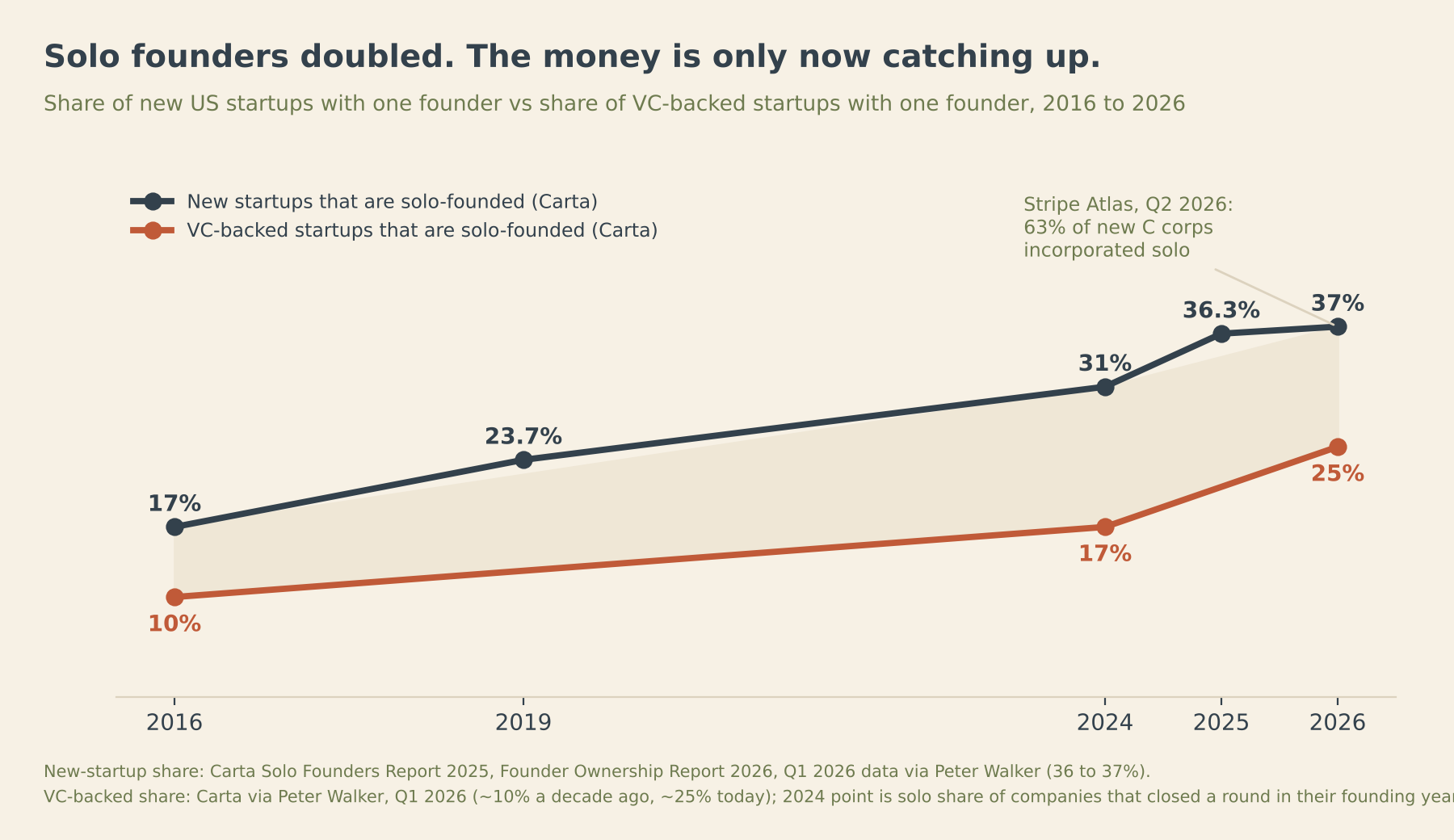
Here’s the number that starts every conversation about solo founders. About 36% of startups founded on Carta in 2025 were solo-led, up from 31% in 2024 and double the 17% of a decade ago. In 2026 it’s 36 to 37% of new companies, and Stripe sees 63% of its new C corps incorporated by one person. AI is the main reason: one person can now build and sell in a way that used to need two.
Here’s the number that should start the conversation instead. Among companies that actually raise venture money, the solo share is roughly 25%, up from about 10% a decade ago. Real progress, but still a 12-point gap. And the cohort data is harsher: in 2024, solo founders were about 35% of new startups but only 17% of the ones that raised that year, and took just 14.7% of the cash in priced rounds. That makes a solo founder roughly two and a half times less likely to close a round in year one.
Investors’ preferences show up the same way. 80% of companies that raised last year had more than one founder, and the most common team that closed a round was two people (36%, or 40% in SaaS).
So the gap is real, it’s big, and it’s closing from both ends. The question is what kind of gap it is, because that changes what you do about it.
Solo founders don't raise at a discount. Most just never get to the round.
Everyone, including most solo founders, assumes the penalty shows up as price: lower valuation, more dilution, worse terms. It’s the thing founders brace for.
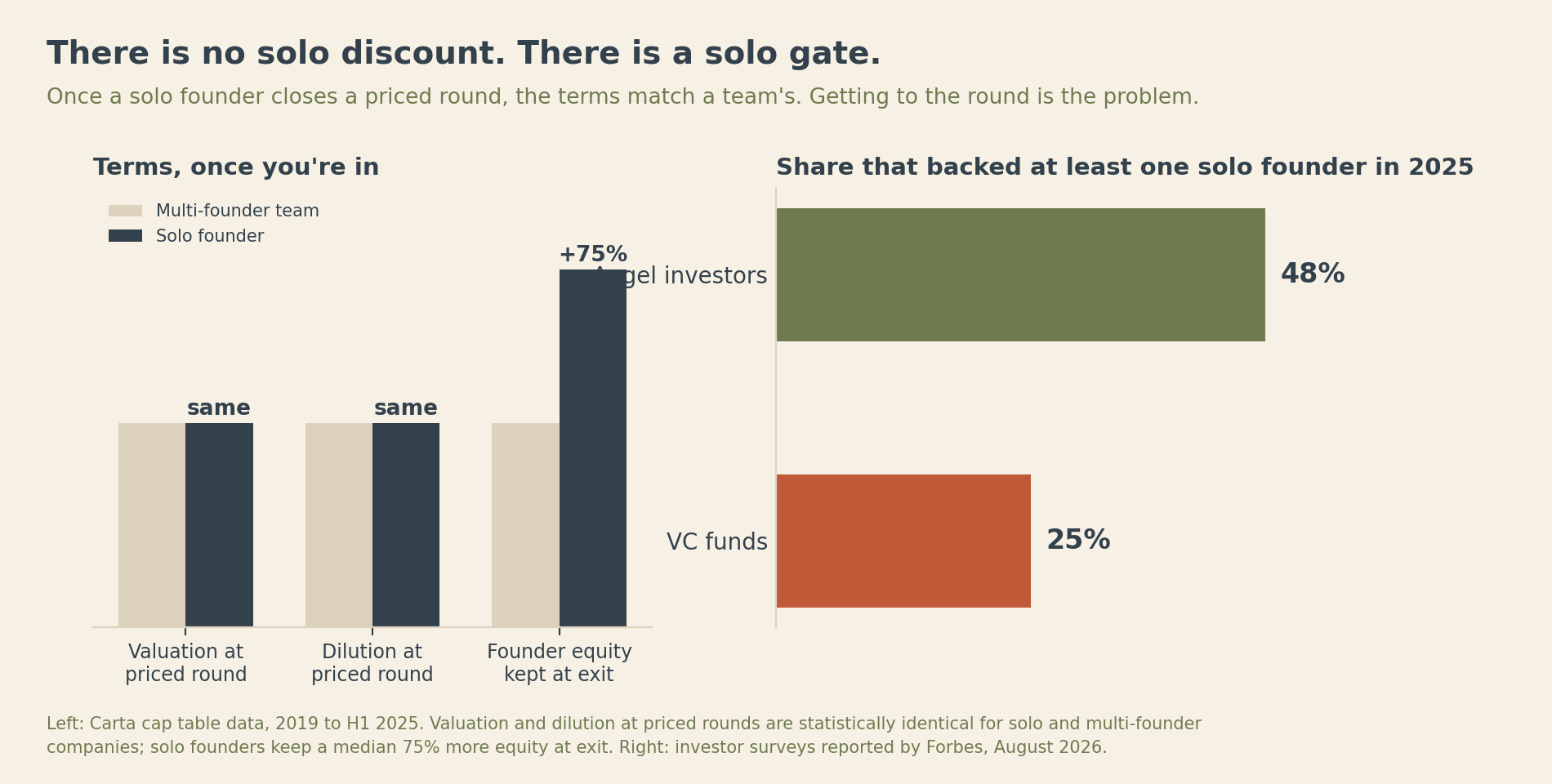
Carta’s cap table data says otherwise. Once a solo founder closes a priced round, the valuation and dilution are statistically identical to a multi-founder team’s. No discount. And because there’s no cofounder on the cap table from day one, solo founders keep a median 75% more equity at exit than the lead founder of a multi-founder company.
Read that again from the investor’s side. Investors are not pricing solo founders down. They are either saying yes at the same price, or saying no. The penalty is binary. It’s a gate, not a discount, and that changes the whole problem. A discount you negotiate. A gate you have to clear.
And the gate is not the same height everywhere. In 2025, about 48% of angel investors made at least one investment in a solo-founder company, while over 75% of VC funds made none. Angels are open. Institutional funds mostly aren’t, yet. That’s the most useful fact in this issue for deciding who to call first, and I’ll come back to it.
And for the solo founders who do get through, 2026 looks different from 2016. A survey of 240 founders who raised seed or pre-seed in 2026 found solo founders closed faster, averaged 14 investor meetings to close, and reported fewer objections than two- and three-founder teams, 81% of whom were asked about equity splits or founder conflict. The objection didn’t disappear. It moved from the solo founder to the team.
Where the gate is opening fastest is also telling.
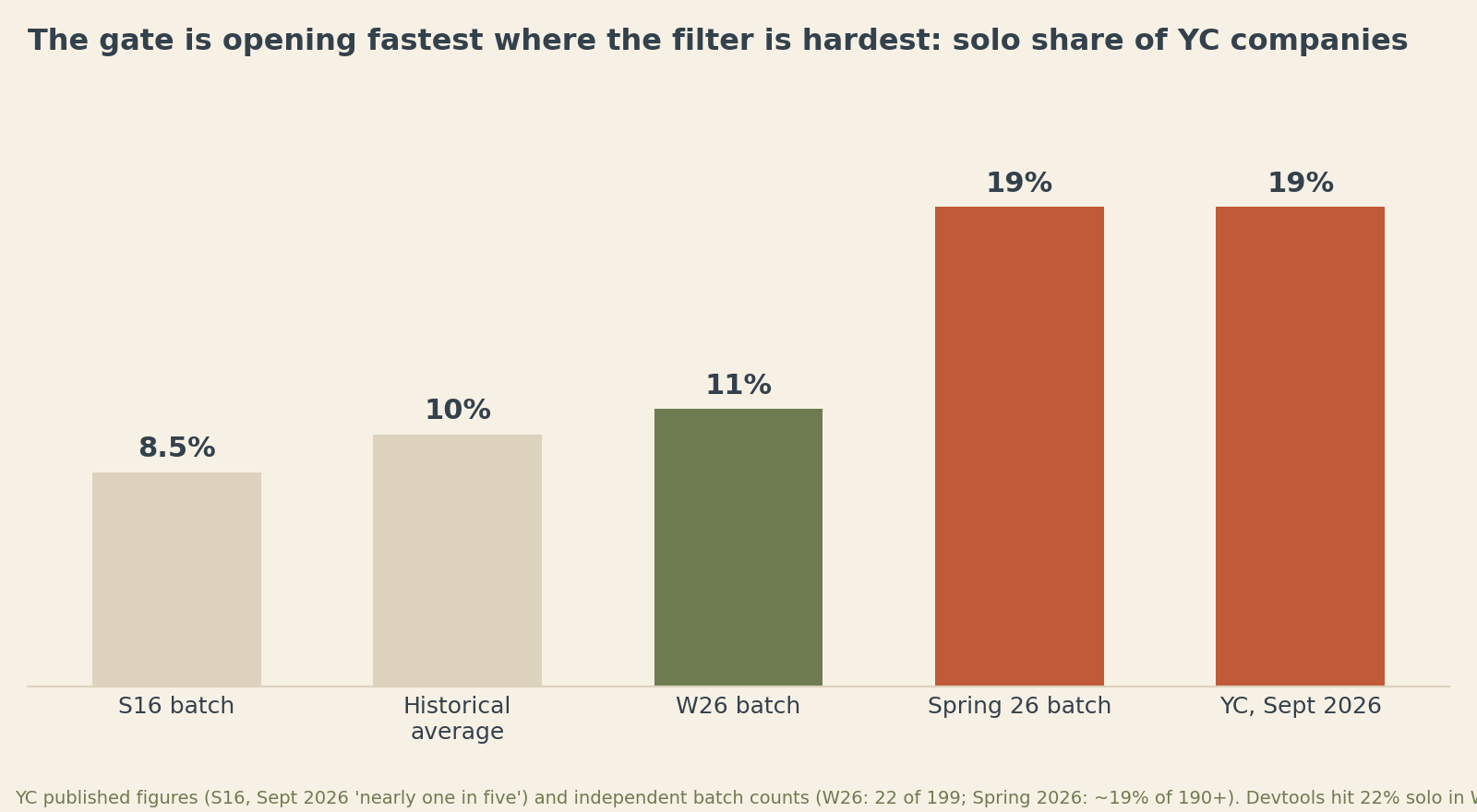
Y Combinator, the hardest filter in startups, had 8.5% solo founders in its Summer 2016 batch. Its Winter 2026 batch had 22 solo founders out of 199, about 11%. Independent counts of the Spring 2026 batch put it at 19%, and in September YC itself said nearly one in five of its companies is now solo-founded. Devtools, where a single builder can show working software fast, hit 22%. The filter that used to tell founders to go find a cofounder is now funding one in five without one.
So here’s the real picture. There’s no price to negotiate. There’s a gate; it’s highest at institutional VC and lowest at angels and accelerators, and it’s moving. Which leaves the only question that matters: what did the solo founders who got through it do differently from the ones who didn’t?
That’s the half of the issue. The four things an investor scores when you walk in alone (one is new this year and it’s the one sinking most AI solo founders), the sentence about being solo that works and the one that ends the meeting, the proof that replaces a cofounder, who to raise from first (almost the reverse of what most people do), how to size the round, the seven mistakes, and a scorecard to tell if you’re ready. If you’re building alone and raising in the next six months, this is the one to read.
Part 1: The four questions an investor asks when you walk in alone
The VC friend walked me through what goes through his head when a solo founder pitches. It’s four questions, in order, and the founder usually only prepares for the first.