

👋 Hey, Sahil here - welcome to today’s edition of Venture Curator, where we break down how great startups grow, how top investors think, and what’s shaping the future of tech.
P.S. Get access to 100+ startup & VC resources, investor databases, fundraising templates, 150+ premium archive posts and exclusive startup research - all in one place.
FROM OUR PARTNER - MACKTEZ
The IT book for founders who aren't technical…

Most founders never decide to have an IT problem. It just shows up as the company grows: a tangle of tools, accounts, vendors, and security gaps that nobody really owns. Tame the Tech Beast, by Macktez founders Noah Landow and Michael Horst, draws on 30 years of guiding organisations through growth and change to show nontechnical leaders how to turn IT from a back-office burden into a strategic advantage.
"I wish I'd had this book 17 years ago." (Cindy Gallop, founder and CEO) Available on Kindle, paperback, hardcover, and audiobook.
Partnership With Us
Get your product in front of an audience of 125,000+ - Our newsletter is read by thousands of tech professionals, founders, investors and managers worldwide. Get in touch today.
📜 DEEP DIVE
What is your startup actually worth in 2026? Plus a valuation calculator to price your next round.
Every founder walks into a raise with a number in their head. Usually it comes from a friend’s round, a headline about a company that sounds a bit like yours, or a rule of thumb from a few years ago, when “10x ARR” was the line most people used.
That way of thinking stopped working sometime in the last eighteen months. In 2021, your multiple mostly tracked your growth rate. Grow faster, get paid more per dollar of revenue. In 2026, two companies with the same revenue and similar growth can raise at prices five times apart, and the gap has very little to do with the numbers in their data rooms. It comes down to which story the investor files you under before the first meeting is over.
I wanted to see that clearly, so I pulled together every AI round I could find from 2024 to 2026 where the company’s annual recurring revenue at the time of the round was disclosed or credibly reported: 31 rounds across coding tools, legal, healthcare, voice, infrastructure, sales and consumer apps. I divided each post-money valuation by the ARR behind it, then compared that with what public software trades at and with the seed and Series A medians from Carta and PitchBook.
The pattern was sharper than I expected. Once you see what investors are actually paying for, you can position your company to be priced on it.
Here’s what we’re covering:
What is a dollar of your revenue worth to a private investor right now, and how far is that from what public markets pay?
Does more revenue get you a higher multiple? (Short answer: no.)
If it isn’t revenue size or growth, what actually decides whether you get 20x or 54x?
What are seed and Series A rounds really pricing at in 2026, AI and non-AI?
How do you position your company so investors put you in the higher bracket? Six moves, and what to change in your deck.
What is a “headline valuation”, and why might the number you announce not be the price you actually raised at?
The valuation calculator: put in your ARR, growth, margin, retention and how you earn revenue, and get a low, base and high valuation plus the dilution at each.
The positioning score: eight questions that tell you which end of that range to anchor your ask on.
A dollar of revenue is worth ten times more in private markets than public ones
Start with the baseline. In April, Meritech’s tracking of public software companies had the median public company trading at about 3.2x ARR. Even the top ten were at 11.7x. That’s 63% below the pre-2021 median, and the median stock was down about a third for the year.
Private AI rounds are in a different universe. Across my 31 rounds, the median company raised at 36.7x ARR. Look only at the rounds priced in 2026, and the median jumps to 54.6x.
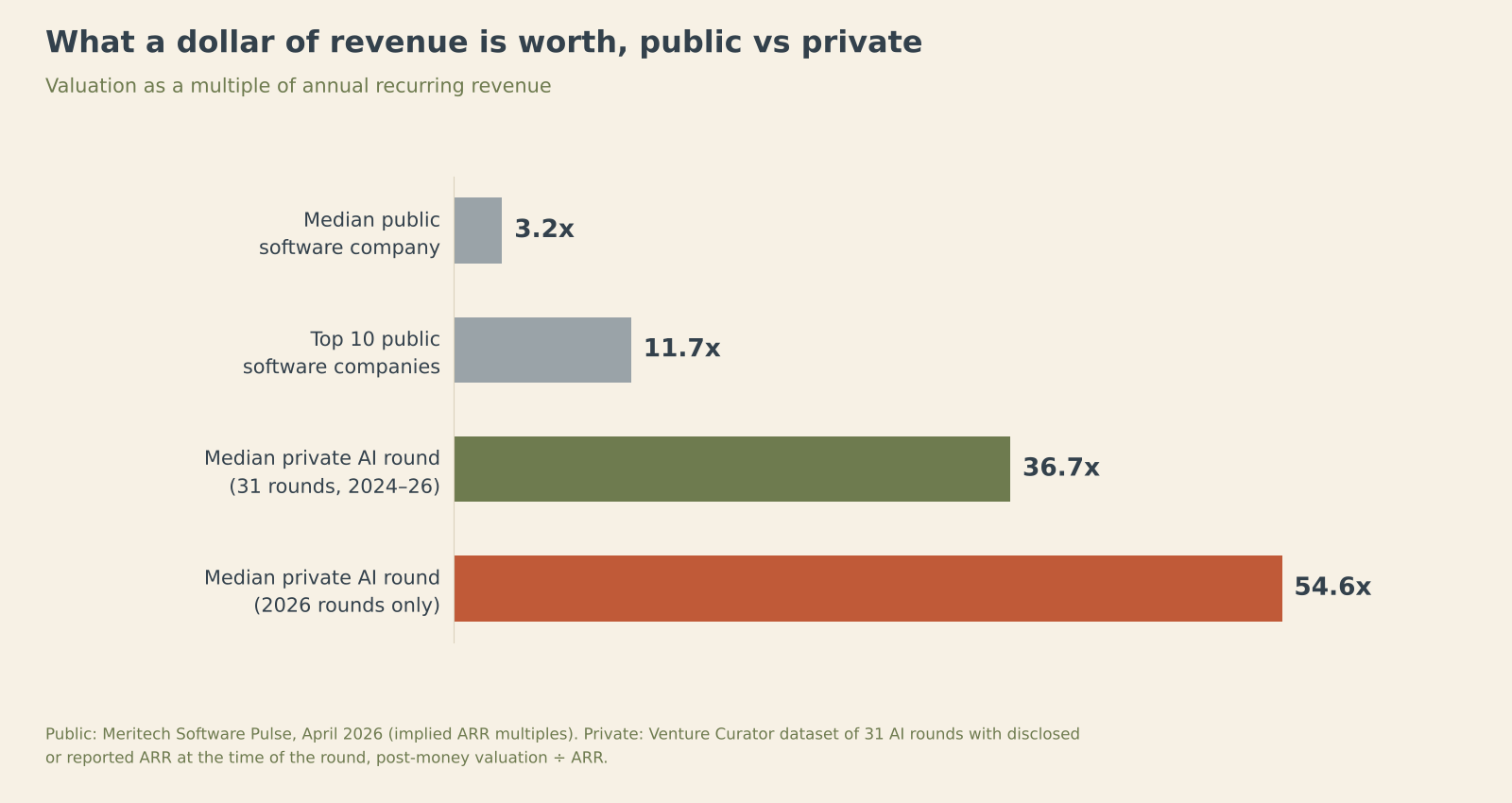
A private investor paying 37x for revenue that public markets value at 3x isn’t paying for the revenue. They’re paying for what they believe the revenue turns into, and for the right to own a piece of a company that might own a category. Everything in this piece follows from that. Your valuation is an investor’s bet on your future position, and in a raise, most of what you control is how believable you make that position.
It also means the number is more fragile than it looks. PitchBook’s latest valuations report points out that the AI valuation thesis hasn’t yet been tested by public markets, and that a repricing could follow if public investors won’t pay what venture has. So a high price now is a bar you have to clear next round, not just a win you get to bank.
Bigger revenue doesn’t buy you a bigger multiple
The obvious assumption is that more revenue earns a higher multiple. It doesn’t, at least not in this data.
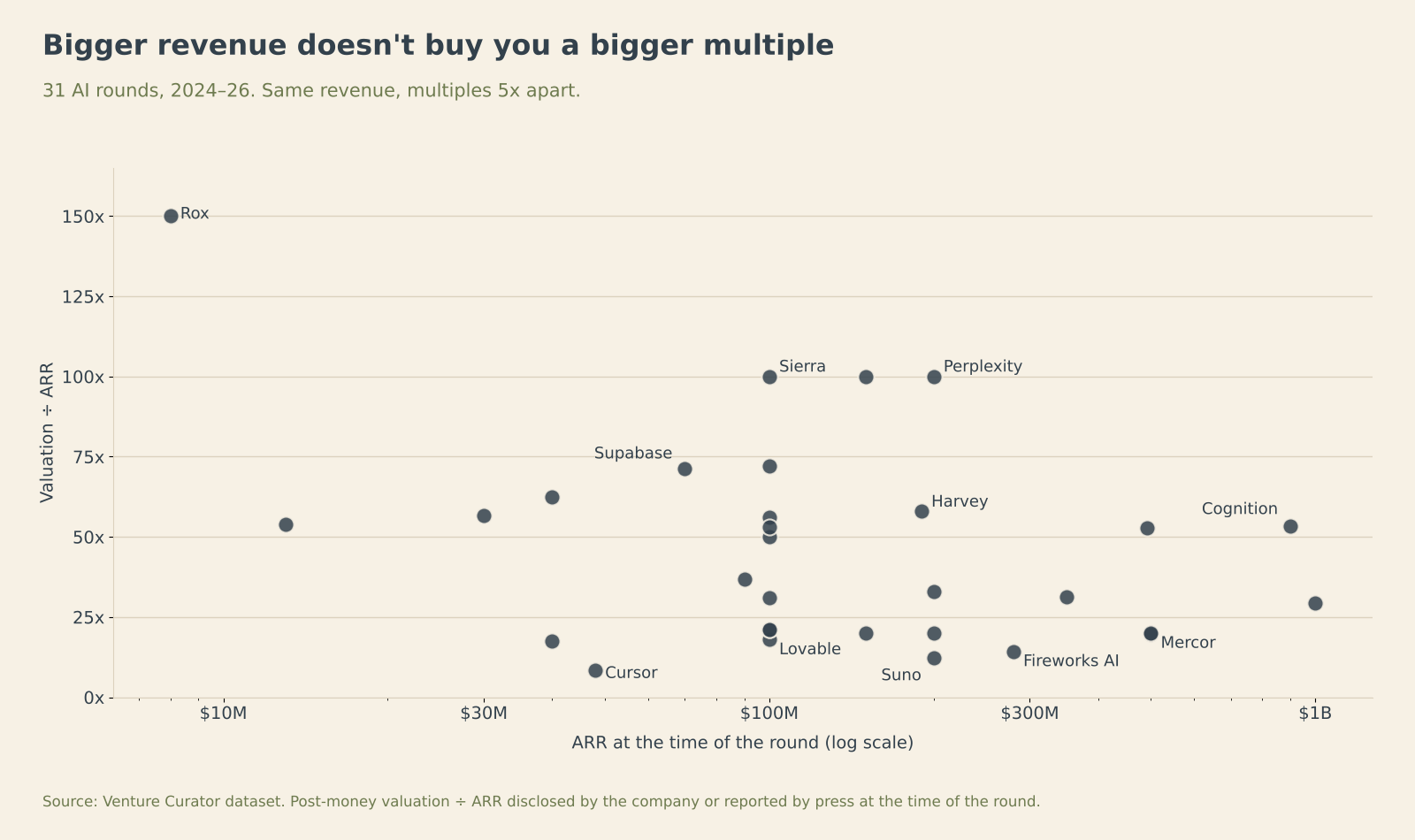
The clearest view is the cluster of companies that raised at almost exactly $100M in ARR. Same revenue, very different prices:
Lovable, the app builder, raised at about 18x.
Gamma, the AI presentation tool, raised at 21x.
Clay, the GTM data platform, at about 31x.
Harvey, in legal, at 50x.
Legora, also legal, at 56x.
Glean, enterprise search, at about 72x.
Sierra, customer service agents, at 100x, and again at 100x a few months later on $150M.
That’s a 5.5x spread at identical revenue. And growth doesn’t close the gap either. Lovable was arguably the fastest-growing company on that list, going from launch to $100M in about eight months, and it priced near the bottom. Tomasz Tunguz noticed the same thing looking at a smaller set of AI companies this summer: the fastest grower priced near the bottom, and the premium tracked something else.
At the small end it’s even more extreme. Rox, a sales agent startup, reportedly raised at $1.2B on around $8M of ARR, which is roughly 150x. Cursor’s Series A in 2024 was priced at about 8x.
So if it isn’t size, and it isn’t speed, what is it? When I sorted the 31 rounds by one simple attribute, the gap mostly explained itself. And once you know what that attribute is, there are specific things you can change in how you describe your company, and in how you report revenue, that move you from one bracket to the other.