
👋 Hey, Sahil here — Welcome back to Venture Curator, where we explore how top investors think, how real founders build, and the strategies shaping tomorrow’s companies. Here’s today at a glance -
The forecast model every startup needs (with template).
Mercury’s Report: The surprising truths 1,500 founders shared about raising, building and spending in 2025.
The top 1% of AI startups are rewriting venture math: Jason Lemkin.
FROM OUR PARTNER - BOARDY
🤝 How I got the right intro without sending a single cold email.
I’d been trying to meet D2C founders for partnerships, but cold outreach was going nowhere.
Then I messaged Boardy on WhatsApp. Within minutes, its AI called me, asked about my startup, and who I wanted to meet. That same day, I had a double opt-in intro to a perfect-fit founder, someone already open and excited to connect.

Founders use it to meet investors, land customers, hire talent, or get expert advice.
Every intro is vetted, so your time isn’t wasted, and the whole process feels personal, quick, and effortless. One clear ask, one valuable connection.
Boardy’s already helped founders close millions in funding and deals through intros like this.
VENTURE CURATORS’ FINDING
📬 My Favourite Finds
Media Posts:
Artisan’s $25M Series A deck, which they just released. (Link)
Chris Dixon’s 2009 essay, "Climbing the Wrong Hill," remains highly relevant today. (Link)
40 real startup pitch decks that raised $350M+ (Including leading startups decks) (Link)
Jeff Bezos' decision-making framework for founders. (Link)
The 60-second pitch formula that gets investors to say “Yes”. (Link)
Reports/Articles:
How to prompt better products with AI. (Link)
Building AI products in the probabilistic era. (Link)
Sam Altman: What I wish someone had told me. (Link)
Elad Gil’s list of biotech companies he wishes existed is well worth a read. (Link)
What is the Price of Demand? (Link)
Why LLMs can't really build software. (Link)
Write your monthly investor update (email template download) (Link)
🤝 PARTNERSHIP WITH US
Get your product in front of over 95,000+ audience - Our newsletter is read by thousands of tech professionals, founders, investors and managers worldwide. Get in touch today.
📜 DEEP DIVE
The forecast model every startup needs (with template).
Running a startup can feel like captaining a boat through a storm. You’re blindfolded. The compass is broken. And you’re mostly guessing.
That’s where a financial forecast model comes in. First thing - it won’t tell you the future. But it will help you see what’s coming, make smarter decisions, and stretch your cash in the right direction.
If “building a financial model” sounds complex, overwhelming, or like something you’ll “do later”... good news: it doesn’t have to be. We’ve created a straightforward forecast model template you can copy, customise, and actually use.
Let’s walk through why every founder (yes, even early-stage) should have one and what to focus on.
Why you need a forecast model, even if you’re still pre-product
Cash is oxygen
Forget “cash is king.” For startups, cash is air.
Without it, you’re done. A forecast model helps you project income and expenses across time, so you’re not surprised when the runway gets tight. Instead of reacting when you're gasping, you’re making moves ahead of time.
Speak the language of money
Investors. Board members. Loan officers. Even vendors.
They all want to see that you’ve got a handle on your finances. A forecast model helps you show, not just say, that you’re building with a plan. It proves you’re not winging it, even if it feels like that some days.
Get better at saying no
Startups are full of decisions that sound exciting: “Let’s ramp up ads!” or “Let’s hire three more engineers!”
But can you afford to do that and still build the product? A forecast model helps you understand tradeoffs, prioritise resources, and stay focused on the metrics that matter.
Know what really moves the needle
Whether your goal is acquisition, profitability, or that next funding round your forecast helps you zoom out and see what truly impacts your outcomes.
For example, improving retention by just 5% might move revenue way more than launching that new feature you’re debating.
So... what actually goes into a good forecast model?

Let’s break it down into five core sections you should focus on, especially in the early stages:
Customer acquisition
Think about how you attract new customers. Break it into clear channels like:
Performance marketing: Ads, paid campaigns, etc. (Track CAC!)
Sales team productivity: Deals won per rep.
Organic growth: SEO, word of mouth, referrals.
Start simple, don’t overcomplicate with 10 variables per channel. Use broad assumptions, then refine with real data over time.
Customer retention
Acquiring a customer means nothing if you can’t keep them. Your model should reflect how long customers stay, and when they tend to churn.
Use cohort analysis or a basic monthly churn rate. Ask:
Do customers stay longer if they activate early?
Are certain channels bringing in stickier customers?
Retention is also your best indicator of product-market fit.
Revenue
Revenue should be tied directly to customer activity:
For SaaS, it’s subscription price × active customers.
For marketplaces, it could be volume × take rate.
Start with average revenue per user (ARPU), and evolve into more granular views as you scale.
Expenses
Your biggest expense? People. Use a headcount plan to map out salaries, hiring timelines, and team functions. Other key categories include:
COGS: Hosting, inventory, services delivered.
Marketing spend: Performance + brand.
Tools & software: Scale with team size and complexity.
Office, travel, services: Keep it lean unless proven otherwise.
Don’t default to “% of revenue” unless you have no better data. You control your budget, make it intentional.
Cash flow + runway
At the end of the day, it’s about how long your cash lasts. Forecasting your runway (how many months you can operate before running out of money) helps guide:
Fundraising timelines
Hiring plans
Growth investments
Always stress-test with multiple scenarios:
Best-case (aggressive growth)
Base-case (reasonable assumptions)
Worst-case (conservative path)
Tips to get started (without burning out)
Start simple. This isn’t a Wall Street IPO model. It’s your startup’s guiding tool.
Update monthly. Compare forecast vs. actuals. Adjust your assumptions.
Don’t aim for perfection. Aim for utility. It’s better to have a rough, usable model than a flawless one that sits unopened.
Think of it as a living document. Not a one-time exercise.
Remember your forecast model = your strategy, in numbers
You don’t build a model because investors ask. You build it to understand your own business better. To make smarter decisions. To align your team. To spot problems early and act on them.
“The real magic happens when you strike a balance between planning and doing.”
(You can use this financial model template to create one for your startup.)
FROM OUR PARTNER - ESPECIALTY INSURANCE
🤝 Protect your emerging fund without breaking the bank.
eSpecialty’s Emerging Fund & SPV Insurance Program is built for venture, private equity, and real estate funds under $100M AUM.

Get GPL (E&O/D&O) coverage that safeguards against today’s investment risks with streamlined onboarding, scale-appropriate pricing, and protection tailored to first-time and growing fund managers.
📄 QUICK WIN
Mercury’s Report: The surprising truths 1,500 founders shared about raising, building and spending in 2025.
Mercury just published a detailed survey of 1,500 early-stage U.S. founders (companies under 6 years old), and the results paint a surprisingly optimistic picture of startups in 2025.
Despite rising costs and policy headwinds, founders are charging forward with new playbooks, especially around AI, funding diversification, and hiring.
Here’s what every founder should know:
Optimism is up:
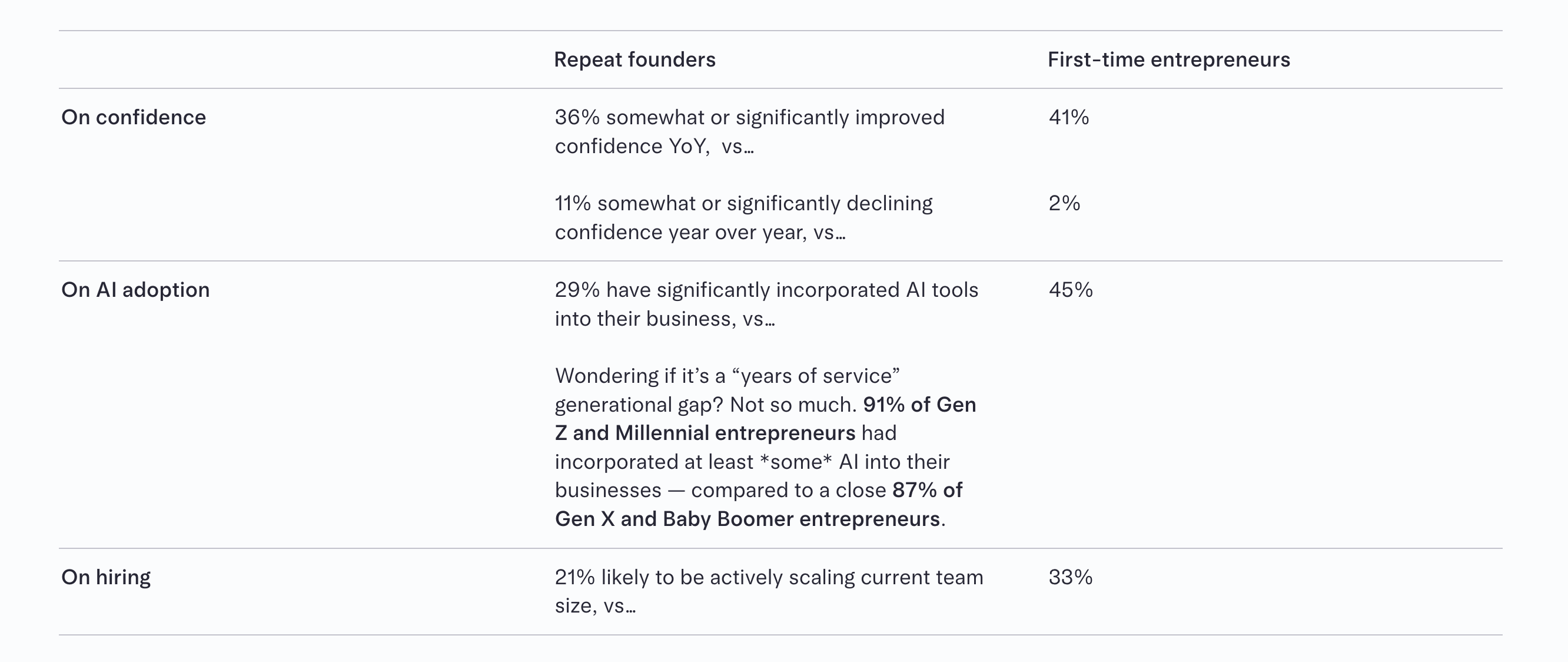
87% of founders say their confidence in their business’s financial prospects has improved since 2024. That number jumps to 93% among companies that have significantly adopted AI. First-time founders are also more optimistic (88%) than repeat founders (76%).
Funding is more diversified:
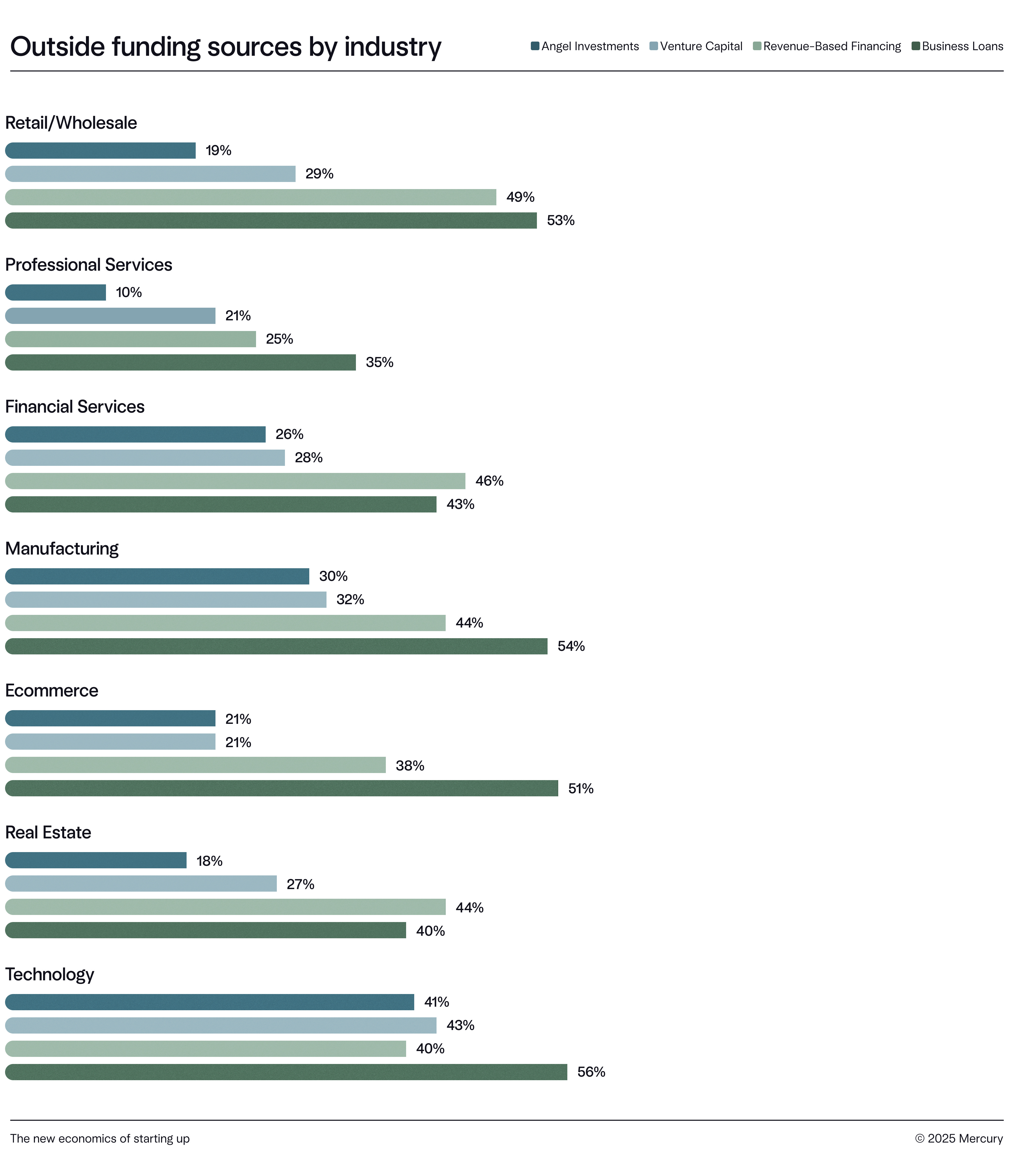
The “VC or bust” mindset is fading. Tech companies still top the list for venture money, but professional services lean heavily on self-funding (72%), and retail is leading on revenue-based financing (49%).
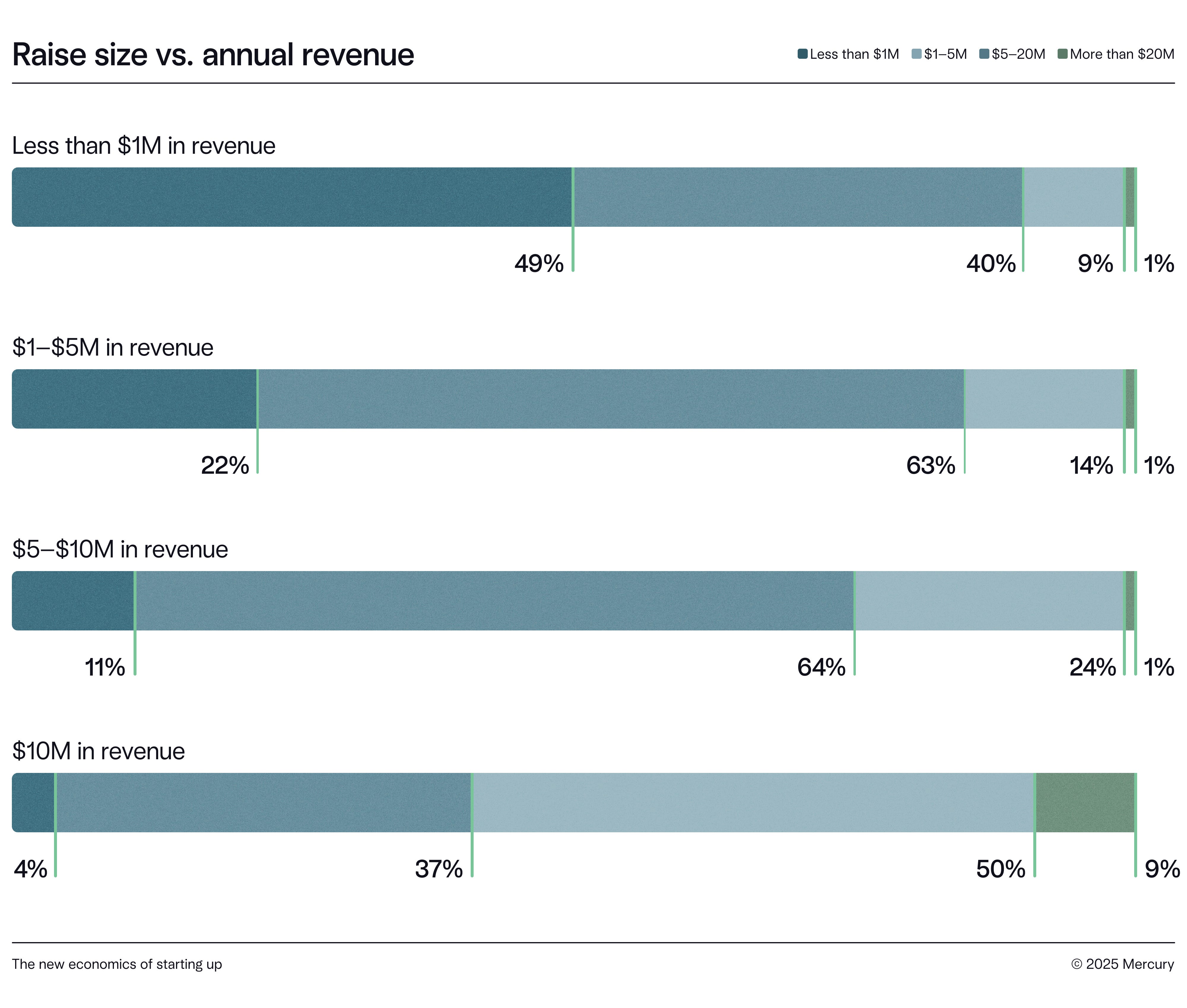
Most rounds remain small, 73% raised under $5M, but larger, multi-source strategies correlate with bigger raises.
Revenue vs. raising:
Big fundraising doesn’t always equal high revenue. Many lean companies are finding alternative paths to profitability, with a sweet spot at $5–10M revenue, where most raise $1–5M. Half of $10M+ revenue companies still operate with fewer than 100 employees.
Costs keep climbing:
66% of founders said expenses were higher than expected, especially in ops and marketing.
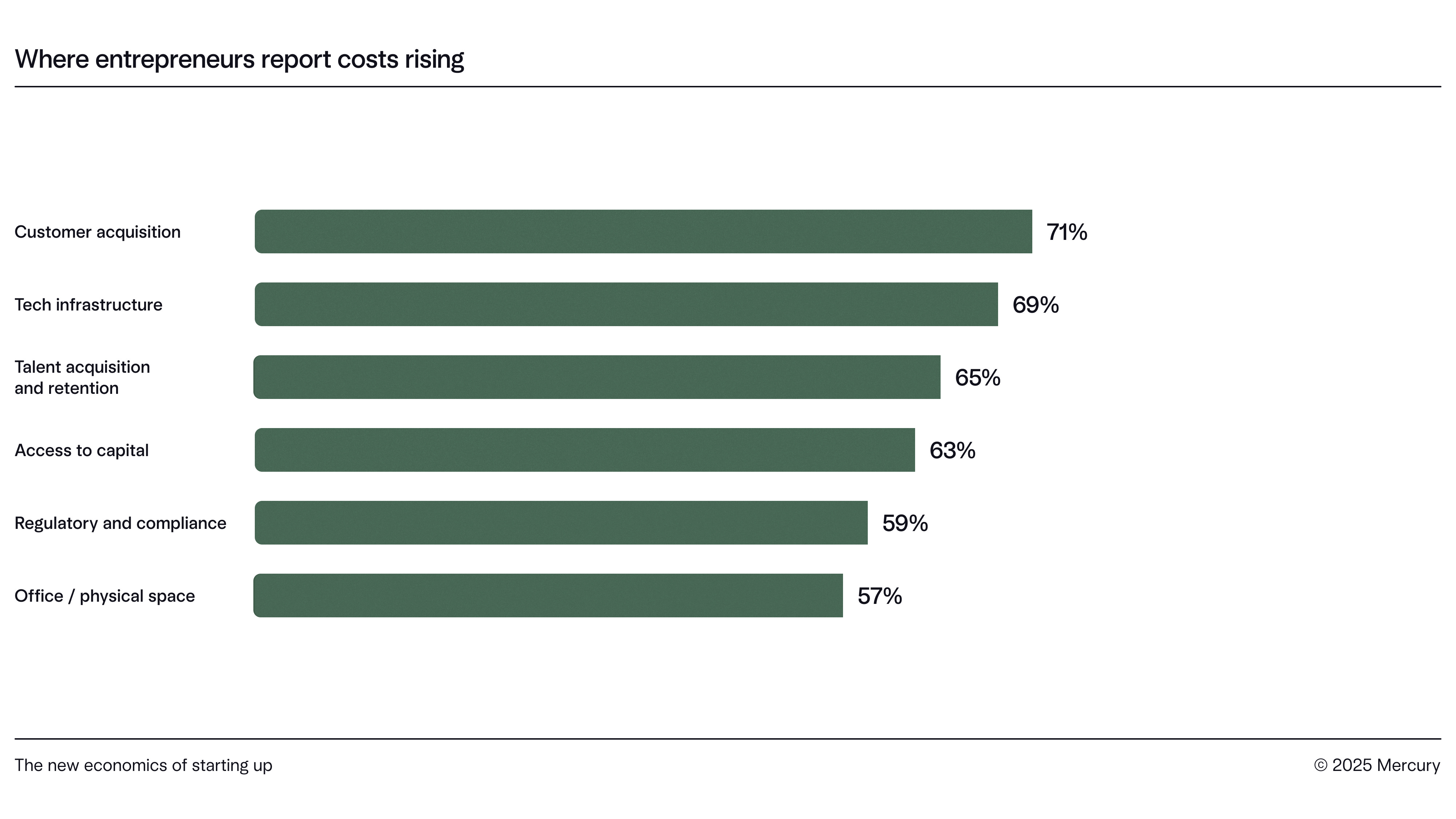
Still, 79% plan to spend more this year — driven by growth opportunities rather than investor pressure.
AI = growth engine:
73% are increasing AI spend, and 55% are actively shifting budget from “traditional” tools to AI. AI adopters are 3x more likely to be scaling teams, 2x more likely to seek bigger rounds, and ~4x more reliant on contractors (especially for sales and marketing).
Hiring is accelerating, not slowing:
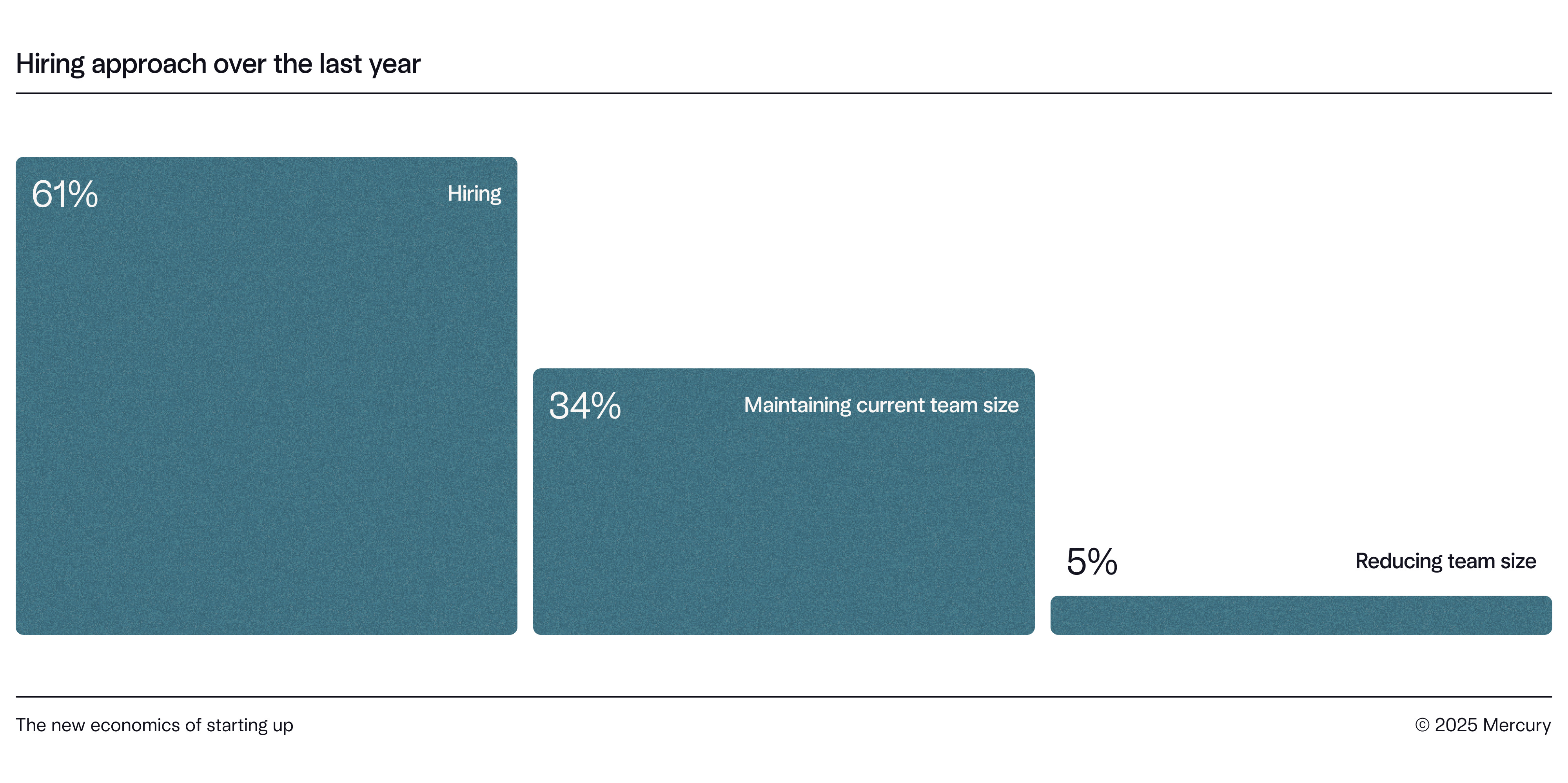
61% of companies hired in the past year. Among AI adopters, 79% said AI made them hire more, not less.
Growth roles like sales, biz dev, marketing, and customer service are top priorities.
Contractors are essential:
61% of companies rely on freelancers/consultants, mostly for flexibility and specialised skills. AI-forward companies in particular are turning contractors into a growth lever, not just a stopgap.
Policy pain is real:
73% said the R&D amortisation rule (since 2022) hurt finances, forcing many to cut R&D budgets, delay projects, or slow hiring. Relief is on the way via the July 2025 tax bill.
Early-stage founders are rewriting startup economics in real time. The old formula of “raise VC, hire fast, scale linearly” is giving way to more flexible models — diversified funding, leaner ops, contractors, and AI at the core of strategy. Those embracing AI aren’t just cutting costs; they’re using it to grow faster, raise bigger, and build more resilient companies.
(Full report from Mercury here: The new economics of starting up)
The top 1% of AI startups are rewriting venture math: Jason Lemkin.
Jason Lemkin just unpacked fresh Carta data from 3,001 U.S. startup rounds (Sept 2024–Aug 2025), and the numbers are staggering: the top 1% of AI startups are now valued at 3–10x higher multiples than “normal” SaaS companies.
This isn’t just a hot market. It’s a structural split.
In one universe, solid SaaS and B2B startups raise at familiar, disciplined multiples.
In the other, AI-native companies are trading in a different universe altogether.
At seed, the 99th percentile valuations are hitting $161M (+123% above the 95th percentile). By Series A, “legendary” AI companies are valued at $716M vs. $250M at the 95th. Series B? A shocking $2B median at the top 1%. And by Series C/D, it’s $7–8B valuations for companies still technically in “growth” stages.
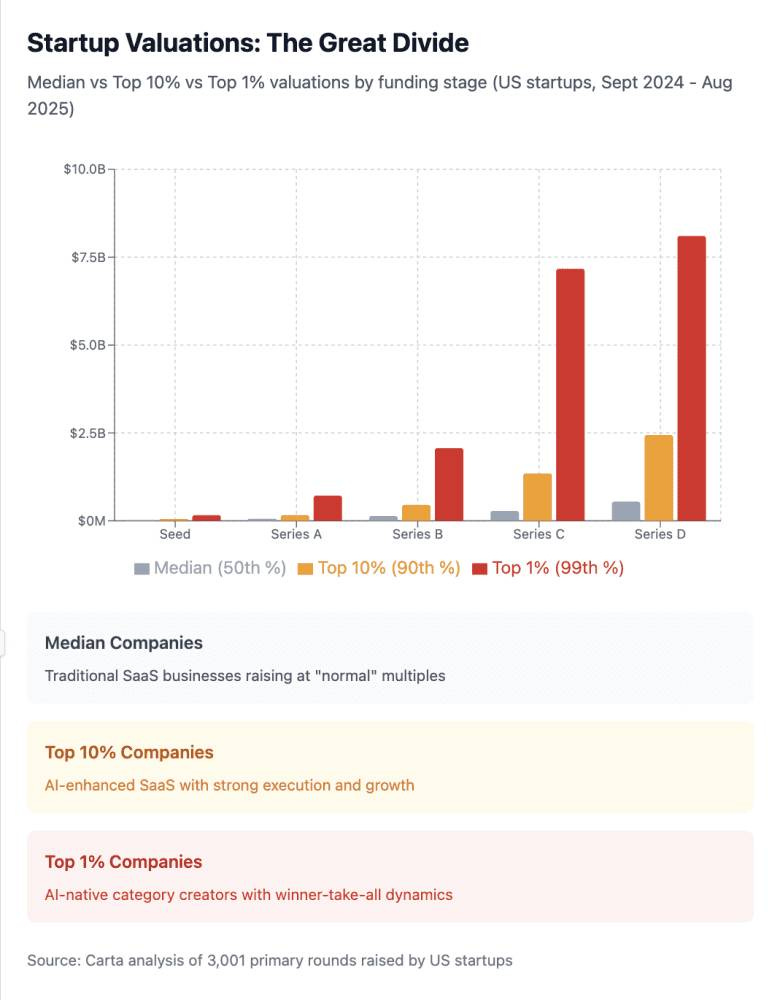
Why is this happening? Three forces:
AI-native moats compound: every customer interaction improves the model, making competition almost impossible.
Infinite TAM + efficiency: SaaS might 3x a market by expanding internationally; AI startups are 10x-ing TAM by automating entire job functions while improving margins.
“Never raise again” premium: the best AI-native companies could realistically stop raising forever, generating cash with widening moats. VCs will pay infinite multiples for that.
The market now looks like a three-tier structure:
Tier 1: Traditional SaaS (predictable, disciplined multiples, but limited upside).
Tier 2: AI-enhanced SaaS (gets some premium, but still feature parity vs. AI-native).
Tier 3: AI-native category creators (valuations in a different universe; true winner-take-all).
The lesson for founders is stark: building a “good SaaS company” may no longer be enough. The middle ground is disappearing. Either you’re proving AI is core to your business, or you’re competing for scraps.
For investors, the cost of being wrong is higher than ever; confusing an AI-enhanced SaaS for a true AI-native category creator could mean missing generational returns.
As Lemkin puts it, in venture today, there’s the AI game and everything else. (Full breakdown here: Winner-take-all has taken over the venture)
TODAY’S JOB OPPORTUNITIES
💼 Venture Capital & Startup Jobs
Ventures Associate | LifeTech - Plug and Play Tech Centre | USA - Apply Here
Capital Formation Associate - B Capital Group | USA - Apply Here
Marketing & Communications Lead - Endiya Partners | India - Apply Here
Associate - Mighty Capital | USA - Apply Here
Associate - Allocator One | USA - Apply Here
Associate - Temasek | USA - Apply Here
Associate/manager - Redalpine | UK - Apply Here
Venture Investment Analyst - Laplace Partner | South Korea - Apply Here
Investment Analyst - Beas Capital | India - Apply Here
Program Manager - generator | USA - Apply Here
Investor Relations Analyst - Techstars | USA - Apply Here
Manager - Finance - Yournest Venture | India - Apply Here
Investor Relations Manager - Beco Capital | UK - Apply Here
Head of Platform - Pledge Venture | UK - Apply Here
ESG Intern - ESG Enterprise | UK - Apply Here
Executive Assistant - AN Venture Partner | USA - Apply Here
🤝 Partnership With Us
Get your product in front of over 95,000+ audience - Our newsletter is read by thousands of tech professionals, founders, investors and managers worldwide. Get in touch today.
🔴 Share Venture Curator
You currently have 0 referrals, only 5 away from receiving a 🎁 gift that includes 20 different investors’ contact database lists - Venture Curator