

👋 Hey, Sahil here - welcome to this edition of Venture Curator, where we break down how great startups grow, how top investors think, and what’s shaping the future of tech.
P.S. Get access to 100+ startup & VC resources, investor databases, fundraising templates, 150+ premium archive posts and exclusive startup research - all in one place.
FROM OUR PARTNER - CYTONICS
500M+ Have Been Waiting for This Biotech Breakthrough

Musculoskeletal conditions are the leading contributor to disability worldwide.* One of the foremost causes is osteoarthritis, which affects 500M+ people.*
Cytonics aims to change that with the first and only potential cure for this $560B disease.
Their drug, CYT-108, targets the root cause of joint degradation. And it just cleared Phase 1 clinical trials.
Historically, like when GSK acquired Bellus for $2B, Big Pharma’s made its move on biotech targets near the next phase, when efficacy data is established but no valuation is set.
While nothing’s guaranteed, Cytonics is preparing for that imminent phase.
Invest in Cytonics before it begins.
Source: World Health Organization*
Source: The Lancet Rheumatology*
This is a paid advertisement for Cytonics Regulation CF offering. Please read the offering circular at https://cytonics.com/
Forward-looking statements are subject to risks and uncertainties. There is no guarantee of performance. Past performance does not predict future results. All investments involve risk, including loss of principal
📜 DEEP DIVE
The Founder’s guide to secondaries: getting liquid before the exit.
A founder I’ll keep anonymous crossed $40 million in net worth two years ago, on paper. Her company had just closed a Series C, the 409A (the formal appraisal that decides what her shares are officially worth) had caught up to the new round, and on a spreadsheet she was rich. That same month she was running the numbers on whether to renew her apartment lease or move somewhere cheaper, because her actual bank balance was a founder’s salary minus rent in a major city.
That gap - wealthy on the cap table, tight in the checking account - used to be the toll you paid to build something big. You accepted it going in. Build for a decade, wait for the IPO or the acquisition, and somewhere on the far side the paper turns into money.
The waiting was the deal.
The deal has changed. Quietly, and a lot faster than most of the people writing about startups have noticed.
Why does $40 million on paper still leave a founder broke?
Because the old clock broke: companies are staying private far longer than the model assumed. Of the roughly 1,920 unicorns in the world as of March 2026, 59% were founded more than ten years ago, and 20% more than fifteen years ago, according to World Economic Forum / Jay Ritter data.
The five-to-seven-year round trip from seed to liquidity that defined venture for thirty years is gone. Top companies now meet their capital needs privately and stay there, sometimes skipping the public markets entirely.
Which leaves a strange new problem at the centre of a “successful” startup:
enormous created value, locked inside shares nobody can spend. Founders feel it. Early employees feel it worse - they took below-market salaries for equity that, for years, has been a number on a screen they can’t touch.
And the longer the private window stretches, the longer that money stays frozen.
For a while, there was no release valve. Now there is one, and it’s swallowing the market whole.
What actually replaced the exit?
Here’s the number that should reframe how you think about your own equity.
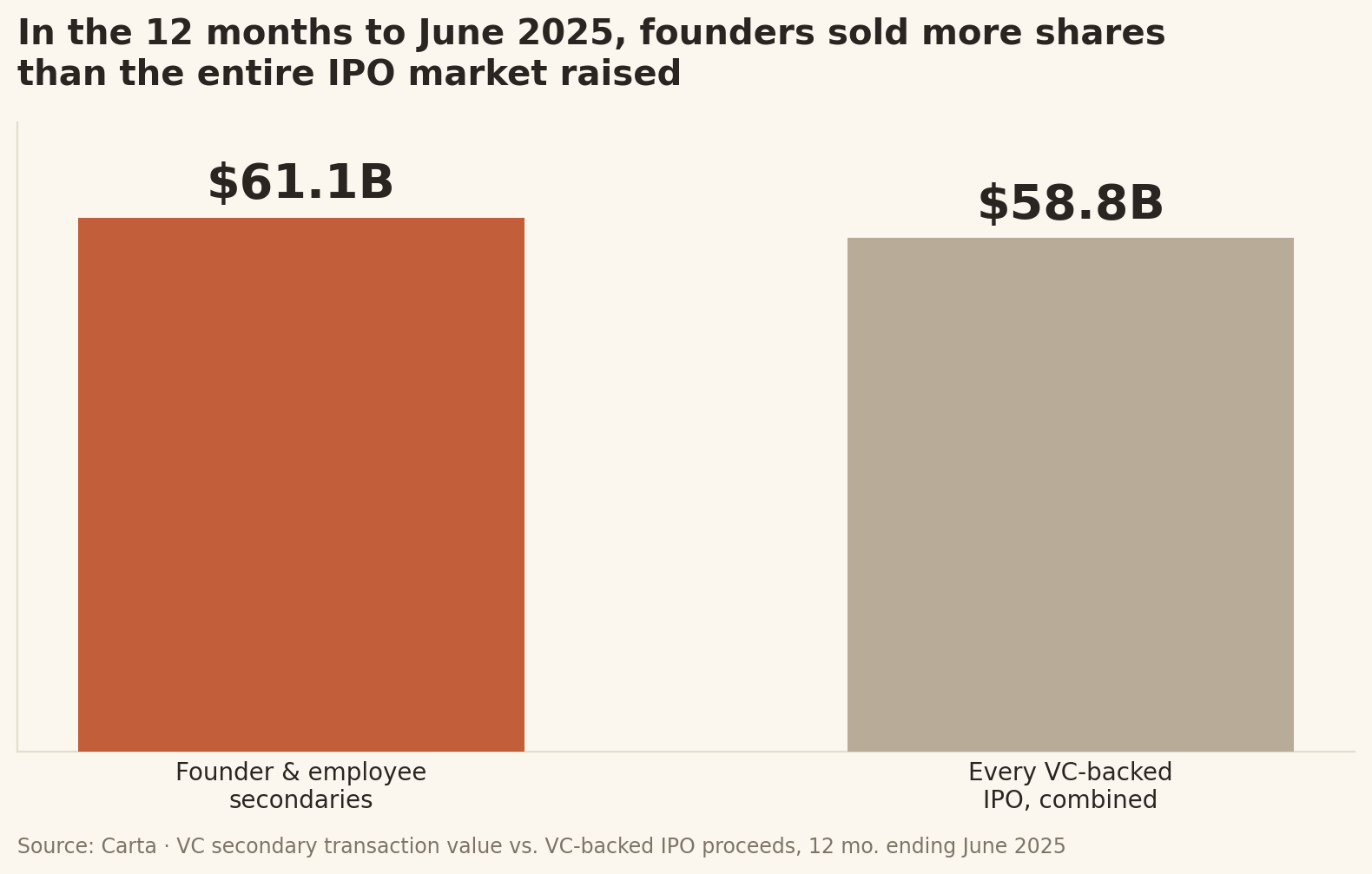
In the twelve months ending June 2025, founders, employees and early investors sold $61.1 billion of existing shares on the secondary market (selling your already-owned shares to another investor, instead of the company issuing new ones to raise money) - more than the $58.8 billion raised by every single VC-backed IPO over the same period, according to Carta.
Selling your shares privately, without an exit, is now a bigger source of liquidity than the entire IPO market.
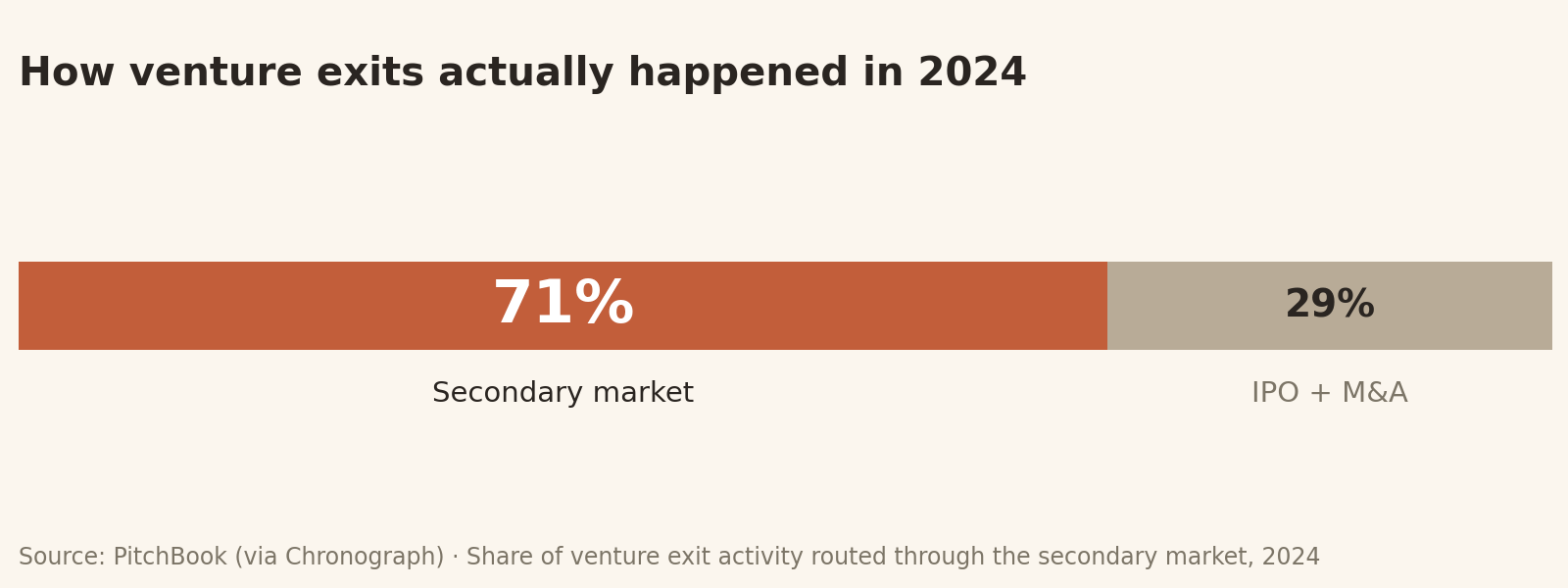
It’s not a one-quarter blip, either. Step back to the full picture of how money actually left venture-backed companies in 2024, and the old playbook looks almost quaint: an estimated 71% of all venture exits ran through the secondary market rather than IPOs or acquisitions (PitchBook, via Chronograph).
The trajectory is the loud part. Annualised direct secondary value climbed from roughly $50 billion at the end of 2024 to about $91.7 billion a year later - an 83% jump in five quarters, per The State of Venture.
Across the whole market (venture plus fund-level), total secondary volume ballooned to about $160 billion in 2024 and is projected to have cleared $210 billion in 2025. And it hasn’t cooled in 2026 - the US venture secondary market hit fresh record levels in the first quarter of 2026, per PitchBook. There is now a deep, well-capitalised bid waiting for private startup stock.
The clearest sign this has gone from rare event to routine plumbing: the average gap between tender offers at a given company collapsed from 899 days in 2022 to just 132 days by 2025 (PitchBook, via Crowdfund Insider). Companies used to open a liquidity window once every two and a half years. Now it’s roughly every four months.
So the finish line moved. The thing you assumed you’d wait ten years for - turning equity into spendable money - is now something that happens during the build, on a repeatable schedule, for a growing list of companies.
But the headline number hides three things that decide whether you get any of it.
The first is that $61 billion is not spread evenly. A startling share of it flows to a tiny handful of names, and whether you make that list depends on factors most founders have never been told to optimise for.
The second is that the mechanics have traps - a wrong move can blow up your 409A, spook your board, or kill the deal before it clears.
And the third is timing: there’s a specific window in a company’s life when this is possible, and a specific way to open it without looking like you’re heading for the door.
That’s what the rest of this issue is for.
What you’ll find below the line
How does a founder actually get a secondary done - the two real paths, and how much of your stake you can realistically sell?
What’s the catch the headline number hides, and why 86% of the money is locked to just twenty companies?
What are the three traps - ROFR, 409A, and the signalling problem, that quietly kill founder secondaries before they close?
What do you actually keep after tax, and why did a 2025 law quietly hand founders a much bigger break on exactly this kind of sale?
When is the window actually open, and how do you time a sale around a round so it reads as confidence, not exit?
If you’re building right now, what do you do this quarter to put yourself on the right side of all of this?
So how does a founder actually get a secondary done?
There are two doors. They look similar from the outside and behave completely differently once you walk through them.
Door one: the company-run tender offer.
This is the one you want. The company itself sponsors a structured liquidity window - it sets a price (usually pegged to the most recent round), decides who’s eligible and how much they can sell, and runs the whole thing through a formal process that, by rule, stays open for a 20-business-day window.
Because the company controls the buyer list and the price, it’s the cleanest, fairest way to get liquidity at scale, and crucially, it’s structured so it doesn’t wreck the company’s 409A valuation. Tenders are how employees and founders at the OpenAIs and Stripes of the world have been cashing out.
Door two: the direct, bilateral sale.
You find a buyer yourself (often through a platform like Hiive, Forge, or Nasdaq Private Market), and the two of you negotiate a price. Faster in theory. Messier in practice, because your company almost certainly holds a right of first refusal and transfer restrictions that let it step in, block the sale, or buy the shares itself, and a high bilateral price can knock your 409A out of line, which raises the strike price on every new option grant and quietly makes hiring harder. More on that trap below.
The good news for sellers is that the buy side has never been healthier. After a brutal 2022–2023 reset, the market has genuinely repriced. Median discounts on direct VC secondaries compressed from 46% below the last round in December 2023 to just 3% a year later, according to Zanbato data via Behind Genius Ventures, and by Q1 2025 the strongest names were trading at premiums.
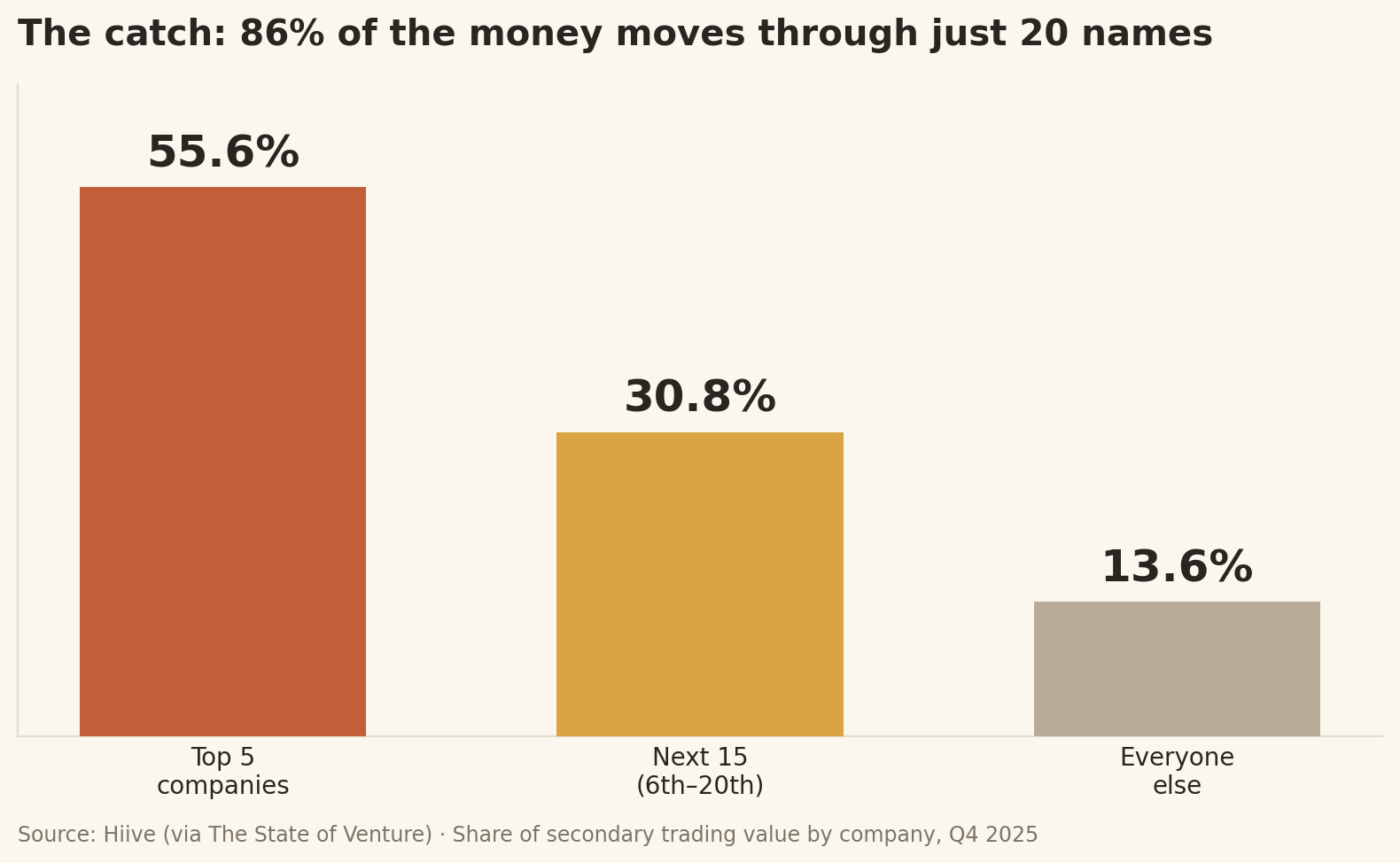
Translation: a year ago, selling meant eating a near-halving of your shares’ value. Today, for a healthy company, you can get something close to par. The cost of liquidity dropped through the floor.
As for how much you can sell - tenders almost always cap participation, typically letting holders sell a slice of their vested position (commonly in the 10-20% range, though it varies by company and round). The design intent is deliberate: enough to take real money off the table and de-risk your life, not so much that it looks like the people who know the company best are running for the door.
What’s the catch nobody puts in the headline?
This one matters, and it’s where most of the breathless coverage misleads you.
That $61 billion is brutally concentrated. On the Hiive platform in Q4 2025, the top five companies accounted for 55.6% of all secondary trading value, and the top twenty soaked up 86.4% (The State of Venture).
Caplight put it even more starkly: 83% of Q3 2025 trading volume happened in just fifteen companies. OpenAI’s single $6.6 billion tender, on its own, was 6.2% of the entire year’s secondary volume.
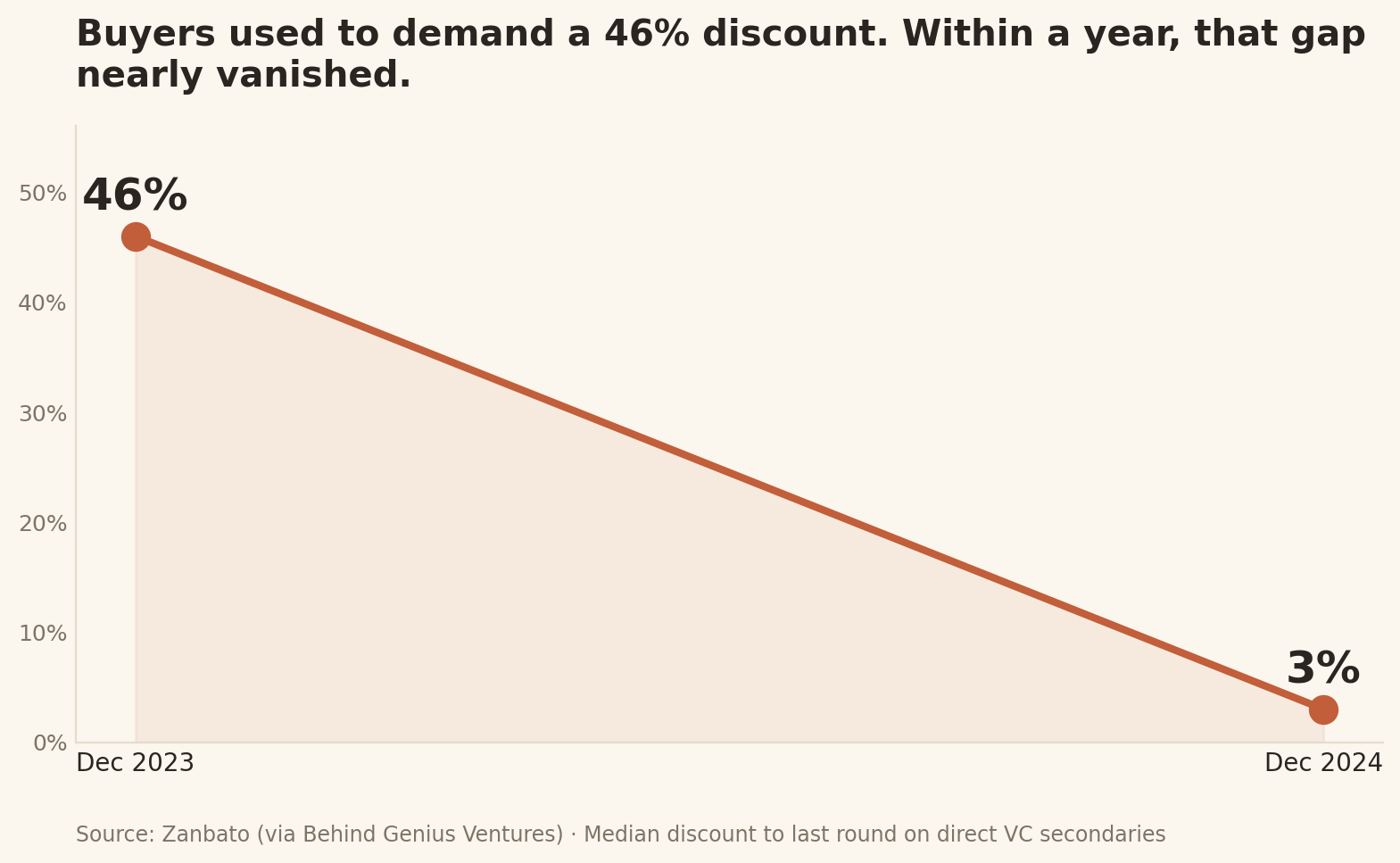
So the honest version of this story is not “every founder can now cash out.” It’s this: a deep, professionalised liquidity market exists, and it pays full freight - if you’re building something the buy side is fighting to own.
If you’re a median seed-stage company, you are not running a tender next quarter, and no one is DMing you on Hiive. Even at the very top it isn’t automatic: in early 2026, roughly $600 million of OpenAI shares that institutional holders tried to sell found no buyers, while demand for Anthropic stock ran hot. Demand is specific, not general.
But the on-ramp is widening, and that’s the part worth planning around. In 2025, 70 companies saw their shares trade on the secondary market for the very first time ($492 million in fresh names, per The State of Venture).
And 2026 is bringing real structural democratisation: tender offers are firing far more often, OpenAI built retail access into its latest round, two no-accreditation venture funds listed on the NYSE, and the London Stock Exchange launched the first regulated private-stock market.
The set of companies and sellers for which this is real grows every quarter. The move isn’t “wait until you’re OpenAI.” It’s “understand the mechanism early, so the moment your company crosses the line into demand, you’re ready to act instead of scrambling.”
What are the three traps that kill founder secondaries?
Plenty of founders technically qualify for liquidity and still botch it. Almost always on one of these three.
The right of first refusal (ROFR).
Buried in your financing docs is, in all likelihood, a clause that lets the company and its existing investors match any outside offer before your shares can change hands.
Try to run a quiet bilateral sale, and you can spend weeks negotiating a buyer only to have the company exercise its ROFR and unwind the whole thing or simply block it under transfer restrictions. The fix is to stop treating a secondary as something you do to the company and start treating it as something you do with it. Tenders exist precisely because they route around this problem by design.
The 409A landmine.
Your 409A valuation sets the strike price on employee options. Sell a chunk of stock bilaterally at a rich price, and you can drag that 409A up - which raises strike prices on new grants, makes your offers less attractive to recruits, and irritates the very employees you’re trying to retain.
This is the single most underrated reason boards prefer structured tenders: a well-run tender can deliver founder liquidity while managing the 409A impact, where a sloppy direct sale just detonates it.
The signalling problem.
A founder selling shares can read, to the wrong audience, as the founder is checking out. This is the fear that keeps most boards from saying yes. The counter is both narrative and structural.
Narratively, the honest case - backed by every investor who’s watched it play out is that a founder who’s banked a modest slice makes better long-term decisions: they can turn down a mediocre acquisition offer, take rational risks, and keep building without their entire net worth held hostage to one outcome.
Structurally, you sell a small percentage, you tie it to a moment of strength, and you bring the board in early rather than asking forgiveness. Sell 10% of your stake in a round everyone’s celebrating and it signals durability. Try to dump 60% in a quiet quarter, and it signals exactly what they’re afraid of.
What do you actually keep after tax?
The second thought after “how much can I sell” should be “what’s left after the IRS takes its cut”, and for founders, the answer changed dramatically in 2025, in a way that’s almost custom-built for pre-exit liquidity.
The mechanism is QSBS - Qualified Small Business Stock, Section 1202 of the tax code. For years it ran on a brutal all-or-nothing cliff: hold shares in a qualifying C-corp for five years, and you could exclude up to $10 million of gain from federal tax; sell a day early and you got nothing.
The One Big Beautiful Bill Act, signed July 4, 2025, scrapped the cliff for stock issued after that date and replaced it with a graduated schedule: hold three years and exclude 50% of the gain, four years and exclude 75%, five-plus years and exclude the full 100%.
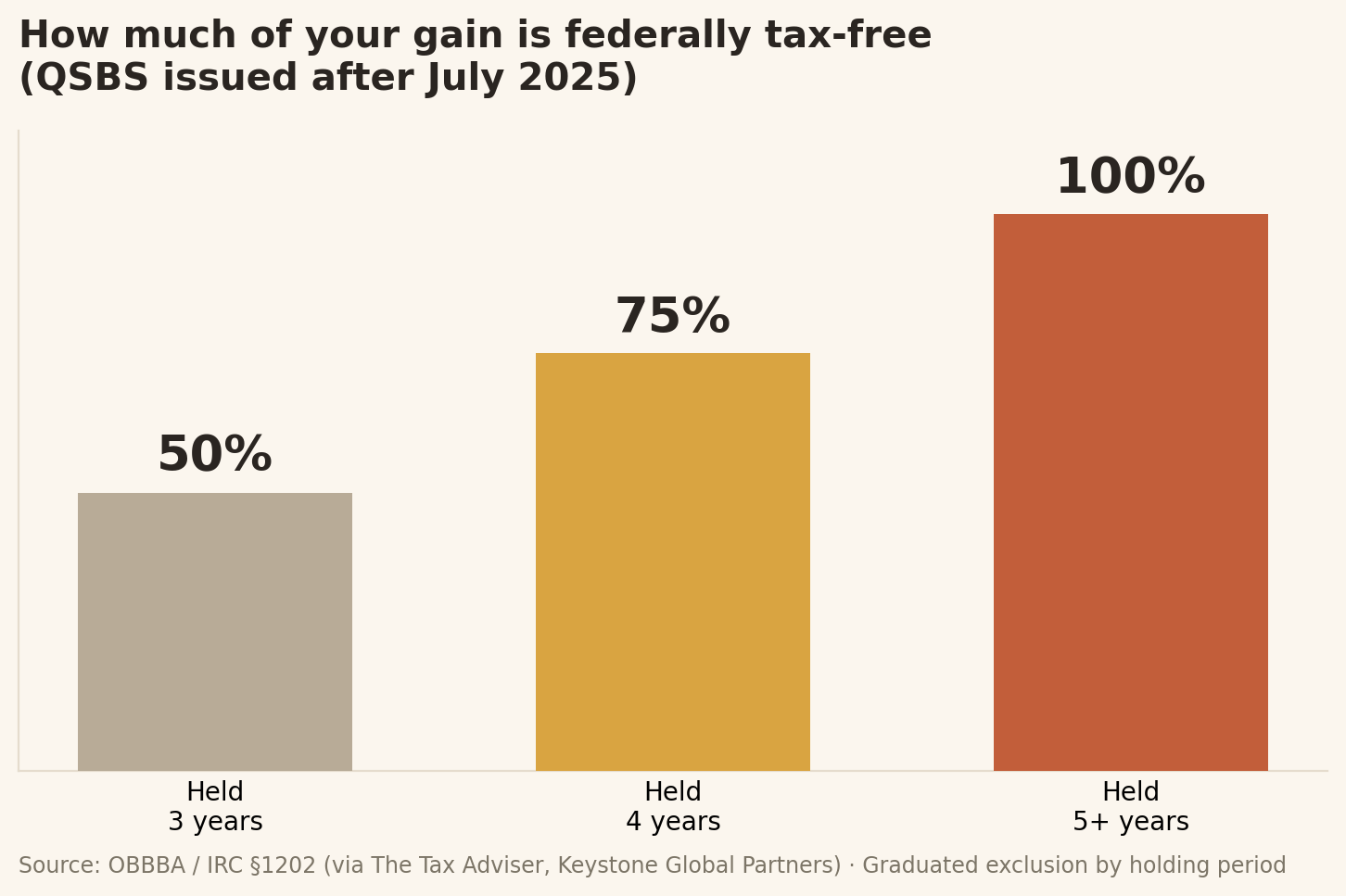
The same law raised the lifetime exclusion cap from $10 million to $15 million (or 10× your basis, whichever is greater), and lifted the company-size ceiling from $50 million to $75 million in gross assets - so larger startups now qualify too.
Here’s why it matters for this conversation specifically. The old rule actively punished early liquidity: take money off the table before year five and you forfeited the entire exclusion. The new graduated schedule means a founder doing a secondary at year three or four can shelter half or three-quarters of the gain instead of paying full freight on all of it. The tax code stopped fighting the exact thing this whole issue is about.
Three things to keep straight, because this is where founders lose money they didn’t have to:
There are two parallel regimes. The new tiers, the $15M cap, and the $75M ceiling apply only to stock issued after July 4, 2025. Shares you already hold from before then are grandfathered under the old rules - five-year cliff, $10M cap, no partial exclusions (Keystone Global Partners). Most founders selling today are still under the old regime, so don’t assume the 3-year break applies to your existing stock.
The partial tiers aren’t as sweet as the headline. The portion of gain that isn’t excluded at year three or four gets taxed at 28%, not the usual 20%. Net it out and the effective federal rate lands around 16% at three years and 8% at four - still a huge saving versus a fully taxable ~24%, but not zero.
Your state may not play along. QSBS is a federal exclusion. Several states - California most prominently - don’t recognise it, so you can owe full state tax even on a federally tax-free sale.
None of this is tax advice, and the qualification rules (C-corp status, the active-business test, excluded sectors like consulting and financial services) are genuinely fiddly. The move is to know whether your stock qualifies and which holding tier you’re in - before you’re staring at a tender deadline, and to have a real advisor run your specific numbers.
The founders who lose here aren’t the ones who pay tax. They’re the ones who sold without realising they were twelve months away from keeping a far bigger slice.
When is the window actually open?
Liquidity isn’t available at random. It clusters around specific triggers — a new financing round, an employee-retention or option-refresh cycle, or a pre-IPO positioning moment.
The cleanest of these by far is the priced round. When you’re raising, three things are true at once: there’s a fresh, defensible valuation; there are sophisticated buyers already at the table; and the company is structurally set up to bolt a small secondary component onto the primary raise.
Lead investors increasingly expect this and will often carve out room for founder and employee secondary as part of the deal. That’s the moment. Trying to engineer a secondary in the dead air between rounds, with a stale valuation and no buyers in the room, is doing it on hard mode.
The bigger mental shift - the one the best-run companies have already made - is to stop treating liquidity as a someday event and start treating it as a recurring operating process. Boards at top companies now run liquidity on a calendar: an annual or semiannual window, clear eligibility rules, set caps, a repeatable structure.
Liquidity becomes a retention and recruiting tool - senior hires from public tech are far more willing to join, and stay, when they can see a real path to realising value before an exit a decade out. It stops being a favour and becomes infrastructure.
If you’re building right now, what do you do this quarter?
You’re probably not running a tender next week. But the founders who get liquidity when the window opens are the ones who did the boring work before they needed it. Five concrete moves:
Read your own paper.
Pull your charter, your financing agreements and your stock plan and find your ROFR language, transfer restrictions, and any existing liquidity provisions. Know what you’re actually allowed to do before you need to do it. Most founders have never read these clauses; the ones who have move fast when it counts.
Build the board relationship around this now, not later.
The time to align on a liquidity philosophy is a year before you want to sell, in a calm moment, framed around retention and team alignment - not in a tense one-off ask that reads as “the founder wants out.”
Tie your thinking to your next round.
If a raise is on the horizon, that’s your window. Raise the idea of a modest secondary component with your lead early in the conversation, when you have leverage, not after terms are set.
Watch your own pricing.
If your company is established enough to trade, your shares may already have an implied price on the secondary platforms. Knowing where you’d clear and whether you’d sell at a discount or a premium turns a panicked decision into a planned one.
Size it like an operator, not a lottery winner.
The whole point is de-risking your life enough to make better decisions, not cashing out. A modest slice, taken from a position of strength, tied to a moment everyone’s celebrating. That’s the version boards approve, and investors respect.
One honest caveat before you treat any of this as permanent. A big share of today’s secondary volume rides on a handful of giants now lining up to go public by early 2026; five of the six most-traded private companies (Anthropic, SpaceX, OpenAI, Databricks, and Anduril in various combinations) were considered credible IPO candidates inside 12–18 months, a potential “$1.4 trillion IPO wave.”
PitchBook expects overall secondary volume to dip when those names list, since they soak up a disproportionate share of activity. Read only the headline number and that looks like the window closing.
It isn’t. More IPOs mean fresher public pricing, which narrows the bid-ask spread that makes private shares hard to value in the first place, and they free up capital that flows back toward the next tier of companies. The mega-cap trades shrink; the on-ramp for everyone else widens.
That’s exactly why the 2026 infrastructure build - more frequent tenders, retail access, no-accreditation venture funds, a regulated private-stock exchange - matters more than any single quarter’s volume. The structural shift - liquidity as a recurring operating process, available years before an exit - is the permanent part. The specific names trading this quarter are not.
The exit was never really the finish line - it was just the only door we knew about. That’s no longer true. Liquidity has quietly become the third pillar of how venture works, sitting right alongside primary fundraising and the eventual exit, and it’s available years earlier than the old model promised.
The founders who understand this aren’t waiting a decade to find out whether the paper was ever real. They’re turning a piece of it into security now, on their own schedule and building better, longer, and calmer because of it.
The money left the building a long time ago. The question is whether you know which door it went through.
This issue is for information only and isn’t legal, tax, or financial advice. Talk to your own advisor before acting on any of it - especially on QSBS eligibility and timing, where the details are specific to your stock.
Get access to 150+ premium archive posts, 100+ startup & VC resources, investor databases, fundraising templates, and exclusive startup research - all in one place.
Partnership With Us
Get your product in front of over 125,000+ audience - Our newsletter is read by thousands of tech professionals, founders, investors and managers worldwide. Get in touch today.