


👋 Hey, Sahil here — Welcome back to Venture Curator, where we explore how top investors think, how real founders build, and the strategies shaping tomorrow’s companies. Today’s edition features even more carefully curated content.
Big idea + report of the week :
The hidden downside of high valuation seed rounds.
The secretive VC firm behind Elon Musk’s empire.
Wall Street bets big as VC secondaries hit a record $95B.
Frameworks & insightful posts :
Should you hire an AI engineer?: Linktree’s surprising results.
What are investors actually evaluating at pre-seed and seed?
The 5-step cold email playbook every founder should copy.
How to launch your startup out of stealth?
FROM OUR PARTNER - BYLDD
🤝 Idea to Launched Product in 45 days

$50k + 6 months = an expensive, unfinished product.
Non-tech founders often spend a fortune building products nobody wants.
In the process, they realise:
Finding a qualified CTO is nearly impossible.
Co-founders flake out.
Freelancers are unreliable mercenaries.
A complete product team needs more than just devs.
Byldd is a venture studio helping domain-expert founders turn raw ideas into fundable, revenue-generating tech startups. We act as your strategic partners helping you refine your product vision, build it, launch and validate - fast.
100+ founders trust Byldd.
Book your free product discovery session →
🤝 PARTNERSHIP WITH US
Get your product in front of over 95,000+ audience - Our newsletter is read by thousands of tech professionals, founders, investors and managers worldwide. Get in touch today.
START WITH
🧠 Big idea + report of the week
The hidden downside of high valuation seed rounds.
PitchBook’s latest analysis digs into a question every early-stage investor is wrestling with:
Are these $30M–$40M seed valuations still worth it, or are we just paying for hype?

Here’s what the data shows:
The historical premium is fading
For years, “consensus deals”, the hottest seed rounds at the highest prices, were worth the markup. They failed less, produced more 10x winners, and helped concentrated portfolios catch the outliers.
But rising valuations now come with shrinking upside: Top-decile seed rounds are now priced around $40M pre-money, roughly 3× the market median, and the math is breaking:
Ownership shrinks with every follow-on round
Dilution compounds faster
Exit timelines have stretched to 11.5 years on median
Distributions are delayed, dragging down IRR
Only managers with deep reserves can protect their stake
Return multiples are compressing hard
For portfolios concentrated in these premium-priced seeds, the shift is dramatic:
Simulated results show the 75th percentile return multiple dropping from 7.7x to 3.8x for recent cohorts.
Same “quality,” half the payoff.
Signals at the seed stage are weaker than ever
Early traction no longer signals long-term quality; it simply attracts more investors, creating bidding wars.
AI has intensified this. A handful of startups get swarmed by funds chasing allocation, pushing valuations higher without materially changing fundamentals.
The new risk: Paying for hype, not quality
When valuations drift too far above intrinsic progress, the hurdle rate becomes unrealistic. Investors aren’t just buying access; they’re buying a longer, thinner, slower path to liquidity.
High-valuation seed rounds used to be the smart bet for catching power-law outcomes. In today’s market, they look more like a trade-off:
Less ownership, slower exits, lower multiples and no guarantee the premium reflects true quality.
The secretive VC firm behind Elon Musk’s empire.
Vy Capital might be the most unconventional and effective investment firm in tech.
With a tiny team and almost zero public footprint, they’ve quietly become one of Elon Musk’s biggest backers, funding SpaceX, xAI, Neuralink, and Twitter/X, and producing results that most VCs only dream of.

Here’s how they operate and why they matter:
Lean team, massive returns: Vy runs with just 4 core investors and about 20 total staff, split between California, London, and Dubai. Despite this, they’ve managed $15B AUM and posted an average 28% annual return over 10 years, doubling the S&P 500.
All-in on Musk: They’re not just passive investors. Vy backed SpaceX at a $15B valuation (now ~$400B), put $700M into Twitter/X, and has large stakes in Neuralink and xAI. Some estimates suggest over half of Vy’s portfolio is tied to Musk-led ventures.
Minimalist by design: Their website is a single page. No media interviews. No pitch decks. Just quiet, outsized results.
Closed to outsiders now: After compounding billions, Vy recently told its LPs it won’t raise more outside capital. They’re now investing their own money, a rare move in venture.
Not just US bets: Vy was also an early investor in Zomato and Urban Company in India, as well as fintech company Upgrade, AI chipmaker Cerebras, and cyber-insurance firm Coalition.
What makes Vy different? They operate more like a high-trust family office than a traditional VC. Back the right people early. Keep the team small. Skip the noise. And ride long-term conviction to outsized outcomes. (Read here)
Wall Street bets big as VC secondaries hit a record $95B.
The US venture secondary market is no longer a side corridor; it’s becoming one of the main liquidity engines of the private markets. PitchBook’s new US VC Secondary Market Watch reports the market hit $95B in annual value in Q3’25, with deal flow accelerating as startups stay private longer and liquidity pressure builds across the ecosystem.

And this time, Wall Street isn’t watching, it’s buying.
What’s driving the surge
Secondary transactions for direct company stakes jumped 31% QoQ, fueled by rising valuations for top AI, defence, and fintech startups. Investors across the spectrum — from Goldman Sachs to retail buyers are crowding into secondaries to access companies that remain private far longer than they did a decade ago.
This pressure is structural: with $3.7T still locked in unicorn equity and limited IPO/M&A activity, secondaries are becoming the default liquidity valve.
Wall Street’s big move
Major financial institutions have entered the market in force:
Goldman Sachs acquired Industry Ventures, marking the first time a top-tier bank bought a dedicated VC secondaries firm.
Morgan Stanley purchased EquityZen to expand private market access for its wealth clients.
Charles Schwab acquired Forge Global, signalling that retail-oriented demand is now mainstream.
These moves give banks a direct foothold in a market where investor appetite is only growing.
The SPV boom
Retail and small investors are chasing exposure too, through special purpose vehicles:
Secondary SPVs grew 682% in count over the last two years.
Capital raised jumped 1,340%, per Sydecar.
This represents a major shift: the secondary market is no longer dominated only by institutions; it’s becoming a mass-access channel for private company ownership.
But the market is extremely top-heavy
Despite the growth, the liquidity is not evenly distributed:
The top 20 most traded startups = 96% of total deal value
The top 5 alone = 74%
Outside elite AI, defence, and fintech names, most companies still trade at deep discounts, if they trade at all.
What this means for the venture ecosystem
Secondaries now represent 32% of primary exit value over the last 12 months, a historic shift.
Yet the overall market is still only 2.2% of total unicorn valuations.
Given the sheer amount of value trapped in late-stage startups, secondaries are set to become a core pillar of VC, not a stopgap.
In other words: liquidity isn’t returning through IPOs anytime soon — but it is being rebuilt through secondaries.
SOMETHING MORE
🧩 Frameworks & insightful posts
Should you hire an AI engineer?: Linktree’s surprising results.
Most founders hit a point where shipping velocity slows, and the default reaction is: hire more engineers. However, adding headcount also introduces complexity — including culture shifts, coordination overhead, and increased burn. An alternative that’s starting to look real: treat AI agents like junior hires.
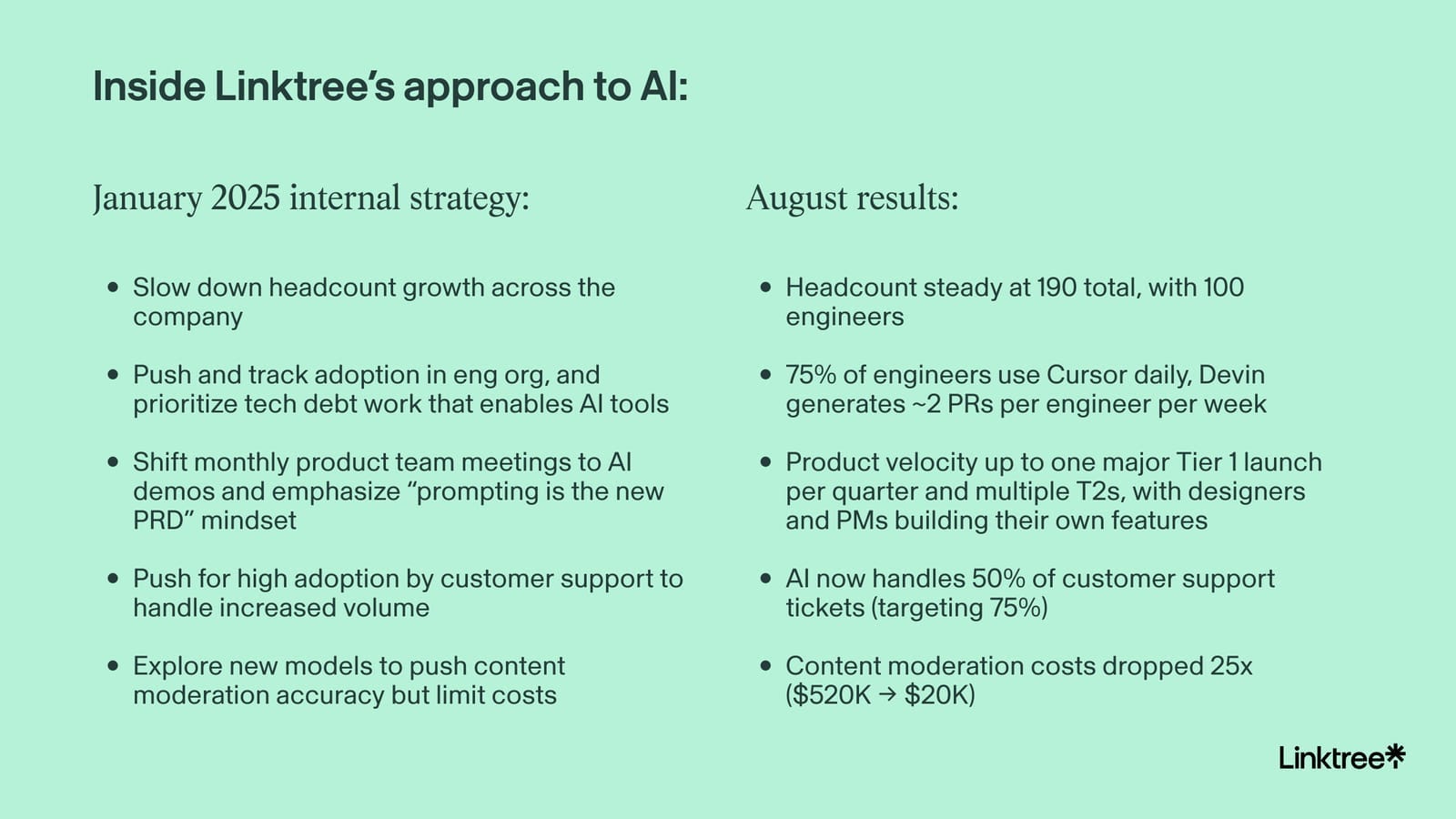
That’s exactly what Linktree did. Going into 2025 planning, they faced pressure to scale their engineering team beyond 100 people. Instead, they froze hiring at ~190 total employees and leaned hard into AI. Here’s what they found:
Where it delivered value
Repetitive engineering tasks: Their AI agent (Devin) now contributes ~2 PRs per engineer per week, especially for dependency upgrades, bug fixes, and debugging.
Faster prototyping: Engineers use it to quickly spike new features or test fixes — not production-ready, but good for grounding discussions and estimation.
Security scanning: AI helps detect and patch vulnerabilities across repos, saving the small security team countless hours.
Where it failed
Complex or messy systems: Inconsistent schemas and tech debt confused the AI, making outputs worse. The team had to clean up naming conventions, event schemas, and APIs first.
Over-ambitious projects: Attempts to auto-generate pixel-perfect pages failed. AI is powerful, but not a replacement for high-craft work.
The real cost
AI adoption didn’t “just happen.” The CTO tracked usage dashboards, nudged laggards, reframed AI as a junior teammate to manage, and created social pressure (AI demo meetings, “Wins and Whoopsies” Slack channel).
The takeaway: Hiring an AI agent is worth it — but only if you:
Point it at repetitive, low-leverage work.
Clean your tech debt so it has good patterns to learn from.
Actively drive adoption across the team.
For Linktree, the payoff was clear: more launches without more hires, 25x cheaper moderation, and customer support scaling 80% with AI. For most startups, that’s a strong case to at least experiment with “hiring” an AI teammate. (Read detailed report here)
What are investors actually evaluating at pre-seed and seed?
Fundraising isn’t about optics. It’s about showing investors you can figure it out. Here’s how they pattern-match across stages (shared by Amanda Zhu):

Investors aren’t scanning for perfection. They’re looking for proof you’ll figure it out.
The 5-step cold email playbook every founder should copy.
It took 2–3 months and multiple tests to refine this. But now it’s a repeatable, scalable framework for startup founders doing outbound.
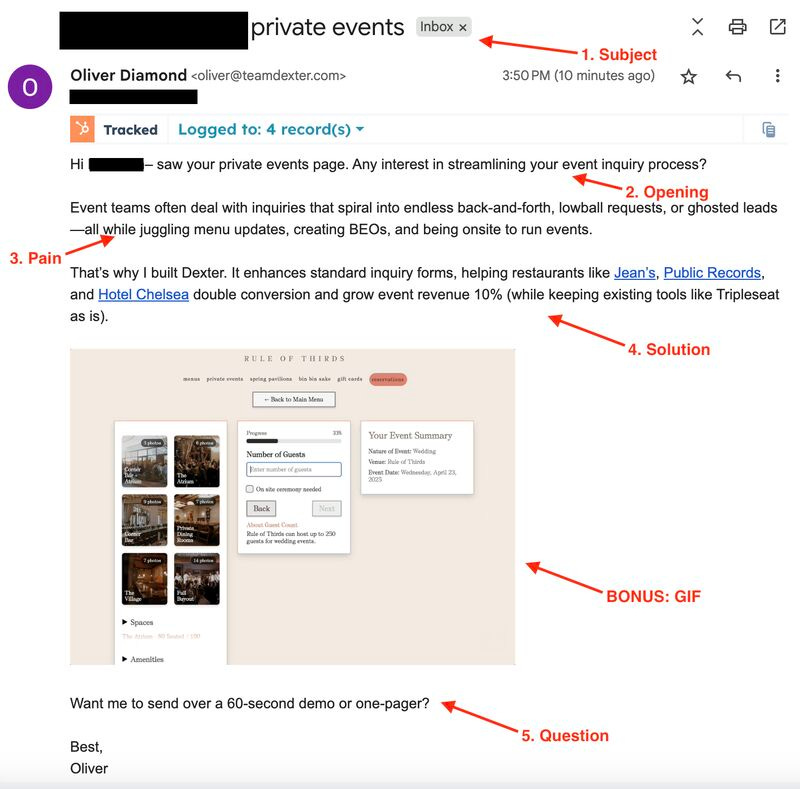
Here’s the breakdown that worked:
Subject
Keep it ultra-relevant and close to the customer’s world. Use a combo like Company Name + Service to make it feel specific, not generic.
Opening
Use a short personalised line that references what they do. You don’t need deep research, find one shared pattern (like “saw your events page”) and connect it to your service with a simple question.
Pain
Call out a real frustration they likely deal with daily. The more vivid and true it feels, the more they’ll read.
Solution
Share who you are, what your tool solves, and a simple result (“grew conversions by 10%”). If you’re the founder, mention it; people respond better to founders than SDRs.
Question
End with an easy A/B choice: “Want a one-pager or a quick 60s demo?” Avoid generic yes/no.
One visual (like a product GIF) can boost replies too; use sparingly in small batches. (Read full post here)
How to launch your startup out of stealth?
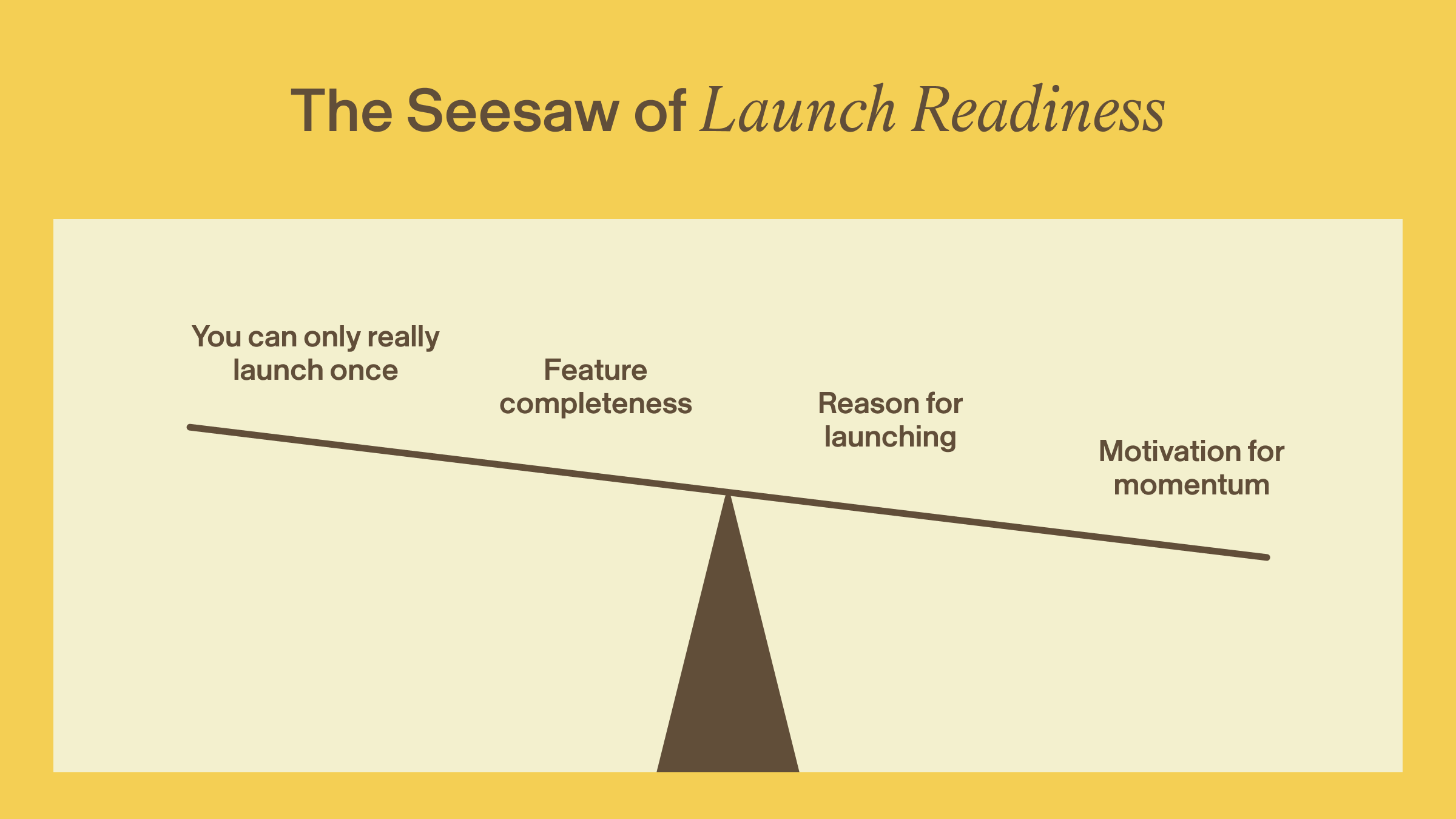
Most founders overthink launches. They keep tinkering, waiting for “perfect,” and end up stuck in stealth. Claire Butler, Figma’s first marketer, says the opposite is true: momentum beats perfection.
Here’s her framework for stepping out of stealth without stalling:
1. Set a date, even if it feels early
Don’t wait for every feature to be done—just reach “critical mass.”
Figma launched without multiplayer (its core feature) to avoid stagnation.
Rule of thumb: if you’re not slightly embarrassed, you’ve waited too long.
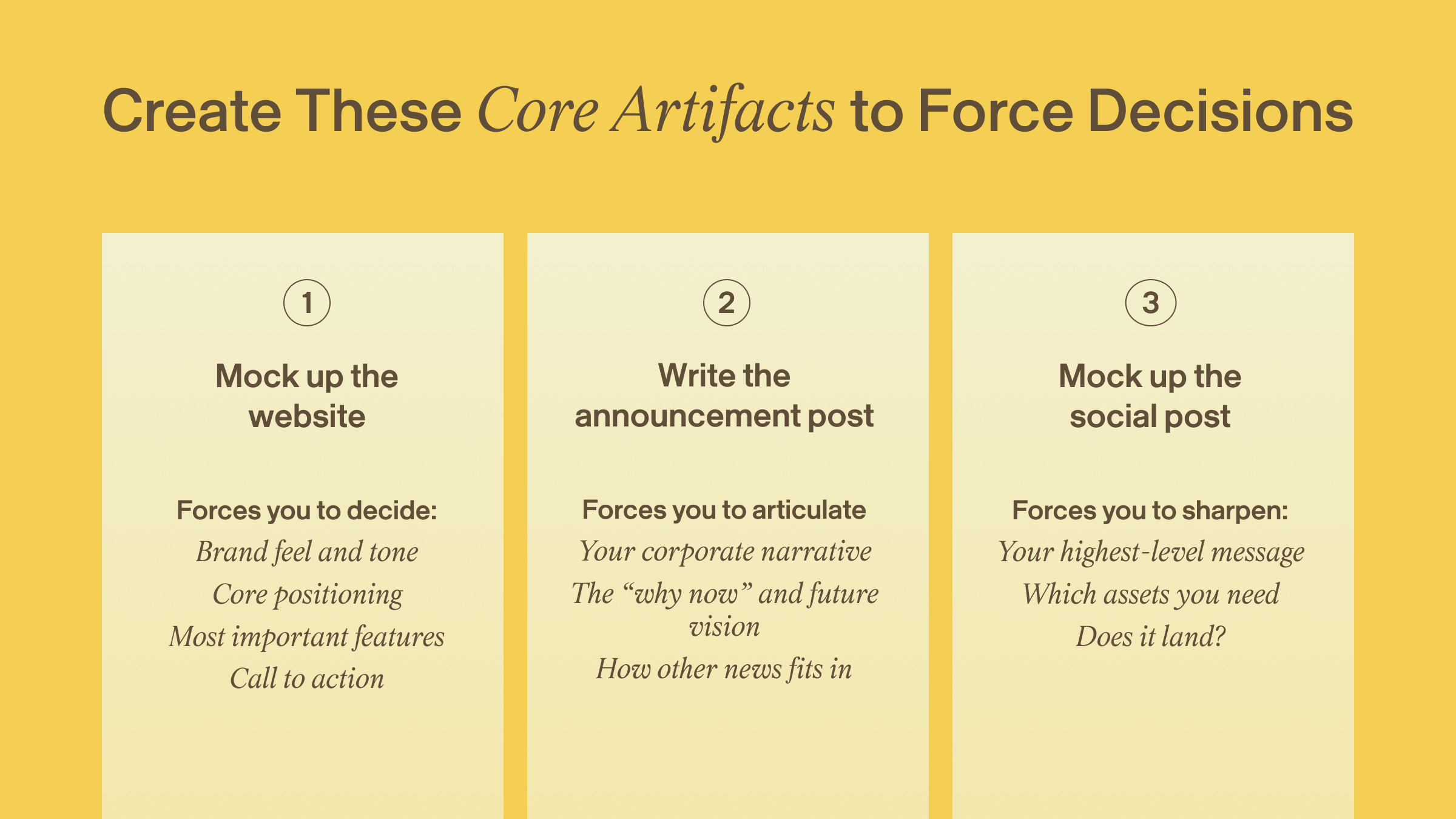
2. Create three forcing-function artifacts
Website: One homepage + about/careers. Define tone, positioning, CTA. (Waitlist vs sign-up vs talk to sales?)
Announcement post: Founder-written narrative → why you built it, why now, where it’s headed.
Social post: Distill it all into a single screenshot, video, or punchy tagline. If it feels fluffy, rewrite until it’s authentic.
3. Pick launch channels wisely
Focus where your ICP already hangs out (Reddit, Discord, LinkedIn, Twitter/X).
Use founder accounts to amplify first—brand handles start from zero.
Press is optional. Unless tied to funding, don’t waste time chasing exclusives.
4. Seed amplification before launch
Build a list: friends, beta users, influencers, your network.
Tell them when launch is, what you’ll need, and share links day-of.
Momentum spreads outward from your circle—plan it, don’t wing it.
5. Remember: launch ≠ finish line
Monitor replies, engage, and bookmark supporters for ongoing community building.
Don’t obsess over metrics too soon—track impressions, traffic, sign-ups, but focus on vibes + momentum.
A flashy launch ≠ product-market fit. The real game starts after.
A launch is a forcing function, not a final exam. Prep your date, artefacts, channels, and amplification. Then get out there; momentum matters more than perfection.
TODAY’S JOB OPPORTUNITIES
💼 Venture Capital & Startup Jobs
Ventures Manager - State Farm Venture | USA - Apply Here
Investment Team - WEH Venture | India - Apply Here
Venture Scout - Frontier Capital Partner | USA - Apply Here
Venture Scout - First momentum Venture | Remote - Apply Here
Analyst / Associate - Core Innovation Capital | USA - Apply Here
Program Associate - Plug and Play tech Center | USA - Apply Here
Executive Assistant - AN Venture Partner | USA - Apply Here
Summer Analyst - Llma Venture | USA - Apply Here
Visiting Investment Analyst - Join Capital | USA - Apply Here
AI Tech Lead - Core Innovation Capital | USA - Apply Here
Investment Analyst - Caanan | USA - Apply Here
VC Associate UK - Breega | UK - Apply Here
Analyst - Investments - Blackhill Fund | India - Apply Here
Venture Analyst - PSV | Hybrid - Apply Here
VP of Fundraising - Scale Asia Venture | Japan - Apply Here
Head of Atlassian Ventures - Atlassian Venture | USA - Apply Here
Associate - Allocator One | UK - Apply Here
Lead Investment - Indigo Venture | India - Apply Here
🤝 Partnership With Us
Get your product in front of over 95,000+ audience - Our newsletter is read by thousands of tech professionals, founders, investors and managers worldwide. Get in touch today.
🔴 Share Venture Curator
You currently have 0 referrals, only 5 away from receiving a 🎁 gift that includes 20 different investors’ contact database lists - Venture Curator