
👋 Hey, Sahil here — Welcome back to Venture Curator, where we explore how top investors think, how real founders build, and the strategies shaping tomorrow’s companies.
VENTURE CURATORS’ FINDING
📬 My Favourite Finds
Media Posts:
The best repo to learn about AI agents HANDS ON. (Link)
Peter Inge on why you shouldn’t start a company to make money. (Link)
How founders should think about pre-PMF burn rate. (Link)
Things you should never do when building an app. (Link)
Startups’ sales learning. (Link)
How I got my first 100 users for each of my 24 startups. (Link)
Reports/Articles:
Why seed rounds are growing as startups shrink. (Link)
The rise of ‘vibe hacking’ is the next AI nightmare. (Link)
The hater's guide to the AI bubble. (Link)
Unicorn funding is back. Bigger than ever!? (Link)
VC finds cautious liquidity in secondaries. (Link)
AI market clarity by Elad Gil. (Link)
How to present to investors by Sequoia Capital. (Link)
All-in-one resources for aspiring venture capitalists. (Link)
FROM OUR PARTNER - XAVIER AI
🧠 Meet Xavier AI - The first AI consultant that creates McKinsey-grade presentations
Creating strategic decks, business plans, and pitch decks is time-consuming for startups and growing ventures - it requires strategic thinking, data analysis and executive-level polish that most teams can't afford from consulting firms.
Now, with Xavier AI, you can transform simple prompts into consulting-quality decks in under a minute. You will get McKinsey-level strategy for $19/month instead of $500K consulting fees, while focusing your time on what matters: building and scaling your business.

Verified Sources: Uses only credible data and real sources with one-click provenance checking, solving the credibility gap that plagues AI-generated content.
Business Focused: Build exclusively for business and consulting presentations, such as strategic plans, pitch decks, business plans, market analysis, financial modelling, sales pitches, competitor benchmarking and more
Consulting Grade: Creates decks that are indistinguishable from elite consulting firms, with executive storytelling and strategic frameworks. Paid plans are available on the web with PowerPoint and PDF export capabilities.
Over 200+ businesses are already using their AI strategy consultant (and saving hours on strategy and deck creation) with Xavier AI.
🤝 PARTNERSHIP WITH US
Get your product in front of over 95,000+ audience - Our newsletter is read by thousands of tech professionals, founders, investors and managers worldwide. Get in touch today.
📜 DEEP DIVE
The “Market Pull” Litmus Test: Is this just a cool idea or a real business?
A startup can look like it’s working long before it is.
You launch a product. You get 500 signups. A few people say they “love it.” One person even tweets about it. It feels like validation. But is it?
The hard truth is: most early signs of traction are noise. Not because they’re fake, but because they don’t always mean what we think they do.
As a founder, your job isn’t just to build something and get it in front of people. It’s to listen for pull, to spot when the market is pulling you forward, not just reacting politely.
Because founders who chase pull build real companies. Founders who chase hype? They burn out.
Market pull vs. market push: why it matters
Push is when you have to constantly follow up, pitch, explain, and convince people to try your product. Most of the energy is coming from you.
Pull is when people ask to try your product. They return without reminders. They want to pay before you’re even ready. They show up because the problem is real, and the solution clicks.
A pull-based startup feels like the market is helping you build. People complain when you ship slowly. They send feedback without you asking.
They invite others. And the product spreads, even when it’s rough around the edges.
If you’re in push mode for too long, you’re likely building something nice-to-have, not need-to-have.
What does pull look like in the real world
You know you’re seeing pull when:
People keep using your product even when it’s broken.
New users who signed up that you didn’t directly pitch or advertise to.
Users are coming back unprompted, no email reminders needed.
People ask when they can start paying.
Customers are actively referring it to teammates or friends.
Push is fueled by effort. Pull is fueled by pain. If the pain is real, people will chase your solution even when it's imperfect.
Examples of pull-driven companies
Loom’s breakout came from a simple screen recorder Chrome extension. It didn’t need explanation.

It immediately solved the pain of communicating async in remote teams. That’s why 3,000 people signed up on Day 1, with no marketing spend.
Figma Designers were already frustrated with offline tools and messy handoffs. Figma made collaboration real-time. That was the unlock. Product teams adopted it naturally, without paid growth. It spread because it was the solution people had been waiting for.
Notion didn’t just build a note-taking app. It gave power users building blocks. Those users started creating templates, building a community, and sharing them widely. Users didn’t just use the product; they amplified it.
The Market Pull Validation Ladder:
Here’s a 6-step framework to assess how close you are to real market pull:
Are people complaining about this problem without being prompted?
Check Reddit, Slack groups, forums, and support tickets. If the pain is visible already, that’s a green light.
Do people lean in when you describe the product?
The right idea feels instantly obvious to the right person. No need for 3 slides and 4 metaphors. If they say, “That’s interesting,” it’s not enough. You want, “Oh wow, I need this.”
Are users coming back without you reminding them?
This is one of the strongest signals. If retention is organic, not driven by drip emails and coupons, you’ve built something sticky.
Will users pay even when the product is rough?
Put up a paywall. Add a $10 plan. Watch what happens. If people pay early, it means the value is clear. Pricing is a forcing function.
Are people bringing others in without being told to?
Referrals, invites, and organic sharing are the ultimate signs of product-market fit. That’s not marketing. That’s pull.
The more you climb this ladder, the clearer it becomes whether you’re building a product or a business.
What to do if you’re not seeing pull yet - It doesn’t mean the idea is bad. It just means you’re not there yet. So here’s what to do:
Talk to your users again, but better. Ask about what they currently use, where they’re frustrated, and what they’ve already tried to fix it.
Go narrower. Focus on the highest-pain segment. Find your 100 true fans, not the next 10,000.
Rework your positioning. Is your landing page confusing? Is your product solving what it says it solves?
Charge early. Money changes behaviour. Free users might tinker. Paid users give you sharper feedback.
Change the use case, not the product. Sometimes, the solution is right, but you’re aiming it at the wrong pain.
I often see founders focus on:
Viral videos
Waitlists from giveaways
Social media impressions
But investors, advisors, and smart operators know to focus on:
Day 7 and Day 30 retention
Actual usage of core features
Organic growth and repeat usage
Willingness to pay
TOOL FOR FOUNDERS
📑 How much is your startup worth?
Most valuation guides online are useless, no investor insight, no real frameworks.
So we built the Startup Valuation Guide for Founders to fix that. It’s a practical, founder-first playbook to help you figure out your startup’s worth and talk numbers with confidence.

✅ What’s inside:
7 proven valuation methods (VC Method, Scorecard, DCF & more)
A step-by-step framework to pick the right one
Real investor benchmarks + Excel templates
How to present your valuation in your pitch deck
Built by VCs and founders who’ve raised money. No jargon. No fluff. Just clarity.
📄 QUICK WIN
The Hook Model: How to make your product addictive (in a good way).
Why do people check Duolingo daily? Why can’t we stop scrolling TikTok? It's not magic, it’s design.
Nir Eyal’s Hook Model shows how the best products turn casual users into loyal ones by building habit loops into the core experience. If you are looking to build such a product, you can practically apply this model intro your product and see great results.
Trigger → Action → Variable Reward → Investment
Here’s how it works and how real startups apply it:
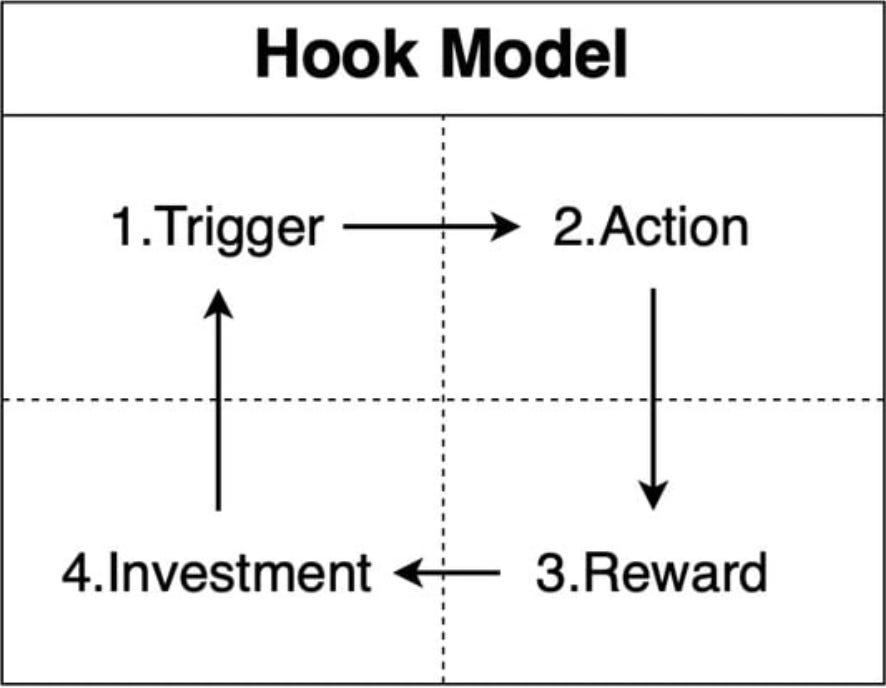
Trigger: A notification, emotion, or itch that brings users back. (Think: Duolingo’s daily reminder or TikTok’s FOMO-driven alerts.)
Action: The simplest behaviour in anticipation of a reward. Open app, swipe, tap. The easier, the better.
Variable reward: Keep it fresh. Offer social validation (likes), content discovery (TikTok), or surprise deals (shopping apps). Unpredictability builds curiosity.
Investment: Users put something in, time, effort, content, and data. That makes them more likely to come back. Every pin saved, playlist created, or streak maintained increases their emotional “buy-in.”
A few real-world examples:
Netflix: Personalised recommendations → 1-click play → binge-worthy content → more watch history = better suggestions.
Flo Health: Daily tracking → quick log action → personalised cycle insights → builds trust through stored health data.
Duolingo: Push notification → lesson tap → XP + streaks → user keeps coming back to avoid breaking progress.
Why this matters:
Great founders don’t just build features. They design behaviour.
If your product has high retention and repeat usage baked in, growth gets easier and CAC gets lower.
And here’s the kicker: internal triggers (like boredom or anxiety) eventually replace the external ones, and users come back on their own.
That’s the real power of the Hook Model: it helps you design products that people want to return to, not because of hacks or tricks, but because it becomes part of their routine.
But it’s not just about engagement for engagement’s sake. The best products that use this model solve real problems and create real value, again and again.
If you're building something people should use daily, build the loop that makes it stick.
Max MRR: The hidden ceiling on your SaaS growth.
Founders often celebrate new MRR. But here’s the harsh truth: Your company will stop growing sooner than you think.
Even if you’re consistently adding new revenue each month, you’ll eventually hit a ceiling, and most don’t realise it until they stall out. That ceiling is predicted by a powerful, underrated metric:
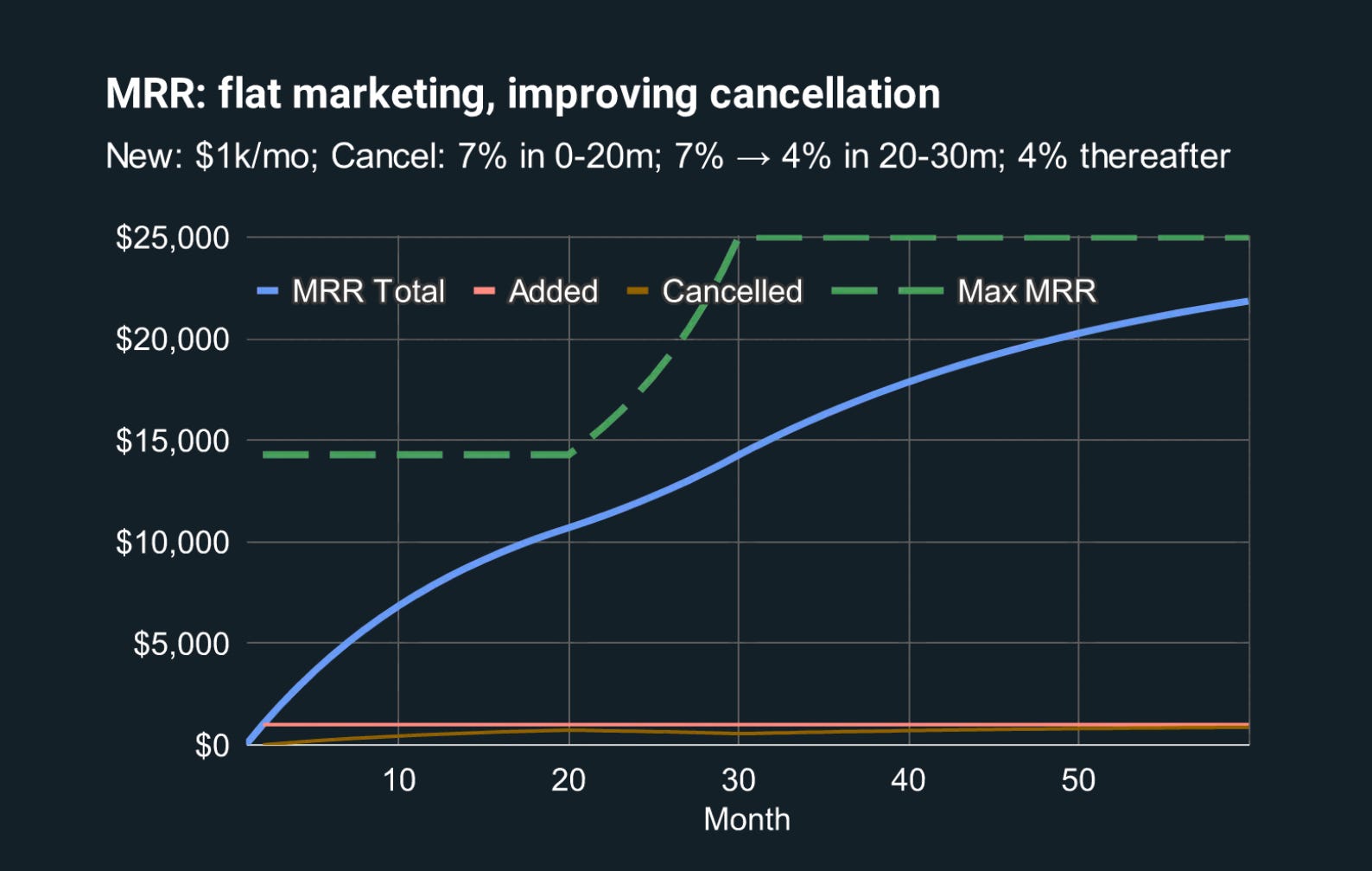
→ Max MRR = New MRR ÷ Churn Rate
Let’s say you’re adding $1,000 in new MRR each month, and your churn is 5%.
Your Max MRR is: $1,000 ÷ 0.05 = $20,000.
That means, even with a steady stream of new customers, your revenue will flatline at $20K MRR.
Why? Because churn grows with your base. At 5%, the bigger your MRR gets, the more you lose each month, until it cancels out your gains.
Why it matters:
It’s predictive. Max MRR tells you where your revenue is headed, not where it is.
It’s visceral. Unlike Quick Ratio or NRR, this gives you a hard cap to aim at or break through.
It explains stagnation. If you’re adding new customers but not growing? This is why.
Case study: Buffer
(Buffer - A popular social media queuing tool)
Buffer’s public data showed this clearly:
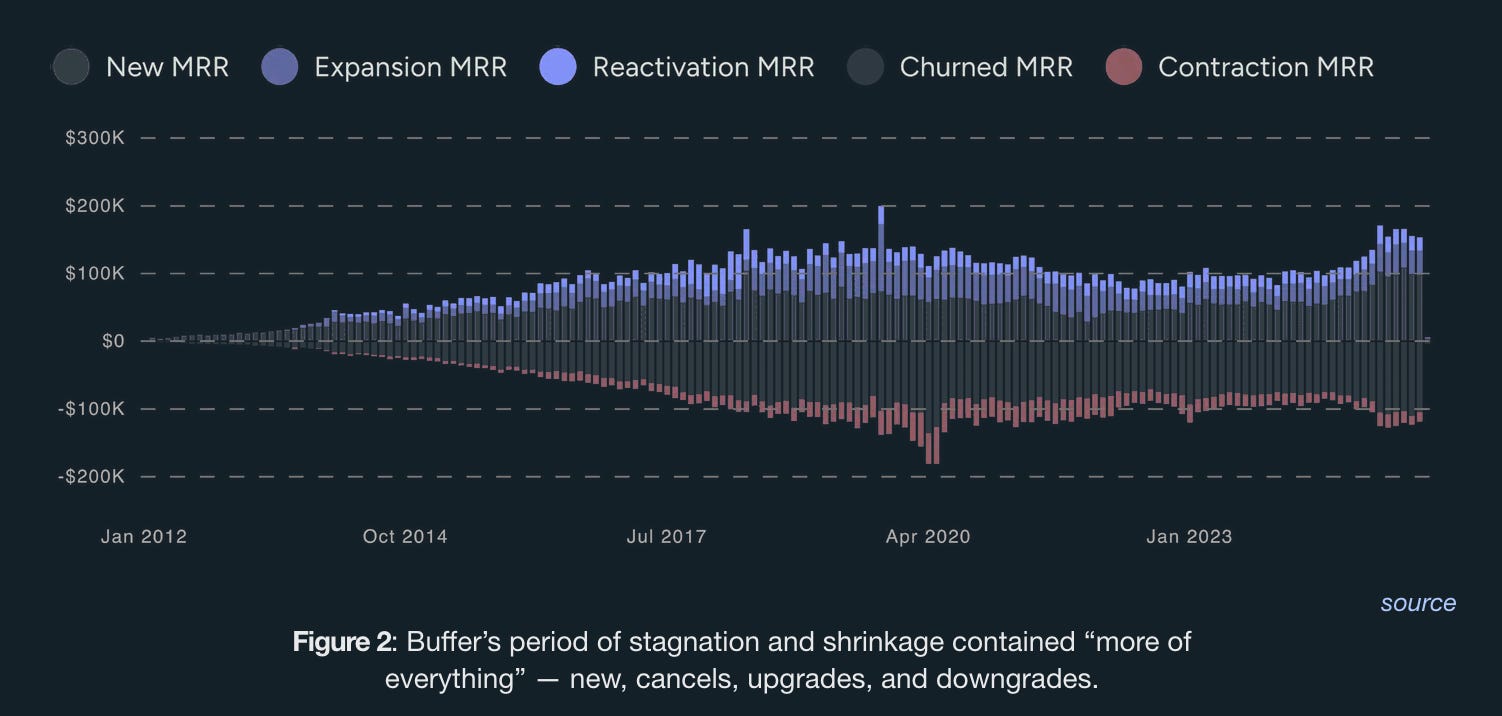
Even during flat or declining revenue periods, they were still adding new MRR.
But because churn was too high (6–8%), that growth was cancelled out.
Only when they improved retention and reset pricing did their Max MRR curve spike, and revenue followed.
What you should do:
Calculate your Max MRR monthly. It's as simple as:
Max MRR = New MRR this month ÷ current churn rateTrack how it changes. If it's not rising, you're not building a scalable engine.
Fix churn first. Cutting churn from 6% to 3% doubles your growth ceiling.
Then layer on growth. With churn low, more of your new MRR compounds.
This one metric can change how you prioritise everything, from roadmap to pricing to onboarding.
TODAY’S JOB OPPORTUNITIES
💼 Venture Capital & Startup Jobs
Investment Fellow - Indian Fund | India - Apply Here
Entrepreneur in Residence - OrbiQ | Canada - Apply Here
Corporate Development & Strategy - Figma Venture | USA - Apply Here
Chief of Staff - Side Stage Venture | Australia - Apply Here
Value Creation - Cadeumen Capital | Spain - Apply Here
Investment Analyst - Beas Capital | India - Apply Here
Investment Intern - TDK Venture | India - Apply Here
Chief of Staff - Penny Jar Capital | USA - Apply Here
Associate - OMERSE Venture | USA - Apply Here
Healthcare Analyst - General Investment Management | UK - Apply Here
Associate- Portfolio Management - Stepstone Group | USA - Apply Here
Chief of Staff - Grey Line Partner | USA - Apply Here
Investment Principal - Cota Capital | USA - Apply Here
Investment Fellow - Indian Fund | India - Apply Here
Investment Analyst - Miras Investment | Dubai - Apply Here
PARTNERSHIP WITH US
Get your product in front of over 95,000+ audience - Our newsletter is read by thousands of tech professionals, founders, investors and managers worldwide. Get in touch today.
🔴 Share Venture Curator
You currently have 0 referrals, only 5 away from receiving a 🎁 gift that includes 20 different investors’ contact database lists - Venture Curator