

👋 Hey, Sahil here — Welcome back to Venture Curator, where we explore how top investors think, how real founders build, and the strategies shaping tomorrow’s companies.
Big idea + report of the week :
AI deal activity slows, but the money keeps getting bigger.
Flat bonuses, rising secondaries and what it means for VC careers.
VCs pull back from China AI investment, why?
Frameworks & insightful posts :
How to do competitor research in 10 minutes using ChatGPT (real prompts inside).
How to navigate PMF in Vertical SaaS (stage by stage).
How many emails does it take for someone to buy a product?
How this founder used Claude to validate the idea (Now at $2.3k MRR)
FROM OUR PARTNER - ROCKET
🤝 Ship Apps Faster with Vibe Solutioning

Rocket, a $15M-funded startup, is pioneering Vibe Solutioning, turning prompts or Figma designs into production-ready web and mobile apps.
Its / and @ commands allow you to execute frequent tasks with precision, while context-aware builds cover Day 0 (solutioning), Day 1 (getting started), and Day 2 (iterations, integrations, deployments).
Reduce engineering friction, accelerate iteration cycles, and maintain full control of your code. Perfect for founders, investors, and product teams looking to build and scale confidently.
🤝 PARTNERSHIP WITH US
Get your product in front of over 95,000+ audience - Our newsletter is read by thousands of tech professionals, founders, investors and managers worldwide. Get in touch today.
START WITH
🧠 Big idea + report of the week
AI deal activity slows, but the money keeps getting bigger.
CB Insights’ State of AI Q3’25 report shows a clear split in the AI funding landscape: fewer deals, but dramatically larger check sizes.
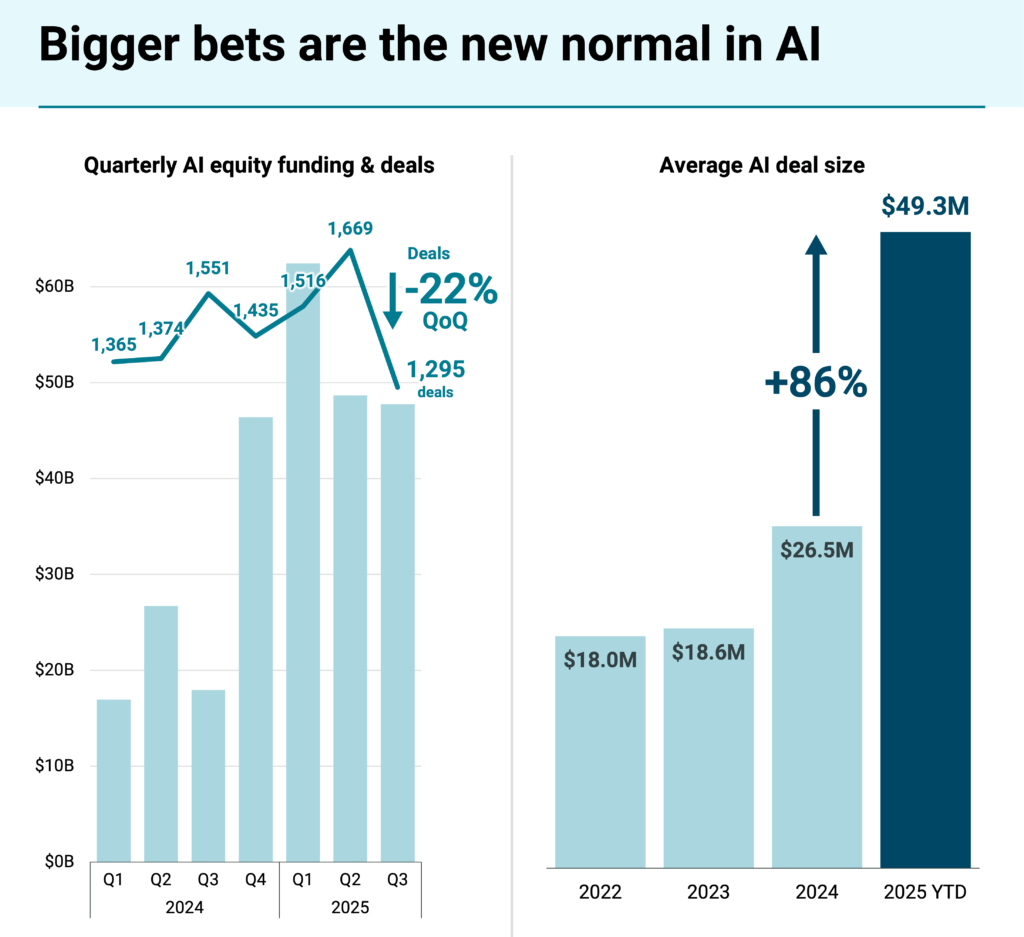
Deal volume dropped 22% QoQ, to 1,295 deals: yet global AI funding still topped $45 billion for the fourth straight quarter.
Average deal size hit $49.3 million YTD, up 86% from 2024, driven by mega-rounds above $100 million, now accounting for more than 75% of total funding.
Early-stage checks are rising too, with median round size climbing to $3.4 million in 2025 (from $2.5 million last year).
Six $1 billion-plus rounds closed in Q3 alone, led by Anthropic ($13B Series F), OpenAI ($8.3B PE), and Mistral AI ($1.5B Series C), underscoring how frontier model building remains capital-intensive.
Infrastructure startups are joining the big leagues: Nscale ($1.1B) and Groq ($750M) show how data-centre and chip companies are capturing investor attention as AI’s backbone costs surge.
AI investing has gone top-heavy. Investors are consolidating capital into fewer, “winner-take-most” bets to fund the immense computing, data, and engineering expenses of frontier model and infrastructure development.
Flat bonuses, rising secondaries and what it means for VC careers.
Johnson Associates’ latest compensation data shows secondaries fund managers will see 10%+ higher bonuses this year, while payouts in private equity and venture capital remain flat.

But veteran Wall Street advisor Alan Johnson cautions early-career professionals not to chase the “hot hand.”
PE and VC bonuses: Flat to +5% YoY, reflecting slow distributions and fundraising challenges.
Secondaries: Up 10%+ for the second straight year, buoyed by $70.9B raised in H1 2025, a 20.4% YoY increase.
VC and PE fundraising: Down 35% and 34%, respectively, with most capital flowing to large-cap funds, putting pressure on smaller managers.
Johnson’s advice: “Pick the one that’s not hot right now. You’ll face less competition and have a longer runway to stand out.”
While secondaries are enjoying their moment, PE and VC still offer the more durable long-term path to deeper networks, more stable capital bases, and less exposure to short-term market swings.
VCs pull back from China AI investment - why?
China’s AI giants are delivering strong public-market returns, but venture capital tells a different story. According to PitchBook, only $6B has been invested across 574 AI deals in 2025, a steep drop from last year’s totals.

Global contrast: US AI funding has surged 61.5% YoY to $174.6 billion, while Europe is up 19% to nearly $22B.
Fewer mega-rounds: This year’s largest China AI deals, MiniMax ($300M) and Leju Robotics ($200M), highlight the shrinking scale of private capital deployment.
Capital constraints: Chinese VC fundraising is now less than one-fourth of 2024’s levels, which were already the weakest in nearly a decade.
Foreign capital pullback: Dealmaking involving international investors dropped to 112 deals worth $2.1B in H1 2025, as geopolitical tensions intensify and the US tightens chip export controls.
Policy response: In March, Beijing launched a 1 trillion yuan ($140B) government-backed tech fund to bridge the funding gap and maintain competitiveness.
Despite the funding freeze, China continues to lead globally in AI research output and patents, according to Stanford’s 2025 AI Index Report. But for now, venture dollars are flowing elsewhere, as investors weigh geopolitics, regulation, and the rising cost of AI scale.
TOOL FOR FOUNDERS
📑 Startup Legal Pack: VC-Ready Docs in One Place
Messy or missing legal docs slow founders down and turn off investors.
The Startup Legal Document Pack gives you everything you need to incorporate, protect equity, and raise confidently.

What’s inside:
Incorporation docs & founder agreements
SAFE notes, term sheets, cap tables
Employment, IP, and advisor agreements
NDAs, privacy policies & customer contracts
Built with startup attorneys and VC teams. Investor-ready. Easy to use.
SOMETHING MORE
🧩 Frameworks & insightful posts
How to do competitor research in 10 minutes using ChatGPT (real prompts inside).
Every founder or marketer has been there, drowning in 20 tabs, trying to figure out what competitors are doing differently. Pricing pages, product screenshots, half-baked case studies, it’s a time sink that often ends with more confusion than clarity.
From a Reddit post where one founder shared how they stopped wasting hours digging through competitor sites and started using ChatGPT to do it in minutes.
They now get a full picture of pricing, features, positioning, and content strategy in under 10 minutes. Here’s how:
1. The Classic SWOT Analysis
This framework helps you quickly identify a competitor’s Strengths, Weaknesses, Opportunities, and Threats.
Prompt:
“Act as a market research analyst. I want to conduct a quick SWOT analysis of my competitor, [Competitor’s Name]. Based on publicly available information, generate a SWOT analysis for them. For each of the four quadrants (Strengths, Weaknesses, Opportunities, Threats), provide at least 3 bullet points and a brief explanation. My company, [Your Company’s Name], operates in the [Your Industry] industry.

Here is the competitor’s website: [Link to competitor’s website]”
2. The 4 Ps of Marketing Mix
Use this prompt to break down a competitor’s marketing strategy into its core components: Product, Price, Place, and Promotion.
Prompt:
“I am a marketing strategist for [Your Company’s Name]. I need to understand the marketing mix of my competitor, [Competitor’s Name]. Please analyze their ‘4 Ps’ (Product, Price, Place, Promotion) based on the information on their website and general online presence.

- Product: What are their core products/services? What are the key features and benefits?
- Price: What is their pricing strategy (e.g., premium, budget, value-based)? Provide specific price points if available.
- Place: Where do they sell their products/services (e.g., online, physical stores, through partners)?
- Promotion: How do they promote their offerings (e.g., social media, content marketing, paid ads, PR)?

Competitor’s Website: [Link to competitor’s website]”
3. Unique Selling Proposition (USP) & Value Proposition
This prompt helps you distil what makes a competitor stand out and what specific value they promise to their customers.
Prompt:
“Act as a brand strategist. I need to understand the Unique Selling Proposition (USP) and overall value proposition of my main competitor, [Competitor’s Name]. Analyze their website, customer reviews, and social media presence to answer the following:

- What is their primary target audience?
- What is the main problem they solve for their customers?
- What is their unique promise or the key differentiator they emphasize in their messaging?
- Summarize their value proposition in a single, compelling sentence.

Competitor’s Website: [Link to competitor’s website]”
4. Content and SEO Angle
This prompt focuses on a competitor’s content strategy and its effectiveness in search engine optimisation (SEO).
“I am an SEO and Content Manager. I want to analyze the content and SEO strategy of my competitor, [Competitor’s Name]. Based on their website and blog, please provide the following:

Main Content Themes: What are the 3-5 primary topics they write about?
Content Formats: What types of content do they create (e.g., blog posts, case studies, videos, whitepapers)?

Keywords: Based on their recent blog titles and meta descriptions, what are some of the likely target keywords?

Call-to-Action (CTA): What actions do they want their audience to take after consuming the content?

Competitor’s Website/Blog: [Link to competitor’s website/blog]”
5. Social Media Presence Snapshot
Use this to get a quick overview of a competitor’s social media strategy and engagement.
“Act as a social media analyst. I need a quick snapshot of the social media presence of [Competitor’s Name]. Analyze their profiles on [mention 2-3 platforms like Instagram, Twitter, LinkedIn] and provide the following:

- Platform Focus: Which platform seems to be their primary focus?
Content Style: What kind of content do they post (e.g., educational, behind-the-scenes, promotional)?
- Engagement Level: Briefly describe the level of engagement (likes, comments, shares) on their recent posts. Is it high, moderate, or low?
- Audience Communication: How do they interact with their audience in the comments or replies?
- Competitor’s Social Media Handle: [e.g., @competitorname]”
6. Customer Review and Sentiment Analysis
This prompt helps you gauge customer satisfaction and identify common feedback points.
Prompt:
“I am a product manager trying to understand customer sentiment for [Competitor’s Name]. Please analyze customer reviews for their main product/service from sites like [mention 2-3 review sites like G2, Capterra, Google Reviews, Yelp]. Summarize your findings by answering these questions:

- Common Praises: What are the most frequently mentioned positive aspects?
- Common Complaints: What are the most common issues or complaints customers have?
- Feature Requests: Are there any recurring suggestions for improvement or new features?
- Overall Sentiment: What is the general sentiment (positive, negative, mixed) surrounding their product/service?
- Search for ‘[Competitor’s Name] reviews’ to find relevant sources.”
7. Website User Experience (UX) and Funnel Analysis
This prompt focuses on the user-friendliness of a competitor’s website and its effectiveness in converting visitors.
Prompt:
“Act as a UX/UI designer. I want you to perform a ‘heuristic evaluation’ of my competitor’s website, [Link to competitor’s website]. Based on your analysis of their homepage and a key product/service page, please provide:

- First Impression: What is the immediate impression of the website in terms of design, clarity, and professionalism?
- Clarity of Message: Is it immediately clear what they offer and for whom?
- Ease of Navigation: How easy is it to find key information, like pricing or features?
- Conversion Path: How do they guide visitors toward a specific action (e.g., ‘Request a Demo,’ ‘Buy Now’)? Is the path clear and compelling?”
8. AIDA Marketing Funnel Breakdown
Use the AIDA (Attention, Interest, Desire, Action) model to analyse a competitor’s marketing and sales funnel.
Prompt:
“As a marketing analyst, please break down the marketing funnel of [Competitor’s Name] using the AIDA model. Based on their online presence (website, social media, content), describe how they:

- Grab Attention: How do they make potential customers aware of their brand? (e.g., ads, SEO, social media)
- Generate Interest: How do they build interest in their product/service? (e.g., informative content, features list)
- Create Desire: What do they do to make customers want their product? (e.g., testimonials, case studies, persuasive copy)
- Drive Action: What are their primary calls-to-action? (e.g., ‘Start Free Trial,’ ‘Contact Sales’)
Competitor’s Website: [Link to competitor’s website]”
9. Brand Voice and Tone Analysis
This prompt helps you understand the personality of a competitor’s brand through its communication style.
Prompt:
“I am a brand manager. I need to analyze the brand voice and tone of my competitor, [Competitor’s Name]. Review the copy on their website, a few recent blog posts, and their social media captions. Then, describe their voice and tone using 3-5 adjectives (e.g., ‘professional,’ ‘playful,’ ‘authoritative,’ ‘friendly’). Provide specific examples of phrases or sentences that support your analysis.
Competitor’s Website: [Link to competitor’s website]”
10. Competitive Landscape Overview (Porter’s Five Forces Lite)
A simplified version of Porter’s Five Forces to quickly understand the competitive dynamics in their market.
Prompt:
“Act as a business strategist. I want a ‘lite’ version of Porter’s Five Forces analysis for my competitor, [Competitor’s Name], within the [Your Industry] industry. Based on your general knowledge and a quick review of their online presence, please provide a brief assessment of the following:

- Competitive Rivalry: How intense is the competition in their immediate market? Are there many direct competitors?
- Threat of New Entrants: How easy or difficult is it for a new company to enter this market?
- Threat of Substitutes: Are there alternative products or services that customers could use instead?
- Bargaining Power of Buyers: How much power do their customers have to drive down prices?
- This analysis will help me understand the broader competitive landscape they operate in.”
One thing to keep in mind, though, ChatGPT’s pretty solid even with basic prompts, but if you really want the best out of it, you need high-quality prompts.
How to navigate PMF in Vertical SaaS (stage by stage).
Most founders think of product-market fit as a binary “you have it or you don’t.” But in vertical SaaS, PMF is more like a spectrum, you move through urgency, repeatability, and scalability in layers.
Here’s a stage-by-stage playbook based on the Healthy Vertical SaaS PMF by Stage framework (Shared by Euclid Venture):

Level 1 – Pre-Revenue (Inception / Pre-Seed)
What matters: Finding urgent demand, not just “logical demand.”
Practical move: Talk to design partners and confirm the hair-on-fire problem in your ICP. Don’t sell a product, uncover a job-to-be-done.
Level 2 – First Customers (Pre-Seed / Seed)
What matters: Urgency validated, early customers willing to pay.
Practical move: Focus on 2–3 early adopters who are standard-bearers in your vertical. Don’t chase every use case, double down where urgency is highest.
Level 3 – Signs of Traction (Seed)
What matters: Repeatability, early customer wins that look similar.
Practical move: Founder-led sales should now shift into a crude but working GTM. Hire an “industry evangelist” who speaks your customer’s language and can open doors.
Level 4 – Early Growth (Seed / Series A)
What matters: High retention + referrals = proof of pull.
Practical move: Codify the sales motion. Start exploring expansion products or segments but only after you’ve nailed your ICP. The first adjacent product should prove you can be more than a feature.
Level 5 – Scaling (Series A+)
What matters: Scalability, customers spread you via word-of-mouth, CAC drops, ARPU grows.
Practical move: Leverage early success into building a platform. Layer in new products, customer segments, and distribution models that widen your moat.
Most vertical SaaS failures don’t die because the product was bad. They die because founders confuse early validation with repeatability, or mistake logical ROI for urgent demand. This framework helps avoid that trap by matching PMF levels with the right founder focus at each funding stage.
How many emails does it take for someone to buy a product?
Most creators think 3–5 emails are enough to sell their product. But the truth? That barely scratches the surface.
Nicolas Cole (co-founder of Ship 30 for 30) shared data from 20+ cohorts, 10,000+ students, and millions in sales, and the answer shocked a lot of people:
On average, it takes nearly 20 emails before someone finally buys. Sometimes more. (The founder can easily create a simple email newsletter to sell their products)

At first, Cole and his team made the same mistake most of us do: worrying that sending “too many emails” would annoy people. But the data proved the opposite. As long as you keep giving away free education and insights, more emails = more sales.
The key: split your launch sequence into two clear halves.
Part 1: 100% education (emails 1–10)
Goal: build authority and remind them your product exists. Each email is 99% free value, 1% soft CTA.
#1 Plain pitch: what you sell, the problem it solves, how to buy.
#2 Who it’s for: 3 archetypes you serve best.
#3 10 biggest problems: why common fixes fail and why your approach is different.
#4 Desired outcomes: top 3 results your audience wants (and how you help).
#5 Your story: past struggles, transformation, credibility.
#6 Stop/Start: what to quit doing, what to do instead.
#7 Myths: common false beliefs + reframes.
#8 Quick tips: actionable advice they can use today.
#9 Mistakes: traps people fall into, how to avoid them.
#10 Templates: share one, hint at more inside your product.
Part 2: 100% sales (emails 11–20)
Goal: force a decision, buy or unsubscribe.
#11 Everything included: break down your product clearly.
#12 Bonuses: extra perks they get.
#13 Testimonials roundup: social proof at scale.
#14 Future pacing: where will they be in 1 year (with vs. without your product)?
#15 Testimonial deep dive: one student’s full journey.
#16 Tale of 2 archetypes: buyer vs. non-buyer outcomes.
#17 On-the-fence survey: ask why they haven’t bought (time, readiness, cost).
#18 Behind the scenes: peek into modules/resources.
#19 Disappearing bonus: add urgency with a 48-hour perk.
#20 Disappearing discount: final 48-hour price incentive.
Why it works
Buyers need repetition: the average person doesn’t convert after a few nudges; they need to be reminded, educated, and reassured.
The first half builds trust and authority; the second half applies pressure and urgency.
If you’re not willing to craft 20 emails, don’t be surprised if sales stay flat.
If you’re launching a product, map your next sequence using this exact 20-email framework. Write the first 10 as pure education, then switch gears into direct selling. More emails = more sales.
How this founder used Claude to validate the idea (Now at $2.3k MRR)
From a Reddit founder who turned 12 scattered SaaS ideas into one that actually made money, all by using Claude for validation instead of guesswork.
They had tried everything before: built two projects, got almost no users, lost motivation. The turning point came when they stopped building from instinct and started validating using real user complaints.
Here’s the process that worked:
Use AI to find real pain, not fake demand.
They prompted Claude to scrape Reddit, Quora, G2, and other public forums for real complaints about “cold email personalisation.”
It came back with 3 pages of data, real quotes from salespeople complaining about manual personalisation, bad templates, and low reply rates.
Ask AI to rate the opportunity.
They told Claude to score the idea 1–10 on “demand vs. competition.” It gave an 8.5, with reasoning about why the gap existed. That was enough to commit.
Build the simplest version fast.
They built Introwarm, upload a prospect list, and it generates personalised openers by analysing what each person posts or reacts to online.
Soft-launched it quietly → got the first paid user ($29) in week 2 → now at $2.3K MRR.
What founders can steal from this:
Users are already validating your ideas for free, in the form of online complaints.
AI can connect patterns way faster than manual research.
You don’t need “perfect” validation, just enough data to prove people care.
Prompt
You are my personal market research assistant. I’m a solo developer, fully bootstrapped, building B2B or prosumer SaaS tools with a strict infrastructure budget of $200/month or less. No big team, no venture capital, just me coding and deploying.

Your job is to scan the web for current, real pain points that users, developers, or small businesses are struggling with. You can look in forums (Reddit, Hacker News, Indie Hackers, Twitter/X, GitHub issues, niche Discords, Quora), reviews, blog comments, etc.

My main goal is to scale a product from $0 to $10k month and see how it goes from there.

For each opportunity you surface, break it down like this:

1. Pain Point: Describe the real-world problem or complaint users are having.

2. Target Audience: Who is having this problem? Be specific.

3. Why It Hurts: Explain why this problem matters or costs them time, money, or peace of mind.

4. Tool Idea: Suggest a simple SaaS or tool I could build to solve it, considering my constraints:
    - Solo dev
    - <$200/month infra
    - MVP in ~2 weeks

5. Monetization Potential: Explain how it could realistically make money (subscription, pay-per-use, etc.)

6. Bonus: If applicable, mention existing solutions and what sucks about them (pricing, UX, complexity, etc.)

Keep the tone direct, no fluff, and prioritize practicality over theory. Focus on problems people are actively complaining about, not abstract trends or “maybe someday” ideas.
EXPLORE MORE
💡 Reports, Articles and a few interesting stuffs
What investors ask and how to answer: A practical Q&A prep kit for founders.
AEO vs. GEO vs. AI SEO — what should we actually call marketing for LLMs?
2700+ US angel investors & VC firms contact database (Email + LinkedIn Link).
Gen AI fast-tracks into the enterprise.
It only took 20 years, but the Strategic Management Society now believes the Lean Startup is a Strategy.
How to evaluate a founding team member.
This is the TikTok growth marketing strategy every Gen Z founder is using right now.
The State of Impact 2025: A Decade in Transition.
NEWS RECAP
🗞️ This week in startups & VC
New In VC
Silicon Valley VC giant Sequoia launched its latest $950M venture fund and its sixth dedicated seed fund. (Link)
Polaris Partners, a Boston, MA-based venture capital firm, is raising $500m for its eleventh fund. (Link)
Burnt Island Ventures, a NYC-based venture capital firm dedicated exclusively to funding early-stage water innovation, closed its second fund at $50m. (Link)
New Startup Deals
Reflectiz, a Boston, MA-based provider of a web exposure management platform, closed its $22m Series B funding. (Link)
Sparrow BioAcoustics, a St. John’s, NL-based cardiac AI platform developer, closed a $10 million financing round. (Link)
Homecourt, a Los Angeles, CA-based home and personal fragrance brand, raised $8m in Series A funding. (Link)
ConductorOne, a San Francisco, CA-based AI-native identity security platform provider, raised $79M in Series B funding. (Link)
Flamingo, a Miami, FL-based provider of a platform for IT service providers, launched from stealth with $2.2m in pre-seed funding. (Link)
Valthos, a San Francisco, CA-based AI biodefense startup, raised $30 million in seed financing. (Link)
Sizable Energy, a Milan, Italy-based long-duration ocean energy storage company, raised $8 million in funding. (Link)
chCurbWaste, a NYC-based operating system for independent waste hauliers, raised $28m ina Series B funding round. (Link)
TODAY’S JOB OPPORTUNITIES
💼 Venture capital & startup jobs
All-In-One VC Interview Preparation Guide: With a leading investor group, we have created an all-in-one VC interview preparation guide for aspiring VCs. Don’t miss this. (Access Here)
VP of Fundraising - Scale Asia Venture | Japan - Apply Here
Research Analyst - Positive Sum | USA - Apply Here
Associate - Venture Capital - Artha Venture Fund | India - Apply Here
Executive Assistant - AN Venture Partner | USA - Apply Here
Analyst - Urban Partners | London - Apply Here
Operations / Program Analyst - Entrepreneur First | India - Apply Here
Venture Fellow - Commonweal Venture | NYC - Apply Here
Investor Relations - Samved VC | India - Apply Here
Interim Senior Analyst, Investments - Pivotal Ventures | USA - Apply Here
Trade Operations Lead - Manhattan Venture Partner | USA - Apply Here
AI Builder In Residence - True Venture | USA - Apply Here
VP of Fundraising - Scale Asia Venture | Japan - Apply Here
Associate - OMERSE Venture | USA - Apply Here
Trade Operations Lead - Manhattan Venture Partner | USA - Apply Here
PARTNERSHIP WITH US
Get your product in front of over 95,000+ audience - Our newsletter is read by thousands of tech professionals, founders, investors and managers worldwide. Get in touch today.
🔴 Share Venture Curator
You currently have 0 referrals, only 5 away from receiving a 🎁 gift that includes 20 different investors’ contact database lists - Venture Curator