

👋 Hey, Sahil here — Welcome back to Venture Curator, where we explore how top investors think, how real founders build, and the strategies shaping tomorrow’s companies.
FROM OUR PARTNER - AFINO
🤝 Your AI-Powered, Slack-Connected Finance Team

You raised the money. You’re building the thing. But now the spending’s piling up, and your “finance dept” is basically a spreadsheet and a prayer.
Afino is your AI-powered, Slack-connected finance team—offering bookkeeping, tax prep, R&D credits, and fractional CFO support, all tailored for startup speed.
If you’re a founder trying to actually get your finances in order, this one’s for you.
We've partnered with Afino to give one year of corporate taxes for FREE to the first 5 companies that claim this offer.
VENTURE CURATORS’ FINDING
📬 My Favourite Finds
Media Posts:
Michael Seibel literally reveals how YC founders find their first customers for MVPs. (Link)
This is what every founder should know about valuation. (Link)
This founder literally hacked Reddit and built a $1 million SaaS. (Link)
Excel template: early-stage startup financial model for fundraising. (Link)
Reports/Articles:
Cluely thesis on virality and hype. (Link)
Beware of “Vibe Revenue” By Greg Isenberg. (Link)
Sales KPIs for startups. (Link)
Why investors don’t care about your business. (Link)
Don't build useless features. (Link)
How top VCs are really investing in AI applications. (Link)
The day the industry admitted AI subscriptions don't work. (Link)
🤝 PARTNERSHIP WITH US
Get your product in front of over 95,000+ audience - Our newsletter is read by thousands of tech professionals, founders, investors and managers worldwide. Get in touch today.
📜 DEEP DIVE
The Pre-Raise Update Strategy: Courting Investors Months in Advance
Imagine you plan to raise a funding round in six months. The rookie move is to wait until then to approach investors. The savvy move is to start now – building relationships and keeping potential investors in the loop well before you ask for a check.
But how? It’s not just about showing up at events or spraying cold emails. There’s a much smarter, proven approach.
It’s called the Pre-Raise Update Strategy.
The Pre-Raise Update Strategy is simple: send regular, concise updates about your startup’s progress to potential investors in the months leading up to a fundraise.
Instead of only contacting investors when you’re raising (or worse, when you’re low on cash), you court them in advance by sharing your journey over time.
Why bother? Because investors often “invest in lines, not dots”, – they want to see a startup’s progress as a trajectory rather than a one-time snapshot.
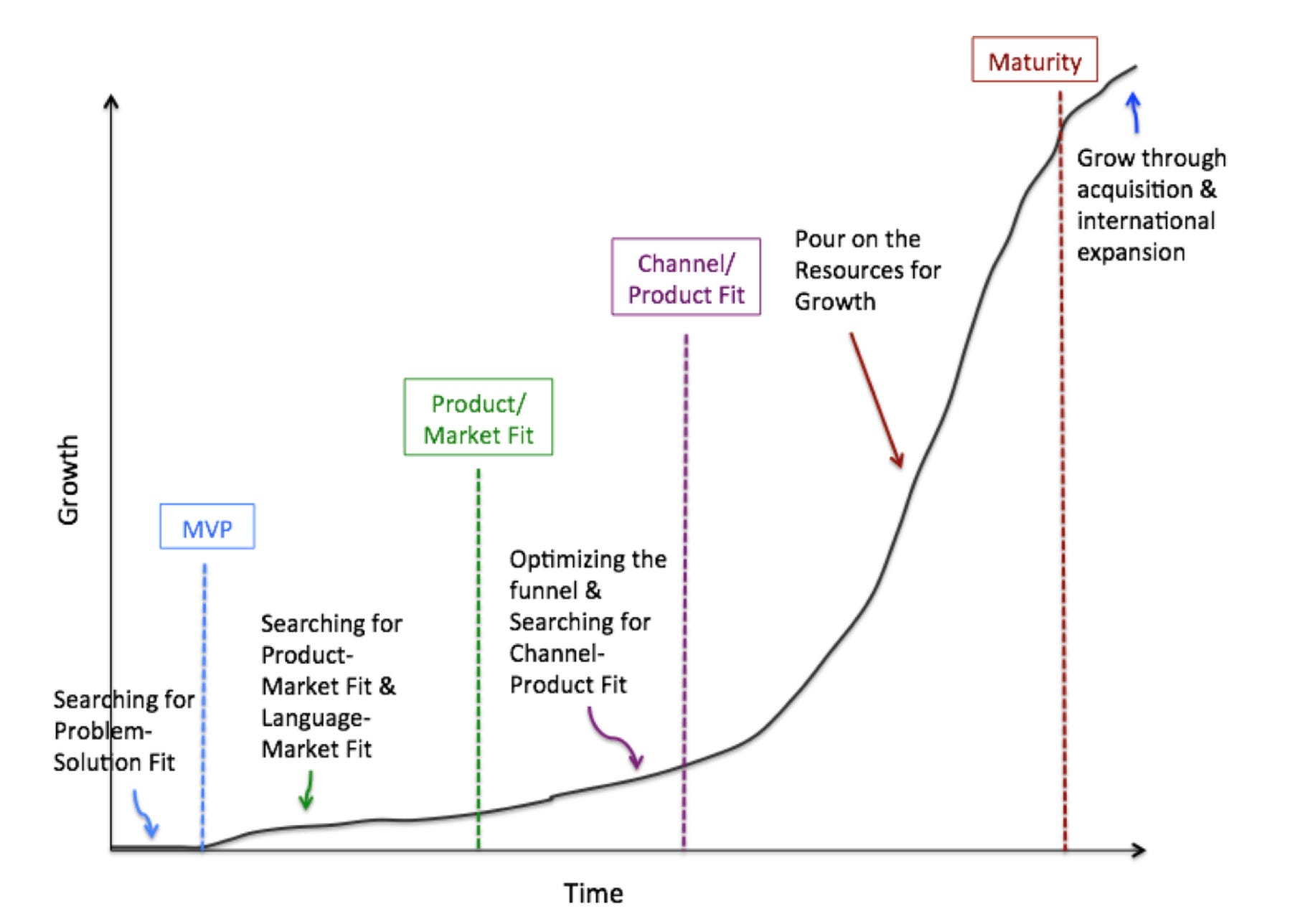
By receiving periodic updates (“the line”), an investor can build conviction that you execute well and hit milestones, making them far more likely to say yes when you finally pitch.
In fact, startups that keep investors updated regularly are 3× more likely to raise follow-on funding - According to NFX survey
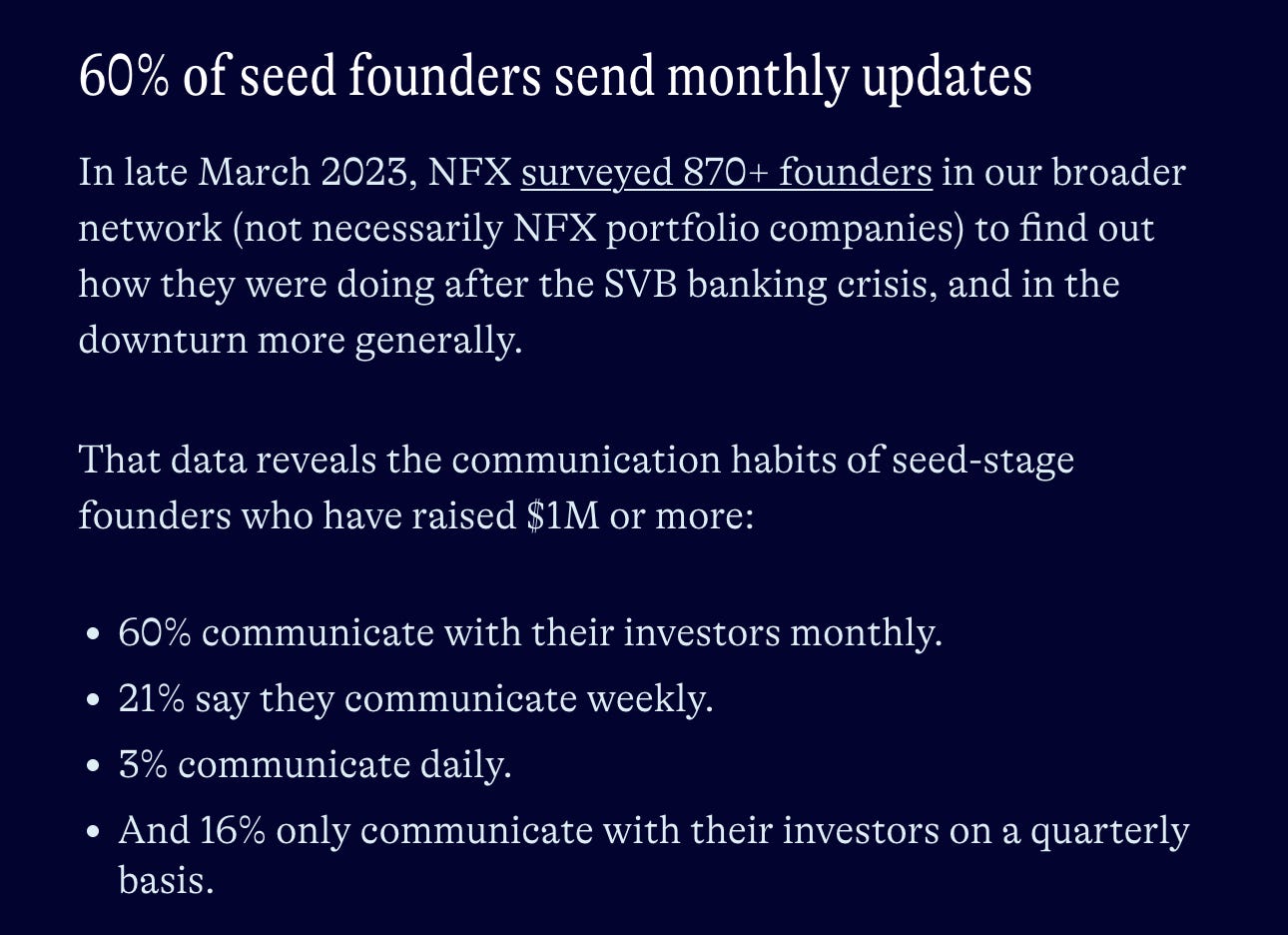
Consistent updates build familiarity and trust: you stay on an investor’s radar (in a good way) and demonstrate momentum and discipline. Remember, investors fund momentum, not just potential. If you show steady progress and the rare discipline of actually sending updates, you’ve immediately set yourself apart (the majority of founders promise updates and never deliver, so those who do are in the top 5% for investor communication
Courting investors early with updates de-risks your raise.
They’re not scrambling to understand your business under pressure; they’ve watched it unfold. Or as one seasoned investor described backing a founder he followed for two years: “I wasn’t taking a risk – I was placing a bet I’d watched them earn over time.”
So, how to start and send the updates?
1. Build a focused target list
Don’t just create a giant spreadsheet of every VC email you can find. A shotgun approach wastes everyone’s time. Instead, curate a list of investors who are actually a fit:
Look at who has backed startups similar to yours, especially at your stage (pre-seed, seed, etc.). Tools like Crunchbase, venture databases, and newsletters are useful here.
Focus on alignment: sector, stage, check size, track record. If you’re a fintech seed-stage startup, a biotech Series B fund is irrelevant — cut them out.
Check activity: Is the fund actually writing checks? If they haven’t invested in 18+ months, they may be dormant.
The goal is not “the biggest list.” It’s a qualified list — the people most likely to say yes.
2. Segment and qualify your leads
Once you have your list, break it down into useful tiers:
Tier 1 (“reach” investors): The dream firms or angels you’d love to bring on board, usually well-known names in your sector.
Tier 2 (“priority” investors): Still good fits, maybe smaller checks or slightly less perfect alignment, but worth engaging.
Also, segment by connection type: who can you reach via a warm intro versus who will be cold outreach? Warm leads always go first.
Pro tip: Use your network to expand the list. Ask advisors, mentors, or founder friends to suggest relevant VCs.
“I know a healthtech founder did this and landed 50 warm introductions in a single weekend.”
And treat this like sales. Use a lightweight “investor CRM” — even a spreadsheet — to track:
Who’s in your funnel
Where the relationship stands
Notes on conversations
That way, no warm lead slips through the cracks.
3. Find the right people at each firm
Don’t just write down firm names; identify individuals. At the seed stage, associates or junior VCs are often the best entry points.
Associates are literally incentivised to scout companies early and build relationships. They may not sign the check, but they can champion you internally to partners.
Don’t overlook angels and micro-VCs. At pre-seed and seed, a syndicate of well-connected angels can be just as valuable as a big-name fund.
Segment your list further by type: angels, seed funds, strategic investors, corporates, and tailor your approach to each.
By the end of this research and filtering, you might have, say, 50–100 solid prospects who could invest in your round. Now it’s time to warm them up – long before you officially pitch.
Warm-up campaign: reach out and get on their radar
Once you’ve built your target list, the next step is simple: start the conversation.
The goal here isn’t to ask for money. It’s to get on their radar and earn permission to keep them updated.
Start with warm intros
Warm introductions beat cold emails every time. Investors get buried in inbound, but when a trusted contact forwards your note with “Hey, you should meet this founder,” they’ll pay attention.
Warm referrals typically see a 20–30% response rate, compared to <5% for pure cold outreach.
Look for mutual connections through fellow founders (especially those in a VC’s portfolio), accelerator peers, or advisors.
Tools like LinkedIn are useful for spotting 2nd-degree connections. When asking for an intro, make it easy by writing a short forwardable blurb that your contact can simply copy-paste.
Don’t fear cold outreach
That said, cold emails aren’t worthless — especially with smaller funds, solo angels, or “super-connectors” in your industry. Many investors do respond if you keep it short, relevant, and personal.
The key is not to open with “we’re raising.” Instead, try a softer approach: ask for permission to send updates as you build. It’s a low-commitment question that’s easy to say yes to, and it starts the relationship without pressure.
One SVB advisor calls this the “permission email.” In just a few lines, you:
Introduce yourself and your company
Show why you might be relevant to their thesis
Ask if you can include them in your progress updates
Most investors will say yes, especially if you’ve done the homework to ensure they’re a good fit.
Example – The Investor Update Invite Email: Below is a template you can adapt when reaching out to a VC (perhaps an associate) you haven’t met yet.
The goal is to introduce yourself, highlight why they might be interested, and get their OK to send updates:
Subject: [Your Company Name] – Updates for [Investor Name/Fund]
Hi [Investor Name],
I’m [Your Name], the founder of [Company], a [brief one-liner describing your startup]. I’m reaching out with a quick ask: we send a short monthly update on our progress and milestones, and I’d love to include you (BCC’d) on that email.
We haven’t officially kicked off fundraising yet, but based on [why they’re a fit – e.g. your focus on healthtech], I thought our journey might be relevant to you. In the past few months we’ve [mention one recent achievement, e.g. launched our beta with 100 users], and over the next quarter we’re aiming to [upcoming goal, e.g. expand to 3 pilot customers].
If you’d prefer not to receive these updates, no worries at all – just let me know. Otherwise, I’ll be excited to keep you in the loop. Thank you!
Best,
[Your Name]
[Your Title], [Company]
[LinkedIn or Website URL]
A few important notes about this approach: keep it short and factual. You’re not attaching a deck, you’re not asking for a meeting. You’re simply asking, “Can I send you updates?” That’s an easy yes for most investors; it costs them nothing until they decide they’re interested.
You’re also dropping a subtle signal that fundraising is on the horizon (“haven’t kicked off fundraising yet”), so they understand the context. Mentioning a recent win plus a near-term goal gives them just enough to see momentum without overselling. And when you start sending updates, always BCC your list, don’t put investor emails on display, and keep the note feeling like a direct message from you.
By doing this, you accomplish two things:
You get on an investor’s radar in a positive, non-intrusive way.
You set yourself up to send consistent, more substantive updates over time.
Most founders are surprised at how high the hit rate is. Early-stage VCs and angels almost always reply with a quick “Sure, go ahead.” Why? Because it’s literally their job to track emerging companies. Or as one Techstars mentor likes to remind founders: “Build your network before you need it.” That’s exactly what you’re doing here.
Once someone agrees, they’ve moved from a cold lead to a warm one. Now the job shifts: send updates that are worth reading and make them want to keep following along.
Crafting your pre-raise investor updates email
So you’ve got a list of investors who’ve agreed to receive updates. Now comes the big question: what do you actually send them?
The guiding principles are simple: keep it concise, keep it high-signal, and keep it consistent. You’re not writing a press release or a novel. This is a short, scannable email that lets investors see your momentum and your thinking — in under two minutes.
Frequency
Monthly is the sweet spot.
Frequent enough to show momentum, not so frequent that it’s annoying.
If your business moves slowly (deep R&D, hardware, etc.), bi-monthly or quarterly is fine. But don’t stretch beyond that.
The real key is consistency. If you commit, stick to it. Sporadic updates erode trust, while regular updates build it.
Think of it like brushing your teeth: set a recurring reminder and get it done on schedule.
Length and format
Keep it short, simple, and skimmable. A few short paragraphs or bullet points.
Use headers like Highlights, Challenges, Asks.
Bullet lists > big blocks of text.
Investors don’t want a board report; they want a quick sense of how things are moving.
Pro tip: Some founders even mirror the structure of post-raise investor updates, just leaving out sensitive details.
What to include
Most strong pre-raise updates have some version of these sections:
Quick overview A one-liner upfront: “Strong month: grew 20% and launched [X].” Think of it as your subject line in sentence form. Investors skim — don’t bury the lede.
Key metrics Share 1–3 metrics that matter: revenue, GMV, users, engagement, churn, burn/runway. Add the change vs. last month/quarter to show momentum. Example:
MRR $15K (+10% MoM)
Users: 8,000 → 9,500
Highlights/wins: A few bullet points of recent wins:
+$50K in new bookings from 3 pilots
Hired a senior engineer from Spotify
App featured in Product Hunt’s newsletter
Challenges/lows Be real. Acknowledge what’s hard — churn up, launch delayed, hiring bottleneck. This builds credibility and often invites help.
Next steps/priorities: What’s coming next? Keep it short, e.g.:
Launch beta with Partner X
Hire 2 sales reps
Target $20K MRR by July
Ask them how they can help. Be specific. Examples:
Referrals for frontend engineers
Intros to HR leaders for beta testing
Advice on B2B SaaS pricing
Specific asks turn passive readers into active allies.
Closing note End with a quick thanks and sign-off. Something simple like:
“Thanks for following along — appreciate the support. Until next time, [Your Name].”
Subject lines & delivery
Stick to a consistent format: [Company] Update – [Month Year]. Easy to search later.
Optional: add a teaser (“March Update – 3× Revenue Growth”) if you want to drive opens.
Always BCC your list, don’t expose emails, and keep the tone personal.
Many top founders swear by this formula of concise, regular updates. It keeps your company at the top of investors’ minds and shows that you operate methodically.
As one VC survey found, the majority of great founders communicate at least monthly. And if you’re wondering whether investors actually read these emails – they do. In fact, some investors will look forward to your updates if you consistently share interesting insights and progress; they become emotionally invested in your journey. You’re effectively turning prospective investors into an audience rooting for you.
Subject: [ABCD] – September 2025 Update
Hi everyone,
It’s been a busy month at ABCD! Our focus this past month was on scaling our new mobile app and boy, did things move.
Key Results: We grew to 15,000 users (25% MoM increase) and landed 2 pilot customers for our B2B platform. Revenue hit $8,200 MRR (+18% MoM).
Highlights:
Product: Launched the Android version of our app, which now accounts for 30% of new signups.
Sales: Signed a 6-month pilot with MegaCorp Inc. (our biggest client to date!).
Team: Brought on a UX designer (ex-Google) to polish our onboarding flow.
Challenges:
App churn ticked up slightly this month – we’re analyzing user feedback to address retention.
Hiring for Head of Sales is moving slower than expected; looking for more candidate leads.
Our AWS costs spiked unexpectedly (perhaps a good problem – usage is growing fast!).
Next Up: In October, our goal is to launch the Team collaboration feature (waitlisted by 500 users) and reduce churn back below 5%. We’re also gearing up for our first industry conference demo in late October.
How You Can Help: 1) We’re hiring a Head of Sales – please send any great SaaS sales leader referrals our way. 2) Seeking intros at enterprise HR departments; we want 2 more pilot customers by year-end in that space. If you know any HR execs open to innovative solutions, we’d love an intro. 3) Any recommendations for optimizing AWS costs at our stage? Tips welcome!
Thank you for reading and for all the support. Several of you responded to last month’s update with helpful advice – hugely appreciated! As always, feel free to reach out any time.
Until next time,
[Your Name]
CEO, AcmeCorp
[LinkedIn] | [Email] | [Company Website]
The example structure above is just a guide. Your updates can be shorter or vary in format — the important thing is to include the core ingredients: a friendly hello, quick recap of focus and wins, a couple of key metrics, highlights, challenges, what’s next, and clear asks.
Keep the tone transparent and grounded, not hypey. If something’s off-track, say so and show how you’re fixing it. Investors value honesty more than spin. And remember: some of your audience isn’t yet an investor, so don’t overshare sensitive details like exact cash in bank — top-line numbers and qualitative progress are enough.
There’s also a hidden benefit for you: writing these updates forces reflection. You celebrate wins, confront problems, and sharpen your story month by month. Many founders later realise their updates became the backbone of their pitch deck — proof they said they’d do X, then did it, then built momentum toward Y and Z.
In short, updates aren’t just about keeping investors warm. They make you a sharper, more disciplined founder, too.
From updates to fundraising: smoothly transitioning to “ask mode”
If you’ve been sending pre-raise updates for a few months, the next step is inevitable: raising for real.
The question is, how do you flip those warm relationships into actual funding conversations? The answer is: tactfully and directly.
It shouldn’t be a surprise to your update recipients that you’re planning to raise. In fact, you may have hinted at it already (“before we start looking to raise, I want you to know us,” or “we’re planning to raise in Q1 to fuel growth”). When the moment comes, don’t send a mass blast. Instead, prioritise the investors who’ve been the most engaged with your updates — the ones who reply, click links, or have already taken calls with you. Send them a short, personal note along the lines of:
“As you’ve seen from my updates, we’ve hit A, B, and C over the last six months. Now we’re raising a $X round to scale [business]. Since you’ve been following along, I wanted to reach out early to see if this could be a fit for [Fund].”
Attach your deck if appropriate, suggest a meeting, and make it clear you’re officially in fundraising mode. This way, the “ask” feels natural — it’s just the next step in a conversation you’ve already been having.
You can also mention your raise more broadly in an update (without a direct ask), e.g.:
“P.S. – We’ve begun preparing to raise our seed round in January. If you’d like details or know someone who might be a fit, let me know.”
This creates soft urgency. You’ll often find that even investors who never replied before will resurface now — nobody likes to miss out once momentum is visible.
The beauty of this strategy is that when you enter fundraising mode, you’re not starting from scratch. These investors already know your team, your cadence, and your execution.
When you finally sit down for pitches, you’ll notice the difference: instead of “so, what do you do again?” the conversation jumps to deeper topics.
Some investors may even feel emotionally invested (“I remember when you had 100 users — now you’re at 10k!”). That sense of shared journey often accelerates a yes.
But don’t get complacent. Warm relationships don’t mean automatic checks. Run a proper process: prep your deck and data room, set a timeline, and keep new investors flowing into the funnel. The difference now is you’re pushing on open doors.
Common mistakes to avoid
Even the best strategy can backfire if you trip on common pitfalls. Here are the ones that derail founders most often:
Waiting too long to start: The #1 mistake is going quiet until you’re desperate for capital. If you show up cold with two months of runway left, expect tough terms (if any). Dig the well before you’re thirsty. One founder raised $1.2M, went silent for 14 months, and when he came back low on cash, almost every investor ignored him. Don’t wait for the “perfect milestone.” Start 3–6 months pre-raise, even if it’s just short updates.
Inconsistent or sporadic updates: One update followed by silence kills momentum. Investors assume something’s wrong or forget you exist. Pick a cadence (monthly or quarterly) and stick to it. Even a two-paragraph note beats disappearing. Use a template and block an hour a month — this isn’t a 3-day writing project.
Sending fluff instead of signal: Avoid vague cheerleading (“we’re excited and working hard!”). Investors want numbers, milestones, and context. Share meaningful metrics (“MRR up 20% MoM thanks to a new referral program”) and the story behind them. Honesty about challenges builds credibility; PR spin erodes it.
Over-optimising and overthinking: Don’t hold updates hostage until you hit some magical milestone. Progress is rarely perfect — share it anyway. Better a simple, timely update than a polished masterpiece that never ships. And don’t over-worry about individual recipients. If someone thinks you’re too early, that’s fine. You’re writing for momentum, not perfection.
Wrapping up: your playbook for “warm” fundraising
Fundraising is hard. But it’s much easier when you’ve been laying bricks for months. The Pre-Raise Update Strategy is about turning cold outreach into warm conversations, and warm conversations into real checks.
To recap:
Start early: Build your target investor list 3–6 months before raising.
Ask for permission: Use a simple outreach to get on their radar with updates.
Send consistent updates: Monthly is ideal. Include metrics, wins, challenges, next steps, and asks. Keep it short, honest, and useful.
Engage replies: Respond quickly to feedback. That’s where real relationships form.
Transition smoothly: When it’s time to raise, reach out personally to your most engaged contacts.
Avoid pitfalls: Don’t ghost, don’t send fluff, don’t over-polish, and don’t break trust.
Done well, you’ll notice the shift: instead of convincing strangers, you’re inviting familiar allies to join your next chapter. For many founders, that difference is everything.
This strategy works — it’s the same rhythm many great founders use with their existing investors, extended to future ones. It costs almost nothing beyond an hour each month, but the payoff in fundraising efficiency is massive. Think of it as planting seeds: you invest in relationships today so that capital grows tomorrow.
RESOURCES FOR FOUNDERS
📃 Access Expertly Curated Resources
Most resources online are generic. We’ve built and curated the ones that actually matter — with input from leading VC firms and founders who’ve raised millions (and some who bootstrapped).
Here’s what’s new (and improved) in our resources:
🌍 Investor Databases (Email + LinkedIn)
💰 Fundraising Tools
📊 Strategic Templates
📩 Communication Tools
📄 Legal & Operational
TODAY’S JOB OPPORTUNITIES
💼 Venture Capital & Startup Jobs
Capital Formation Associate - B Capital Group | USA - Apply Here
Program Manager - Generator | USA - Apply Here
Investment Analyst - Capital Oven | India - Apply Here
Investor Relations Associate - Chenel Capital Partner | USA - Apply Here
VP of Fundraising - Scale Asia Venture | Japan - Apply Here
Research Analyst - Positive Sum | USA - Apply Here
Student Venture Scout - Strand Venture | UK - Apply Here
2026 Venture Capital Summer Analyst - Stepstone Group | USA - Apply Here
AI Venture Analyst Intern - Untaped Venture | USA - Apply Here
Investment Analyst - ECBF | France - Apply Here
Investor Relations Manager - Beco Capital | UK - Apply Here
Investor - AI Tools - Samsung next | USA - Apply Here
Associate - Venture Capital - Artha Venture Fund | India - Apply Here
Executive Assistant - AN Venture Partner | USA - Apply Here
Investor Relations Manager - Beco Capital | UK - Apply Here
Senior Associate - Strike Capital | USA - Apply Here
Investment Associate - Beco Capital | UAE - Apply Here
Head of Platform - Pledge Venture | UK - Apply Here
General Partner Gaikka Capital | Singapore - Apply Here
Partner 22 - a16z | USA - Apply Here
ESG Intern - ESG Enterprise | UK - Apply Here
🤝 Partnership With Us
Get your product in front of over 95,000+ audience - Our newsletter is read by thousands of tech professionals, founders, investors and managers worldwide. Get in touch today.
🔴 Share Venture Curator
You currently have 0 referrals, only 5 away from receiving a 🎁 gift that includes 20 different investors’ contact database lists - Venture Curator
great content. Wonder if you have benchmark data from seed to A for burn, growth etc?