
👋 Hey, Sahil here — Welcome back to Venture Curator, where we explore how top investors think, how real founders build, and the strategies shaping tomorrow’s companies. In today’s newsletter:
VENTURE CURATORS’ FINDING
📬 My Favourite Finds
Media Posts:
All-in-one venture capital valuation Excel sheet. (Link)
What makes a killer fundraising memo? (Link)
Eliana on the hard truth that no one tells you about launching. (Link)
Do VC-backed founders or bootstrapped founders get more stressed? (Link)
The clearest path to a $10M ARR b2b AI agent startup. (Link)
All-In-One resources for aspiring Venture Capitalists. (Link)
Breaking into VC? These 150+ fellowships (free & paid) can help you get started. (Link)
40 real startup pitch decks that raised $350M+ (Including leading startups decks). (Link)
Reports/Articles:
Hidden Technical Debt in AI. (Link)
This is the best advice Y Combinator has shared for anyone in their 20s building in the AI era. (Link)
Startup legal document pack – essential legal docs for founders. (Link)
Here are the three most promising M&A targets in the space, with a focus on these key areas. (Link)
Deep dive: the path to PMF. (Link)
The viral loop illusion. (Link)
$10K+/month real biz ideas that you can do. (Link)
Map: The geography of US venture deals in Q2 2025. (Link)
FROM OUR PARTNER - AFFINITY
🤝 Why 3,000+ firms use Affinity to find and win better deals…
Affinity is a relationship intelligence platform that empowers dealmakers in relationship-driven industries to find and win better deals more quickly.

With industry-leading automated relationship insights and technology, Affinity frees dealmakers from manual data entry and equips teams to act with confidence knowing the full context and history of every relationship.
Trusted by over 3,000 organisations worldwide, Affinity is your partner for smarter dealmaking.
Get started with Affinity today and unlock the power of your network →
🤝 PARTNERSHIP WITH US
Get your product in front of over 95,000+ audience - Our newsletter is read by thousands of tech professionals, founders, investors and managers worldwide. Get in touch today.
📜 DEEP DIVE
The startup metrics that fool everyone.
These days, if you scroll through Twitter or LinkedIn, you’ll see a familiar story:
A startup goes viral. A launch video racks up 1 million views. The founder posts screenshots of a 10,000-person waitlist. Investors start circling.
I’ve reviewed dozens of these startups for potential angel investment. Many pitch impressive surface metrics, traffic spikes, social shares, thousands of signups.
But the moment I ask a few simple questions, most of the answers are either vague or missing altogether.
Because here’s the truth: not all traction is created equal.
What feels like momentum is often just noise.
A viral launch might bring attention for a day, but attention doesn’t mean users.
A huge waitlist doesn’t mean people will show up.
And early revenue doesn’t mean the business is working.
This guide is about cutting through all that. These are six of the most common vanity metrics startups use and what matters instead.
If you’re a founder, this will help you build trust through real signals. If you’re an investor, it’ll help you spot red flags before you write a check.
The viral launch trap
Viral moments feel like a win. A product video hits 100,000 views. The website crashes from traffic. Thousands of users sign up overnight.
But virality is fleeting. The real question isn’t how many people saw it, it’s how many people came back.
Ask instead:
How many of those signups became active users?
What’s the 7-day and 30-day retention rate?
Are users returning without being nudged?
The signal isn’t in the spike — it’s in the slope after the spike.
2. Revenue that isn’t repeatable
Some startups start with early revenue, which looks great on paper. But when that revenue comes from:
The founder’s connections
A one-off enterprise deal
Steep discounts to close deals fast
…it can give a false sense of product-market fit.
What matters more:
Are customers coming from diverse, scalable channels?
Are they paying full price?
Are they sticking around long enough to cover CAC?
Early revenue without repeatability is just noise.
3. Inflated waitlists
A 10,000-person waitlist looks impressive. But how was it built?
If the list was grown through gift card giveaways, viral loops, or referral bribes, it’s often low-intent and low-conversion.
Real signal comes from:
Conversion rate from waitlist to paid usage
Activation rate within 7 days of launch
Engagement metrics of early users
You don’t need a big list. You need a hungry one.
4. Niche fans ≠ , broad market
Some products gather passionate early adopters, indie hackers, communities on Reddit, or hobbyists who love trying new tools.
That’s a great starting point. But niche love doesn’t always translate to scalable demand.
You want to see:
Usage spreading beyond the founder’s inner circle
Demand from users in adjacent verticals
Growth without constant hand-holding
A tiny, obsessed fan base is encouraging. But market validation comes when strangers start using and recommending the product, without being nudged.
5. The enterprise pilot illusion
Startups selling to enterprises love to highlight pilot programs with big brands. But corporate pilots are easy to land and even easier to lose.
Many never convert into real contracts.
Look for:
Pilot-to-paid conversion rates
Renewal rates after 6–12 months
Growth in usage or seat expansion over time
A pilot is a foot in the door. Real traction is when the product becomes embedded in the customer’s workflow, when churning becomes painful.
6. Fundraising ≠ product-market fit
Raising from a top-tier VC can create momentum. But capital raised doesn’t equal value created.
Some founders are simply excellent storytellers. They can pitch. They can sell the vision. And that’s a skill worth admiring.
But it doesn’t guarantee a great product.
Instead, look at:
Organic growth driven by word of mouth
Unprompted referrals from customers
Metrics that show depth of usage (not just breadth)
The best companies often don’t look loud in the beginning. But they have consistent, compounding usage that speaks for itself.
Remember, Vanity metrics create hype. But long-term value comes from retention, engagement, expansion, and referrals.
Don’t just celebrate the first spike. Study what happens after it. Because true traction doesn’t just show up, it sticks around.
FROM OUR PARTNER - DELVE
🛡️ SOC 2 in 15 hours, not 6 months—Delve makes it effortless.
That enterprise deal you're chasing?
They just asked for SOC 2. The traditional path: 6 months and $100K+. Your path with Delve: 15 hours.

We turned compliance into a solved problem. Our AI agents collect evidence, generate policies, and prep everything while you focus on building. Plus, our security experts join your sales calls to close deals faster.
Lovable got SOC 2 in 20 hours. 11x unlocked $2.3M ARR. Bland AI went from zero to $500K in 7 days.
Stop letting compliance kill your momentum….
Book a demo here and use code VENTURECREW1K for $1,000 off →
📄 QUICK WIN
Product - When ChatGPT lied… so they built the feature
Sometimes product inspiration comes from users. This time, it came from a hallucination.
Sheet music platform Soundslice started noticing strange uploads in their system, screenshots of ChatGPT chats where users had pasted something called ASCII tabs (a plain-text way of writing guitar notes, like “E|--0--2--2--1--0--”).
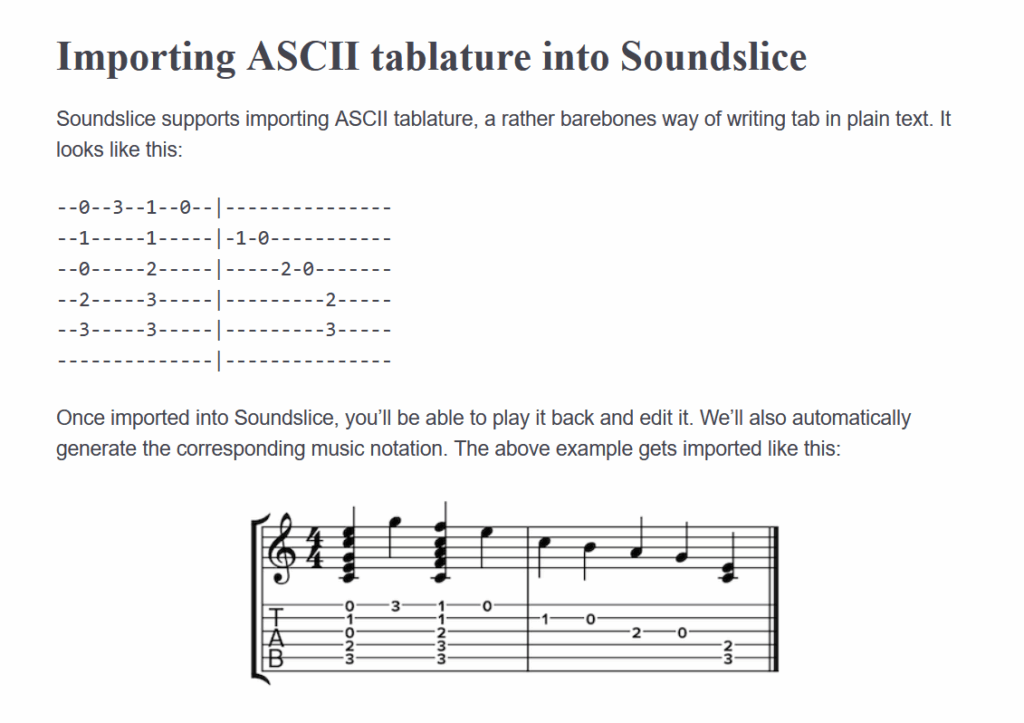
Confused, co-founder Adrian Holovaty checked ChatGPT himself… and discovered something wild:
The AI was confidently telling users that Soundslice supported ASCII tab imports, a feature they never offered.
Rather than ignore the confusion, Holovaty and team leaned in. They shipped it. A hallucinated feature became reality.
Here’s what makes this fascinating:
The market was already acting as if the feature existed. The demand was real, even if the origin wasn’t.
It forced a product dilemma: Should you build something just because an AI model said you do?
Their choice? Embrace it. Help users. And turn a false assumption into a real workflow.
It’s one of the first real cases of AI shaping a product roadmap by mistake.
And it begs the question: When AI creates expectation at scale… does that change what you should build?
A roadmap led by hallucination, but backed by demand. (Original Story Here)
AI - Shopify’s AI adoption playbook: From memo to movement
This one’s worth slowing down for. After Shopify CEO Tobi Lütke released an internal memo urging the company to treat AI as a baseline expectation, the world noticed.
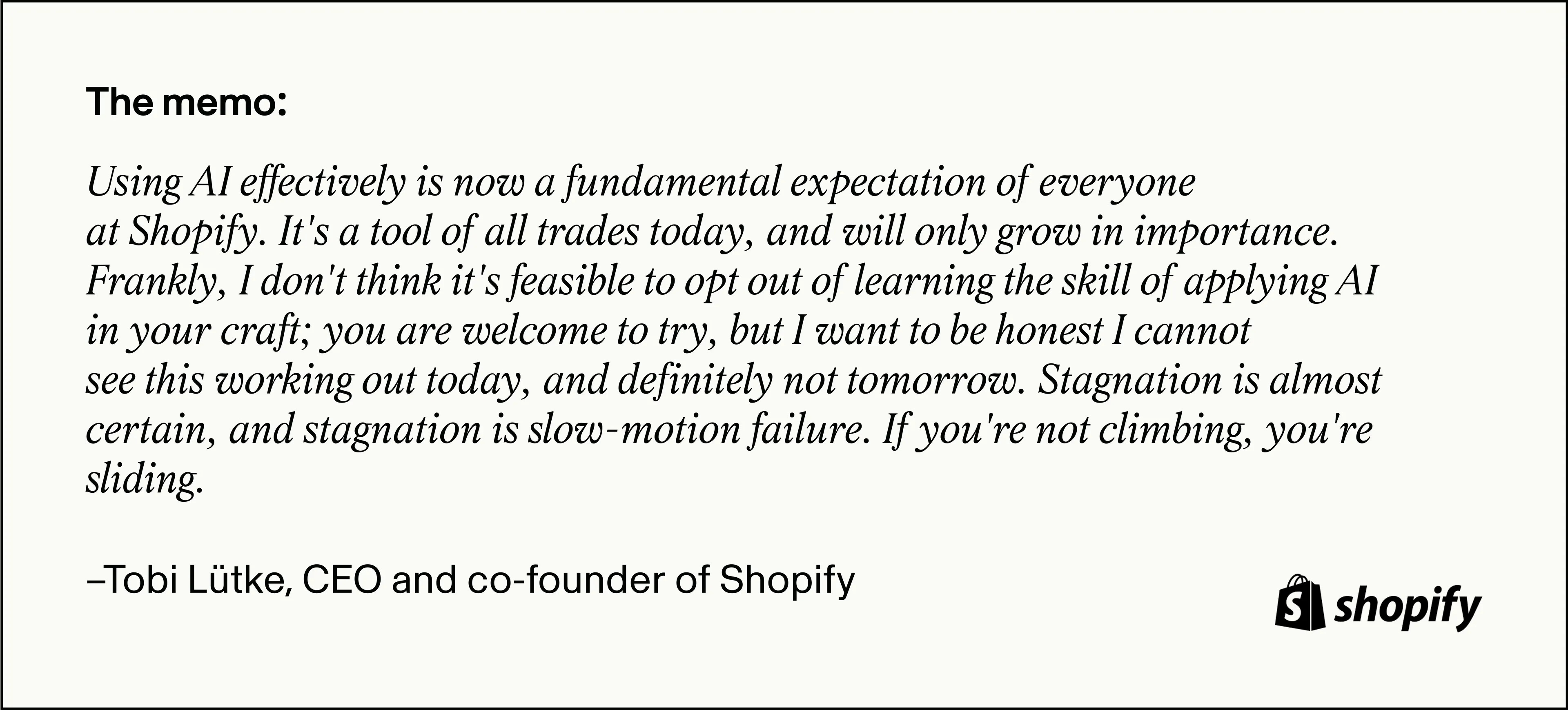
But what happened after the memo is what truly matters, and First Round’s deep dive reveals exactly how Shopify operationalised AI across every part of the company.
Here’s what they shared:
Let everyone use powerful models. Engineers weren’t the only ones using AI support, and sales adopted Cursor faster than anyone. High-value use cases came from unexpected teams.
Default to “yes.” Their legal team was told upfront: we’re doing this, help us do it safely. This top-down alignment removed blockers most companies still face.
No budget limits. Shopify tracks AI usage via token spend, not to restrict it, but to reward teams creating value. One internal leaderboard celebrates top AI power users.
One interface for all AI. They built an internal LLM proxy + a layer of MCPs so any employee could build workflows, tools, and agents without friction.
Real workflows, real outcomes. From RFP bots and sales audit tools to personal dashboards that replace email, non-technical staff are building useful tools, fast.
Context engineering. They built systems where AI writes project updates by pulling from GitHub, Slack, PRs, and more, and humans refine them. Half go unedited.
Roast your code. Their internal framework, Roast, critiques and improves code in structured steps. It’s now open source.
Hire more interns. Not fewer. Shopify believes beginners are more AI-native; they experiment more, prototype faster, and spot new possibilities others miss.
What stands out most: They didn’t just “adopt AI.” They rewired the company to collaborate with AI, making it part of how people build, sell, and think.
One insight from Farhan Thawar, their Head of Engineering, says it all:
“If AI makes your engineers 10% more productive, and that costs $1K per month... it’s too cheap. You’re under-investing.”
Read this if you’re serious about AI as a team-wide advantage.
TODAY’S JOB OPPORTUNITIES
💼 Venture Capital & Startup Jobs
Investment Lead - DCG | USA - Apply Here
Director of Fundraising - Crosscut Venture | USA - Apply Here
Partner 34 - a16z | USA - Apply Here
Fund Accounting Manager - Elevation Capital | India - Apply Here
Associate- Portfolio Management - Stepstone Group | USA - Apply Here
Chief of Staff - Grey Line Partner | USA - Apply Here
Investment Principal - Cota Capital | USA - Apply Here
Investment Fellow - Indian Fund | India - Apply Here
Corporate Development & Strategy - Figma Venture | USA - Apply Here
Value Creation - Cadeumen Capital | Spain - Apply Here
Investment analyst - Beas Capital | India - Apply Here
Chief of Staff - Penny Jar Capital | USA - Apply Here
Associate - OMERSE Venture | USA - Apply Here
Healthcare Analyst - General Investment Management | UK - Apply Here
Investment Analyst - Miras Investment | Dubai - Apply Here
PARTNERSHIP WITH US
Get your product in front of over 95,000+ audience - Our newsletter is read by thousands of tech professionals, founders, investors and managers worldwide. Get in touch today.
🔴 Share Venture Curator
You currently have 0 referrals, only 5 away from receiving a 🎁 gift that includes 20 different investors’ contact database lists - Venture Curator