


👋 Hey, Sahil here — Welcome back to Venture Curator, where we explore how top investors think, how real founders build, and the strategies shaping tomorrow’s companies.
The three sales frameworks every early-stage founder needs.
When Waitlists Work and Why They Usually Don’t?
Raising a seed round 101: Templates, Tips and Strategy to Raise.
FROM OUR PARTNER - 1PASSWORD
🚀 Explore achievable, affordable security for SMBs

No company is too small to be a target for cybercrime..
1Password’s on-demand webinar explores how lean teams can guard against the growing threat of credential-based attacks.
Watch the webinar for a discussion on:
The biggest risks facing SMBs
Security tools to reduce friction for growing teams
How your company can secure authentication in hours
🤝 PARTNERSHIP WITH US
Get your product in front of over 100,000+ audience - Our newsletter is read by thousands of tech professionals, founders, investors and managers worldwide. Get in touch today.
VENTURE CURATORS’ FINDING
📬 My Favourite Finds
Media Posts:
Lovable founders’ AI playbook to help new founders reach PMF faster. (Link)
Alex Bouaziz (Deel founder) just shared his principles for work. This guy knows his stuff. (Link)
Great essay on the importance of being original in business. (Link)
According to these four charts, we’re not in an AI bubble. (Link)
ChatGPT product retention. (Link)
Startup Legal Document Pack – Essential Legal Docs for Founders. (Link)
Reports/Articles:
How did you hear about us: The most useful data — that you’re not gathering. (Link)
Benchmarking humans & AI in contract drafting. (Link)
Dot com bubble vs AI bubble. (Link)
Perplexity prompt guide to get more work done. (Link)
How to keep winning. (Link)
State of crypto in 2025 by a16z. (Link)
What investors ask and how to answer: A practical Q&A prep kit for founders. (Link)
📜 DEEP DIVE
The three sales frameworks every early-stage founder needs.
Sales at an early-stage startup often feel like wandering in the dark with a flashlight that barely works. You hear a lot of vague advice: “Just hustle,” or “Go get ‘em!” But when you’re the founder or first salesperson trying to land those critical first customers, what you need are tactics, not motivational quotes.
I came across an interesting post shared by Whitney Sales, founder of ThoughtForge, creator of The Sales Method, and one of the sharpest sales minds. She shared three powerful sales frameworks that I believe every founder should know and use.
So I’m sharing some key points, along with my thoughts on them:
1. Start with your own founder story
Why? Because at this stage, you are the first customer.
According to Whitney, “The inception of any company is inevitably linked to the challenge the founder first faced and addressed. This part of the narrative is too often forgotten, and it’s key to connecting with a customer.”
Before you’ve got fancy logos and metrics, you’ve got your pain and your reason for building the product. Use it.
The Exercise: Use this simple story-building template to craft a value-based founder narrative:
“[SUBJECT] [ONCE UPON A TIME], [SITUATION] [CUSTOMER PROBLEM]. [CUSTOMER] and realized [FEATURES OF PROBLEM]. [COST]. [SUBJECT] learned [IDEATION PROCESS]. As a result, [SOLUTION].”
This isn’t fluff. It’s how you relate, build trust, and show the human reason behind your product.
Example: The TalentIQ founder started his first company and lost time and money because a recruiter couldn’t send qualified candidates fast enough. He saw the chaos of 50 tabs open across scattered data sources, and realised recruiters lacked one clean source of truth. That pain led to the product.
You’ve already told this story to yourself, your early hires, and maybe investors. Tell it again, but now to your customers.
2. Tell value-based customer stories
Why? Because the founder’s story won’t always resonate with every buyer.
Whitney says, “If you only have one customer, extract the elements of their use case that are most relatable to your prospect. A beta customer’s story can be as valuable as a paid customer’s story.”
This is where your product’s real-world value starts to come through. It builds credibility and defuses objections.
→ The Exercise: Here’s Whitney’s customer story framework:
“One of my clients, [CUSTOMER NAME], who is in the same [QUALIFICATION CRITERIA], was having the same problem. When I met with their [TITLE], they mentioned that [CUSTOMER PAIN POINT]. [DETAIL]. We implemented [FEATURE], and enabled them to [BENEFIT]. They saw [RESULT].”
📌 Example: A client had onboarding emails that weren’t working users dropped off. Whitney’s team implemented behaviour-based emails that matched user activity. The result? 63% more conversions. $4.2M in revenue unlocked.
Even if you have just one beta user, document their story. Get specific. Then build a bank of these stories, segmented by company size, pain point, industry, or tech stack.
3. Structure your sales calls around stories
Why? Because stories make people open up.
Early sales aren’t about pitching features. It’s about using founder and customer stories to get a prospect to start talking. Whitney emphasises: “The best sign a pitch is working? The customer starts asking you questions.”
The Structure: Here’s her proven sales conversation flow:
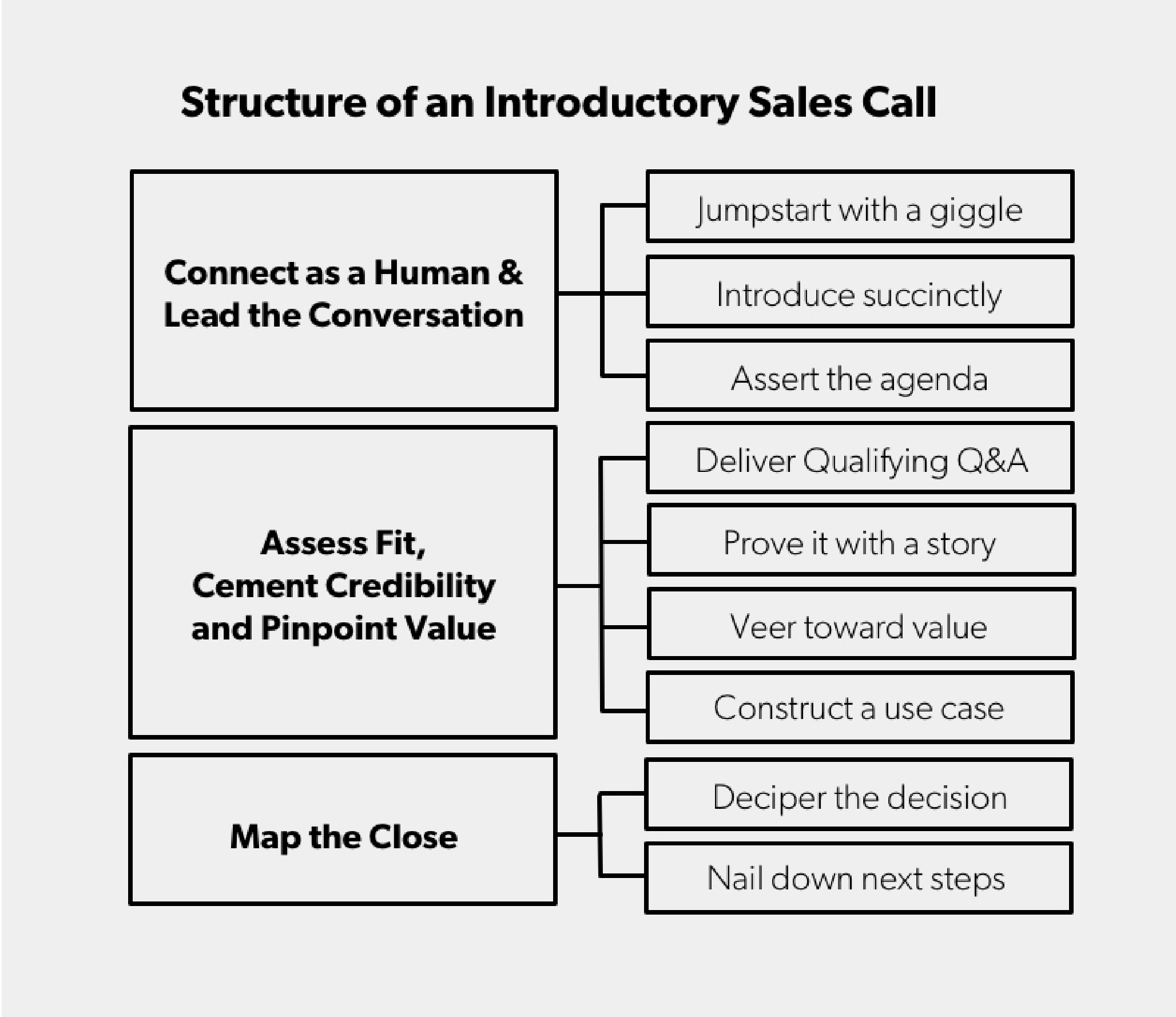
Start human (5–10 min): Crack a joke. Be real. Show you’re not a robot.
Assert the agenda (2 min): “I’d love to understand how you do ___ today, then share how we might help.”
Ask value-based questions (5–10 min): Learn their pain points. What’s costing them time or money?
Tell a customer story (2–3 min): Match their pain to a real use case. Share what worked.
Go deeper into ROI (5–10 min): Tie their pain to your product’s benefits. Use their own words to frame the solution.
Decide or qualify (10+ min): Ask about their budget, timeline, and who else needs to be involved (a.k.a. the classic BANT framework).
Lock next steps (5 min): Don’t end the call on “we’ll be in touch.” Schedule the next meeting now.
If you’re an early-stage founder, your sales pitch is not your deck. Your real pitch is your founding story and your first customer win.
Before you have a product that sells itself, you need stories that speak for it.
Whitney puts it best:
“The first sale founders make with these stories is with themselves. Then they use them to hire, raise money, and attract beta users. Scale happens when these stories are passed on to your salespeople.”
If you’re starting from zero, these three frameworks will get you your first few wins. And those first few wins? They’re what unlock everything else.
I highly recommend reading this article.
📃 QUICK DIVES
When Waitlists Work — and Why They Usually Don’t?
Founders love the idea of a waitlist. It feels like growth. The optics are great, exclusivity, buzz, FOMO, and a line of people waiting to get in. But as Gaurav Vohra, former head of growth at Superhuman, explains, most waitlists don’t drive growth at all. They quietly kill momentum.
In his essay “The Waitlist Delusion,” he breaks down what founders get wrong about waitlists, when they actually make sense, and why they usually backfire.
He learned this firsthand running Superhuman’s massive 500K+ waitlist, which, while great for early buzz, ultimately hurt conversion and slowed growth over time.
Here’s what every founder should take away:
When a waitlist actually makes sense
The only valid reason for a waitlist is when you have a supply constraint that prevents you from serving new users properly.

Hard product constraint: You physically can’t serve more customers (e.g. hardware units, limited compute, unsupported devices).
Soft product constraint: Your product isn’t ready for all use cases or quality standards yet.
Service constraint: You lack enough people to onboard or support customers.
If you don’t have one of these three, you don’t need a waitlist. Everything else — hype, optics, “community building” — is noise.
Why waitlists hurt more than they help

You lose conversions fast. At Superhuman, live signups converted to paid users at around 10%, while waitlisted users converted at just 3%. The longer someone stayed on the waitlist, the worse it got — conversion halved every additional year they waited.
You lose momentum. Startups run on speed. A waitlist pauses your growth engine and delays critical learning loops — from user feedback to product-market validation.
You waste focus. Teams end up managing “the queue” — writing nurture emails, sending updates, running referral gimmicks — instead of building the product that actually fixes the supply problem.
The common traps founders fall into
“It builds hype.” — Maybe for a few months, then it fades. If the product is great, real word-of-mouth will do far more.
“It enhances our brand.” — Works for luxury fashion, not software. People want access, not anticipation.
“It nurtures prospects.” — You’re better off giving high-intent users access and educating the rest separately.
“It looks good for investors.” — Only as a short-term signal. It’s not a repeatable growth motion.
What good waitlists actually look like
OpenAI (DALL·E 2): Clear communication about why the waitlist existed, when it would end, and what users could expect. They closed it in five months — perfect execution.
Superpower (2024): Used a waitlist only because of genuine logistical limits (blood tests and clinician access), then killed it quickly after scaling operations.
Superhuman: Initially justified, but kept it too long — a lesson in how even a successful waitlist becomes dead weight once constraints are gone.
What founders should do instead?
Use a waitlist only as a short-term bridge — not a branding exercise. Make fixing the supply constraint your top priority. The moment you can handle demand, kill the waitlist.
Because growth doesn’t come from a longer line at the door, it comes from letting people in.
Raising a seed round 101: Templates, Tips and Strategy to Raise.
Founders often ask: how much should I raise, what do I need to prove, and how do I actually close a great seed round? Here’s a practical playbook you can use:
Figure out how much to raise
Model for a 24–36 month runway. Median time from seed to Series A is ~23 months (Carta data).
Add a 25% buffer. Unexpected things always happen.
Example: If your burn is $60k/month → $1.8M for 30 months → round up to ~$2.25M with buffer.
Simple spreadsheet - how does this model work out?
Prove the basics before you pitch
Proof of commitment: quit your job, show you’re all in.
Proof of work: talk to 30+ SMB buyers or 100+ consumers. Listen for 40%+ saying “wow, when can I get this?”
Proof of insight: either a working prototype with early users or a clear memo/deck that explains your unique thesis.
Run a compressed fundraising process
Block 2–3 weeks on your calendar. Speak to as many investors as possible in that window.
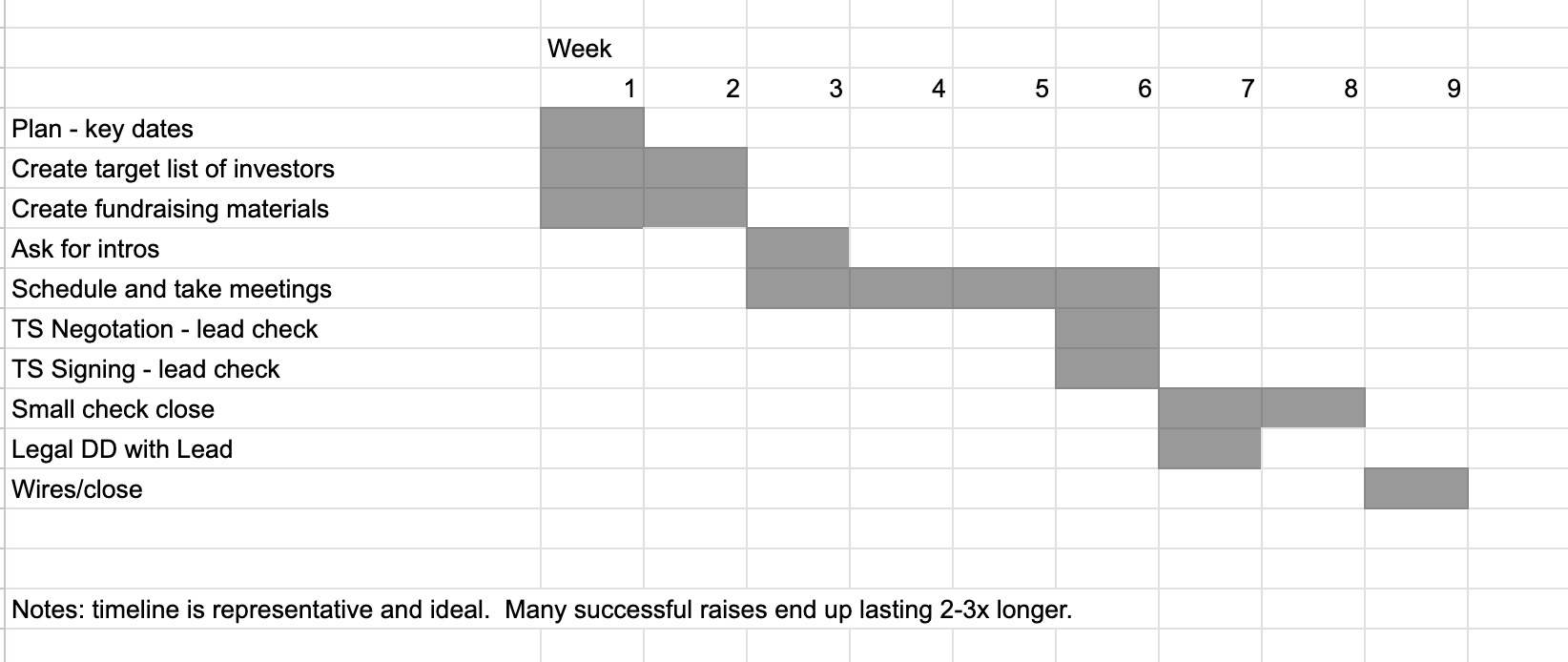
The compression creates FOMO and scarcity, which pushes decisions.
Do your homework on investors
Build a target list with check size, sectors, whether they lead, and reputation with other founders.

Use Crunchbase, LinkedIn, and backchannel references to prep. Or you can download the investors’ contact database here.
Polish your materials
Keep it minimal: a clear deck or memo, a budget, and a simple model.
Make it visually sharp — good design = signal of quality.
Line up strong intros
Best: portfolio founders of the VC, respected operators, or other active investors.
Avoid: intros from lawyers/service providers or investors not investing in your round.
If you don’t have an intro, send a crisp cold email — low hit rate, but worth trying.
Practice your pitch
Write a memo, even if you don’t share it. It sharpens your story.
Rehearse with “B-list” investors first. Iterate before you hit your top targets.
Expect investor questions to carry more weight than your slides. Prepare FAQs.
Use angels to build momentum
Open a SAFE and let smaller checks come in early.
This creates social proof that makes bigger VCs move faster.
Manage the close carefully
Don’t reveal names of other investors — just describe in general terms.
A round isn’t closed until funds are wired. Push for quick close dates.
Treat verbal commitments as meaningless until you see a signed SAFE/term sheet.
If you take away one thing: seed rounds are less about a perfect business and more about running a tight, well-planned process that creates momentum and scarcity.
TODAY’S JOB OPPORTUNITIES
💼 Venture Capital & Startup Jobs
Finance & Portfolio Analyst - Giant Venture | London - Apply Here
Analyst - Urban Partners | London - Apply Here
Venture Fellow - Commonweal Venture | NYC - Apply Here
Investor Relations - Samved VC | India - Apply Here
Interim Senior Analyst, Investments - Pivotal Ventures | USA - Apply Here
Trade Operations Lead - Manhattan Venture Partner | USA - Apply Here
AI Builder In Residence - True Venture | USA - Apply Here
VP of Fundraising - Scale Asia Venture | Japan - Apply Here
Associate - OMERSE Venture | USA - Apply Here
Senior Associate - M12 | USA - Apply Here
Investment Analyst - Cornell University | USA - Apply Here
Associate - Venture Capital - Artha Venture Fund | India - Apply Here
Investment Team - WEH Venture | India - Apply Here
Executive Assistant - AN Venture Partner | USA - Apply Here
Visiting Investment Analyst - Join Capital | USA - Apply Here
Investment Analyst - Caanan | USA - Apply Here
VC Associate UK - Breega | UK - Apply Here
🤝 Partnership With Us
Get your product in front of over 95,000+ audience - Our newsletter is read by thousands of tech professionals, founders, investors and managers worldwide. Get in touch today.
🔴 Share Venture Curator
You currently have 0 referrals, only 5 away from receiving a 🎁 gift that includes 20 different investors’ contact database lists - Venture Curator
Wow! This one article in itself is a treasure trove of information and guidance! Thank you!
We are right at the point where we want to go out and start raising for Kithli.com. I've had more than a few tell me it's late, this isn't the best time of year. I believe that if you have a great business, a great team, and proof of commitment, work, and insight, i.e. a working prototype, that there is no bad time of year.