
👋 Hey, Sahil here - welcome to today’s edition of Venture Curator, where we break down how great startups grow, how top investors think, and what’s shaping the future of tech.
P.S. Get access to 100+ startup & VC resources, investor databases, fundraising templates, 150+ premium archive posts and exclusive startup research - all in one place.
FROM OUR PARTNER - SEMRUSH
Your buyers don’t just search Google anymore.
I’ve been looking at how search is changing, and this is probably the biggest shift marketers need to pay attention to.

People still use Google, but they’re also discovering products through ChatGPT, AI Overviews, and other AI tools. Semrush now lets you track both from one place.
You can see where your brand ranks in search, how often it appears in AI answers, where competitors are gaining visibility, and what may be holding your site back.
So instead of treating SEO and AI discovery as two separate strategies, you can manage both together.
Partnership With Us
Get your product in front of an audience of 125,000+ - Our newsletter is read by thousands of tech professionals, founders, investors and managers worldwide. Get in touch today.
📜 DEEP DIVE
Run your pitch deck through a VC’s AI screener before they do.
If you sent a deck to a seed fund in the last 90 days, there is a very good chance the first thing that read it was not a person. It was a model, running against a rubric, producing a one-page memo with a section titled something like “Reasons to pass.” A rubric, if the word is new to you, is just a scoring sheet: what the fund wants to see, points for each, and zero for anything missing.
That memo decided whether an associate spent ten minutes on you or whether you got the "not a fit right now" email three days later.
Nobody tells you this happened. The rejection reads the same as one written by a human who thought hard about it.
Last week I spent an hour on a call with a partner at a seed fund (roughly $80M fund, mostly B2B, US and Europe). He shared his screen and walked me through their intake pipeline. I’m not naming him or the fund, but he let me keep the structure, the rubric fields and the output format on the condition that I don’t quote the fund’s thesis file. Fair. Everything below is built from that, plus a few other investors I’ve spoken with who run some version of the same thing.
This one has a lot of practical stuff in it, so here’s what we’re covering:
The pipeline your deck goes through, step by step, and where you actually get cut
What the AI memo looks like when it’s about you (I’ll show you a real output)
The 8-field rubric the screener scores against, with the weights
The full three-prompt chain, copy-paste ready
A Claude Project setup so you can run yourself through it in 20 minutes
The five pass reasons that show up most, and the deck fix for each
Downloadable rubric file and prompt file
Let’s go.
The part nobody told you about
Here’s the thing that stuck with me from the call. He said (I’m paraphrasing from memory, not a direct quote): “Founders think the deck is a story we read. It’s not. It’s a form we extract.”
That’s the shift. When you send a deck to most funds now, the first pass is extraction. A model pulls out fields: stage, round size, ARR, growth, team, market, thesis fit, red flags. Then it scores those fields against the fund’s rubric and thesis file. Then it drafts a short memo. Then it routes you to one of three piles.
Decks that clear the criteria move to a second stage where an analyst validates the main claims and a first-pass memo gets drafted. Borderline decks, usually 15 to 25% of inbound, get a short analyst look before they’re classified. By the time a partner sees anything, the screen has cut inbound down to roughly 5%, each one arriving with a memo already drafted.
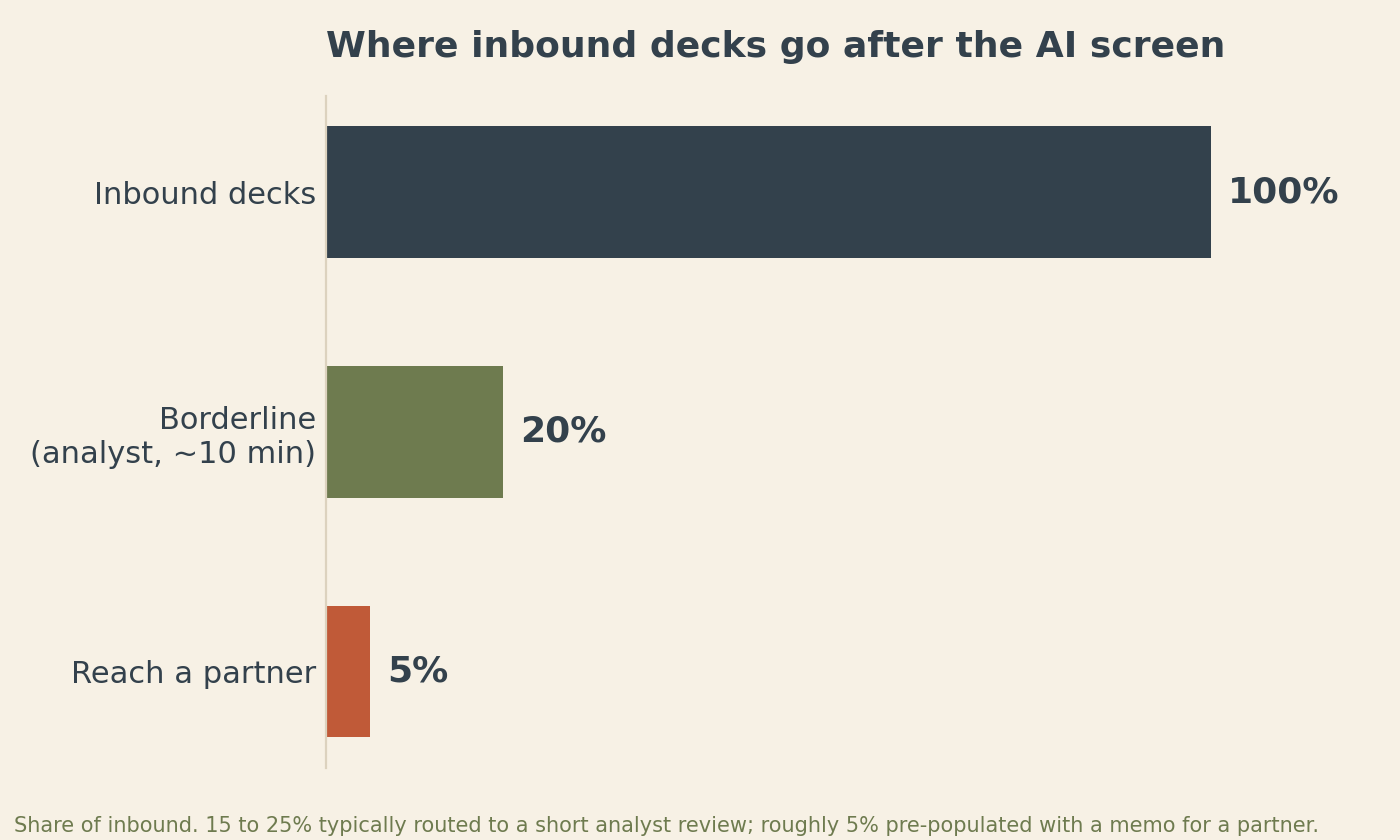
So the real funnel isn’t “we get 2,000 decks a year and take 200 meetings.” It’s “we get 2,000 decks, a model kills 1,500 in the first minute, an associate spends ten minutes each on 400, and a partner reads 100 memos that were 70% written by software.”
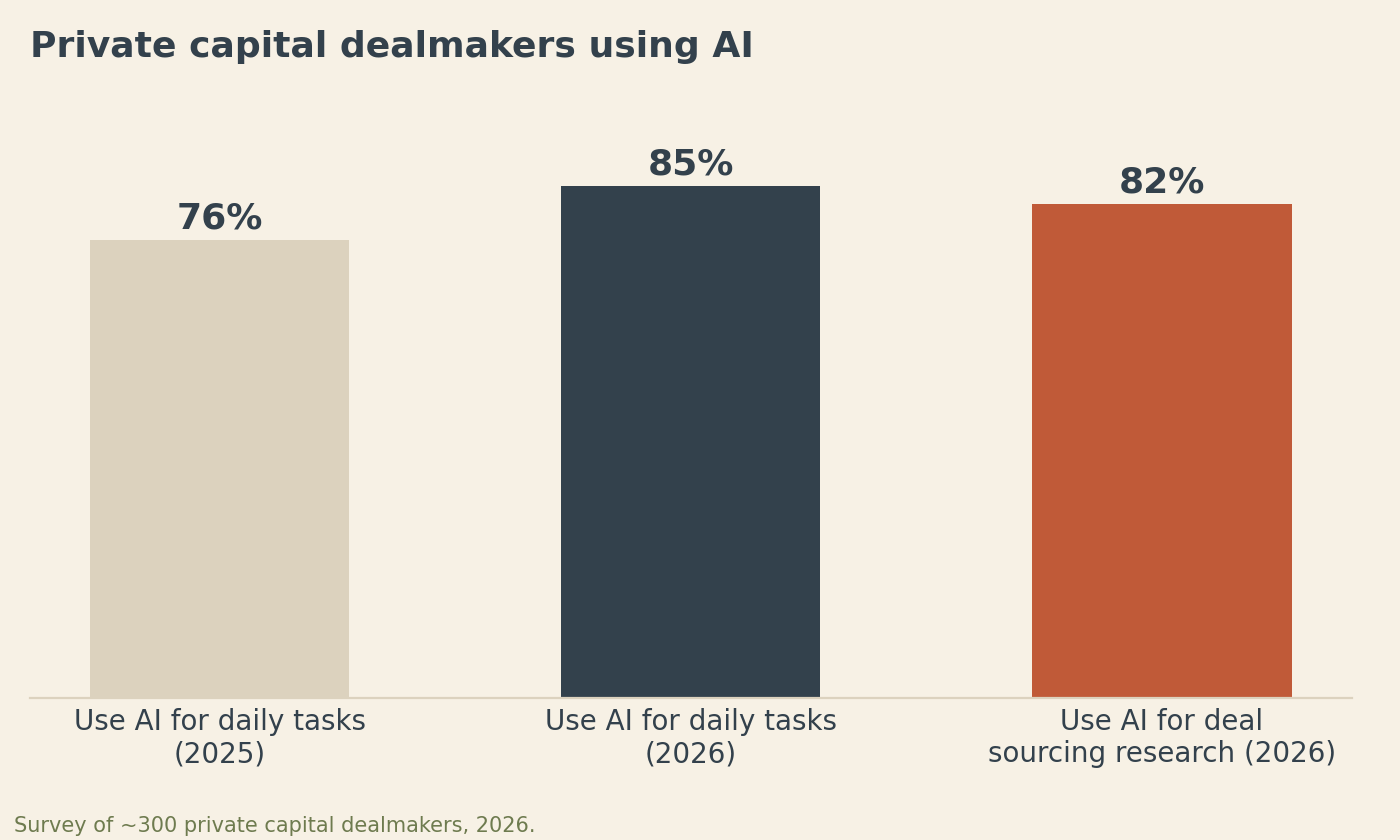
And this isn’t a few elite firms with data science teams. A survey of nearly 300 private capital dealmakers this year found 85% now use AI to automate daily work, up from 76% a year earlier, and 82% use it for deal sourcing research. On the M&A side, Deloitte found 79% of dealmakers had digitised target screening and 97% had brought generative AI or advanced analytics into the process somewhere.
The partner I spoke with was blunt about why: their inbound tripled between 2023 and 2025, headcount didn’t move, and the two associates were spending 60% of their week reading decks that should never have reached them. So they built the screen. It took two weeks. It’s a Claude project with a rubric file, a thesis file and three prompts. That’s it. No custom software.
Which is exactly why you can build the same thing.
What the memo about you looks like
This is the part that made me want to write this issue. He ran a deck through it live (a real inbound they had already passed on, founder details stripped). Here is the top of what came out, lightly edited to remove identifying stuff:
Company: [redacted], workflow tool for mid-size logistics brokers
Stage / ask: Pre-seed, raising $1.2M on a $10M post SAFE
Traction: 4 pilots, 0 paying, “LOIs with 2 enterprises”
Thesis fit: Partial. Vertical SaaS is in scope, logistics is not a focus sector. Team: 2 founders, 1 domain (8 yrs brokerage ops), 1 technical (first startup). No prior founder exits.
Score: 41 / 100
Routing: ArchiveReasons to pass
No paying customers at $10M post; pilots are unpriced and no conversion timeline given.
Market size slide uses top-down TAM ($48B) with no bottoms-up path; serviceable market not stated.
“LOIs” not attached or quantified; screen treats unquantified LOIs as zero.
Deck has no slide on why now; thesis file requires a stated catalyst for vertical SaaS.
Ask implies 12 months runway on the model’s burn estimate; no milestone stated for the next raise.
What would change the score 1 paid pilot with a number attached, or a bottoms-up SAM with a named first segment, would move this to Needs Human Review.
Read that again from the founder’s side.
That founder probably has a great answer for every one of those five points. The LOIs are real. The pilots have a conversion date. There’s a why-now; it’s just spread across slides 3 and 9 instead of being called out. None of it mattered, because none of it was extractable from the deck as written. The model doesn’t infer what you meant. It scores what’s on the page, and an
ything missing is not a blank. It’s a flag.
And here’s the bit that should worry you: the founder got an email that said: “We loved the space, but it’s a bit early for us.” That’s the human translation of a 41. It tells you nothing about which of the five things to fix.
This is what I mean when I say the past reasons are being written about you in a room you’re not in. The difference now is that the room is a prompt, and you can rebuild it.
Everything below is the rebuild. The rubric, the three prompts, the project setup, and the fixes for the pass reasons that come up most. If you’re raising in the next six months, run yourself through it before you send a single deck. At $99 a year, that’s less than one hour of the lawyer you’ll hire to paper the round that this helps you get.