
👋 Hey, Sahil here - welcome to today’s edition of Venture Curator, where we break down how great startups grow, how top investors think, and what’s shaping the future of tech.
P.S. Get access to 100+ startup & VC resources, investor databases, fundraising templates, 150+ premium archive posts and exclusive startup research - all in one place.
FROM OUR PARTNER - SEMRUSH
Your buyers don’t just search Google anymore.
I’ve been looking at how search is changing, and this is probably the biggest shift marketers need to pay attention to.

People still use Google, but they’re also discovering products through ChatGPT, AI Overviews, and other AI tools. Semrush now lets you track both from one place.
You can see where your brand ranks in search, how often it appears in AI answers, where competitors are gaining visibility, and what may be holding your site back.
So instead of treating SEO and AI discovery as two separate strategies, you can manage both together.
Partnership With Us
Get your product in front of an audience of 125,000+ - Our newsletter is read by thousands of tech professionals, founders, investors and managers worldwide. Get in touch today.
📜 DEEP DIVE
Your VC called your competitor before passing on you. How to spot it, stop it and protect your deck.
You had a good first meeting. The partner leaned in, asked real questions about your pricing and your wedge, pushed on your ICP in a way that told you he’d looked at the category before. He closed with “this is interesting, let me bring it to the team,” and you walked out thinking you had a lead.
Then nine days of silence, and a polite two-line pass with no reason in it.
Here’s what most likely happened in those nine days. Before the partner meeting, an associate ran your company against the portfolio, the way they run every company that gets past a first call. Your name came up next to one of their existing investments, not a direct competitor, but close enough that the partner who sits on that board had to make a call before anyone spent more time on you. So he messaged that founder, or caught him on a check-in that was already on the calendar, and asked some version of “we’re looking at a company in your space, does this bother you?”
That founder said yes. Or said “not really, but I’d want to know more,” which in practice means the same thing. Either way, your deal was done before the partner meeting started, and the partner who liked you never had to argue for you in the room.
You were never on that call. Nobody was going to write you an email that said “we passed because someone we already own asked us to,” so what you got instead was the version with no reason in it.
I’ve watched this play out enough times now that I can usually spot it from the shape of the pass. Meeting goes well, partner is engaged, deal evaporates without a substantive reason. When a founder tells me that story, my first question is always the same: did you check their portfolio before you walked in?
Almost nobody has.
The call nobody tells you about
Every fund that takes portfolio conflicts seriously runs some version of this check. The mechanics vary, but the shape doesn’t.
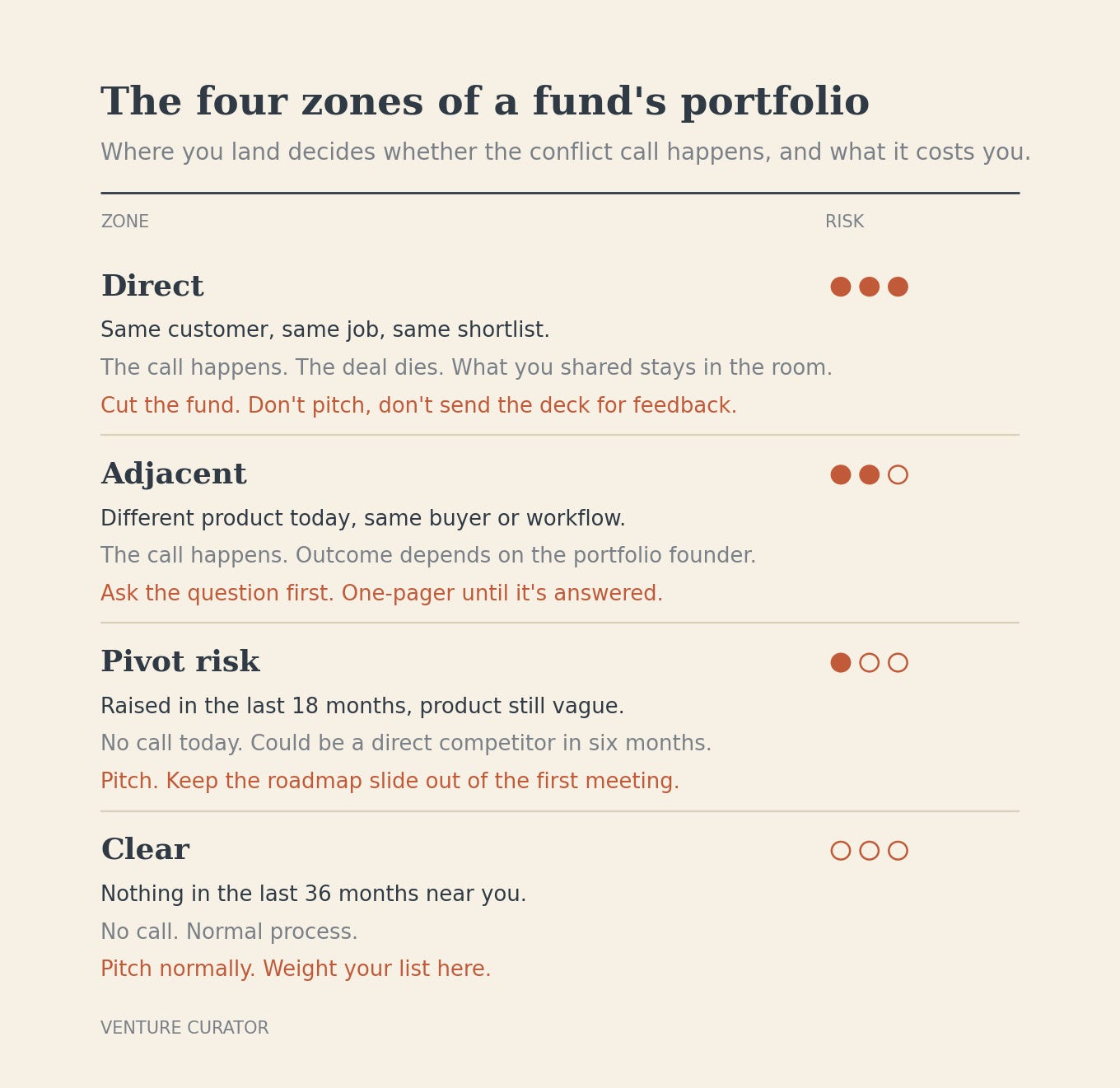
Before a partner spends real time on you, someone on the team screens you against the existing portfolio. If there’s an overlap, direct or adjacent, the partner who sits closest to that portfolio company picks up the phone. Sometimes it’s a five-minute courtesy call. Sometimes it’s a real conversation about whether the fund should be anywhere near you.
Three things can come out of that call, and you don’t get a vote in any of them -
The first is a clean pass. The portfolio founder says “yeah, that’s us in eighteen months,” the fund backs off, and you get the two-line email. This is the polite version. It’s also the most common one, because the best investors don’t want to be in a position of conflict. They’d rather kill your deal early than have to choose later.
The second is worse. The portfolio founder says “no, not competitive, go ahead,” but the call itself has now put you on their radar. Your positioning, your pricing, the wedge you spent the meeting explaining. There’s no formal leak, but there doesn’t need to be. Investors have a very clear interest in helping their portfolio companies succeed, and if what they learned from you is useful to a company they already own, it moves.
The third is the one that used to be rare and isn’t anymore. The fund decides you’re the better bet and invests anyway. Good for you, until you find out your new lead investor is also sitting on the board of the company you’re trying to beat.
Why this is getting worse, not better
For most of venture’s history, the rule was simple. VC firms do not invest in startups that compete directly with existing portfolio companies, and most went out of their way to leave enough room between portfolio companies that a pivot wouldn’t cause a collision.
That norm is breaking, and the reason is fund size. A mega-fund can’t make its math work unless it’s in every outlier, and right now there are more dollars chasing outliers than there are outliers. Something has to give, and what’s giving is the rule that kept two competitors out of the same portfolio.
You can already see it at the top of the market. Lightspeed holds a sizable stake in Anthropic and is also a big backer of Mistral. a16z’s AI portfolio lists OpenAI, Anthropic and Mistral side by side. SoftBank funded multiple sides of the same fight years before anyone else was willing to say it out loud.
Those are frontier labs, and the founders involved have enough leverage to negotiate around it. You don’t. Most founders lack the hard power to block a competitive investment, and the small set who have soft power are the ones with the biggest companies. That’s not you at seed.
So the situation you’re actually walking into in 2026 is this: the conflict check still happens, it still kills deals, and it still leaks information. But the old guarantee that a fund won’t back your competitor after seeing your deck is gone. Both risks are live at the same time.
The mistake I see over and over
Here’s the pattern. A founder builds a target list of forty funds, sorts by “invests in our stage and sector,” and starts sending emails. The sector filter is the problem. The funds most likely to show up in a sector search are, by definition, the funds most likely to already own something near you.
One founder I know pitched a well-regarded seed fund for a vertical SaaS product. Great meeting - two weeks later, a pass. Six months after that, the fund led a round in a company that had quietly pivoted into the founder’s exact category. Nobody did anything illegal. The founder had just spent forty-five minutes explaining their playbook to the one fund in the market that had a reason to pass it along.
Another founder went a step further and pitched a partner who sat on a direct competitor’s board, on the theory that “they know the space, they’ll get it fast.” They did get it fast. The partner has a fiduciary duty of loyalty to the company they sit on the board of, and that duty doesn’t switch off because you asked for feedback.
The third mistake is subtler. The founder describes the market so broadly, “we start with X, then expand into Y and Z,” that they walk straight into an adjacency with a portfolio company that’s nowhere near their actual product. The fund hears “Y” and calls the founder of the Y company. Deal dead over a slide about year three.
Even the funds themselves know how costly the check is. Hunter Walk at Homebrew has written that his fund explicitly passed on companies related to current investments at least twice, and in both cases the startup they passed on outperformed the portfolio company. That’s the honest version. The check kills good deals, and the fund would rather eat that cost than the conflict.
What almost none of these founders did is the one thing that would have caught it. You know, at best, 1 out of every 100 founders asks a direct conflict question at the start of the meeting. One in a hundred.
The other ninety-nine walk in blind, pitch for forty-five minutes, and find out from the silence.
Below the line: how to map a fund’s portfolio for conflicts in about twenty minutes before you pitch, the exact question to ask in the first two minutes and how to read the four answers you’ll get, what to do if you’re already conflicted and don’t know it, and the pre-pitch checklist.