


👋 Hey, Sahil here - Welcome back to Venture Curator, where we explore how top investors think, how real founders build, and the strategies shaping tomorrow’s companies.
Big idea + report of the week :
If 80% of companies are using AI agents, why can’t they prove ROI yet?
Are startup exits actually dying or just concentrating in the US and AI?
Frameworks & insightful posts :
How to angel invest (even if you have no money).
What are the smartest founders building right now (according to YC)?
The marketing framework ClickUp used to scale to a $4B company.
FROM OUR PARTNER - FRAMER
Launch fast. Design beautifully. Build your company’s website on Framer

Framer helps teams design, build, and launch their marketing sites lightning fast. With the ability to publish hundreds of CMS pages in a single click, operate at a global scale with seamless localisation, and even host unified content across multiple domains, teams have never been able to ship faster. Trusted by companies like Miro, Bilt, and Perplexity
Speed without chaos: ship pages and updates faster without turning the site into a fragile set of one-off hacks
Reduce dependency: shift routine brand and marketing work out of product engineering queues.
Production-grade foundation: Run real marketing systems (CMS, SEO, performance optimisation) with governance and collaboration
Build your company’s site on Framer today →
START WITH
🧠 Big idea + report of the week
If 80% of companies are using AI agents, why can’t they prove ROI yet?
There’s a strange disconnect happening inside enterprises right now. AI agents are moving fast - from experiments to production, but the systems to measure their impact are still catching up.
A recent report from CB Insights highlights this gap clearly: in a survey of executives, 80% said AI agents are a priority… yet 40% admitted they either can’t track ROI or don’t even know how to measure it.
That’s not a small problem. It’s a signal. Whenever adoption moves faster than measurement, a new infrastructure layer is built.
And that’s exactly what’s happening here.
The next wave of AI startups won’t just build agents - they’ll build the systems that explain whether those agents are actually working.
Three categories are quietly emerging as the backbone of this shift:
Observability & evaluation (knowing what your agents are doing)
Memory infrastructure (helping agents retain and use context)
Cost + ROI attribution (linking spend to real business outcomes)
Each of these solves a different bottleneck - but together, they define how AI agents scale inside real companies.
Take observability first.
Right now, agents fail silently more often than people think. They hallucinate, mis-handle workflows, or break in edge cases - and without proper tooling, no one even notices.
That’s why this has become the most active AI market right now by deal count. What’s interesting is how fast this layer is becoming “must-have”:
Startups are building automated evaluation systems that test agents before deployment
Others are using reinforcement learning from real-world failures to continuously improve agents
Simulation tools are running thousands of scenarios to stress-test agents at scale
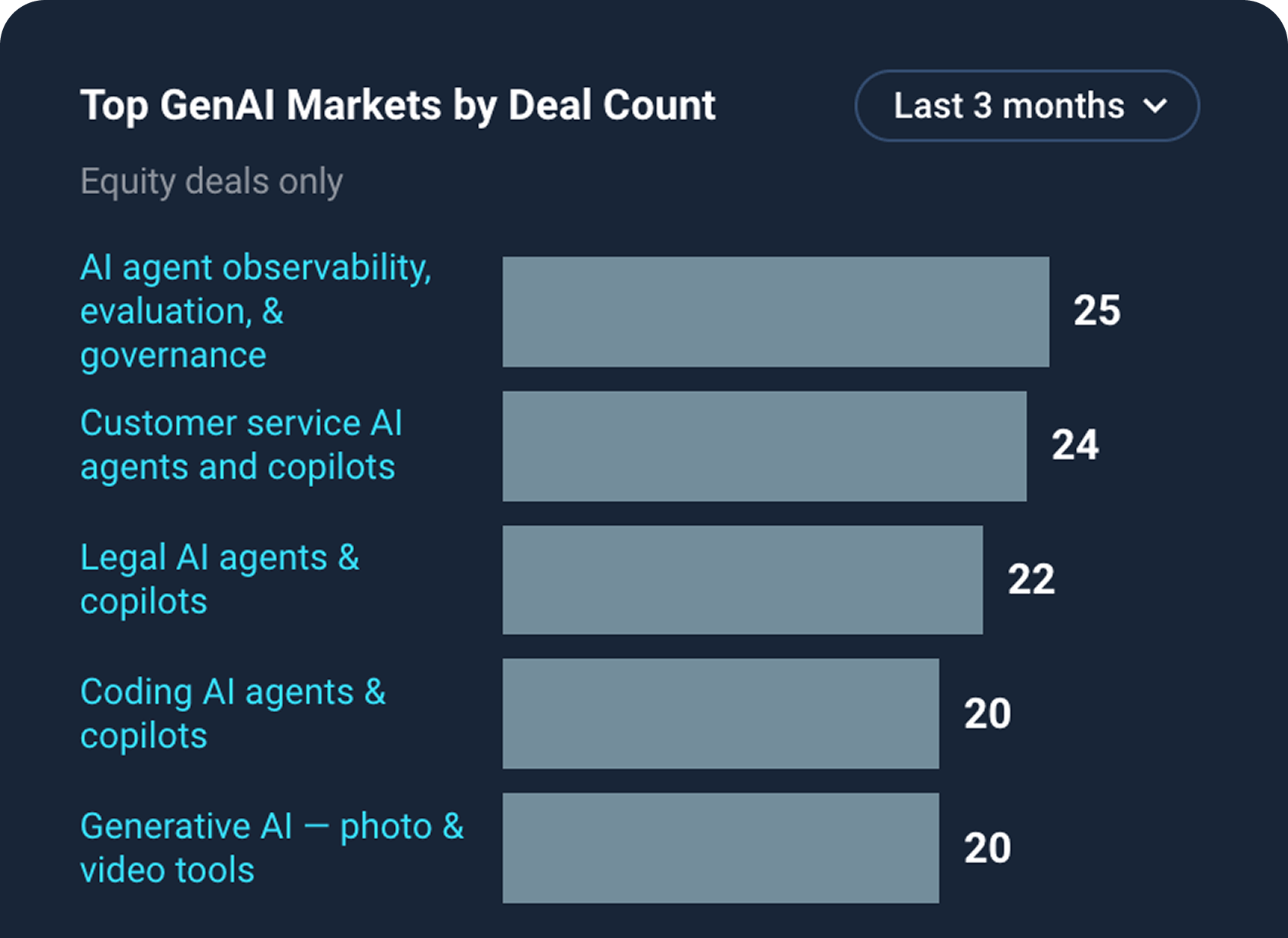
Even incumbents like Snyk and Coralogix are acquiring in this space - clear signal that monitoring won’t stay a feature, it becomes core infrastructure.
Then comes memory.
Most AI agents today are still surprisingly “forgetful.” They handle tasks well in isolation but struggle in real enterprise environments where context matters - past conversations, internal data, workflows across teams.
That’s why memory is emerging as a separate category. Not just storing chat history - but building systems where agents can:
Decide what information matters
Update their memory over time
Retrieve the right context across sessions and systems
This directly addresses one of the biggest adoption blockers companies report: integration complexity and lack of internal expertise.
If agents can “remember” the business, they become far more useful. Finally, the hardest piece: cost and ROI attribution.
Most companies today track AI success using proxy metrics:
Time saved
Productivity gains
Cost reduction
But only ~25% are actually measuring revenue impact. That’s a huge gap.
Because AI doesn’t become a budget priority until it ties to outcomes. This is where a new generation of tools is emerging:
Platforms that map model usage and token spend to business metrics
Systems that track costs across multiple AI providers and agents
Tools that show how changes in prompts or models impact revenue, latency, and quality
Right now, this category is still early - but it’s arguably the most important one because visibility without outcomes doesn’t drive decisions.
What’s really happening here is a shift in where value gets created. The first wave of AI was about building capabilities.
The next wave is about making those capabilities measurable, reliable, and economically justifiable.
And that’s where the biggest opportunities now sit. If you’re building in AI today, it’s worth asking a simple question:
Are you building the agent… Or the layer that helps companies trust, scale, and pay for those agents?
Because history suggests the second layer often ends up just as valuable.
Are startup exits actually dying or just concentrating in the US and AI?
For the last two years, one narrative has dominated venture: exits are broken.
But the latest Q1’26 data from CB Insights tells a more nuanced story. Yes, global exits have slowed. But they haven’t disappeared - they’ve become highly selective, and increasingly concentrated in specific regions and sectors.

At a headline level, the numbers look concerning.
Exit activity dropped 15% in Q1’26, hitting a near two-year low. IPOs were cut almost in half, falling from 196 to just 111 in a single quarter. M&A activity also declined.
But when you zoom in, the story changes. This isn’t a uniform global slowdown - it’s a regional divergence.
US exits were nearly flat (just -2% QoQ)
Europe saw a 21% decline
Asia dropped even more sharply at 25%
In other words, the US is holding steady while the rest of the world is pulling back.
That gap is starting to matter more than most people realise.
In Asia, regulatory pressure - especially in China - continues to slow liquidity. In Europe, cross-border deal friction and weaker IPO pipelines are adding drag. Meanwhile, US markets remain relatively more open, deeper, and more liquid.
The result: exits are concentrating where capital markets actually work. At the same time, there’s another layer to this shift - what kinds of companies are exiting?
AI is quietly taking over the exit market.
AI M&A deals hit 266, near record highs
AI IPOs reached a record 21 in a single quarter
AI companies made up 15.4% of all US exits - the highest ever
So even as total exits decline, AI exits are increasing their share. That’s a critical signal. Because it suggests the market isn’t shutting down - it’s filtering.
Capital is still flowing. Buyers are still active. Public markets are still opening. But only for companies that meet a much higher bar:
Clear category leadership
Strong revenue visibility
Strategic importance (especially in AI)
You can see this in the largest deals of the quarter.
Massive, high-conviction transactions are still happening - like the Google-Wiz deal or the broader consolidation across AI infrastructure and platforms.
So, we’re not in an “exit drought.” We’re in a selective liquidity environment. And that has real implications for founders:
Building a “good” company is no longer enough - you need to be category-defining
Geography matters more than before - where you build affects how you exit
AI tailwinds are real - they’re influencing not just funding, but actual liquidity
For investors, it explains why DPI has been slow - not because exits are impossible, but because only a narrow slice of companies are clearing the bar right now.
And for the ecosystem as a whole, it points to something bigger: The venture market isn’t contracting evenly.
It’s concentrating on fewer regions, fewer companies, and fewer breakout outcomes. Which makes one thing clear: The exit market isn’t broken. It’s just a lot more unforgiving.
FROM OUR PARTNER - LEMLIST
📈 Your first sales hire shouldn’t spend half their day on admin.

lemlist gives your first sales hire everything they need: 450M+ leads, AI enrichment, and multichannel sequences across email, LinkedIn, and calls - all in one place.
ElevenLabs went from 5% to 30% of the pipeline from outbound with lemlist.
🤝 PARTNERSHIP WITH US
Get your product in front of over 115,000+ audience - Our newsletter is read by thousands of tech professionals, founders, investors and managers worldwide. Get in touch today.
SOMETHING MORE
🧩 Frameworks & insightful posts
How to angel invest (even if you have no money).
Most people think angel investing starts with capital. Big checks. Strong networks. Years of experience.
But that assumption is outdated.
Sarah Chieng shared a simple but powerful insight after her first angel investment (which later got acquired by Jeff Bezos): angel investing today is less about capital - and more about value.
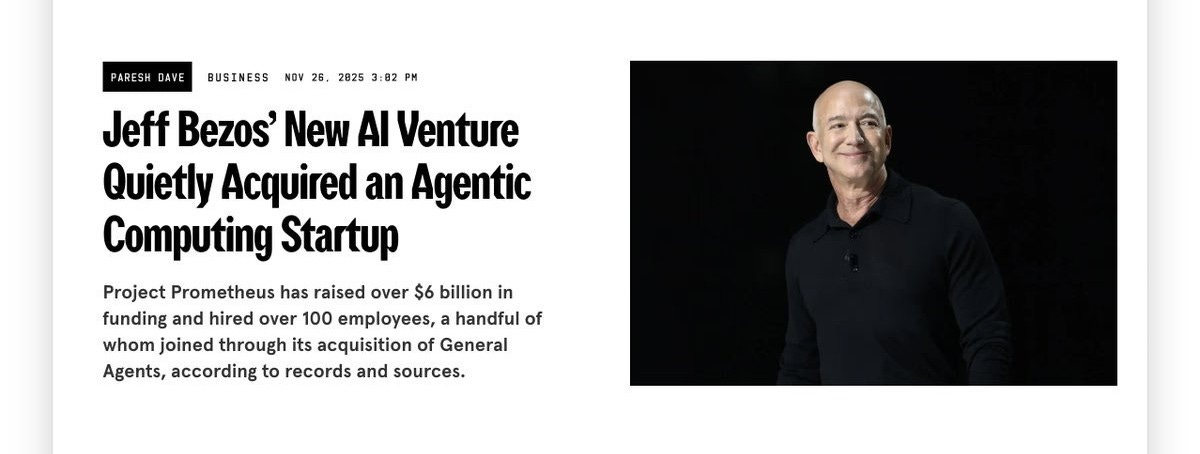
And once you understand that, the barrier to entry drops significantly. We’re in a capital-abundant era.
In 2025 alone, over $160B was deployed globally into AI. Pre-seed rounds that used to be $500K are now closer to $2M. Founders aren’t struggling to find money - they’re struggling to decide which money actually matters.
That changes the role of an angel completely. Because if capital is abundant, then the only thing that differentiates you is:
what you know
who you can connect with
and how you can help
In many cases, early-stage operators can add more value than traditional investors - especially in AI, where execution speed and insight matter more than capital access.
So how do people actually get started without money? The most common path today is through scout programs.
Instead of investing your own capital, you invest on behalf of a VC firm. Firms like a16z, Sequoia, Index, and others give scouts an allocation (say $50K-$200K per year) to invest in startups, and you get a share of the upside if those companies succeed.
The structure varies:
Some give full autonomy (“deploy this capital however you want”)
Others are more gatekept (“bring deals, partners decide”)
But either way, it solves the biggest problem - access to capital.
Once you’re in, the real question becomes: how do you actually become a good angel?
Sarah breaks it down into three simple ideas - and they’re more practical than most investment frameworks.
Your value is your leverage
Angel investing is not about writing checks. It’s about earning the right to be in the round. And that only happens if you bring something founders actually need.
if you’re strong at GTM → help with distribution
if you work in a top AI company → unlock access or insights
if you have a network → make the right introductions
If you don’t think this way, you’ll only get access to weak deals.
Good founders don’t need money. They need useful people.
Who you learn from matters more than where you invest
Most people optimise for brand, which fund they scout for.
But the real advantage is who you’re learning next to. Angel investing is mostly judgment under uncertainty. So your learning curve depends on whether you have someone you trust to sanity-check your thinking.
Someone you can call and say:
“This looks like every other AI startup… but I think this one is different. Am I missing something?”
That feedback loop compounds fast.
Only invest in two types of founders
This is the sharpest filter in the piece. There are only two categories worth investing in:
people you know extremely well (your “best friends”)
or people who are undeniably exceptional (“Michael Jordan”)
Anything in between is noise. Because as an angel, you don’t have the luxury of large portfolios or long timelines like VCs. You need a much higher bar for conviction.
What ties all of this together is a simple shift in mindset. Angel investing used to be about access to capital.
Now it’s about access to value.
The people who win in this game aren’t the ones writing the biggest checks. They’re the ones founders actually want on their cap table because they make the company better.
What are the smartest founders building right now (according to YC)?
There’s a clear shift happening. AI is no longer a feature you add to software - it’s becoming the foundation everything is built on. And when YC publishes its Requests for Startups, it’s usually a good signal of where the next wave is forming.
This comes from Y Combinator’s latest Summer 2026 RFS, where they outline the ideas they want founders to go after based on what they’re seeing on the frontier.
What stands out isn’t just individual ideas - it’s the pattern underneath them.
The big shift: from tools → systems → infrastructure
For the last couple of years, most startups were building AI copilots - tools that help people do work faster. That phase is ending.
Now, YC is clearly pointing toward something bigger:
replacing entire services (not just improving them)
Rebuilding software from scratch as AI-native systems
creating new infrastructure layers for agents and automation
pushing AI into the physical world (robots, chips, agriculture, space)
This is less about adding AI to workflows… and more about redesigning the entire stack.
AI replacing services (not software)
One of the clearest opportunities YC highlights is AI-native service companies. Instead of selling SaaS tools, these companies directly deliver outcomes:
accounting, tax, compliance
insurance brokerage
healthcare admin
Services markets are far bigger than software markets, and a lot of that work is already outsourced.
So the winning companies won’t say “here’s a tool.” They’ll say: “we’ll just do it for you.”
The rise of the “company brain”
Another major theme is the idea that data isn’t enough - context is missing. Every company today runs on fragmented knowledge:
Slack threads
emails
internal docs
people’s memory
YC calls the solution a “company brain” - a system that:
pulls knowledge from everywhere
structures it
keeps it updated
turns it into something AI can actually execute on
This becomes the missing layer between raw data and real automation. And if this works, it changes everything - because AI stops assisting work and starts doing it reliably.
Software is being rebuilt for agents
YC makes a bold point: the next billion “users” of software won’t be humans - they’ll be AI agents. That breaks how software is designed today.
Current software assumes:
Humans clicking buttons
visual interfaces
manual workflows
But agents need:
APIs, CLIs, machine-readable systems
structured documentation
programmatic access
So a massive opportunity opens up:
build software that agents can use, not humans.
And that likely won’t come from incumbents retrofitting old systems — it’ll come from startups building from scratch.
SaaS is vulnerable (and that’s the opportunity)
YC directly calls this out: if AI really weakens SaaS moats, this is one of the biggest startup opportunities in a decade. Why? Because the old advantage of SaaS was:
expensive to build
hard to replicate
required large teams
AI changes that equation:
10–100x faster development
smaller teams can compete
legacy codebases lose their edge
That opens multiple attack paths:
build cheaper alternatives (10x cheaper)
bundle multiple tools into one
Rethink workflows entirely with AI-native design
The next generation of big software companies will likely come from here.
AI is moving into the physical world
A lot of founders still think AI = software. YC is clearly saying that’s incomplete. Some of the biggest opportunities are in:
agriculture (precision farming, low pesticide systems)
robotics and physical AI
hardware supply chains
space infrastructure
semiconductor systems
The reason is simple: software is getting easier… but atoms are still hard.
So whoever combines AI with real-world systems - sensors, robotics, energy, manufacturing - gets a much stronger moat.
New infrastructure layers are being built
Several ideas point to a deeper shift: entirely new infrastructure is needed for this AI world. Examples YC highlights:
Inference chips built specifically for agent workflows
semiconductor supply chain visibility tools
AI operating systems for companies
dynamic software interfaces that users can reshape
These aren’t features - they’re foundational layers.
And historically, building at the infrastructure layer is where massive value gets created.
Selling to big companies just got easier
One underrated shift YC calls out: early-stage startups can now sell directly to Fortune 100 companies. That used to be nearly impossible.
Now:
small teams can ship enterprise-grade products quickly
buyers are actively looking for AI solutions
deals are closing earlier (even during YC batches)
This flips an old startup rule on its head. Instead of avoiding big companies… you can build for them from day one.
What this actually means for founders
If you step back, the RFS isn’t just a list of ideas - it’s a map of where things are going:
AI is collapsing the cost of building software
value is shifting from tools → outcomes
data alone isn’t enough — structured context is the moat
agents will become primary users of software
physical-world applications will define the next frontier
infrastructure layers are being rebuilt from scratch
And maybe the most important takeaway:The next wave of great companies won’t look like SaaS companies. They’ll look like:
service providers powered by AI
systems that run entire workflows
infrastructure that other AI systems depend on
companies that blend software + hardware + data
That’s the direction YC is pointing toward. And historically, when YC starts talking like this… it’s usually early, not late.
The marketing framework ClickUp used to scale to a $4B company.
Should you go all in on SEO? Launch a TikTok? Buy a billboard? Run a cold email campaign? The options are endless, but what works for one startup might not work for you. So how do you choose?
Hustle Fund shared ClickUp’s (valued at $4B) marketing framework that they used to scale to a $4B company. Here’s how he thinks about marketing.
The ClickUp Marketing Framework
On the X-axis, we have audience size. On the Y-axis, we have lifetime value (LTV). Where you fall on this model determines your marketing approach.

High LTV, Tiny Audience (e.g., Defense Tech, Enterprise SaaS)
Selling a $500M contract? Google Ads won’t cut it.
You need business development, a strong network, and a killer pitch deck.
Sales is 1:1, relationship-driven, and highly personalized.
Low LTV, Huge Audience (e.g., Keychains, Stickers, Fidget Spinners)
Paid ads don’t make sense here—ad costs eat up profits.
Growth comes from community, virality, and organic reach.
Strategies: Product Hunt, Reddit, TikTok, referral loops (think Dropbox, Boomerang).
Higher LTV, Large Audience (e.g., SaaS, Consumer Products, B2B Software)
With money in the bank, paid media (Facebook, Google Ads) can drive growth.
Early-stage startups often lack budget for this, so experiment wisely.
Sponsoring newsletters (like this one 😉) can work if done right.
Mid-Size Audience, Mid-High LTV (e.g., Niche SaaS, B2B Tools, DTC Brands)
Trade shows, outbound emails, investor intros, and live events become key.
If you’re selling to 100,000 buyers, scaling outreach matters.
The goal: personalized + scalable marketing efforts.
Low LTV, Small Audience? Bad business. Stay away.

How Would ClickUp Go-to-Market Today?
ClickUp is a collaboration + work planning tool valued at $4B. In 2022, they served 100,000+ customers, made $150M in revenue, and raised $400M.
From Clicksup growth manager - If I were starting ClickUp today:
Validate Product-Market Fit First
Talk to users. Why do they love the product?
Use that data to craft killer messaging.
Find Where Users Hang Out
Ask: “How did you hear about us?”
Identify their communities (Reddit, Facebook groups, LinkedIn, etc.)
Build your own engaged community.
Leverage Organic Growth
Launch on Product Hunt, Hacker News, and Reddit.
Invest in SEO—it takes time but pays off.
Scale Once the Foundation Is Strong
Trade shows, outbound emails, targeted ads come next.
Nail product/message fit first, then hit the gas.
It all boils down to:
What’s your LTV?
How big is your audience?
How much $ can you spend on marketing today?
Before throwing money at ads, focus on product-market fit, organic traction, and the right messaging. Once that’s in place—light the fire.
NEWS RECAP
🗞️ This week in startups & VC
New In VC
Mighty Capital, a San Francisco, CA-based venture capital firm specialising in product-led investing, closed Fund III at $91m. (Link)
Oncology Ventures, an Austin, TX-based venture capital firm investing in startups transforming cancer care, closed its $62m Fund II. (Link)
Eclipse, a Palo Alto, CA-based venture capital firm, raised $1.311 billion for two funds. (Link)
Futurepresent, a NYC, Berlin, and Munich, Germany-based venture capital firm backing AI startups in the US and Europe, launched with its first $300M vehicle. (Link)
Zero Shot, a U.S.-based VC fund founded by former OpenAI leaders, has raised $20M in its first close toward a $100M target to invest in early-stage AI startups. (Link)
New Startup Deals
Iridius, a Seattle, WA-based compliance-by-design AI platform, raised $8.6M in Seed funding. (Link)
RE Joule (VREY), a Berlin, Germany-based solar solutions startup, raised €3.3M in Seed funding. (Link)
Astor, a San Francisco, CA-based AI-native investment advisory platform, raised $5M in Seed funding. (Link)
Ferrosa Therapeutics, a Basel, Switzerland-based biotech company, raised $3.5M in Seed funding. (Link)
DOJO AI, a London & Lisbon-based agentic marketing platform, raised $6M in Seed funding. (Link)
Almanack Health, a Boston, MA-based clinical AI platform, raised $10M in Seed funding. (Link)
TODAY’S JOB OPPORTUNITIES
💼 Venture capital & startup jobs
All-In-One VC Interview Preparation Guide: With a leading investor group, we have created an all-in-one VC interview preparation guide for aspiring VCs. Don’t miss this. (Access Here)
Partner 18, Healthcare - a16z | USA - Apply Here
Associate - DN Capital | Germany - Apply Here
Investment Intern - DTCP | UK - Apply Here
Venture Scout - First Momentum Venture | UK - Apply Here
Analyst, Global Investment Team - 500 Global | USA - Apply Here
Associate, Data Operations - Iconiq Capital | USA - Apply Here
Investor - AI - Samsung Next | USA - Apply Here
Finance Associate - RA Capital | USA - Apply Here
Fund Controller - NFX | USA - Apply Here
Vice President, Investor Relations - General Atlantic - Apply Here
Senior Associate - RA Capital | USA - Apply Here
PE & VC Partner Manager - Dealhub | UK - Apply Here
Partner 22 -a16z | USA - Apply Here
Infra / Platform Engineer - Pear VC | USA - Apply Here
Associate / Senior Associate - Stepstone Group | Italy - Apply Here
PARTNERSHIP WITH US
Get your product in front of over 115,000+ audience - Our newsletter is read by thousands of tech professionals, founders, investors and managers worldwide. Get in touch today.
🔴 Share Venture Curator
You currently have 0 referrals, only 5 away from receiving a 🎁 gift that includes 20 different investors’ contact database lists - Venture Curator