

👋 Hey, Sahil here - welcome to today’s edition of Venture Curator, where we break down how great startups grow, how top investors think, and what’s shaping the future of tech.
P.S. Get access to 100+ startup & VC resources, investor databases, fundraising templates, 150+ premium archive posts and exclusive startup research - all in one place.
FROM OUR PARTNER - ATTIO
Introducing Attio: the agentic CRM

Attio’s new workflows engine just made it a lot easier for you to accelerate deal flow, from source to close.
Describe the process you need, and Attio builds it end-to-end, ready for your approval. Agents run deal triage, diligence prep, LP reporting, and more, handling the work that used to take your team days.
Agents handle the work, so you can unlock context across your entire deal flow and act on it instantly.
If you can describe it, Attio can build it.
WORK WITH US
🤝 Partnership With Us
Get your product in front of over 125,000+ audience - Our newsletter is read by thousands of tech professionals, founders, investors and managers worldwide. Get in touch today.
📜 DEEP DIVE
What does a VC really write in their internal notes after they reject you? (Most founders never see it).
You have a VC rejection sitting in your inbox right now. Most founders do.
Three or four sentences. Warm, slightly apologetic, no reason you can act on. “Really enjoyed the conversation. It’s a bit early for us at this stage. Would love to stay close as you grow.”
You’ve probably read it more than once, looking for the part that says what went wrong.
It isn’t in there. It was never in there. That email was written to politely end a conversation, and it did its job.
But it isn’t the only thing that got written. When a fund passes, a second record goes into their system - a reason code, a short note, and often a date. That one wasn’t written for you (many founders never get a chance to see this). It was written so a colleague who has never met you can open your file in eighteen months and know exactly what to do with it.
You’re reacting to the rejection email. The firm is operating off the other document.
Most passes aren’t verdicts at all.
Here’s what changes how you should read every rejection you’ve ever had.
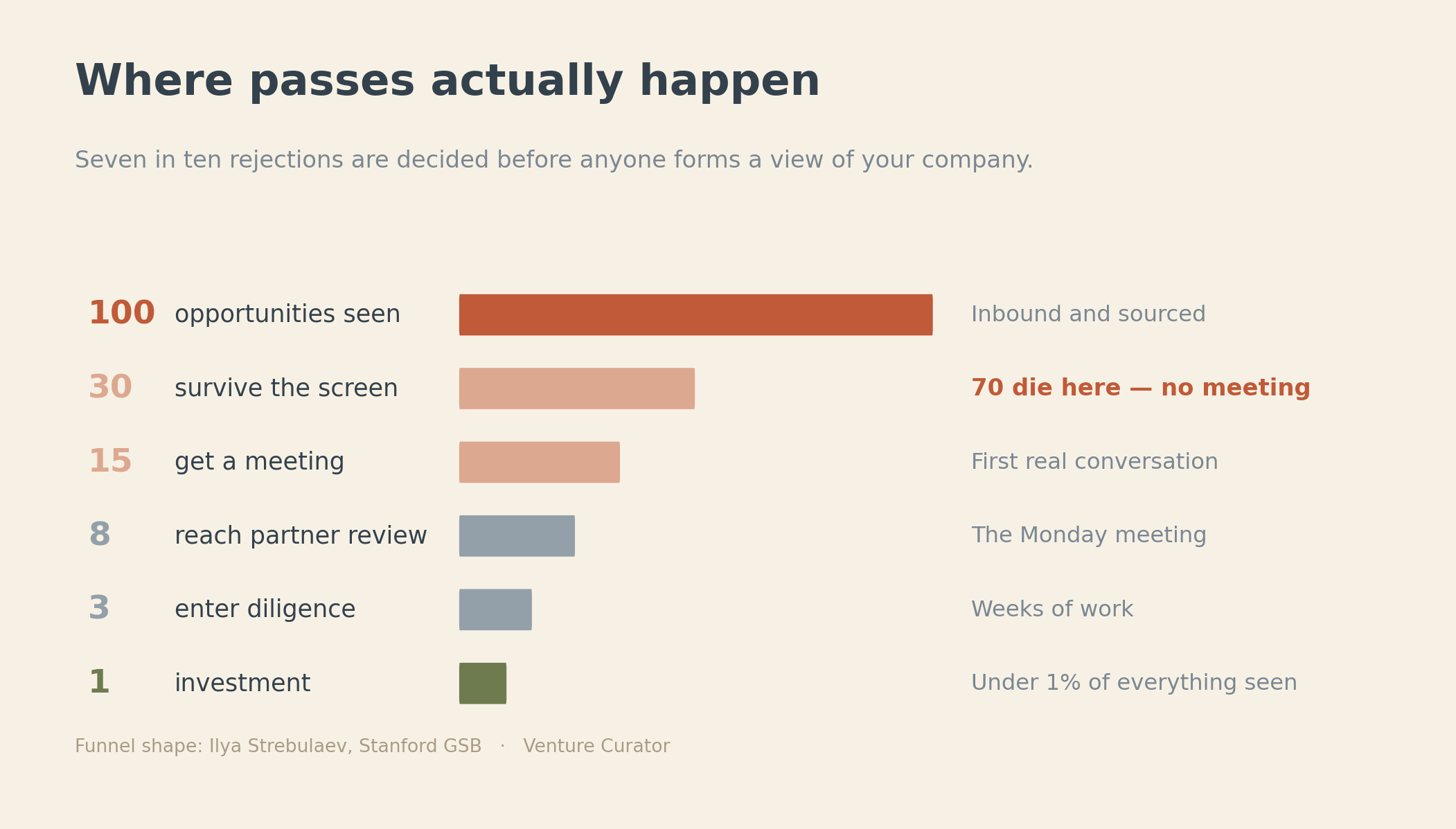
Stanford’s Ilya Strebulaev, who has spent a decade surveying how VCs actually behave, describes the funnel plainly: roughly 70 of 100 opportunities die in the initial screen - usually within minutes, without any meeting at all. Conversion from first contact to cheque runs about 1% at Homebrew, 0.7% at a firm like a16z.
Read that with your own inbox in mind. If seven in ten deals are killed before a conversation, most of the passes you’ve collected were never assessments of your company. Nobody formed a view. There was no evaluation to fail.
So the honest framing is this: a pass is the default outcome. It is what happens when nothing overrides it. Getting one tells you almost nothing on its own. What tells you something is which kind you got - and that information exists, in writing, in their system.
The mistake this produces
Founders treat a pass as feedback. So they change something.
They rebuild the deck. They rewrite the market slide. They wait for a metric to move before going back out. Sometimes they change the actual company - a pivot triggered by a pattern of rejections that was never about the product.
And the pattern was real, in a sense. Twenty funds said no. But if fifteen of those were killed in the screen for stage, sector, geography or cheque size, then the pattern you’re responding to is a pattern in your target list, not in your business.
The genuinely useful signal is buried in the handful of passes that came after real work - the ones where a partner spent hours, took it to a Monday meeting, maybe started references. Those are verdicts. Those contain information.
Nobody can tell the two apart from the outside, because the email is identical either way. That’s not an accident. The same three sentences get sent whether they spent four minutes or four weeks on you.
Which means the skill isn’t getting fewer passes. It’s reading the ones you get.
What’s inside today’s deep dive
What’s actually in the record? The four fields a firm keeps on a passed deal and which one decides whether you ever hear from them again.
Why is the reason you’re given never the reason that’s written? The internal note has a different audience, and a different job.
What do the eight standard phrases actually mean? Each one decoded, with the tell that separates the polite version from the real one.
Which passes can be re-opened, and which are permanent? Three categories. Only one of them is worth your energy.
What do you say back? The two-line reply that gets a real answer roughly a third of the time and why the obvious version of that question never works.
How do you get back in eighteen months later? The trigger their system is actually waiting for.
Plus the pass decoder - all eight phrases, what’s written, and what to do and the audit to run on every rejection you’ve already collected.
Let’s get into it.