

👋 Hey, Sahil here — Welcome back to Venture Curator, where we explore how top investors think, how real founders build, and the strategies shaping tomorrow’s companies. Today’s edition features even more carefully curated content.
Big idea + report of the week :
How developers are really using AI: Inside the 2025 DORA Report.
SaaS valuation multiples: 2015-2025.
Frameworks & insightful posts :
What makes $1M micro-SaaS ideas win?
How to launch your startup out of stealth?
The unit economics Excel sheet template every founder should use.
Writing a cold email that gets VC funding - advice from leading VCs.
FROM OUR PARTNER - ROCKET
🤝 Turn Your AI Idea Into a Working App

Rocket.new is a vibe solutioning tool that helps tech creators, AI builders, and product leads build complete web or mobile apps from just a prompt or a Figma design.
You get frontend, backend logic, workflows, and clean code ownership. Bring your concept all the way to launch without managing scattered parts. Take advantage of 1M token credits to begin your first app build.
This is a chance to reduce development time, skip setup friction, and focus on creating value.
Try Rocket →
🤝 PARTNERSHIP WITH US
Get your product in front of over 95,000+ audience - Our newsletter is read by thousands of tech professionals, founders, investors and managers worldwide. Get in touch today.
START WITH
🧠 Big idea + report of the week
How developers are really using AI: Inside the 2025 DORA Report.
Google Cloud’s 2025 DORA (DevOps Research and Assessment) report just dropped, and it’s the clearest evidence yet that AI has fundamentally changed the way software is built. Nearly 5,000 technology professionals across the world were surveyed, and the findings show massive adoption — but also some surprising paradoxes.
Here’s what you need to know:

1. AI adoption is now mainstream
90% of software professionals (developers, PMs, engineers) now use AI in their workflows — up 14% from last year.
Median usage: 2 hours a day spent with AI tools.
65% report heavy reliance on AI, with 20% saying they rely on it “a lot” and 8% “a great deal.”
Translation: AI is no longer a sidekick — it’s part of the daily toolkit for nearly every developer.
2. The clear benefits

Productivity: 80%+ say AI boosted how much they can ship.
Code quality: 59% report better-quality code as a direct result of AI use.
Throughput: Teams adopting AI are releasing more software and applications — reversing last year’s mixed results.
In short, AI isn’t just helping individuals; it’s starting to improve organizational velocity too.
3. The “trust paradox”
Even though AI is widely adopted, trust lags behind:
24% trust AI “a lot” or “a great deal.”
30% trust it “a little” or “not at all.”
This paradox shows up in practice: developers use AI heavily because it’s useful, but they don’t fully rely on it for final decisions. AI is a productivity enhancer, not a replacement for human judgment.
4. AI as “mirror and multiplier”
The report introduces a critical idea: AI reflects the state of your team.
In cohesive teams, AI amplifies efficiency.
In fragmented teams, AI highlights weaknesses — faster delivery, but also faster exposure of flaws.
This is why some orgs see AI as transformative, while others see only chaos.
5. The seven developer archetypes
DORA moved beyond simple metrics this year and mapped seven team archetypes, from “Harmonious high-achievers” to “Legacy bottlenecks.” These profiles show how AI interacts with team culture and workflows. Big insight: organizational health determines AI ROI.
6. The blueprint: DORA AI Capabilities Model
Adoption alone isn’t enough. The report lays out seven essential capabilities that drive meaningful AI impact: a blend of technical practices (like CI/CD, data integration, and testing) and cultural factors (like feedback loops, psychological safety, and cross-functional collaboration).
Put simply: AI won’t fix broken systems. To get the promised productivity boost, orgs must evolve both their tools and culture.
SaaS valuation multiples: 2015-2025.
Aventis Advisors released a new analysis of SaaS valuation trends across public markets and private M&A from 2015 to 2025.
Public SaaS multiples: Revenue multiples peaked at nearly 20× in 2021, collapsed to 6.7× in 2023, and now sit at ~6.1× in August 2025. Profitable companies are trading at clear premiums.
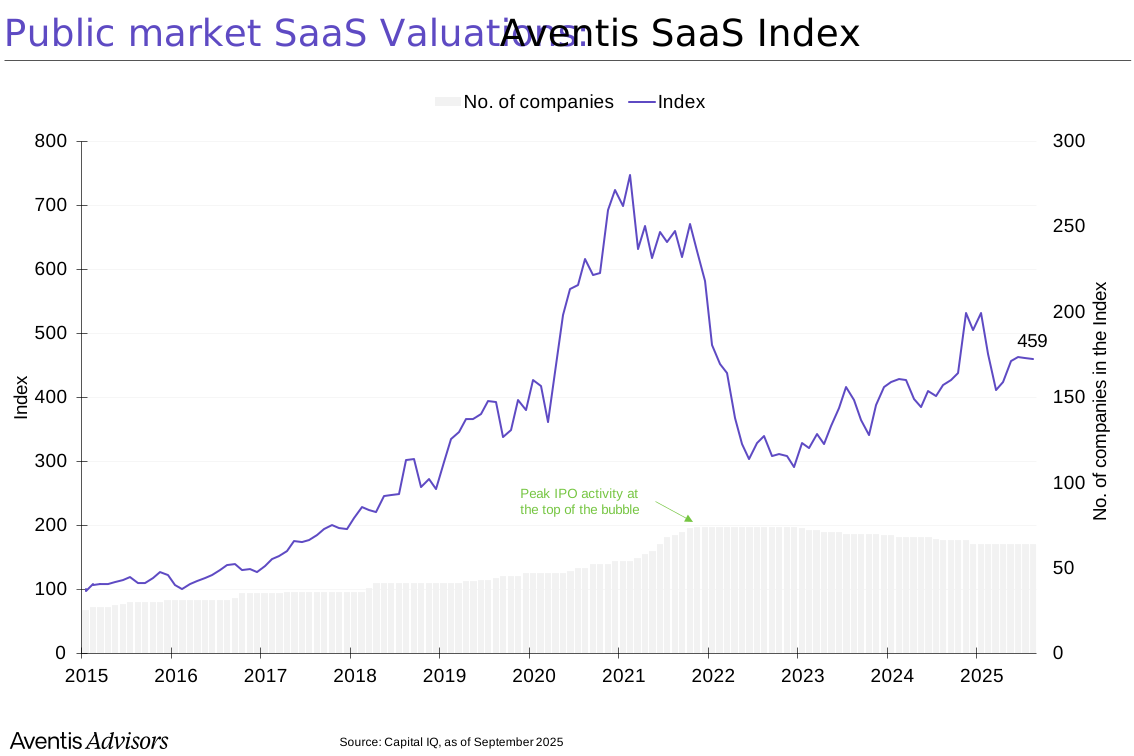
Growth slowdown: Median revenue growth hit 31% during COVID but has since dropped to 12.8% in Q2 2025, putting downward pressure on valuations.
Profitability push: Median EBITDA margins reached 7.5% in 2025, with investors rewarding efficient, cash-generating SaaS companies.
Rule of 40: Median score fell to 23%, but each 10-point improvement can add about 1.5× to revenue multiples, making it a critical benchmark.
Private M&A: More stable than public markets, with a long-term median around 4.7× EV/Revenue. Multiples dipped to 2.9× in 2024, but rebounded to 5.7× in 2025, mostly on larger $50M+ transactions.
Valuation drivers: Scale, durable growth, and defensible AI integrations are commanding premiums, while smaller SaaS firms with high burn face tougher scrutiny and tighter deal terms.
The SaaS boom-and-bust cycle has reset expectations. Going forward, efficiency, scale, and AI defensibility—not just top-line growth—will define premium valuations.
TOOL FOR FOUNDERS
📑 Startup Legal Pack: VC-Ready Docs in One Place
Messy or missing legal docs slow founders down and turn off investors.
The Startup Legal Document Pack gives you everything you need to incorporate, protect equity, and raise confidently.

What’s inside:
Incorporation docs & founder agreements
SAFE notes, term sheets, cap tables
Employment, IP, and advisor agreements
NDAs, privacy policies & customer contracts
Built with startup attorneys and VC teams. Investor-ready. Easy to use.
SOMETHING MORE
🧩 Frameworks & insightful posts
What makes $1M micro-SaaS ideas win?
Micro-SaaS = a focused SaaS product with pointy features for a very specific customer. Pat studied dozens of case studies and found common patterns behind the winners:

Ride trends or shifts
Growing trend → e.g. waitlist software (ReferralHero, $18K MRR).
Missed opportunity → Amazon FBA tools (Gorilla ROI, $40K MRR).
Change in the world → rise of personal brands → Tweet Hunter ($220K MRR & acquired).
Build on large platforms
Shopify (2M merchants), Amazon FBA (1.5M sellers), Twitter (100M+ businesses).
Example: WideBundle, a Shopify plugin for product bundling, $55K MRR.
Pointy solutions
Do one thing extremely well → not an all-in-one.
Example: Testimonial → embed video testimonials, $83K MRR.
Serve a narrow customer base
CyberLeads: only digital agencies targeting VC-backed startups ($40K MRR).
Gorilla ROI: not all FBA sellers, only spreadsheet/data-heavy ones.
Solve painful business problems
Every winning SaaS ties back to either → “we’re not making enough money” or “we don’t have enough time.”
$1M micro-SaaS ideas aren’t random — they win because they’re simple, built on big platforms, serve specific customers, and solve money/time problems. Start small, ship fast, and let the pointy feature lead you to growth.
How to launch your startup out of stealth?
Most founders overthink launches. They keep tinkering, waiting for “perfect,” and end up stuck in stealth. Claire Butler, Figma’s first marketer, says the opposite is true: momentum beats perfection.
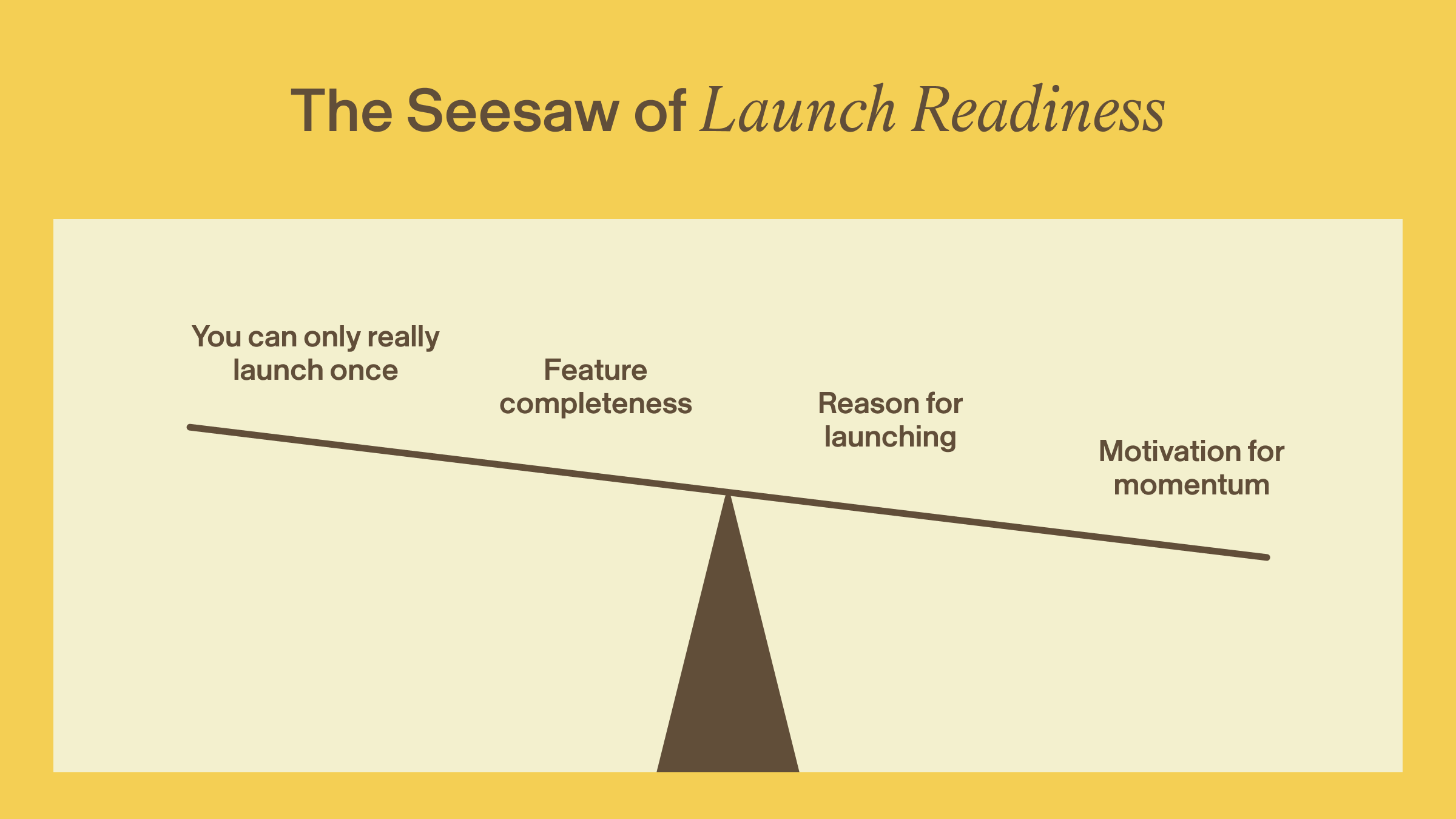
Here’s her framework for stepping out of stealth without stalling:
1. Set a date, even if it feels early
Don’t wait for every feature to be done—just reach “critical mass.”
Figma launched without multiplayer (its core feature) to avoid stagnation.
Rule of thumb: if you’re not slightly embarrassed, you’ve waited too long.
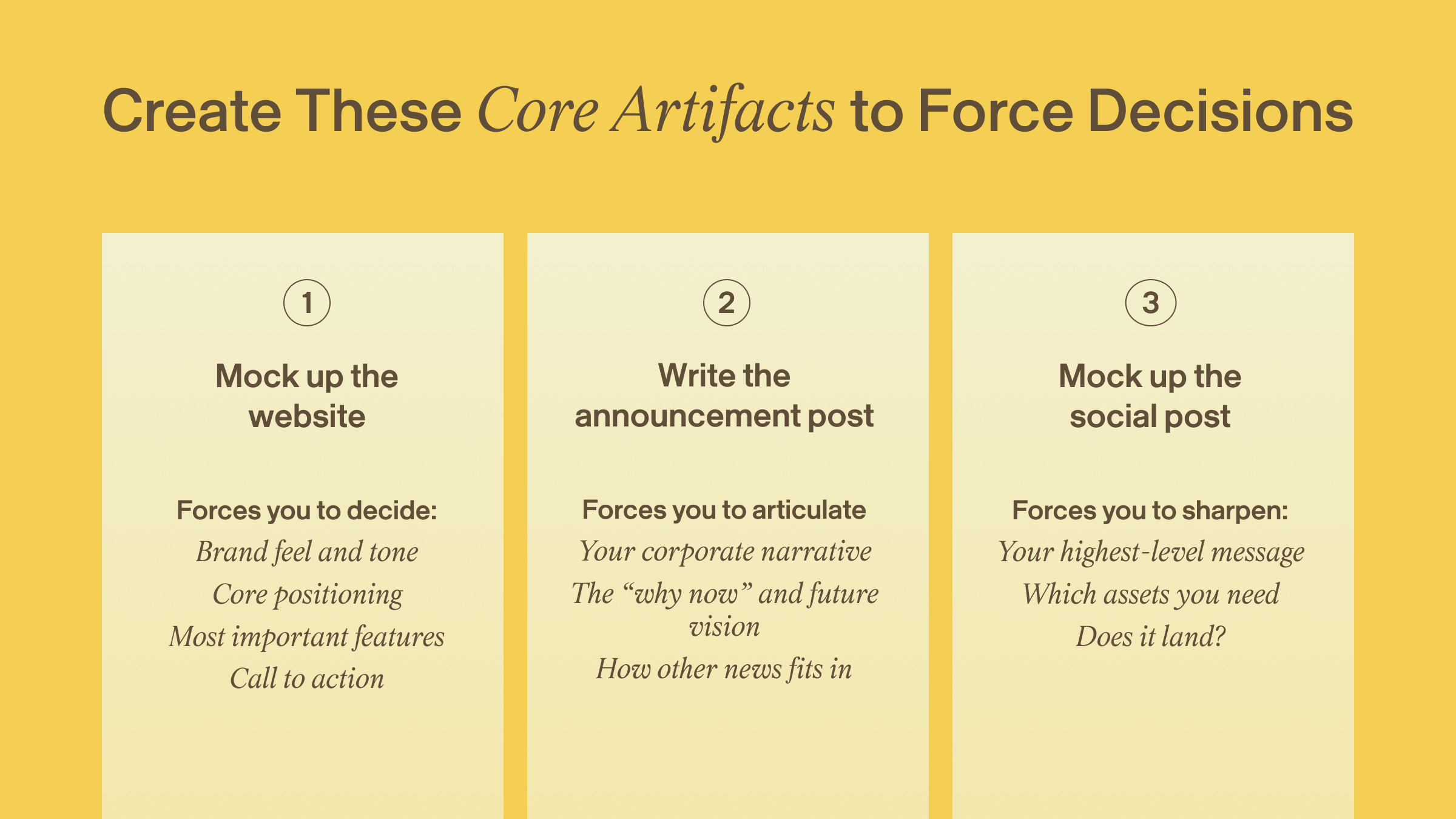
2. Create three forcing-function artifacts
Website: One homepage + about/careers. Define tone, positioning, CTA. (Waitlist vs sign-up vs talk to sales?)
Announcement post: Founder-written narrative → why you built it, why now, where it’s headed.
Social post: Distill it all into a single screenshot, video, or punchy tagline. If it feels fluffy, rewrite until it’s authentic.
3. Pick launch channels wisely
Focus where your ICP already hangs out (Reddit, Discord, LinkedIn, Twitter/X).
Use founder accounts to amplify first—brand handles start from zero.
Press is optional. Unless tied to funding, don’t waste time chasing exclusives.
4. Seed amplification before launch
Build a list: friends, beta users, influencers, your network.
Tell them when launch is, what you’ll need, and share links day-of.
Momentum spreads outward from your circle—plan it, don’t wing it.
5. Remember: launch ≠ finish line
Monitor replies, engage, and bookmark supporters for ongoing community building.
Don’t obsess over metrics too soon—track impressions, traffic, sign-ups, but focus on vibes + momentum.
A flashy launch ≠ product-market fit. The real game starts after.
A launch is a forcing function, not a final exam. Prep your date, artefacts, channels, and amplification. Then get out there; momentum matters more than perfection.
The unit economics Excel sheet template every founder should use.
Most founders talk about growth. Few can clearly show how each new customer makes or loses them money. That’s why running a unit economics model early matters; it tells you if your business will compound or collapse.

Here’s how to use the sheet I’ve shared:
1. Map your revenues
Enter your average revenue per unit (subscription, fee, or transaction).
Decide if it’s recurring (monthly/annual) or one-time.
Pro tip: if you don’t know exact numbers yet, start with estimates and refine over time.
2. Add cost of sales (COGS)
Enter costs as a % of revenue (hosting, delivery, support).
The sheet calculates your gross margin per unit automatically.
3. Plug in churn + growth assumptions
Set billing cycle (monthly = 1, annual = 12).
Add churn % (customers who drop each cycle).
Add expected annual margin growth (e.g., 5%).
The model uses these to estimate the average customer lifetime.
4. Add acquisition + retention costs
Enter your CAC (cost to acquire one customer).
Add optional retention/expansion costs if relevant.
5. Review key outputs
LTV (Lifetime Value): how much a customer is worth over their lifecycle.
LTV/CAC ratio: >3 is usually healthy.
CAC payback period: months it takes to earn back the acquisition spend.
Cumulative cash flows: show when you turn profitable per customer.
6. Stress-test scenarios
Increase churn by 30%.
Drop your AOV (average order value) by 20%.
Raise CAC by 50%.
See how fast LTV/CAC breaks. This is where most founders get surprised.
Why this matters
Investors use this as a quick sanity check.
It forces you to confront pricing, churn, and acquisition head-on.
A business with shaky unit economics will break no matter how good the growth story sounds.
Download the sheet, plug in your numbers, and run 3 scenarios: best case, expected case, worst case. You’ll instantly see whether your idea scales or needs fixing.
Writing a cold email that gets VC funding - advice from leading VCs.

Recently, Brett Adcock, the founder of Figure Robot, shared a tweet in which he listed several reasons why he believes cold emails work better than referrals.
Outbound cold email scales several orders of magnitude better than referrals - you can find 99.9% of anybody’s email.
Raising capital is a shots-on-goal game; you want to maximize top-of-funnel pitches. Optimizing your fundraising for referrals will put you at a local maximum.
It’s a challenge finding somebody who will stick their neck out to refer you. People rarely want to use their political capital referring you to a *highly important person* in their network, therefore at best you’re left with lousy double opt-in email.
Although I completely agree with these points, many founders struggle with writing cold emails to investors. Some founders even question whether investors open cold emails. Here’s what investors said:
Keith Rabois prefers a deck, and he reads most of them.
Aileen Lee or her partners read every email pitch that comes into Cowboy Ventures.
David Sacks of Craft prefers a short email pitch that summarises the opportunity.
Satya Patel of Homebrew reads everything sent to him


Jason (Founder of SaaStrfund) said - “I do get behind on email, but I love an amazing cold email and have funded maybe ~50% of my investments from them. I like an email pitch that is so amazing that I’d fund it just based on the email alone. “
So yes, is a perfect warm intro better? Yes. But even the top, most famous Seed VCs are hunting. Hunting unicorns and decacorns. And they can’t wait for them all to come from their networks.
Here’s the email from two startups to which Jason gave a million-dollar funding…
Email 1:
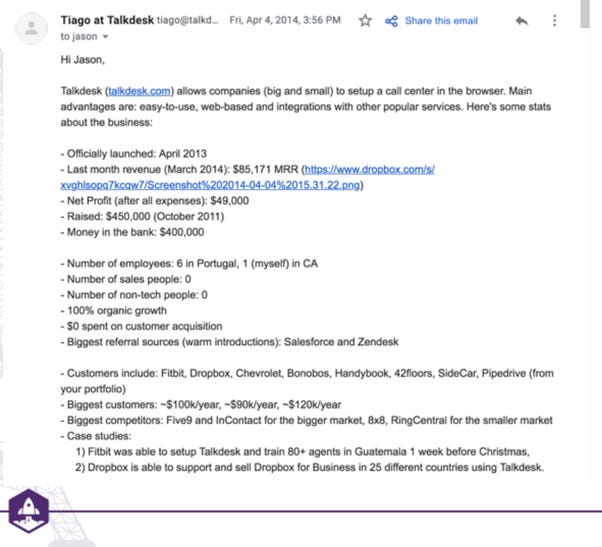
Email 2:
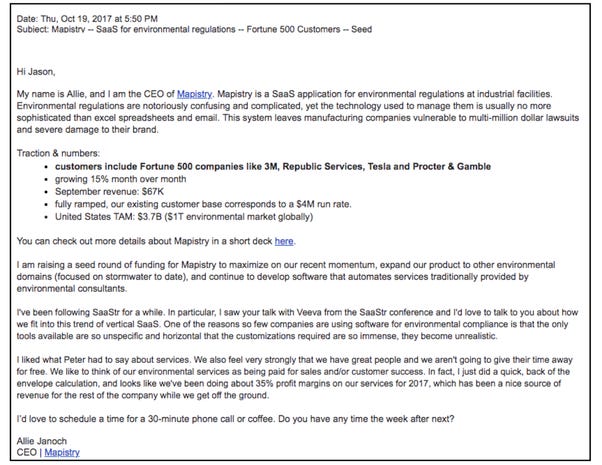
So put together the very, very best cold email you can. Make it awesome in every way. And send it to your top VCs. At least seed and probably Series A VCs, too.
They may not respond. But if it’s awesome, including the title, I bet they open it. And if it’s super awesome, you have a better chance than you might think of getting a meeting.
EXPLORE MORE
💡 Reports, Articles and a few interesting stuffs
How to define your actual target market, which probably isn’t traditional demographics and firmographics. (Link)
B2B Marketing in 2026: Distribution is the Monopoly. (Link)
The Right Way To Pitch VCs And Accelerators (And Why Most Founders Get It Wrong). (Link)
AI Investment Is Starting to Look Like a Slush Fund. (Link)
Why investors don’t care about your business. (Link)
The Mac App Flea Market. (Link)
Fund maths for dummies. (Link)
The quality of AI-assisted software depends on the unit of work management. (Link)
NEWS RECAP
🗞️ This week in startups & VC
New In VC
American Exceptionalism, a SPAC launched by VC Chamath Palihapitiya, has gone public with $345 million raised. (Link)
Better Tomorrow Ventures, a San Francisco-based fintech-focused VC firm, has closed its $140 million third fund. (Link)
Boost VC, a San Mateo, CA-based early stage venture capital firm, closed Fund 4, at $87M. (Link)
New Startup Deals
Significo, an Austin, TX-based health AI and digital therapeutics company, closed its Series B financing round of undisclosed amount. (Link)
DualEntry, a NYC-based provider of an AI-native ERP platform, raised $90m in Series A funding. (Link)
Mondoo, a San Francisco, CA-based agentic vulnerability management company, raised $17.5M in additional funding. (Link)
Gelt, a Miami, FL-based AI-native tax firm for high-earning professionals, raised $13M in Series A funding. (Link)
Datawizz, a San Franciso, CA-based company providing specialized language models (SLMs) as an alternative to large general-purpose LLMs, raised $12.5M in Seed funding. (Link)
Tato, a Montreal, Canada-based provider of an AI-native project platform purpose-built for system integrators, raised $5M Seed funding. (Link)
TODAY’S JOB OPPORTUNITIES
💼 Venture capital & startup jobs
All-In-One VC Interview Preparation Guide: With a leading investor group, we have created an all-in-one VC interview preparation guide for aspiring VCs. Don’t miss this. (Access Here)
Partner 22 - a16z | USA - Apply Here
ESG Intern - ESG Enterprise | UK - Apply Here
Senior Associate, Vertical AI - Primary | USA - Apply Here
Investment Analyst - Capital Oven | India - Apply Here
Capital Formation Associate - B Capital Group | USA - Apply Here
Trade Operations Lead - Manhattan Venture Partner | USA - Apply Here
VP of Fundraising - Scale Asia Venture | Japan - Apply Here
Research Analyst - Positive Sum | USA - Apply Here
Fund Operations Associate - TNB Aura | Singapore - Apply Here
Analyst - Nightdragon | USA - Apply Here
Valuation & Investment Data Analyst - Techstar | USA - Apply Here
Investment Analyst - Rocket Capital | India - Apply Here
Investor - AI Tools - Samsung next | USA - Apply Here
Associate - Venture Capital - Artha Venture Fund | India - Apply Here
Executive Assistant - AN Venture Partner | USA - Apply Here
Investor Relations Manager - Beco Capital | UK - Apply Here
Senior Associate - Strike Capital | USA - Apply Here
Investment Associate - Beco Capital | UAE - Apply Here
Head of Platform - Pledge Venture | UK - Apply Here
PARTNERSHIP WITH US
Get your product in front of over 95,000+ audience - Our newsletter is read by thousands of tech professionals, founders, investors and managers worldwide. Get in touch today.
🔴 Share Venture Curator
You currently have 0 referrals, only 5 away from receiving a 🎁 gift that includes 20 different investors’ contact database lists - Venture Curator