

👋 Hey, Sahil here! Welcome to this bi-weekly venture curator newsletter, where we dive into the world of startups, growth, product building, and venture capital. In today’s newsletter -
Deep Dive: What real traction looks like (before product-market fit happens).
Quick Dive:
GEO is the new SEO: What Founders need to know.
Understanding the investor thesis: the filter behind every ‘no’.
Major News: Nvidia hit with $8B revenue loss from H20 chip export ban, Telegram signs $300M xAI deal to integrate Grok, Apple rejected Elon Musk’s satellite offer, now its plans are in jeopardy & Meta loses 78% of original Llama AI team.
20+ VC & Startups job opportunities.
📬 VENTURE CURATORS’ FINDING
My favourite finds of the week.
Sam Altman's Guide to Startup Fundraising: What Really Works.
A Banner Year for M&A only Five Months In.
The Art of Evals: How Figma Put People at the Center of Its AI Product.
Making a Million-Dollar Product From a Dorm Room.
AI Hallucinations Are Getting Worse.
Building the agent economy: How cloud leaders are shaping AI’s next frontier.
8 venture-backed IPO candidates to watch in 2025.
State of VC-backed SaaS Startups in 2025.
Symptoms vs. problems: the trap every founder must avoid.
Need a pitch deck that gets investor meetings? We’ve opened just 3 slots to help founders craft winning decks built by experts and reviewed by investors. Don’t leave funding to chance[schedule a call today →]
CURATED RESOURCES FOR FOUNDERS…
🤝 The Ultimate Resource Hub for Founders…
Your startup’s first investor might already be in your inbox. You need the right pitch, the right email, and the right list of who to send it to.
We’ve curated the exact resources used by top VCs and breakout founders to raise millions:
Global investor contact databases (US, Europe, India, Africa, Latin America, France, Australia & more)
Pitch deck templates & storytelling guides
Early-stage startup financial models & projections (including SaaS models)
Cap table builder and investor CRM tracker
Legal doc packs, founder agreements, valuation templates, and term sheet guides. (Access here)
Competitor analysis frameworks & investor update templates
VC interview prep guides & data room checklists
Everything you need to pitch smarter, raise faster, and run your startup with confidence.
PARTNERSHIP WITH US
Get your product in front of over 95,000+ audience - Our newsletter is read by thousands of tech professionals, founders, investors and managers worldwide. Get in touch today.
📜 TODAY’S DEEP DIVE
What real traction looks like (before product-market fit happens).
You know that awkward “it’s kind of working” phase? Where the product’s not failing, but it’s not taking off either? Where every dashboard sort of shows progress, but nothing feels definitive?
Rob Go shared an insightful mental model (In 2016, still relevant today) for exactly this phase the shape of traction before product-market fit and it’s one every founder should understand.
Here’s the breakdown and my thoughts on this:
Most early-stage founders believe that the more you improve your product, the more traction you’ll get. And that sounds reasonable. If the product gets better, more people should use it, right?
In theory, this would show up as a straight line on a graph product quality on the X-axis, traction on the Y-axis.

But that’s not what happens in real life.
The actual shape of traction, especially before product-market fit, is more like an S-curve. In the beginning, you make improvements but only see a modest bump in traction. Then, if you’re on the right path, things suddenly start to click traction accelerates quickly.
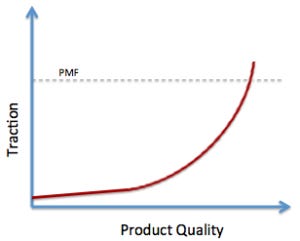
Eventually, growth levels off again once you hit saturation or diminishing returns. But the tricky part is the beginning, before the curve bends upward. That flat part is what traps so many teams.
The most dangerous part? You can squint and convince yourself that progress is happening. That you’re close.
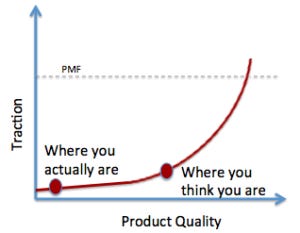
That one more feature or one more marketing push will tip the balance. You see a few signs of life users using the product, some positive feedback, maybe a handful of sales and you convince yourself PMF is just around the corner.
But what if it’s not?

Two common founder misreads often make this phase even more confusing.
First, many founders overestimate how polished or “complete” the product needs to be to generate traction. It’s incredible how often raw, even borderline broken tools get early love, if they’re solving something people truly care about. Founders worry too much about perfection. But real early adoption often happens in spite of flaws. If the pain is real, and your solution is fresh, people will use it.
Second, founders often underestimate how obvious it becomes when things start working. When you actually hit product-market fit, everything moves. Usage grows fast. Word-of-mouth spreads. Customers convert quickly. Money shows up in your Stripe account. You're hiring support and sales people just to keep up. It's not subtle. It doesn't require interpretation. You know it's happening. So if you’re sitting there wondering if you’re close to PMF, chances are, you’re probably not.
And that brings us to a better mental model. Most founders imagine they’re slowly climbing one S-curve and just need to keep going. But Rob suggests flipping the X-axis from product quality to time.

Because what actually happens for most companies is that you try one curve, it flattens, and then you jump to another. Each curve represents a new product idea, a new target audience, a repositioning, or a fresh attempt at traction. This isn’t about making slow steady progress on a single path. It’s about running experiments, resetting, and switching tracks until something clicks.
The takeaway here is critical: traction doesn’t usually happen on a continuous line it comes after a series of pivots, retries, and sharp learning loops.
So how should you navigate this phase if you’re still pre-PMF?
First, shorten the feedback loop. Don’t wait months to know if something is working. Run faster experiments. Measure quickly. Decide faster. Speed is your advantage here.
Second, stay lean. A large team increases burn and slows learning. It also makes it harder to pivot when you need to. You might have the money to hire fast — but don’t. Before PMF, you want focus, not scale.
Third, don’t stick to incremental changes if the curve is flat. If your current direction isn’t working, don’t keep tweaking the surface. Consider radical shifts a different customer segment, new pricing, a reworked core feature. Sometimes what you need isn’t polish it’s a reset.
Fourth, raise accordingly. If you haven’t found PMF, don’t raise with a mindset of scaling. Raise with the goal of learning. You’re not building a company yet you’re still finding out what kind of company to build.
This way of thinking is especially helpful for teams still figuring out their first real product-market fit. Everything that comes after scaling, hiring, optimizing plays out differently. But in the early days, the shape of traction is one of the few honest signals you have. It tells you where you actually are, not just where you want to be.
And the truth is, it’s often the rough, simple products that spark the strongest reactions. When you finally land on something that really works, you won’t have to overanalyze it. You’ll just know. It shows up in your users, your numbers, your gut.
Read originial article here: https://robgo.org/2016/09/07/the-shape-of-traction/
📃 QUICK DIVES
1. GEO is the new SEO: What Founders need to know.
For 20+ years, if you wanted people to find your company online, you learned the rules of SEO: keywords, backlinks, rankings. You played the Google game. And that worked, until now.
In 2025, the game is changing. Fast.
Search isn’t happening on browsers the way it used to. It’s happening inside models. People are asking ChatGPT, Claude, and Perplexity instead of Google. Apple is baking AI-native search into Safari. That’s a tectonic shift.
And with it comes a new playbook: Generative Engine Optimisation (GEO).
SEO helped you rank.
GEO helps you get remembered.
Classic SEO was about getting on the first page of search results. GEO is about getting mentioned in the answer itself, the paragraph ChatGPT gives your potential customer when they ask, “What’s the best waterproof winter jacket?”
In that response, is your brand even mentioned? If not, you're invisible.
Where SEO is optimised for Google’s algorithm, GEO is optimised for how LLMs think, how they synthesise, cite, and share information from across the internet.
LLMs don’t list. They reason. They remember. They compress. So instead of fighting to rank on page one, you’re now fighting to become part of the model’s memory.
GEO ≠ Gaming the system
This isn’t about hacks or stuffing keywords. It’s about building content and presence that earns you a place in the AI layer.
And here’s where the model era is different:
LLMs are paywalled, not ad-driven.
They’re personalised, not one-size-fits-all.
They summarise, not paginate.
That means brands need to think differently. You’re not bidding for ad slots or traffic. You’re trying to become a trusted reference, something the model brings up organically because you’re seen as legit.
So what matters in GEO?
You want to be cited by the model. That means:
Creating dense, well-structured content that models can parse.
Using summary formats, bullet points, and context-rich explanations.
Being referenced in authoritative sources and public knowledge bases.
This is about model relevance, not search rank.
We’re seeing the rise of platforms like Profound, Daydream, and Goodie that help brands understand how they’re showing up in model outputs and why.
Some startups are even fine-tuning their own mini-LLMs to simulate how major models think, allowing them to test prompts at scale and adjust content strategy accordingly.
Canada Goose did this. They weren’t just looking at traffic. They wanted to know:
“Does the model think of us when someone asks about premium winter jackets?”
That’s the new game: unaided model awareness.
From clicks to citations
You don’t need 10 blue links anymore. You need one line in the AI’s answer.
New metrics are emerging:
Reference Rate: how often you’re cited by LLMs.
Sentiment Memory: how you’re framed in model outputs.
Competitive Share of Voice in AI-generated responses.
Ahrefs has already launched Brand Radar to track mentions inside AI Overviews. Semrush is building an AI toolkit to monitor and improve your visibility in generative platforms.
This is SEO 2.0 but deeper, more dynamic, and closer to the conversion moment.
Early-stage? This is your edge.

For founders and growth teams, GEO is a first-mover opportunity.
Just like Adwords in 2003 or Facebook targeting in 2013, this is a new channel. The difference? The channel is the model.
And the model is becoming the new front door to commerce. If your startup isn’t present there, if the model doesn’t remember you, you’re not just missing traffic. You’re missing trust.
The startups that win will:
Understand how to create GEO-friendly content
Use new tools to monitor model perception
Adapt quickly as LLM behaviour evolves
GEO isn’t static. Every model update may change the rules. Just like Google updates used to wreck SEO rankings overnight, you’ll need to keep testing, tracking, and iterating.
This isn’t just about visibility. GEO is a wedge into something bigger:
Real-time brand management inside LLMs
Autonomous marketing loops that optimise messaging daily
Full-stack platforms that own the loop from monitoring to creation to response
The companies that get this right won’t just sell insights. They’ll become the channel itself.
Just like Shopify became more than a tool for e-commerce, the GEO winners will become the system of record for brand-model interaction.
In a world where AI answers everything, the real question for your startup is: “Will the model remember you?”
Because if it doesn’t, your next customer might not either.
Read the original article here: https://a16z.com/geo-over-seo/
2. Understanding the investor thesis: the filter behind every ‘no’.
Your pitch deck is tight. Your traction looks good. You're solving a real problem. So why did that investor still say no? It’s not always because your startup isn’t good enough. Often, it’s because you don’t fit their investment thesis.
An investment thesis is a VC’s internal filter — their “rulebook” for deciding what to fund.
Sometimes it’s formal (a PDF sent to LPs), other times it’s just an instinct they’ve honed over years. But it always exists.
VCs use it to raise money from their limited partners (LPs). If they veer too far off thesis, LPs get nervous. And nervous LPs mean no next fund.
Here’s what a typical thesis includes:
1. Check size + round size
“We invest $2M–$4M in $5M–$10M rounds.” If you're raising too little or too much, you're out.
2. Lead vs. follow
Some VCs lead (set terms, take board seats).
Others follow (join after someone else leads).
Many don’t have bandwidth to lead too many deals.
3. Business model
B2B: high-ticket sales to fewer customers
B2C: mass market, more users, smaller tickets
B2B2C: infra that powers someone else’s consumer play
Misalignment here can end the conversation fast.
4. Vertical focus
Some funds go deep in fintech, healthtech, AI, climate, etc.
Others avoid certain areas entirely (edtech, crypto, adtech, surveillance).
You may be a great company — just in the wrong space for them.
5. Ownership targets
“We aim to own at least 10–15% in every deal.” If your valuation or round structure doesn’t get them that, they may pass.
6. Founder background
Some funds back founders from certain alumni networks (e.g., Stanford, YC, ex-Stripe, etc.).
Some only invest in “underrepresented” founders by geography, race, gender, or background.
7. Geography
Some invest only in the US.
Some only in Europe.
Some anywhere, but still prefer proximity. Yes, location still matters even in 2025.
8. Market size & return potential
A $100M fund writing $5M checks expects each company could return the full fund (i.e., become a $500M–$1B exit).
If your company looks like a solid 3x return but not a fund-returner, that’s a pass even if it’s a great business.
So… what should you do as a founder?
Before reaching out to any investors, check out their website, oftern time you will find investmetn criteria on their website. If not then ask early.
A few simple questions can save you a lot of wasted time:
“What kinds of companies do you typically invest in?”
“Do we fit your thesis?”
“If not, is there one specific area where we don’t align?”
Founders often get rejected for the wrong reasons or worse, no reason at all.
Sometimes it’s a misunderstanding. Sometimes you just don’t fit the filter.
But when you understand how investors think and how tightly they stick to their thesis you can stop taking rejection personally… and start focusing on the investors who can say yes.
Remember, even the best pitch can fall flat when it’s aimed at the wrong target. So do your all research before reaching out to any investor.
THIS WEEK’S NEWS RECAP
🗞️ Major News In Tech, VC, & Startup Funding
New In VC
NYC-based VC firm Work-Bench has closed a $160M Fund IV to invest in seed-stage enterprise software companies. (Read)
Humain, the Saudi state-backed AI company, is planning a $10 billion venture fund named Humain Ventures to invest in startups across the U.S., Europe, and Asia. (Read)
Major Tech Updates
Apple claims to have prevented $2B in fraudulent transactions and blocked nearly 2M risky app submissions in 2024, part of $9B in fraud stopped over the past five years. (Read)
Eleven of the fourteen authors from Meta's foundational Llama paper have now left the company, raising questions about its AI talent retention and momentum. (Read)
Apple declined Elon Musk's 2022 demand for $5 billion upfront for exclusive SpaceX satellite connectivity on iPhones, leading Musk to partner with T-Mobile. (Read)
Tesla’s European sales fell 49% year-over-year in April despite the launch of a refreshed Model Y, signaling weakening brand strength. (Read)
Elon Musk’s xAI is partnering with Telegram to distribute its chatbot Grok across the messaging app for one year. (Read)
Chinese AI startup DeepSeek released an updated version of its R1 reasoning model on Hugging Face with a permissive MIT license for commercial use. (Read)
New Startup Deals
Alba Health, a Stockholm, Sweden-based gut health startup, raised $2.5m in seed funding. (Read)
Frinks AI, a Bangalore, India-based provider of a vision AI platform for manufacturing, raised $5.4M in Pre-Series A funding. (Read)
Pallet, a San Francisco, CA-based company behind CoPallet, the AI workforce for logistics, raised $27M in Series B funding. (Read)
Context, a Palo Alto, CA – based AI-native office suite, raised $11m in seed funding at a $70m valuation. (Read)
Creatify, a Mountain View, CA-based provider of an AI platform for video advertising, raised $15.5M in Series A funding. (Read)
Palla, a Miami, FL-based provider of a platform that enables instant cross-border payments for global financial institutions and fintech firms, raised $14.5M in Series A funding. (Read)
→ Get the most important startup funding, venture capital & tech news. Join 45,000+ early adopters staying ahead of the curve for free. Subscribe to the Venture Daily Digest Newsletter.
TODAY’S JOB OPPORTUNITIES
💼 Venture Capital & Startup Jobs
All-In-One VC Interview Preparation Guide: With a leading investors group, we have created an all-in-one VC interview preparation guide for aspiring VCs, offering a 30% discount for a limited time. Don’t miss it. (Access Here)
Senior Associate - M12 | USA - Apply Here
Staff Accountant - Energy Impact Partner | USA - Apply Here
Writer - First Round Capital | USA - Apply Here
Partner 32 - a16z | USA - Apply Here
Associate - Omerse Venture | USA - Apply Here
Investor (AI) - Samsung Next | USA - Apply Here
Senior Analyst - Chiratae Venture | India - Apply Here
Managing Director - Generator Accelerator | USA - Apply Here
Investment Analyst - Moonfire | UK - Apply Here
Investment Manager - Noba Capital | UK - Apply Here
Associate / Sr. Associate - Moneta Venture | USA - Apply Here
Investment Analyst - EXEO Fund | USA - Apply Here
Summer Investment Analyst - Red Beard Venture | USA - Apply Here
Investment Analyst - 12 Flag | India - Apply Here
Associate - Capital One Venture | USA - Apply Here
Corporate Venture Capital Fund - Thomson Venture | USA - Apply Here
Investment Manager - Techstar | USA - Apply Here
Chief of Staff & Head of Administrative Operations - Beyond Alpha Venture | USA - Apply Here
PARTNERSHIP WITH US
Get your product in front of over 95,000+ audience - Our newsletter is read by thousands of tech professionals, founders, investors and managers worldwide. Get in touch today.
🔴 Share Venture Curator
You currently have 0 referrals, only 5 away from receiving a 🎁 gift that includes 20 different investors’ contact database lists - Venture Curator