
👋 Hey, Sahil here - welcome to today’s edition of Venture Curator, where we break down how great startups grow, how top investors think, and what’s shaping the future of tech.
This one’s in partnership with Papermark - thanks to their team for sharing the data and customer stories that made this edition possible.
The deck’s ready, so you hit send. Then you can’t stop checking your inbox: did they open it, did they get three slides in and jump on a call, or close the tab in ten seconds? You don’t know, and you won’t, not unless you ask.
A week goes by. You send a “just following up” email into a silence that could mean anything.
I’ve seen this from both sides. Founders who can’t put their phone down for a week after sending. Investors who open the deck, skim it in under a minute, and move on without a second thought.
This is the real dark stretch of any raise, the days between sending and hearing back. I know this is right for almost every founder out there, and almost none of them can see what’s happening on the other side.
Papermark recently pulled the numbers on this across 24,541 pitch decks and 358,672 real investor views: anonymised data from decks sent through their platform.
A few of their numbers are worth sitting with before you send your next one.
44% - the share of investors who actually reach your last slide, which is usually where the ask lives. More than half never get there.
79% of founders send the exact same link to every single investor. So when that link shows “26 views,” there’s no way to know who any of those 26 people were.
Day 3 is when silence starts to mean something. A quarter of the decks are still unopened by then.
The strongest signal in the whole dataset isn’t a warm call - it’s an investor coming back to reopen the deck, or downloading it. Only 18% of founders even have download tracking turned on, so most never see this signal at all.
Check your own deck against these before you read on: the typical opened deck gets 5 views, not the 26 you’d guess from the average. Total reading time across a deck runs about 18 minutes; decks that go on to close a round get almost double that, at 36 minutes.
The sweet spot for length is 9 to 16 pages, and the single best exact length is 12. And financials hold above-average attention when investors reach that slide, yet 6 out of 10 founders leave it out entirely.
None of this is a slide-writing problem. It’s the fact that your raise is happening in a room you can’t see into, and the only real fix is being able to see into it.
That’s the entire premise behind Papermark: tracked sharing and page-by-page analytics on a free plan and a full data room with NDA gating and watermarking once things get serious enough to need it. Skip the feature list, though.
Here’s what three very different founders actually did with that visibility -
Oscar tested 10 data rooms before he trusted one with his raise
Oscar Levy is building River Markets, a prime brokerage for prediction markets. Before he sent a single deck, he signed up for ten different data room tools and ran the identical test on each one: same files, shared the way he’d actually share them with a real investor.
Once he picked Papermark, he used the page-by-page analytics the way an operator reads a dashboard. Slides that consistently held investor attention stayed in the deck. Slides that got skipped got cut or rewritten.
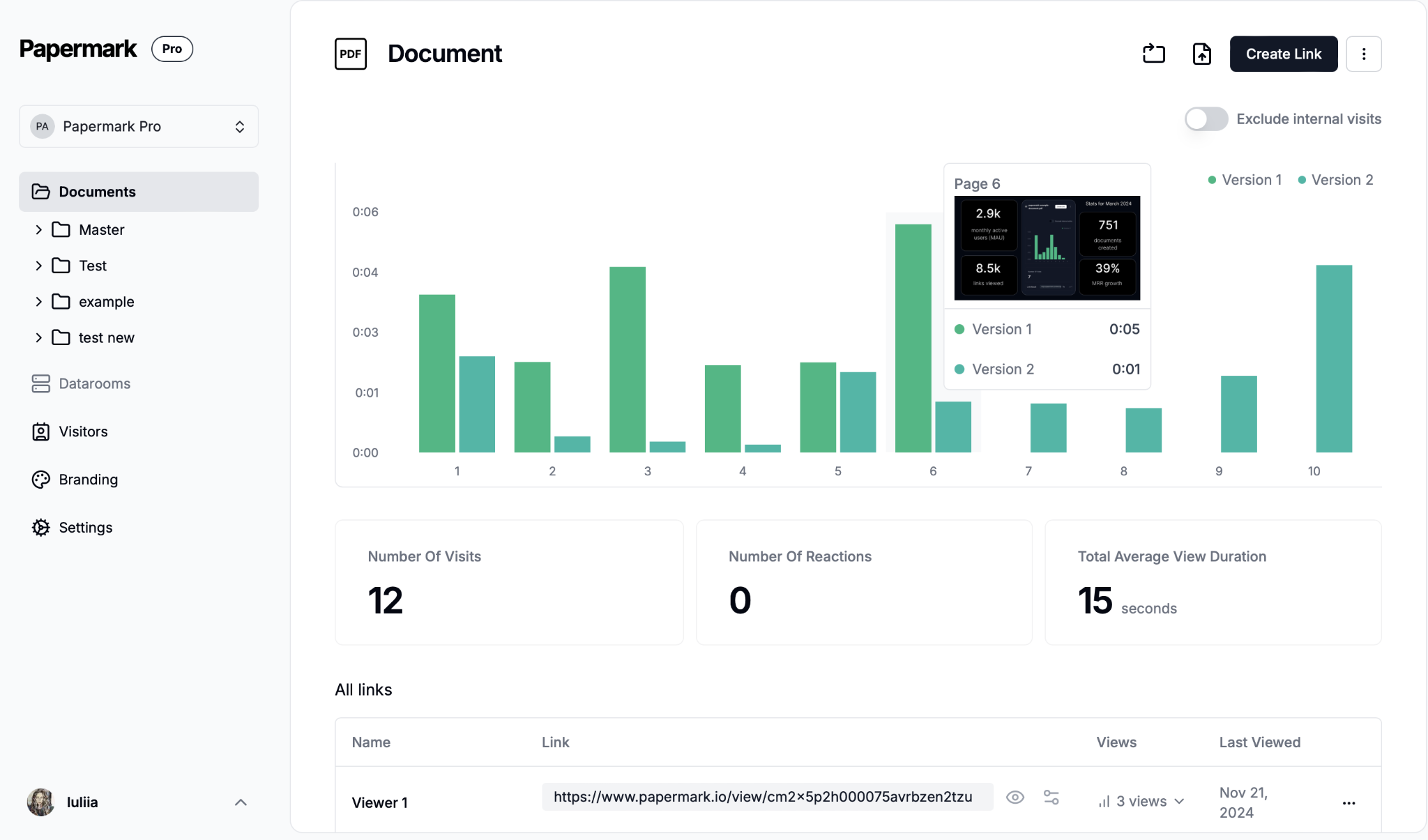
Follow-ups went out the moment a repeat view came in, not on a fixed weekly cadence. His words: it was “extremely good to see which slides were eye-catching or boring.”
River Markets closed an $8.5M seed round led by Haun Ventures, with several other funds and angels from Google, Nvidia and Citadel participating.
George’s raise took 9 months. His data room outlived it entirely.
George Catinean co-founded LaDepozit, a self-storage operator. His raise wasn’t a two-week sprint - it was a 9-month private round, with site economics and the build-out plan shifting the entire time, and a team of ten people with zero spare hours for document logistics.
He started on Papermark’s open-source, self-hosted version, because he’s an engineer and figured he could run it himself. It didn’t stick.
In his words: “It’s worth paying for a good data room and not having a headache.” He moved to the paid product, used granular permissions to open more of the room as each investor’s conviction grew, and closed €1.5M.
The part I actually like most: the round closing didn’t end the data room’s job. LaDepozit still uses that same room today for investor updates and earnings calls. It’s not archived - it just changed jobs.
Martin needed to know the moment a conversation was actually starting
Martin Patz runs Differential Bio, a Munich biotech startup using AI and lab automation to de-risk bioprocess scale-up. Sensitive IP, sensitive data, and a small team meant he couldn’t afford to guess when to follow up. He set up Papermark’s webhooks to fire the instant an investor engaged with the materials, instead of checking a dashboard every hour.
He raised a €2M pre-seed round led by Ananda Impact Ventures and ReGen Ventures, and credits the tracking directly: “Papermark’s tracking features were instrumental in our fundraising success.”
Oscar’s fast rules for anyone raising right now
A few things Oscar said he’d tell any founder starting a raise today, and none of them are about the tool itself:
Be clear about what you do and where the money goes. Ambiguity is the most expensive thing in a deck.
Investor sequencing matters more than people admit. Who you talk to first changes the outcome of the round, not just the speed.
A small angel check can lead to a much bigger intro. Who’s writing matters more than the size.
Track what happens after you send. Knowing which slides actually landed is the difference between guessing and iterating.
What this actually looks like once you set it up
Twenty minutes. Most of it is just breaking the habit of attaching a PDF instead of sending a link.
Free plan, no card needed. Send a tracked link, one per investor. Not a rule, just math: the second two investors share a link, “26 views” tells you nothing.
Turn notifications on. 92% of founders in Papermark’s own data already do this. It’s the whole difference between a same-day follow-up and a guess two weeks later.
Once the deck has real numbers, a cap table, unreleased traction, or you’re raising a bigger round and an investor asks for more than just the deck, it’s time to move up to a full data room. The NDA sits before the first page loads, gets timestamped and saved automatically- no chasing anyone for a signature. Watermark and per-investor folders live here too, same setup George used at LaDepozit.
When the round closes, don’t archive it. LaDepozit’s room is still open right now, just doing investor updates instead of a raise.
None of this fixes a weak pitch, and it won’t warm up a cold list. But if your deck is good and your list is warm, this is the difference between wondering why someone went quiet and actually knowing.