


👋 Hey, Sahil here - welcome to today’s edition of Venture Curator, where we break down how great startups grow, how top investors think, and what’s shaping the future of tech.
P.S. Get access to 100+ startup & VC resources, investor databases, fundraising templates, 150+ premium archive posts and exclusive startup research - all in one place.
FROM OUR PARTNER - ALTS
Film Studios Wait on Tax Credits, You Get Paid

Everyone’s chasing AI. Meanwhile, a quiet corner of the market keeps delivering - film bridge lending.
Studios sit on millions in approved tax credits they can’t access yet.
Bridge lenders step in, fill the gap, and get repaid when the deal closes.
These are not complicated structured products. They’re simple, 12-week asset-backed loans for productions that are already greenlit. It’s boring. It works.
If you’re an accredited investor looking for uncorrelated yield, this is worth your attention.
WORK WITH US
🤝 Partnership With Us
Get your product in front of over 125,000+ audience - Our newsletter is read by thousands of tech professionals, founders, investors and managers worldwide. Get in touch today.
📜 DEEP DIVE
What should your AI spend actually be measured against?
Ask most founders what they spend on AI, and they’ll give you a number without blinking. A few thousand dollars a month - some ChatGPT and Claude seats, a Cursor bill, an API line that’s been creeping, a couple of tools the team swears by. It sounds precise. It isn’t.
The question “what are we spending on AI?” produces a genuinely meaningless answer, because it adds together three unrelated kinds of spending that happen to share a vendor category. It’s like asking “what are we spending on electricity?” and lumping in the office lights, the product servers, and the salary of the person you didn’t hire because a machine does their job now.
The data: 70,000 companies, one cliff
Ramp sees actual payments across more than 70,000 US businesses - not surveys, money leaving accounts.
The median company spends $11.38 per employee per month on AI.
The top 10% spend $611.
The top 1% - what Ramp’s economists call “AI-pilled” - spend $7,449 per employee per month, growing 14.1% month over month.
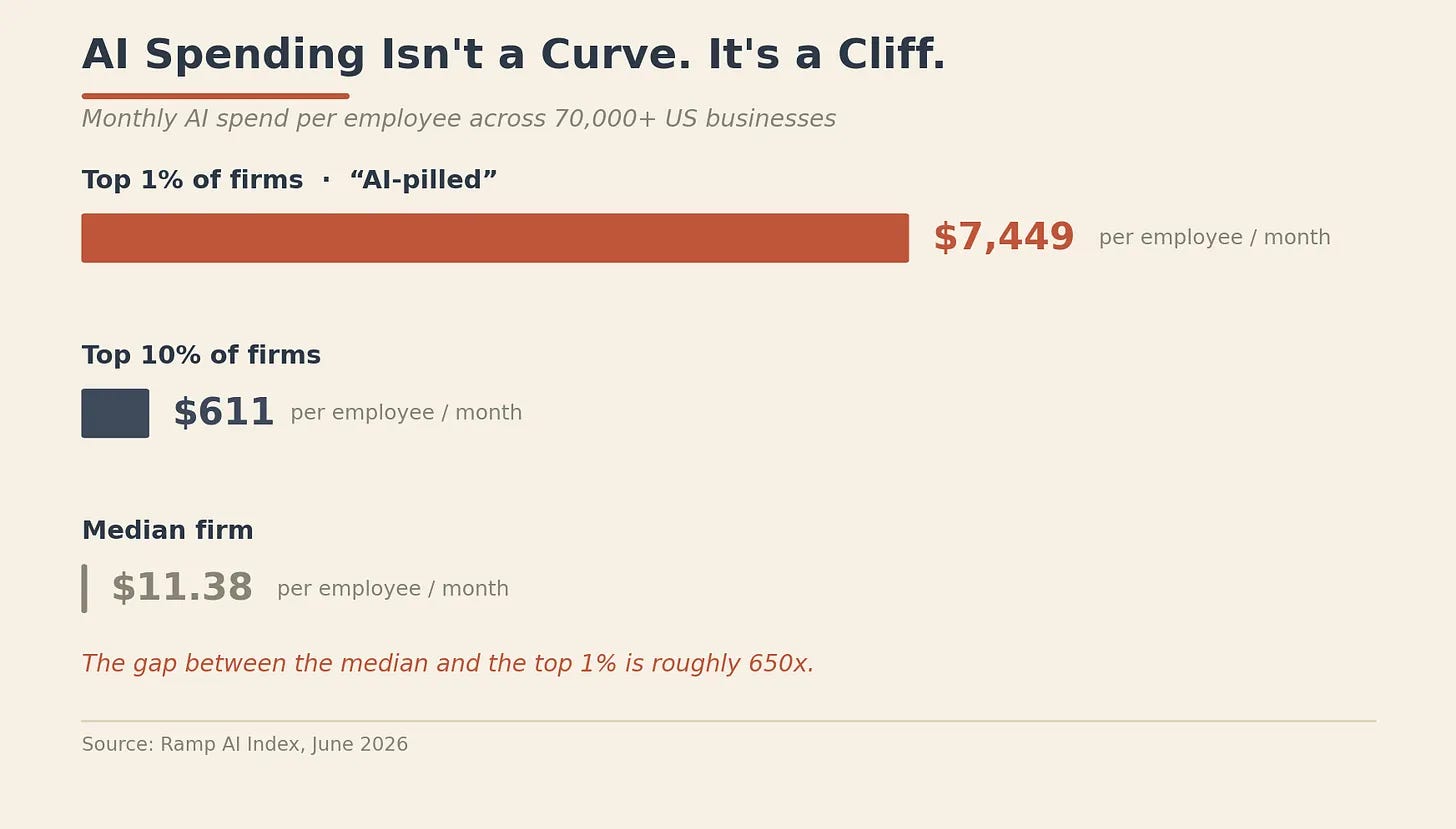
That’s not a bell curve with a long tail. It’s a cliff - a roughly 650x gap between the median and the top.
“Using AI” has split into two economies: a small group treating it as a core input to production, and everyone else buying subscriptions. Kruze Consulting’s data across 1,000+ venture-backed startups shows the same pattern from the inside - the average AI line item nearly tripled in 18 months, from $2,000/month in early 2023 to $5,000-6,000 by 2024, and almost nobody restructured how they account for it.
Dabbling returns nothing. Literally nothing.
Ramp linked its payment data to Revelio Labs’ workforce records across 21,559 companies - the first study to connect actual firm-level AI spending to what happened afterwards.
Companies that adopted AI grew headcount 10.2% over the next two years, entry-level hiring up 12%, gains spread across sales, admin, finance, and customer service.
But the gains belonged entirely to high-intensity adopters.
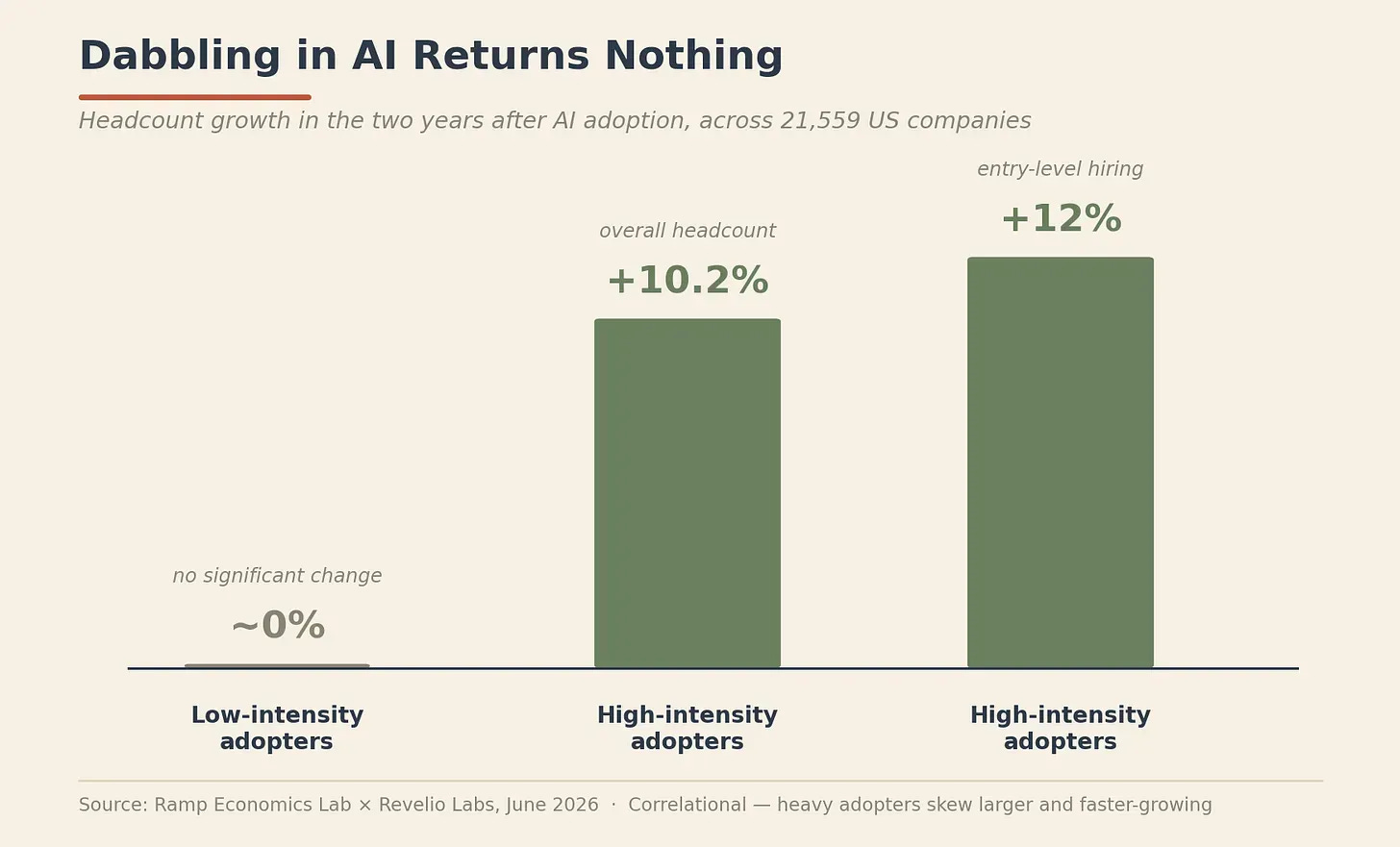
Low-intensity adopters - companies technically “using AI” but spending little per employee - showed no significant change at all. The $200-a-month, few-seats, we’re-experimenting posture - the one the median $11.38 represents - is indistinguishable from doing nothing.
So: spend more. On what? This is where nearly every founder makes the same mistake - not a spending mistake, an accounting one. The question “are we spending enough” can’t be answered while AI is one line in your head. Most founders are benchmarking that number against their software budget. For the part of the spend that actually matters, that’s the wrong denominator entirely.
The rest of this issue:
The denominator error - the number your AI spend should actually be judged against (it’s not your software budget).
The three budgets - the sort that shows where you’re overspending and where the returns actually live.
The kill-criteria - the cancellation signal from 70,000 companies that tells you a tool failed before you’ve admitted it.
The 30-minute audit - run it on your own statements this week and find the $500–$2K/month you’re burning on nothing.