

👋 Hey, Sahil here - welcome to today’s edition of Venture Curator, where we break down how great startups grow, how top investors think, and what’s shaping the future of tech.
P.S. Get access to 100+ startup & VC resources, investor databases, fundraising templates, 150+ premium archive posts and exclusive startup research - all in one place.
FROM OUR PARTNER - SEMRUSH
Search has changed. Has your SEO strategy?

Ranking on Google is still important.
But today’s buyers also discover companies through ChatGPT, Gemini, AI Overviews, and other AI-powered search experiences.
Semrush One helps you track both worlds from a single platform. Monitor your SEO performance, measure AI visibility, identify competitive gaps, and discover new growth opportunities before your competitors do.
If your goal is to stay visible wherever customers are searching, this is worth exploring.
Try Semrush One free for 7 days →
WORK WITH US
🤝 Partnership With Us
Get your product in front of over 125,000+ audience - Our newsletter is read by thousands of tech professionals, founders, investors and managers worldwide. Get in touch today.
📜 DEEP DIVE
What are VCs really asking AI founders during due diligence? (And what you’re expected to show).
Over the last few weeks I’ve been talking to investors actively writing checks into AI companies. Not the growth people putting $50M into a Series C. The ones doing $400K to $4M into companies that are nine months old - four people, one paying customer, a demo that works about 80% of the time.
I asked all of them the same question: what are you asking now that you weren’t asking a year ago?
Everyone had an answer ready. Several pulled up an actual list.
One described a call where the founder had answered everything on market, team and traction well - genuinely well and then got asked what happens to his product when the next frontier model ships the feature he’d built the company around. The founder said they’d move faster than the model companies. The partner wrote three words in the memo. The deal died in a week, and the founder still thinks he lost it on valuation.
Another now asks to see the eval harness run live, in the meeting. She said maybe one in fifteen companies can do it.
This isn’t a stylistic shift. There is a whole new section of AI diligence; it has five distinct parts, and most founders raising right now have never seen the questions in it - let alone built the documents it expects.
So they gave me the questions. All of them.
Why it changed this fast
The money got easier, and the diligence got harder at once. Same cause.
AI crossed 50% of all pre-seed dollars in Q1 2026, up from roughly 30% a few years ago. When one category absorbs that much capital, a fund can’t differentiate on category anymore - only on which company inside it. The only lever left is forensics. Carta now puts the AI Series A threshold near $3.5M ARR, roughly triple where it sat three years ago, and ICONIQ puts average AI gross margin at 52% - inference alone eating around 23% of revenue.
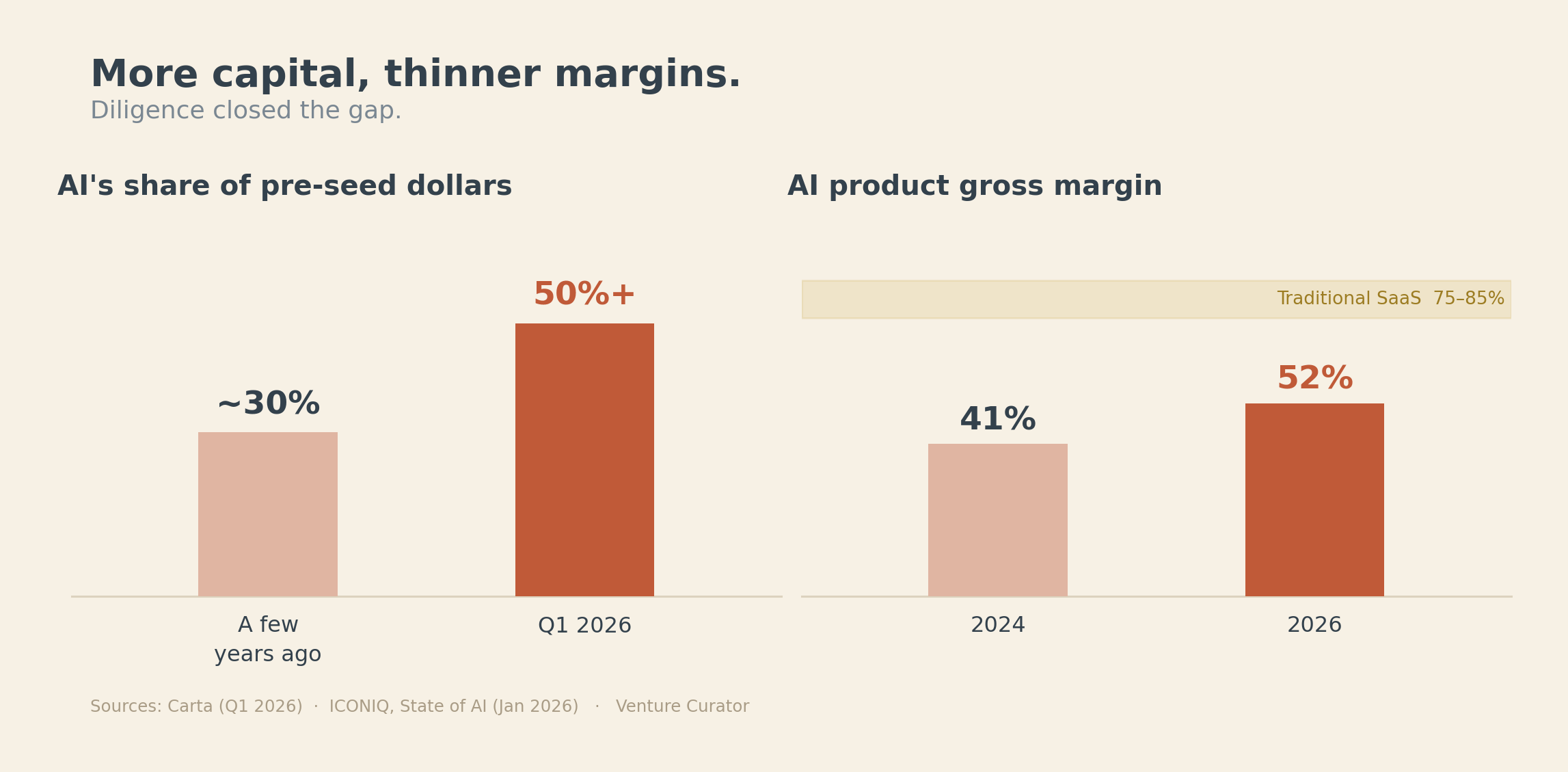
Every investor knows that last number. So when you say “software margins,” they don’t hear a business model. They hear a claim that needs a spreadsheet behind it.
The actual shift: they stopped wanting answers
Old diligence tested your narrative. AI diligence tests your artefacts. Not what you say about data rights - the inventory. Not your accuracy claim - the harness. Not your margin story - the waterfall.
One investor put it plainly: the default assumption on any AI company is that it’s replicable in a weekend, and the founder carries the burden of proof. A verbal answer no longer discharges that burden. A file does.
Which is why founders keep failing questions they could answer fine in conversation. The question isn’t “what’s your gross margin.” It’s “open the model.” And the tell isn’t a wrong number - it’s the pause before someone says they’ll follow up over email.
The follow-up arrives four days later. By then the memo is written.
What’s inside today’s deep dive -
All 21 questions, in five blocks. For each: how it gets asked, what’s actually being tested, the answer that quietly ends the conversation, how to answer it well, and the document you’re expected to open.
Model dependency - 4 questions. The block that kills the most deals. Founders answer it with confidence, and the confident answer is the fatal one.
Data rights - 4 questions. Where the moat you described twenty minutes earlier quietly evaporates.
Evaluation - 5 questions. One in fifteen companies can do the thing asked here. The other fourteen find out live.
Inference economics - 5 questions. There’s a specific month coming that most founders haven’t modelled.
Deployment and exposure - 3 questions. Everyone read the AI Acts headline. Almost everyone read it wrong.
Plus the self-test with scoring, a stage triage for pre-seed versus Series A, the data room structure to build before your first meeting, and the one move that flips diligence from evaluation to closing.
Before you start
Don’t dump the artefacts. The point of building the file isn’t to send it - it’s that having built it changes what comes out of your mouth. Founders who’ve done the work answer in specifics. Founders who haven’t answer in adjectives.