

👋 Hey, Sahil here - welcome to today’s edition of Venture Curator, where we break down how great startups grow, how top investors think, and what’s shaping the future of tech.
P.S. Get access to 100+ startup & VC resources, investor databases, fundraising templates, 150+ premium archive posts and exclusive startup research - all in one place.
FROM OUR PARTNER - ALUMNI VENTURE
Exclusive: Invest in High-Potential Startups Like These

Alumni Ventures is offering readers early access to high-potential startup opportunities, including some of today’s most exciting AI, Deep Tech, Quantum Computing, Cybersecurity, and Space companies co-invested alongside top VC firms like Andreessen Horowitz (a16z), Bessemer, & Y Combinator.
You get:
Curated deal flow of high-potential startups
Invest alongside elite lead venture firms
No cost to see deals
No obligation to invest
WORK WITH US
🤝 Partnership With Us
Get your product in front of over 125,000+ decision-makers - our newsletter is read by thousands of tech professionals, founders, investors and managers worldwide. Get in touch today.
📜 DEEP DIVE
You’re benchmarking your AI spend against the wrong number (The data just proved it).
At some point in the next quarter, someone on your board is going to ask what you’re spending on AI.
You’ll pull the number. It’ll be a few thousand dollars a month - some ChatGPT and Claude seats, a Cursor bill, an API line that’s been creeping, a couple of tools someone on the team swears by. You’ll say the number.
Someone will nod and say it seems reasonable. And the conversation will move on, because nobody in the room - including you - has any idea what “reasonable” means.
Here’s the uncomfortable part: the question can’t be answered in the form it was asked. “What are we spending on AI?” produces a genuinely meaningless number, because it adds together three completely unrelated kinds of spending that happen to share a vendor category. It’s like asking “what are we spending on electricity?” and including the office lights, the product servers, and the salary of the person you didn’t hire because a machine does their job.
This issue is about fixing that - with the best spending data that exists, and a framework for reading your own statement that most founders have never applied. By the end, you’ll run a 30-minute audit on your last three months of card statements and know, with actual confidence, whether your AI spend is working. Most founders who run it find the same thing: they’re overspending on the bucket that returns nothing and underspending on the one that compounds.
The data: 70,000 companies, one cliff
Ramp sits in an unusual position. As a corporate card and bill-pay platform, it sees actual payments - not surveys but money leaving accounts. Its AI Index tracks this across more than 70,000 US businesses, and last month it published the number that should reframe every AI budget conversation you have this year.
The median company on Ramp spends $11.38 per employee per month on AI. That’s one enterprise seat.
The top 10% of companies spend $611 per employee per month.
And the top 1% - the companies Ramp’s economists call “AI-pilled” - spend $7,449 per employee per month, a figure growing 14.1% month over month.
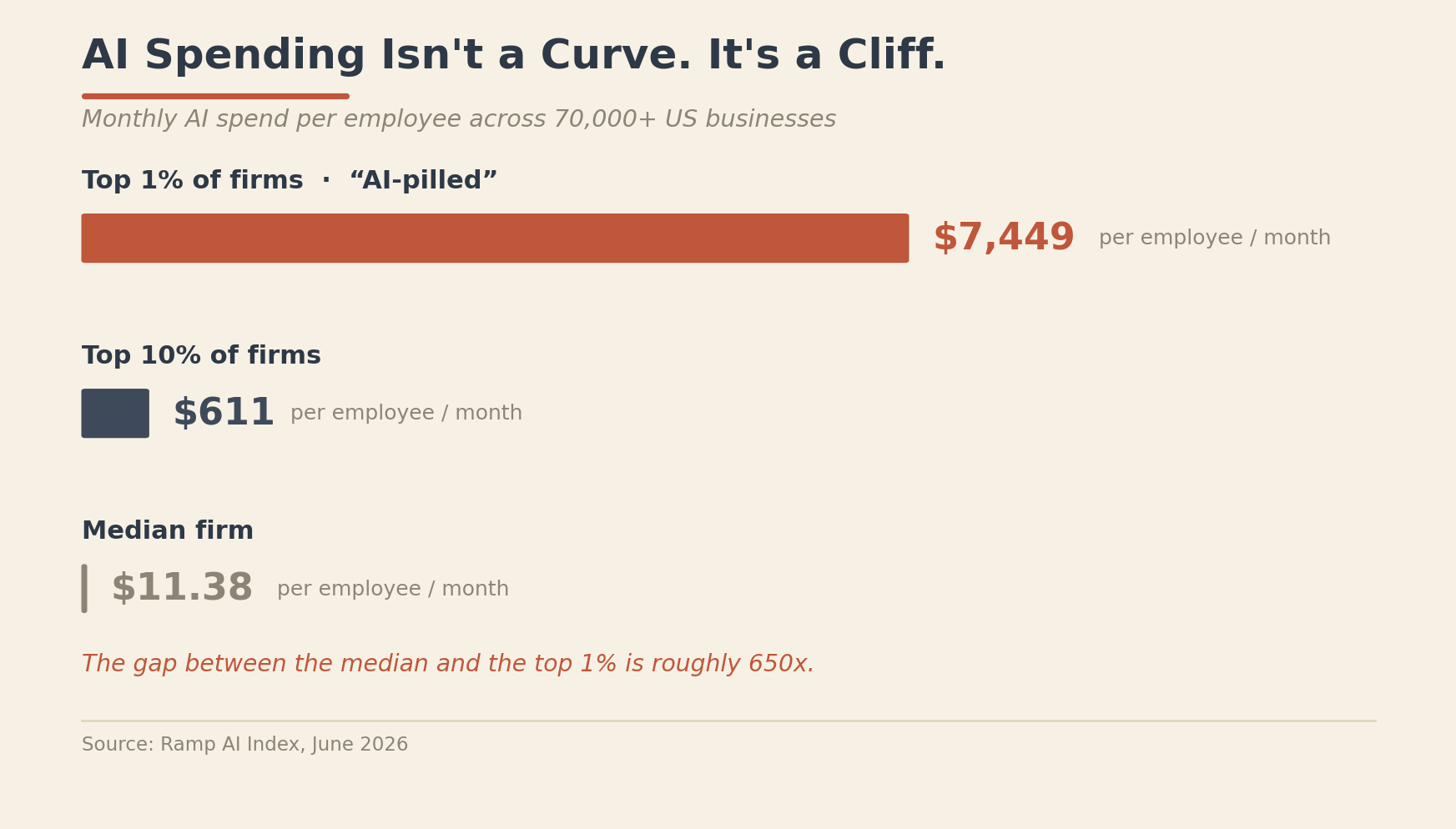
Read that distribution again. It’s not a bell curve with a long tail. It’s a cliff - a roughly 650x gap between the median and the top. Adoption is no longer the story; Ramp itself has stopped treating “does this company use AI” as an interesting question and rebuilt its entire index around intensity, because nearly everyone now pays for something.
The story is that “using AI” has split into two economies: a small group treating it as a core input to production, and everyone else buying subscriptions.
Startups sit somewhere in the middle of this picture. Kruze Consulting’s data across 1,000+ venture-backed startups shows the average AI line item climbing from about $2,000 a month in early 2023 to $5,000-6,000 by 2024, and roughly 70% of startups paying for at least one AI tool. The line item nearly tripled in 18 months and almost nobody restructured how they account for it.
So far, this could just be an interesting distribution. Here’s where it becomes a warning.
Dabbling returns nothing. Literally nothing.
In June, Ramp’s economics team linked its payment data to Revelio Labs’ workforce records across 21,559 US companies - the first study to connect observed firm-level AI spending (not surveys) to what actually happened to those companies afterwards.
The finding:
Companies that adopted AI grew headcount 10.2% over the following two years, with entry-level hiring up around 12%.
Growth, not layoffs - the companies spending seriously on AI were expanding, and the gains showed up across sales, admin, finance, and customer service, not just engineering.
But that’s not the finding that matters for you. The finding that matters is in the split:
Those gains were entirely driven by high-intensity adopters. Low-intensity adopters - companies that technically “use AI” but spend little per employee - showed no statistically significant change at all.
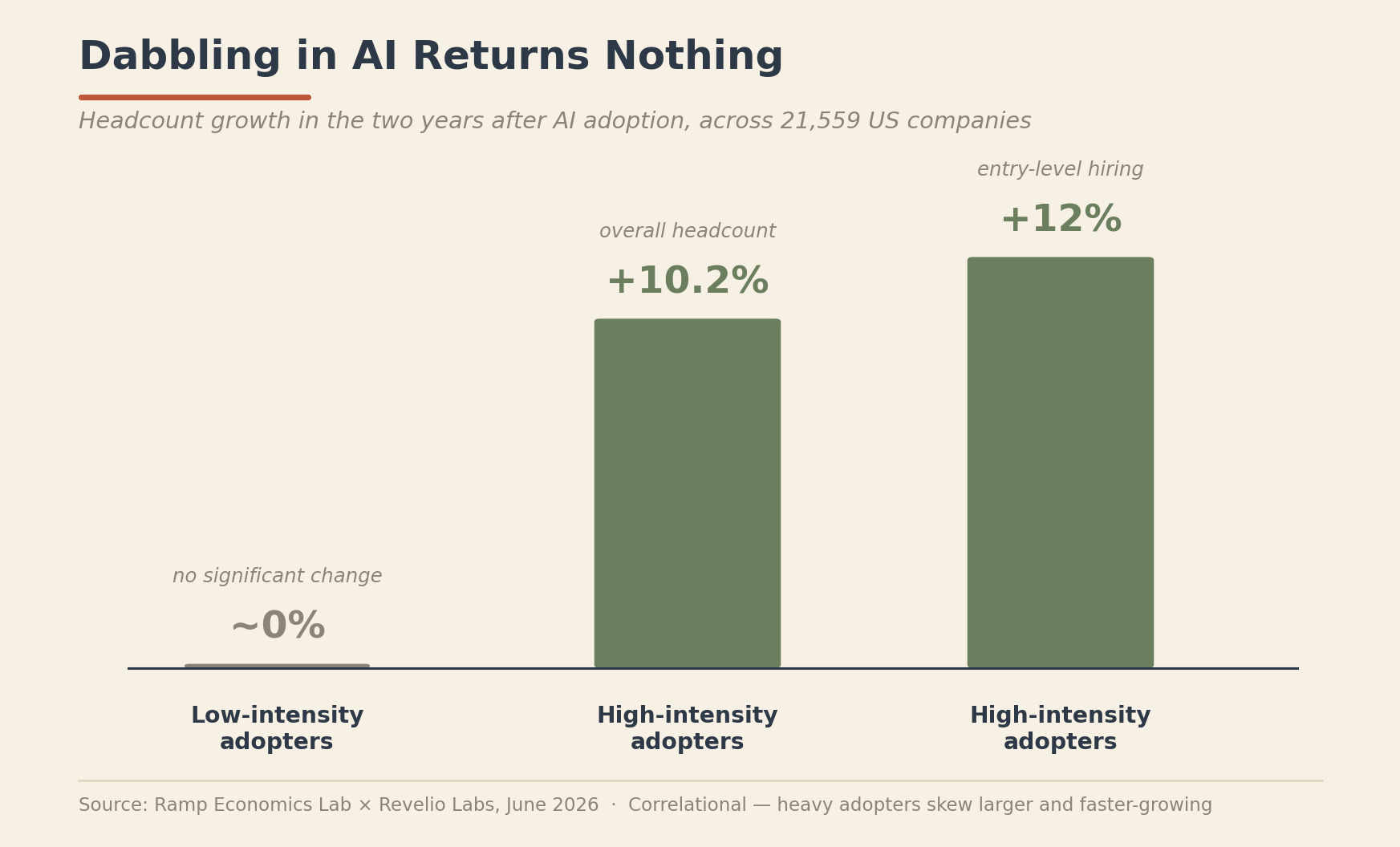
The honest caveats: this is correlation, not causation - heavy adopters were already larger, more technical, and faster-growing, and the gains took 6-12 months to show up, because integrating AI into real workflows takes time. But even read conservatively, the data kills the most common startup AI posture stone dead.
The $200-a-month, few-seats, we’re-experimenting position — the one the median $11.38 represents - is indistinguishable from doing nothing. There is no measurable dividend for dabbling. The returns live entirely at intensity.
Which creates an obvious question: fine - spend more. On what? Cursor seats? API credits? That vertical sales tool the team wants? More Claude?
And this is where nearly every founder makes the same mistake. Not a spending mistake - an accounting mistake.
Because the question “are we spending enough on AI?” cannot be answered while “AI” is one line in your head.
You’re benchmarking the number against your software budget. And for the part of your AI spend that actually matters, that’s the wrong denominator entirely.
The rest of this issue:
The denominator error - the number your AI spend should actually be judged against (it’s not your software budget).
The three budgets - the sort that shows where you’re overspending and where the returns actually live.
The kill-criteria - the cancellation signal from 70,000 companies that tells you a tool failed before you’ve admitted it.
The 30-minute audit - run it on your own statements this week and find the $500–$2K/month you’re burning on nothing.