
👋 Hey, Sahil here - welcome to today’s edition of Venture Curator, where we break down how great startups grow, how top investors think, and what’s shaping the future of tech.
P.S. Get access to 100+ startup & VC resources, investor databases, fundraising templates, 150+ premium archive posts and exclusive startup research - all in one place.
FROM OUR PARTNER - SEMRUSH
Your buyers don’t just search Google anymore.
I’ve been looking at how search is changing, and this is probably the biggest shift marketers need to pay attention to.
People still use Google, but they’re also discovering products through ChatGPT, AI Overviews, and other AI tools. Semrush now lets you track both from one place.
You can see where your brand ranks in search, how often it appears in AI answers, where competitors are gaining visibility, and what may be holding your site back.
Partnership With Us
Get your product in front of an audience of 125,000+ - Our newsletter is read by thousands of tech professionals, founders, investors and managers worldwide. Get in touch today.
📜 DEEP DIVE
Which AI categories did investors fund and then abandon? An analysis of fund flows vs shutdowns by category, 2021 to 2026.
I’ve had a couple of calls with VC friends over the last week, and one thing came up in both that I haven’t been able to stop thinking about.
Neither of them is really evaluating AI SDR companies anymore. One told me he’d got a deck that morning and just didn’t open it. When I asked why, he said the category already showed him how it ends, so the deck wasn’t going to change much. The other said something similar about a couple of categories she’s stopped taking meetings in.
That’s a big shift for seed investors. Three years ago, the whole point of the job was that you didn’t know which company in a hot category would win, so you took a few shots. Now a chunk of the market has decided that some categories have a shape, and the shape ends badly regardless of who’s in it.
So I went looking for whether that’s true. I took every AI category with a clear funding wave between 2021 and 2026, dated the peak, and then traced what happened to the named leaders 12, 18, and 24 months later. Layoffs, valuation cuts, acquihires, fire sales, shutdowns, or, sometimes, a $60 billion exit. Dates from announcements and press. Category totals where a tracker published one.
Here’s what we’re covering:
The one chart: how long a hot category takes to turn, and why that number is falling
What actually happened to 14 AI categories after the money arrived
The bit the “AI reckoning” headlines get wrong (fewer AI shutdowns by share, but older and better funded)
The four tells that a category is 12 months from correcting
Which 2025 categories are running the 2023 pattern, named
A scored test for your own category, and what to do if it fails
Hot categories now turn in under a year
The thing that surprised me most wasn’t which categories died. It was how consistently the timing worked, and which way it’s moving.
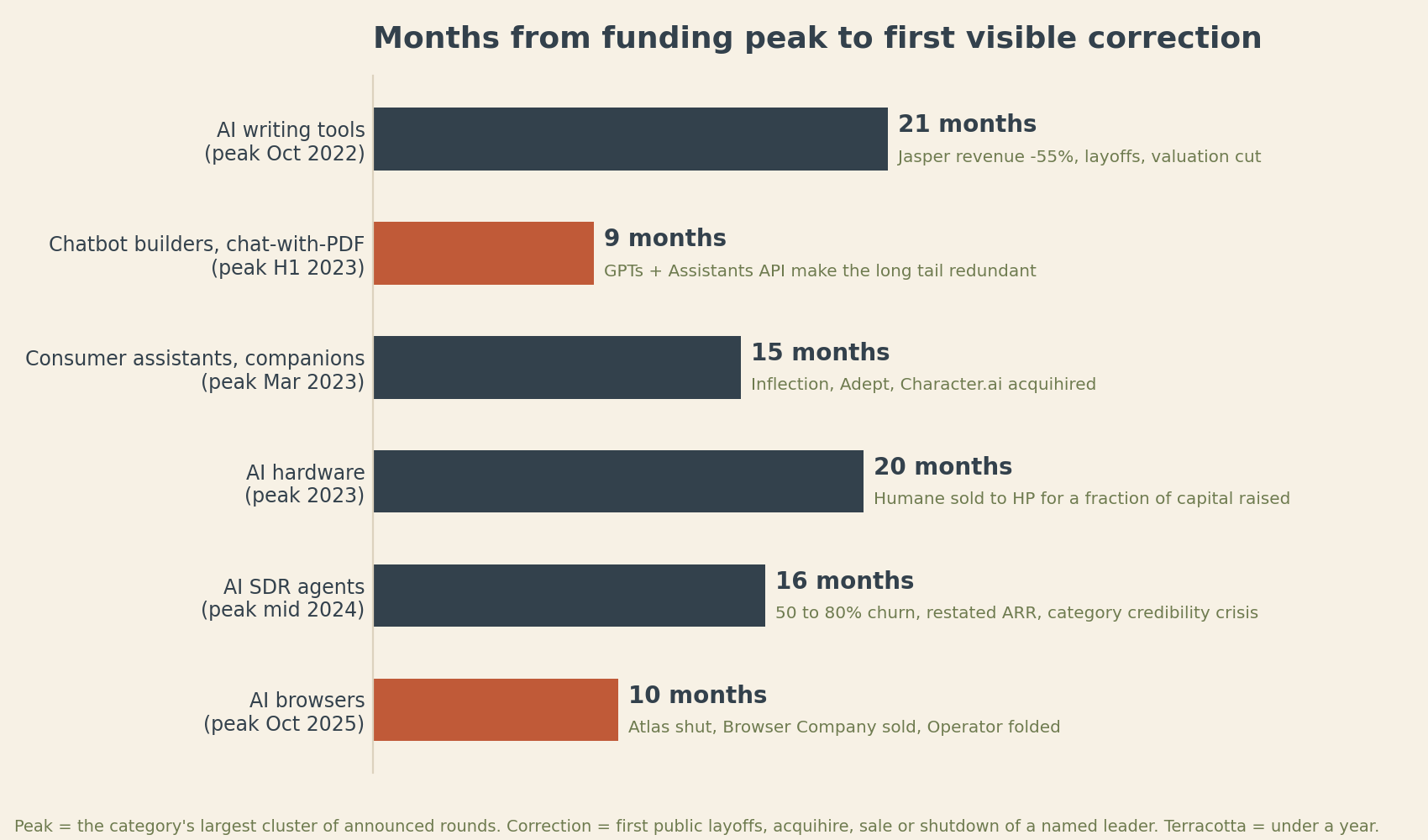
AI writing peaked in October 2022, when Jasper raised $125M at $1.5 billion. ChatGPT launched six weeks later. The first visible damage- layoffs and a CEO change- took until mid 2023, and the full picture- revenue from roughly $120M down to $55M, four rounds of layoffs, an internal valuation cut, took about 21 months to become public.
AI browsers peaked in October 2025 with Atlas. Atlas was shut down in August 2026. Ten months.
That’s the pattern in one line. The gap between “hottest category in venture” and “first leader in trouble” has gone from around two years to under one. It’s not because startups got worse. It’s because the two things that end a category- a lab shipping the feature and the buyer working out the product doesn’t stick- both happen faster now. The lab release cycle is quarterly, and the churn data arrives at the 90-day renewal.
Which means the founder who raised into a hot category in 2026 doesn’t have the runway the 2022 founder had. The 2022 founder got two years to find a second act. The 2026 founder gets three or four quarters.
So which of this year’s hot categories are on the short clock? That’s what the rest of this issue answers.
Below the line: every category mapped, money in and what came out; the four signs a category is about to turn, one of which shows up in job postings months before anywhere else; the three 2025 categories I’d be nervous about, named; and a test to score your own. If you raised into anything hot this year, you want this before your next investor call.