


👋 Hey, Sahil here - welcome back to Venture Curator, where we explore how top investors think, how real founders build, and the strategies shaping tomorrow’s companies.
Big idea + report of the week :
The new startup stack is here. Most founders haven’t caught up.
What 1,133 funding rounds reveal about startup dilution?
Frameworks & insightful posts :
Are your “Contact Us” forms quietly killing high-intent leads?
Claude can do far more than you think: The hidden features most founders never touch.
Is your AI product actually a software business? The margin data says maybe not.
Get access to 150+ premium archive posts, 100+ startup & VC resources, investor databases, fundraising templates, and exclusive startup research - all in one place.
FROM OUR PARTNER - ATTIO
What do Granola, Modal, and Wispr Flow all have in common? They all use Attio, the agentic CRM…

It meets you where you work, compounds every customer signal into context, then acts on it across your pipeline to let you move at unmatched speed and scale.
With agents and automations that build pipeline, chase signals, and move deals forward, Attio orchestrates your revenue work around the clock.
Loved by some of the world’s most successful startups, Attio amplifies what you can achieve and scales with your success.
WORK WITH US
🤝 Partnership With Us
Get your product in front of over 125,000+ audience - Our newsletter is read by thousands of tech professionals, founders, investors and managers worldwide. Get in touch today.
START WITH
🧠 Big idea + report of the week
The new startup stack is here. Most founders haven't caught up.
Supabase surveyed 2,000 startup builders worldwide to understand how startups changed between 2025 and 2026.
The report shows that AI has dramatically reduced the cost of building software, allowing more people to launch startups while shifting the real competitive advantage toward distribution, customer acquisition and product differentiation.
More founders are building alone than ever before.
Solo founders now make up 61% of startups (up from 53% last year), while only 29% have two founders.

At the same time, 22% of startups are founded by non-technical founders, showing that AI has significantly lowered the technical barrier to building software.
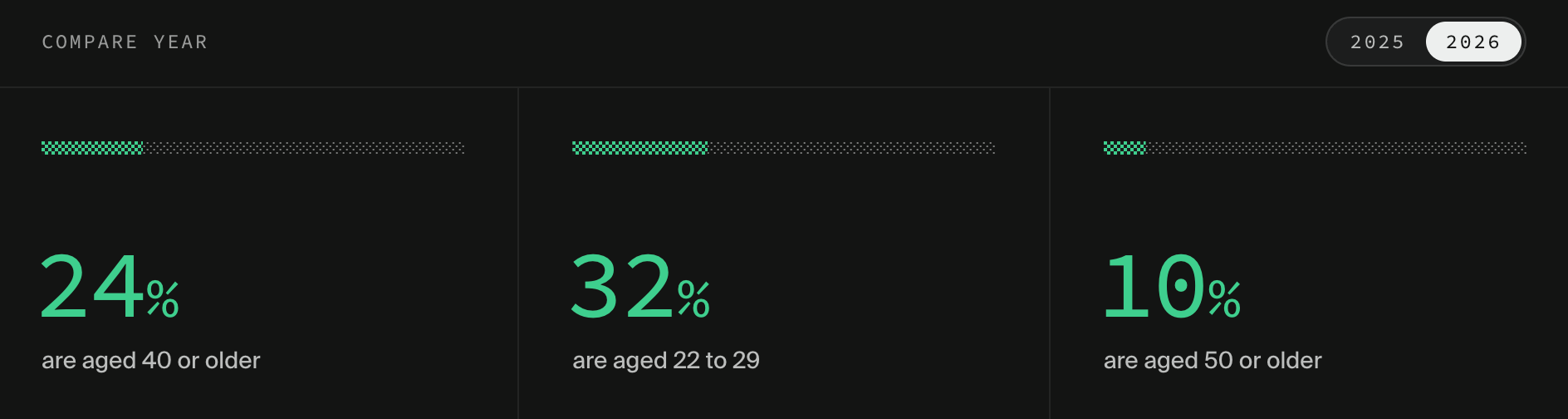
The founder demographic is also becoming more experienced, with founders aged 40+ increasing to 24% as seasoned operators use AI to build companies without needing large engineering teams.
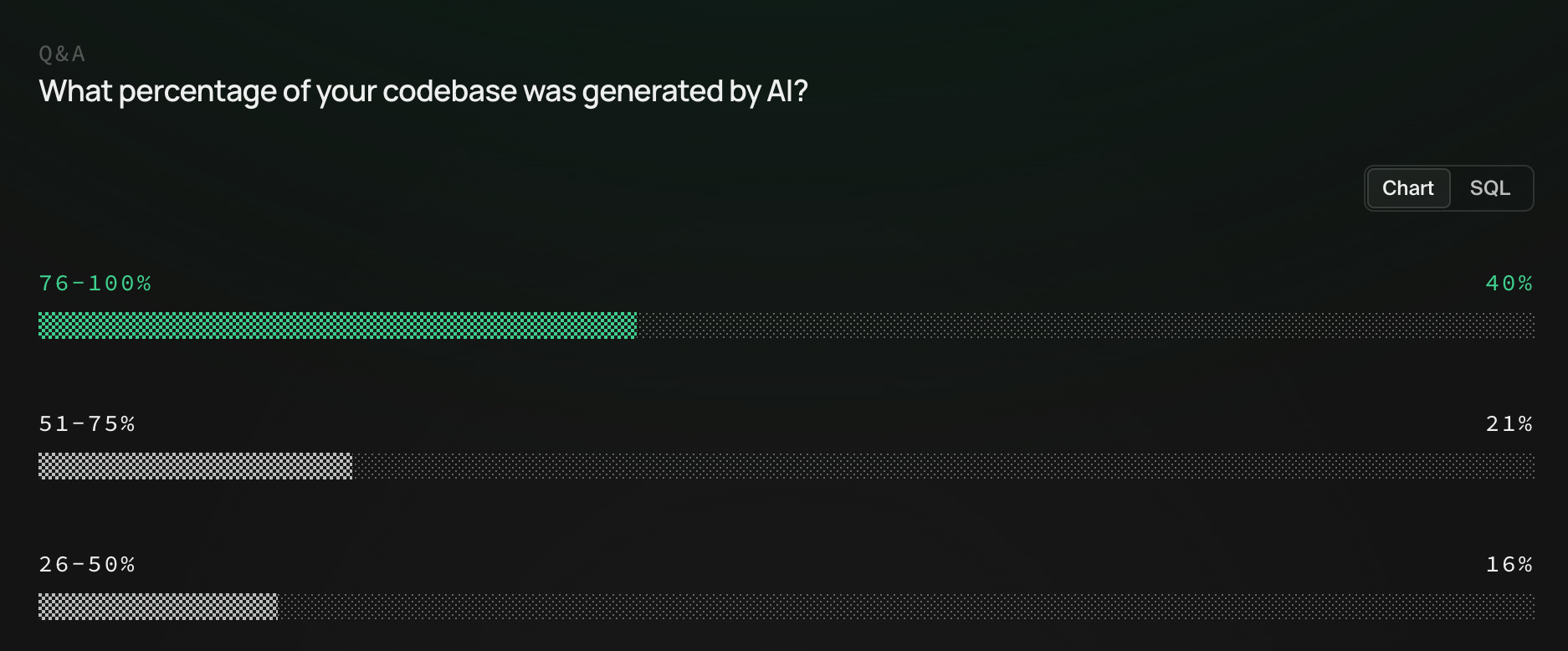
AI-generated code is now the default way startups build products.
Around 62% of startups have the majority of their code generated by AI, while 40% say more than three-quarters of their codebase is AI-written.
Anthropic has become the preferred AI platform, with 64% using Claude models, 59% paying for Claude subscriptions, and 63% actively using Claude Code, overtaking OpenAI across multiple developer categories.
Building products has become easier, but getting customers has become much harder.
The report shows customer acquisition (32%) is now the biggest challenge for founders, replacing technical complexity, which has fallen to 11%.
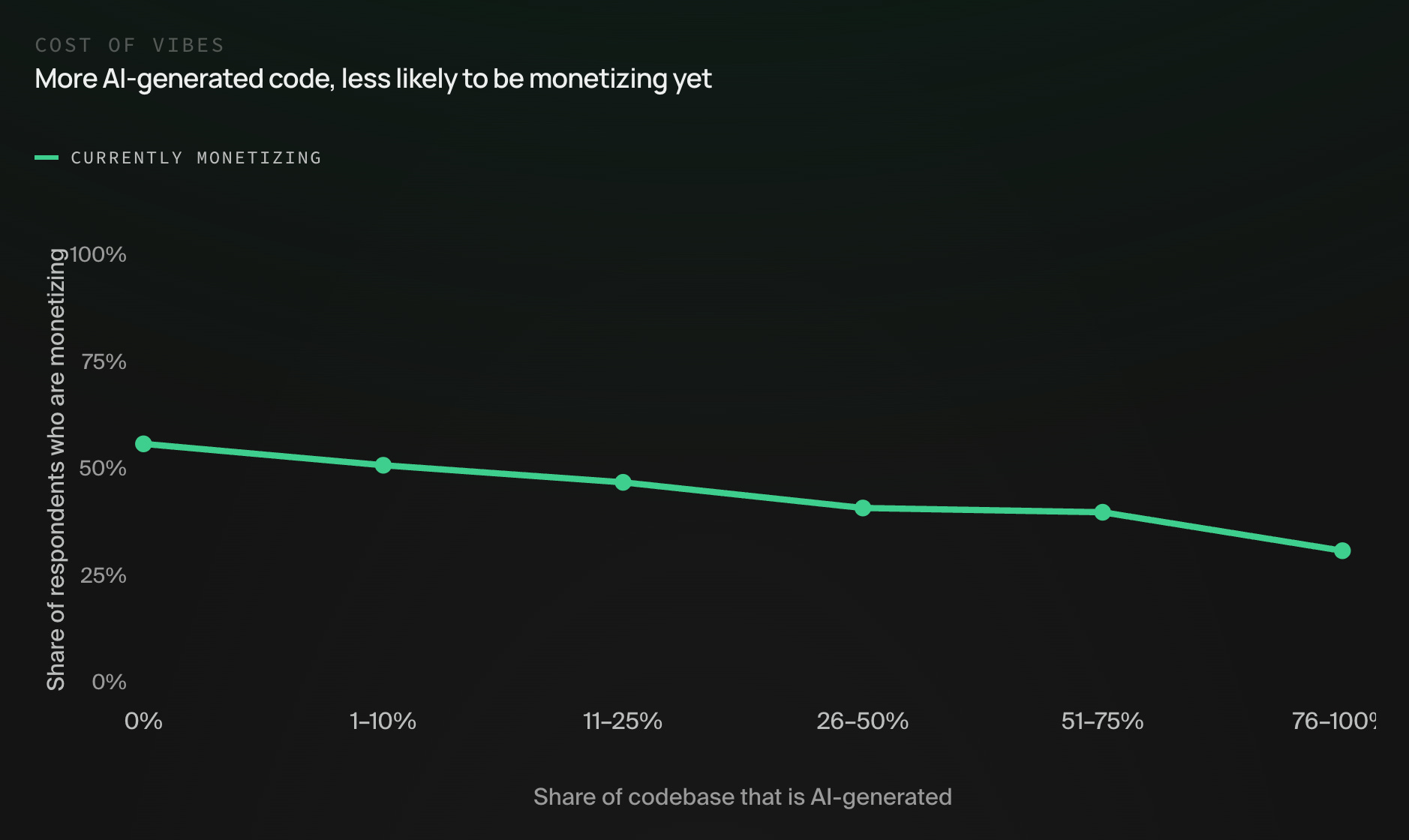
Interestingly, startups with the highest percentage of AI-generated code are less likely to be monetising than companies writing little or no AI-generated code, suggesting that shipping products has become much easier, while distribution and finding paying customers remain the real bottlenecks.
AI agents are moving into production, but the tooling ecosystem is still immature.
More than 52% of startups are building AI agents,
24% already have multi-agent systems in production, and
57% have adopted or are experimenting with MCP (Model Context Protocol).
Yet 59% don’t monitor AI workloads, 47% have no formal prompt management system, and 36% have no structured evaluation process, highlighting a major opportunity for startups building AI infrastructure and developer tools.
The modern startup stack is rapidly consolidating.
Supabase (65%), Vercel (45%), Cloudflare (27%), and Postgres (80% combined) have become the dominant infrastructure choices among startups. On the frontend, React and Next.js remain the leaders, while newer frameworks like Expo and TanStack are seeing rapid adoption. The report suggests founders are increasingly standardising around a smaller set of AI-native development tools.
The broader implication is that AI is no longer the differentiator - it has become table stakes. As software becomes cheaper and faster to build, founders who win will likely be those who excel at distribution, community building, customer acquisition and creating products people genuinely want, rather than simply shipping features faster.
What 1,133 funding rounds reveal about startup dilution?
Startup fundraising has remained challenging over the past two years, but founders negotiating new rounds may finally be seeing better terms.
Fresh data from Carta, covering 1,133 U.S. software funding rounds raised over the last six months, suggests investors are asking for smaller ownership stakes while companies continue raising substantial amounts of capital.
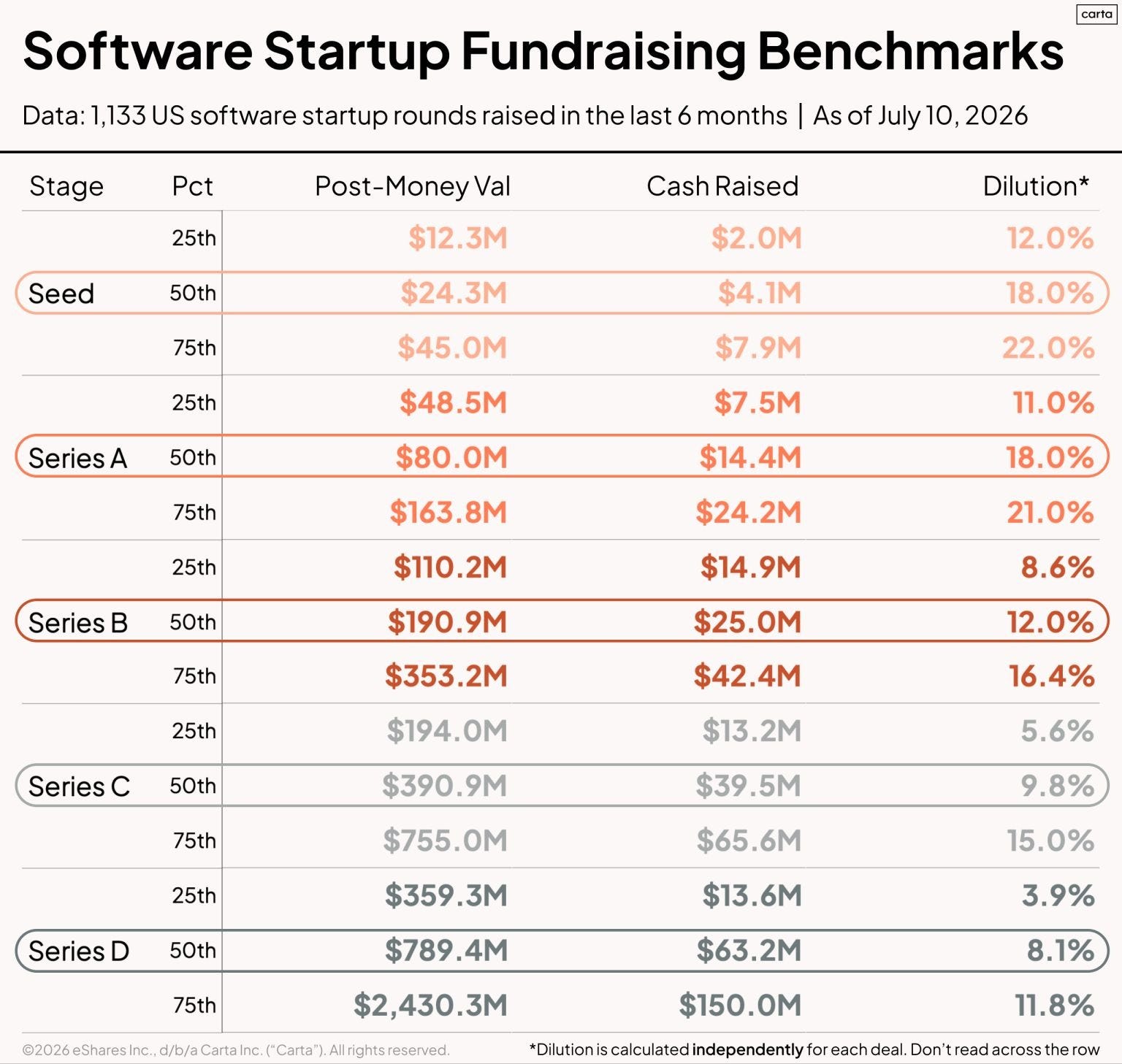
Seed founders are giving up less equity.
The median seed round closed at a $24.3M post-money valuation, with $4.1M raised for 18% dilution. Carta notes that seed dilution has been gradually declining for several months, giving founders more ownership after fundraising.
Series A terms are improving as well.
The median Series A round came in at an $80M valuation with $14.4M raised, also at 18% dilution-the lowest median dilution Carta has recorded at this stage in several years. Later-stage companies are selling even less equity, with median dilution falling to 12% at Series B, 9.8% at Series C, and just 8.1% at Series D.
Valuations need context.
While higher valuations grab headlines, they’re often simply a result of raising more capital while targeting a specific dilution level. Carta also notes that many companies in this dataset are AI-native, meaning these benchmarks shouldn’t be treated as universal targets for every startup.
These numbers are useful as fundraising reference points - not fundraising goals. Every company raises under different market conditions, and the right round is the one that provides enough capital to reach the next meaningful milestone without unnecessary dilution. Founders should optimise for building leverage over time rather than chasing benchmark valuations.
FEATURED POSTS
📄 Must Read Post
What really happens in the 48 hours after you pitch a VC? (The decision process most founders never see.)

👋 Hey, Sahil here - welcome to today’s edition of Venture Curator, where we break down how great startups grow, how top investors think, and what’s shaping the future of tech.
You're Benchmarking Your AI Spend Against the Wrong Number (The Data Just Proved It).

👋 Hey, Sahil here - welcome to today’s edition of Venture Curator, where we break down how great startups grow, how top investors think, and what’s shaping the future of tech.
SOMETHING MORE
🧩 Frameworks & insightful posts
Are your "Contact Us" forms quietly killing high-intent leads?
Most B2B companies spend heavily to bring visitors to their website, only to slow everything down at the moment someone is finally ready to buy. A prospect fills out a contact form, waits for a salesperson to respond, and by the time someone reaches out, they’ve often moved on to another vendor.
Recently, Jason Lemkin shared how SaaStr replaced its traditional contact form with an AI-powered inbound agent - and the results were hard to ignore.
Instead of asking visitors to submit a form and wait, the AI immediately started conversations, answered questions, qualified prospects, and booked meetings in real time.
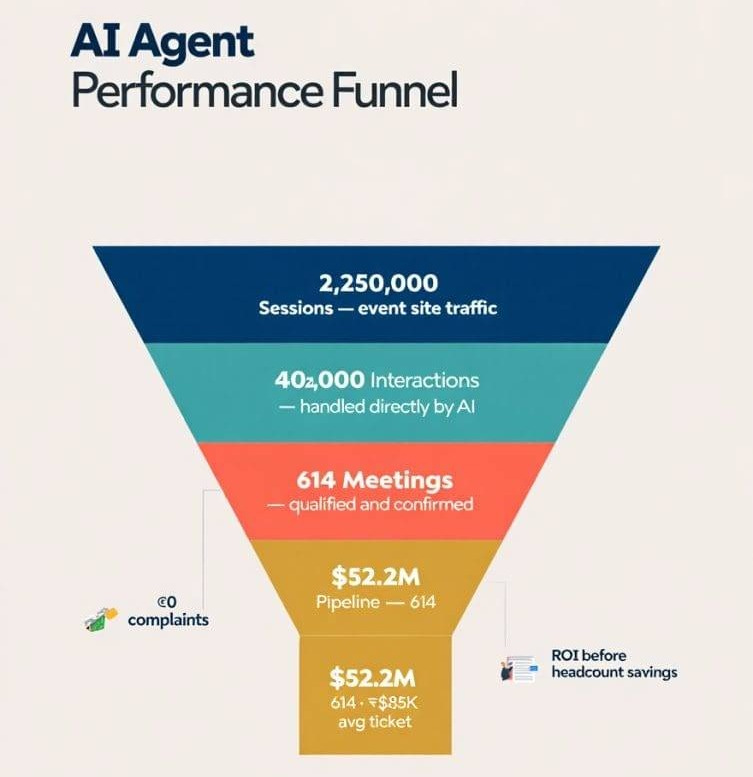
The numbers from a single event were impressive:
Around 2.25 million website sessions
Over 402,000 conversations handled by AI
614 qualified meetings booked
More than $52M in sales pipeline generated (based on an average deal size of ~$85K)
Almost zero complaints from users interacting with the AI agent
What made the agent effective wasn’t simply using AI - it was how deeply it was trained.
Instead of acting like a generic chatbot, it was continuously updated with the latest website content, event information, CRM data, different buyer personas, and separate playbooks for sponsors, attendees, and customers.
That meant it could give accurate answers instantly while understanding who it was talking to.
The AI also handled work that normally requires multiple sales operations processes:
Routed meetings to the salesperson most likely to close the opportunity using historical CRM data.
Automatically followed up with visitors who abandoned sponsorship or ticket purchases.
Applied pre-approved discount rules without creating inconsistent pricing or relying on manual sales decisions.
Stayed available 24/7 without adding headcount.
So - the biggest opportunity isn’t replacing salespeople - it’s eliminating waiting time.
Warm inbound leads are at their highest intent the moment they arrive. Every hour of delay reduces the chances of converting them. An AI agent responds instantly, qualifies the opportunity, and only brings humans into the conversation once the lead is ready.
The takeaway is simple: if your website still relies on a “Contact Us” form followed by manual follow-up, you’re introducing friction exactly when prospects are most interested.
AI agents won’t replace complex enterprise sales conversations, but they can remove the slow, repetitive work at the top of the funnel and help sales teams spend more time closing qualified opportunities instead of chasing inbound requests.
Claude can do far more than you think: The hidden features most founders never touch.
Most founders use Claude the same way: open a chat, type a question, copy the answer, close the tab.
That’s roughly 20% of what the product actually does.
A recent guide from Antoli mapped out 17 features hidden across Claude’s ecosystem - most of them off by default, buried in settings, or living in separate products people don’t know exist. Here are the ones that matter most if you’re running a company.
1. Stop re-explaining yourself: Projects + Memory
Every new chat starts from zero - Claude doesn’t know your company, your stage, or your investors. Most people accept this and re-type context every single conversation.
Two features fix it:
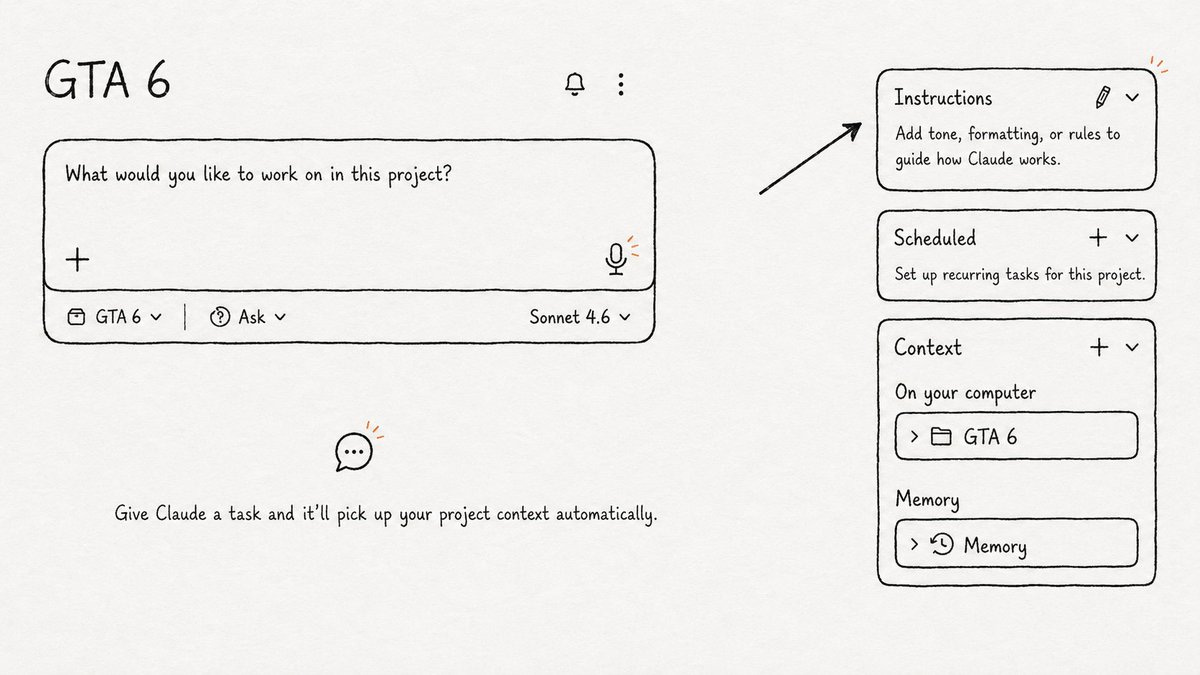
Projects let you upload documents and write standing instructions once. Open the project next week and Claude picks up exactly where you left off - your deck, your metrics, your positioning, all held permanently.
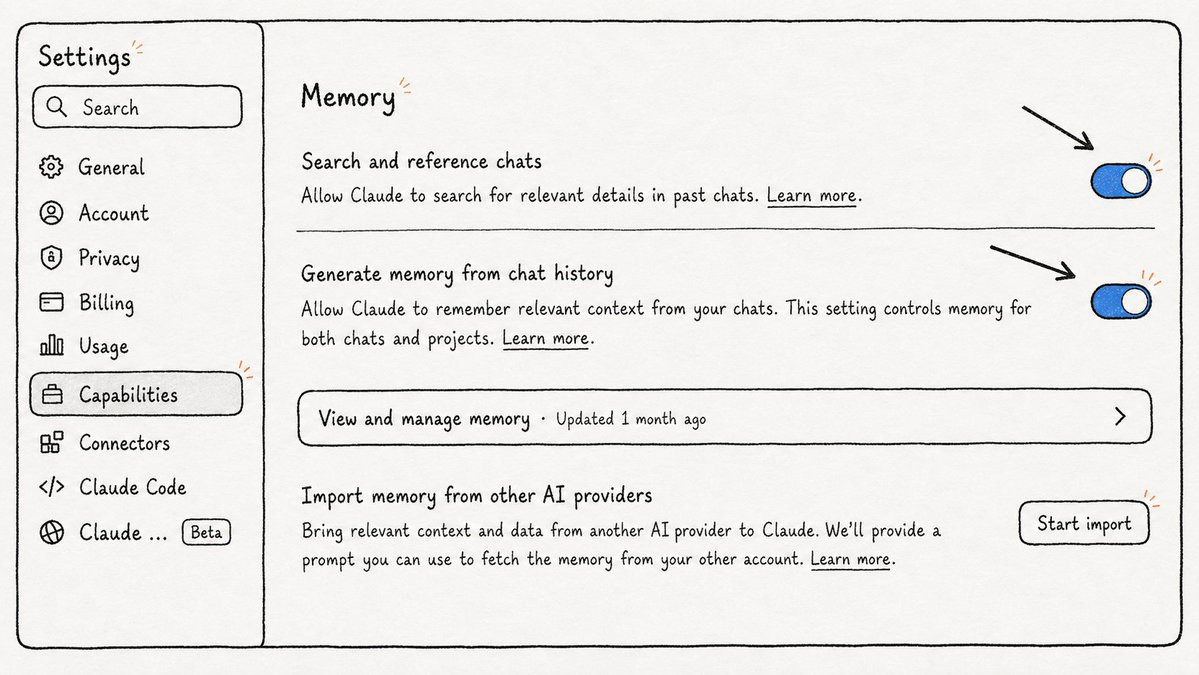
Memory builds a profile of you across all chats - your role, what you’re working on, how you like output formatted. It’s off by default (Settings → Capabilities), which is why most users have never seen it work.
The combination means Claude behaves less like a search box and more like a chief of staff who’s been in every meeting.
2. Turn off the validation machine
By default, Claude agrees with you. It supports your reasoning, finds the positives, adds to your ideas.
For a founder making capital allocation decisions, that’s actively dangerous.
The guide’s most useful insight isn’t a feature - it’s a usage pattern: give Claude an adversarial role before you commit to anything expensive. Three prompts worth stealing:
The hard mentor: “Disagree with me when I’m wrong. Point out what I’m avoiding because I want my plan to work. If it’s a bad idea, say so - don’t balance it with ‘on the other hand.’”
Devil’s advocate: Before committing to a decision you’ve already made, have Claude build the strongest case against it - the assumptions that could be wrong, the three most realistic failure modes, what you’d need to believe for it to be a genuinely bad call.
Negotiation practice: Have Claude roleplay your investor, your co-founder, or the enterprise buyer you’re about to call - responding the way they would, not the way you’d like them to. Practice the hard conversation before the real one.
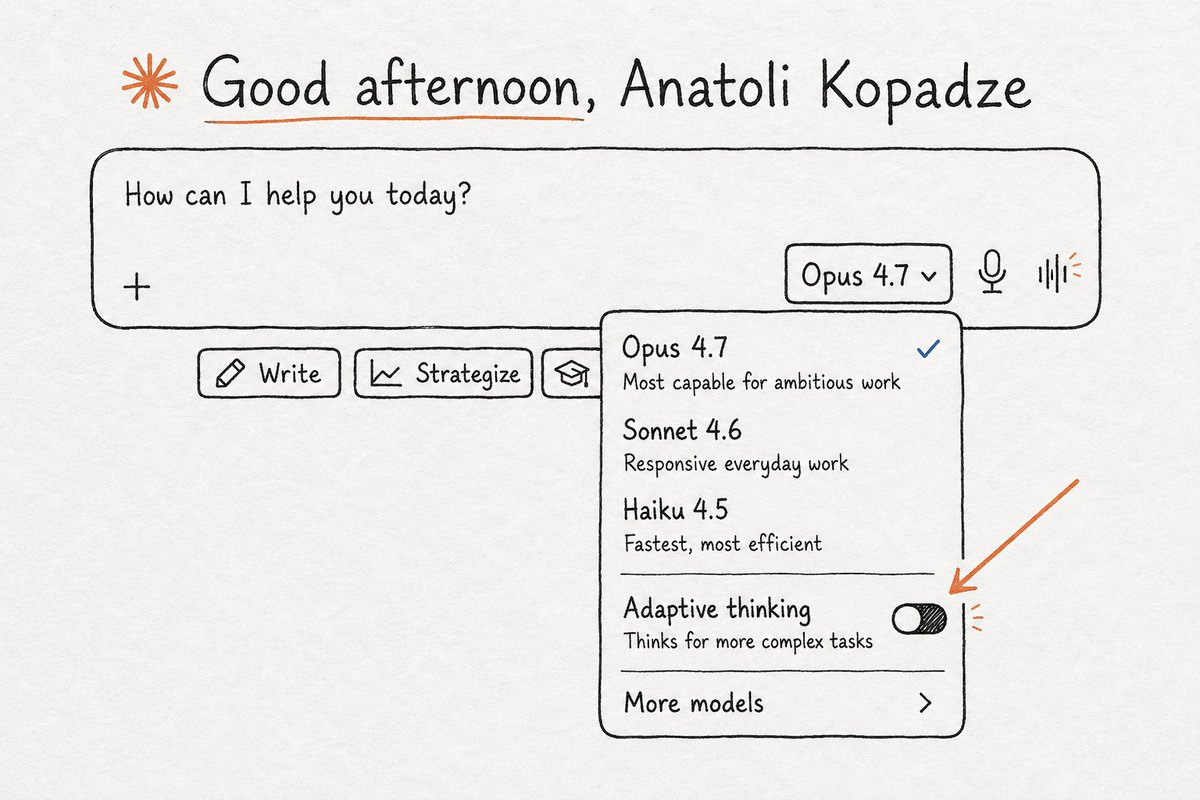
Also worth flipping on: Adaptive/Extended Thinking (in the model selector). For strategic decisions, it forces Claude to reason step-by-step instead of pattern-matching - and you can watch the entire process.
3. Claude that works without you in the loop
The biggest gap between casual users and power users isn’t prompting - it’s that power users have Claude running when they’re not there:
Scheduled Tasks: Set a task once and it runs automatically - a competitor scan every Monday, a funding-news brief every morning at 7:30, saved to your folder before you wake up.
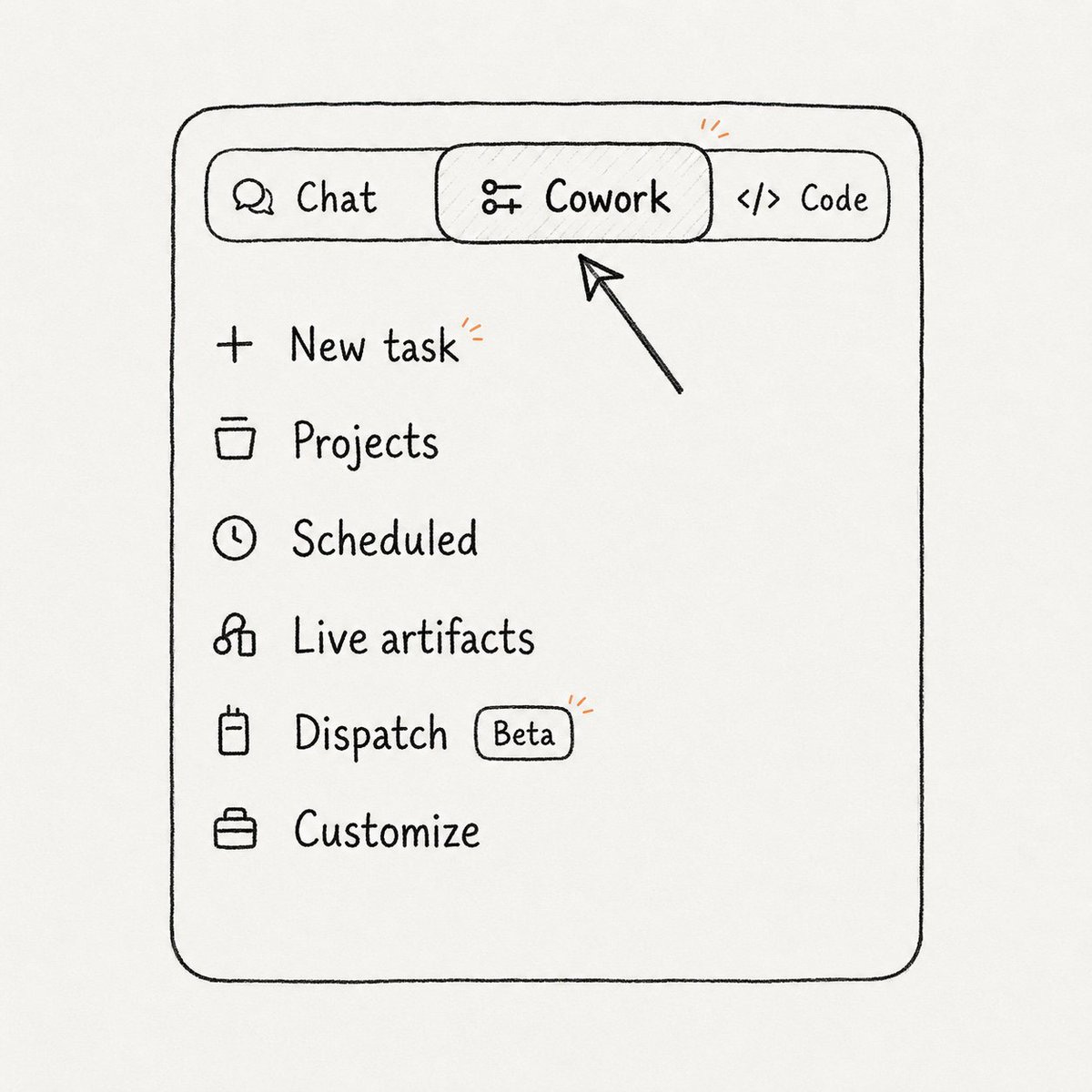
Claude Cowork (desktop): Direct access to your file system. It reads your actual files, edits documents, organizes folders - no copy-pasting into a chat box.
Claude in Chrome: A browser extension that sees your active tab and acts on it - reads pages, clicks through pagination, fills forms, extracts data into comparison tables.
CLAUDE.md: A rules file in your project folder that Claude reads automatically at the start of every session. Your writing conventions, your terminology, your brand voice - write it once, and it applies forever.
Claude Design (claude.ai/design): A separate tool for pitch decks, one-pagers, and landing page layouts. Exports to PPTX, Canva, PDF, or HTML - replaces a 3-hour Figma session for non-designers.
The takeaway: the gap between AI power users and everyone else isn’t intelligence or prompting skill. It’s simply knowing what exists. Most of these take under five minutes to set up - and the founders getting outsized leverage from AI aren’t using a different model than you. They’ve just turned more of it on.
Is your AI product actually a software business? The margin data says maybe not.
For twenty years, the deal with software was simple: build it once, sell it forever, enjoy 75-85% gross margins. Every SaaS playbook, every valuation multiple, every hiring plan was built on that math.
AI products don’t work that way. And a new dataset - one of the few honest looks inside the P&Ls of companies actually building AI - shows exactly how different the math has become.
ICONIQ just released its State of AI: Bi-Annual Snapshot - 44 slides, fully ungated, built on surveys of roughly 300 executives at software companies building AI products: CEOs, heads of engineering, heads of AI, CROs, and CFOs, from sub-$5M to $1B+ in ARR. It’s their second bi-annual survey, which means we finally have trendlines, not snapshots.
Three findings matter more than the rest.
AI margins are improving - but they may never look like software margins.
Average AI product gross margins are projected to hit 52% in 2026, up from 45% in 2025 and 41% in 2024. Real progress. But 52% is still a full 25-30 points below the SaaS standard and the cost-structure breakdown explains why the gap may be structural, not temporary.
In classic software, most costs are fixed: build the product, and every incremental customer is nearly pure margin. In AI products, talent - the main fixed cost - is only about 26-28% of the cost structure for companies at GA through scaling stage. Almost everything else is variable: inference, cloud, even model training, which never really ends. Every new customer brings new costs with them.
That’s not a software business with a temporary margin problem. That’s a different kind of business.
The model layer stopped being the moat - officially.
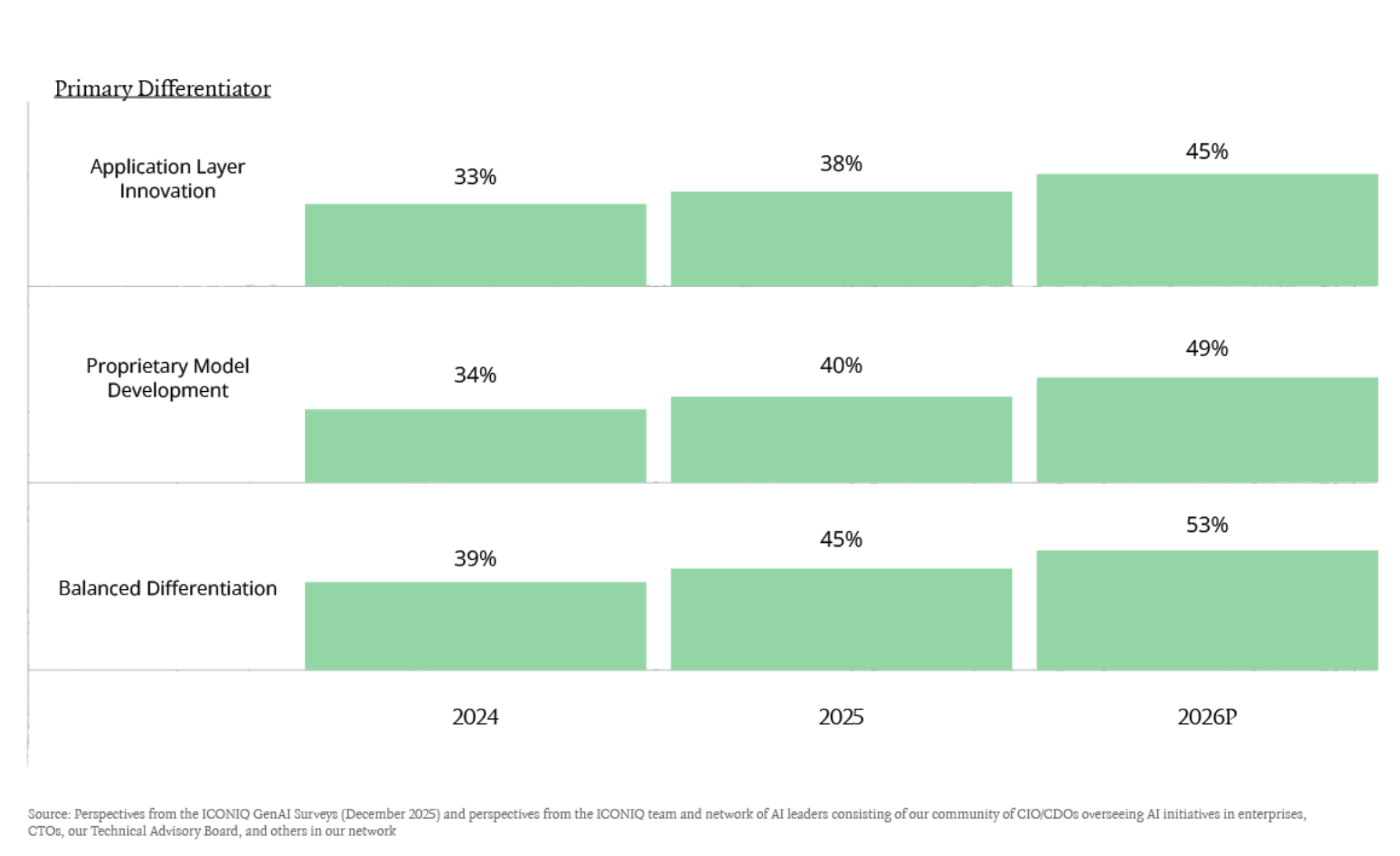
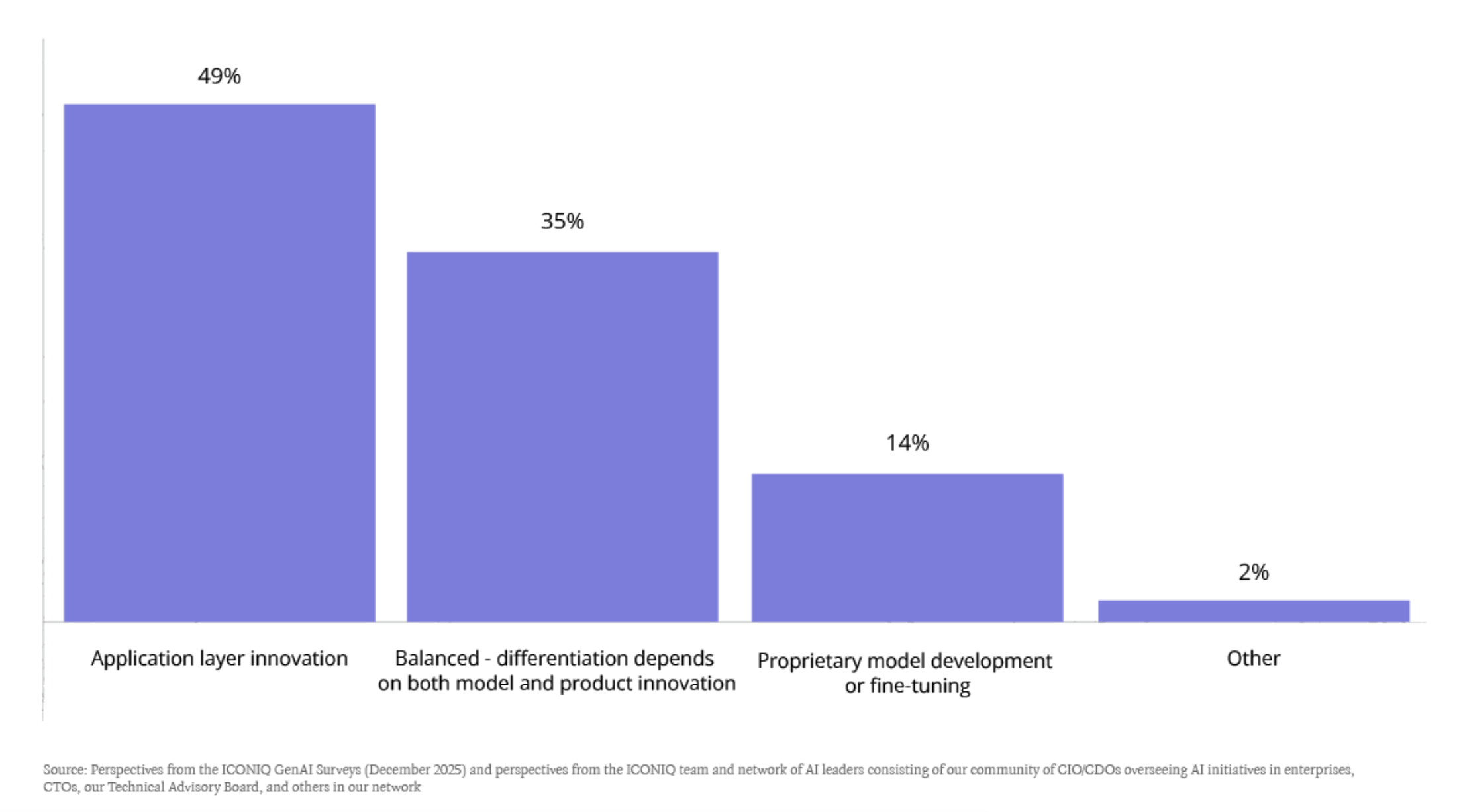
Only 14% of companies say proprietary model development is their primary differentiation. 49% now differentiate at the application layer - UX, workflows, integrations, data application and ~70% of builders are focused on vertical AI applications.
The margin data backs the strategy: companies routing most workloads to smaller or fine-tuned models and escalating only complex tasks to frontier models are the ones driving margins up.
Model usage tells the same story: OpenAI leads at 77%, but Gemini jumped from 43% to 55% and Anthropic sits at 51% - the standard pattern is now OpenAI plus one or two others.
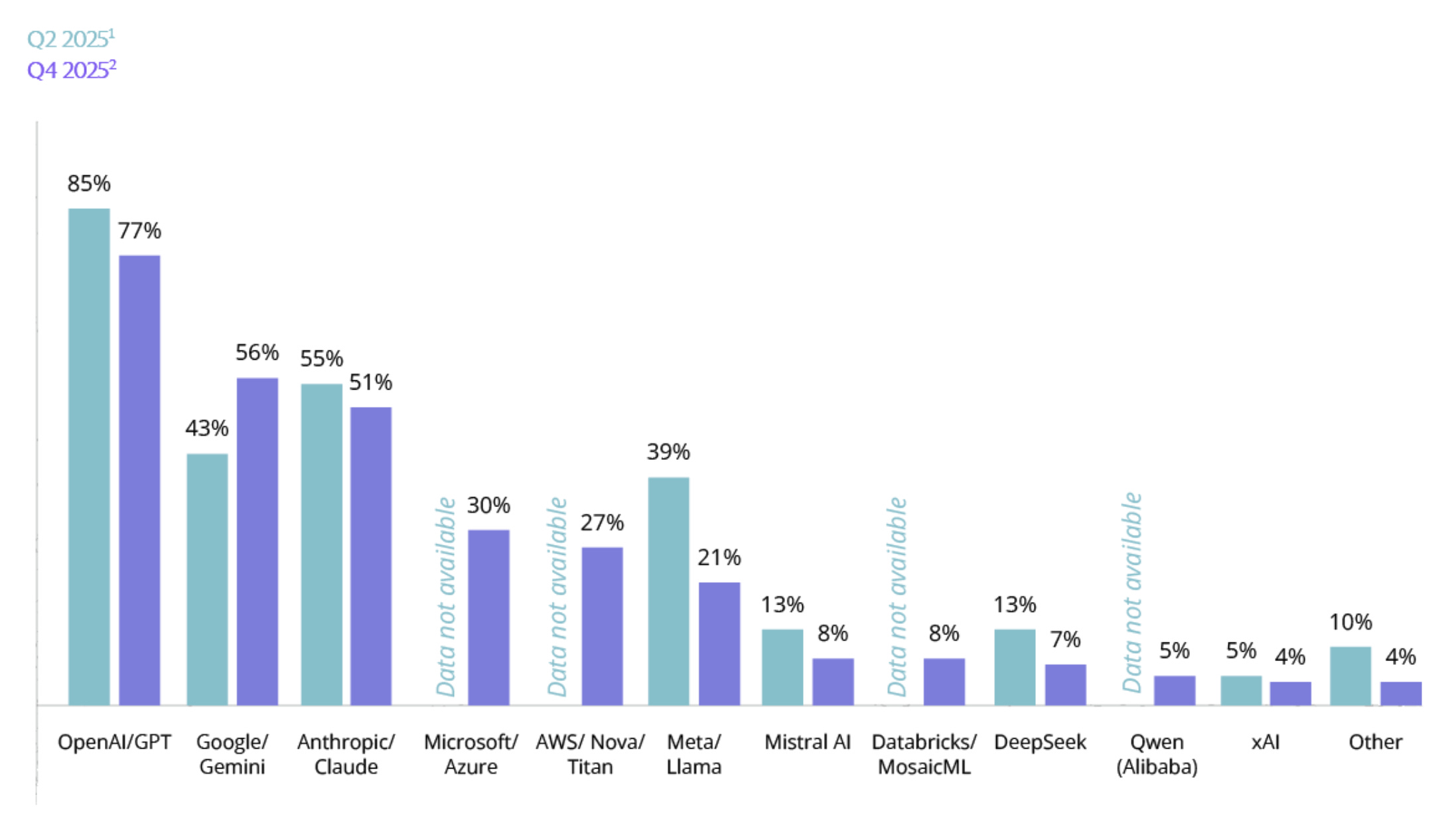
Models are becoming interchangeable infrastructure. Nobody’s paying a premium for what everyone can rent.
Nobody has figured out pricing - including your competitors.
58% of companies still include a subscription component, but consumption-based (35%) and outcome-based (18%) pricing both grew meaningfully in just six months. And here’s the number to sit with: 37% of companies plan to change their AI pricing model within the next 12 months, driven by customer demand, competitive pressure, and margin concerns.
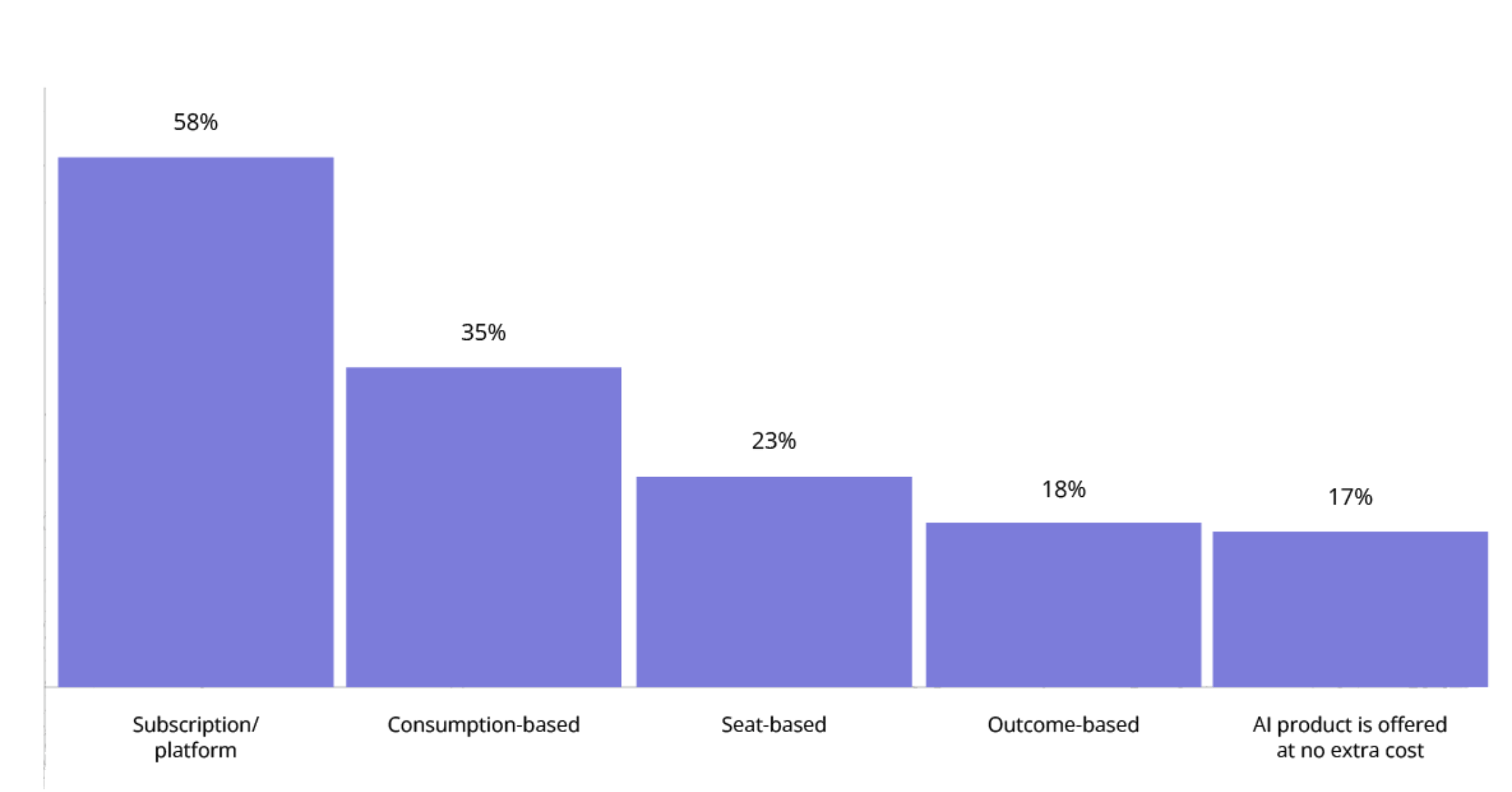
More than a third of the industry is about to reprice. If you’ve been treating your pricing model as settled, you’re likely the outlier.
One more warning shot buried in the deck: internal AI is increasingly funded from existing R&D budgets, not net-new spend. AI vendors are no longer selling into a separate “innovation” pool - they’re competing for the same IT dollar as every other line item. Budget season just got harder for everyone.
What this means for you:
Run your own margin stack the way ICONIQ breaks it down: what % of your COGS is fixed (people) vs variable (inference, cloud, training)? If variable costs dominate, your margins won’t improve with scale by default - they only improve with deliberate model routing, and the companies doing it are already 10+ points ahead.
And if your pricing hasn’t been revisited in the last two quarters, the market is moving without you: the fastest-growing companies in the survey are the ones aligning price to demonstrable value - cost saved or revenue generated - not seats.
The takeaway isn’t that AI products are bad businesses. It’s that they’re new businesses, and the founders who win will be the ones who stopped pretending the old math applies.
📬 Upgrade to Venture Curator Premium
Get access to 150+ premium archive posts, 100+ startup & VC resources, investor databases, fundraising templates, and exclusive startup research - all in one place.
NEWS RECAP
🗞️ This week in startups & VC
New In VC
Greylock Ventures, a Silicon Valley-based venture firm, raised $1.5 billion for its 18th flagship fund. (Link)
Isogon Ventures, a New York City and Madrid, Spain-based early-stage venture capital firm, is raising its first fund. (Link)
Paradigm, a U.S.-based venture capital firm founded by Matt Huang and Fred Ehrsam, raised $1.2 billion for its latest fund. (Link)
New Startup Deals
Spectro Cloud, a San Jose, CA-based AI infrastructure management software company, raised more than $100M in Series D funding. (Link)
Pure, a San Francisco, CA-based financial infrastructure platform for peer-to-peer games, raised $8M in Seed funding. (Link)
Valarian, a London, UK-based sovereign AI infrastructure company, raised $50M in Series A funding. (Link)
Quadric, a Burlingame, CA-based AI inference processor company, extended its Series C to $46M. (Link)
Auxilius, a Munich, Germany-based AI-native governance, risk and compliance solutions company, raised €1.3M in Pre-Seed funding. (Link)
Reformed, a London, UK-based wellness beverages company, raised $22M in Series A funding. (Link)
TODAY’S JOB OPPORTUNITIES
💼 Venture capital & startup jobs
All-In-One VC Interview Preparation Guide: In partnership with a leading investor group, we have created an all-in-one guide for aspiring VCs. Don’t miss this. (Access Here)
Vice President/Director - B Capital | USA - Apply Here
Partner 16, Partner 18 - a16z | USA - Apply Here
Principal - 2150 VC | UK - Apply Here
Associate - Artha Capital | India - Apply Here
Investment Associate - Alexandar Chapman | USA - Apply Here
Marketing Associate - Turbostart | India - Apply Here
Marketing Intern - TNB Aura | USA - Apply Here
Finance Intern - 0g Labs | Remote - Apply Here
Associate - Sowefund | France - Apply Here
Investment Associate / Analyst - Flashpoint VC | USA - Apply Here
VC Investment Intern - First Momentum Venture | USA - Apply Here
Investment Associate - Antler | UK - Apply Here
Analyst - ICONIQUE Capital | USA - Apply Here
Finance Director - AI Fund | USA - Apply Here
Head of Fund Accounting - Stepstone Group | USA - Apply Here
Associate or Senior Associate - Bessemer Partner | USA - Apply Here
VC Fellow - V11 | Remote - Apply Here
Investment Analyst - Forum Venture | Canada - Apply Here
Partnership With Us
Get your product in front of over 125,000+ audience - Our newsletter is read by thousands of tech professionals, founders, investors and managers worldwide. Get in touch today.
Upgrade to Venture Curator Premium
Get access to 150+ premium archive posts, 100+ startup & VC resources, investor databases, fundraising templates, and exclusive startup research - all in one place.
(Subscribe to Venture Curator Premium and get 20% off forever.)