


👋 Hey, Sahil here - welcome back to Venture Curator, where we explore how top investors think, how real founders build, and the strategies shaping tomorrow’s companies.
Big idea + report of the week :
Is AI creating a new era of VC herding?
Are we measuring the “Best VCs” the wrong way?
Frameworks & insightful posts :
Why is SaaS’s “Per Seat” pricing starting to break in the AI era?
Is the AI company you’re investing in actually defensible or just a wrapper with ARR?
Before negotiating your seed valuation, do this VC’s fund math.
Get access to 150+ premium archive posts, 100+ startup & VC resources, investor databases, fundraising templates, and exclusive startup research - all in one place.
FROM OUR PARTNER - ALTS.CO
🤝 These guys go way beyond stocks and bonds...
Alts is the go-to newsletter for investors who are tired of the same investing ideas.
Each week, Stefan and Wyatt uncover overlooked markets, from Ferrari arbitrage to K‑Pop royalties to Paraguay persimmon farms to film financing bridge loans.
But they don’t just talk about investing. They structure the SPVs.
Members have already invested over $18 million into SPVs, so you can invest directly into each deal alongside the community.
If you’re an accredited investor, join 135,000 subscribers and see what you’ve been missing.
WORK WITH US
🤝 Partnership With Us
Get your product in front of over 125,000+ audience - Our newsletter is read by thousands of tech professionals, founders, investors and managers worldwide. Get in touch today.
START WITH
🧠 Big idea + report of the week
Is AI creating a new era of VC herding?
With hundreds of billions flowing into AI, venture capital increasingly looks like a market where the biggest investors are all chasing the same handful of companies.
The same funds appear across massive AI rounds. Capital is concentrating around a small group of perceived winners. But is the entire VC industry really becoming more crowded around the same bets?
SVB looked at this in its State of the Markets H2 2026 report, using Foresight cap table and ownership data.
The numbers show something more nuanced: herding is clearly increasing at the very top, but it is still relatively uncommon across the broader venture market.
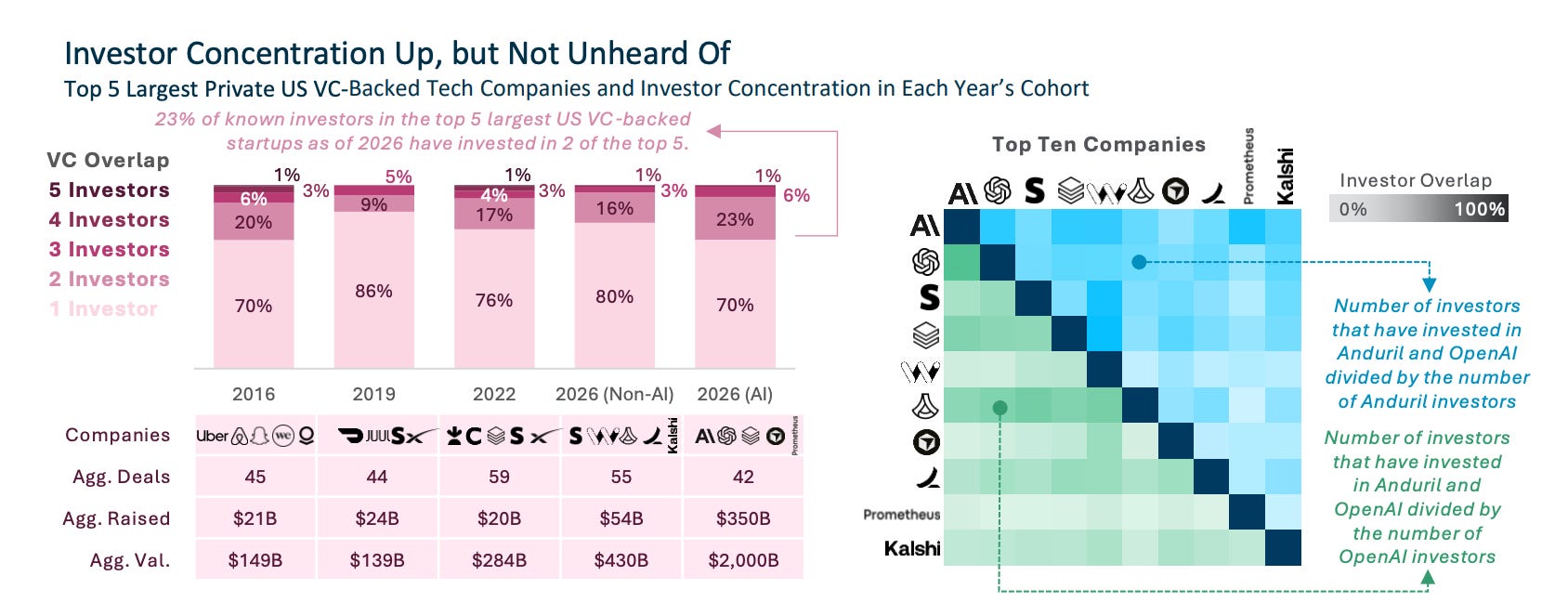
Among the five largest US VC-backed startups in 2019, just 9% of known investors had invested in two of the five companies.
For the five largest startups in 2026, that number has jumped to 23%.
AI makes the concentration particularly striking. The five largest AI startups in the analysis have collectively raised around $350 billion and reached roughly $2 trillion in aggregate valuation. When companies reach this scale, many large investors want exposure to the same perceived category leaders.
But this isn’t necessarily a new VC behaviour.
A similar pattern appeared during the consumer technology boom. In 2016, around 20% of investors in the five largest startups had invested in two of them, with capital clustering around companies such as Uber, Airbnb, Snap and WeWork.
So the pattern may be less “VC suddenly became a herd” and more “capital concentrates around perceived winners during major technology cycles.”
The broader startup market looks very different.
SVB examined roughly 1,600 startups that raised funding since 2023. Only 167, around 10% of the sample, shared five or more institutional investors with another company.
Even among startups backed by one of the ten most active investors, 74% had only one of those top investors on their cap table. Just 6% had more than three.
There is a small cluster where genuine concentration appears much stronger. Twenty-four companies shared at least five institutional investors with ten or more other startups. And 38% of these companies were already Series B or later.
That makes sense. As startups mature, rounds become larger and the universe of investors capable of writing $50 million, $100 million or larger checks becomes much smaller. The same large funds naturally begin appearing together.
The important distinction is therefore between capital concentration and industry-wide herding.
VC doesn’t appear to be one giant herd. Instead, the market increasingly looks like a funnel. Thousands of startups begin with relatively diverse investor bases, but as a small number emerge as potential category leaders, capital starts converging around them.
For founders, this matters because the investors appearing on OpenAI-sized rounds are not necessarily representative of the fundraising market you are operating in. Most startups still compete across a much more fragmented investor landscape.
For investors, there is a harder question hiding inside the data: when 23% of investors start overlapping around the same five companies, are they independently identifying exceptional businesses, or is growing consensus itself making those companies feel safer to back?
That distinction only becomes obvious after the returns arrive.
Are we measuring the “Best VCs” the wrong way?
Every time a ranking of the “best VC firms” comes out, people immediately look for the familiar names.
If Sequoia, Andreessen Horowitz, Benchmark or other major firms aren’t near the top, people question the ranking. But there is a deeper problem: what exactly does “best” mean in venture capital?
Dan Grey explored this in his piece on the futility of ranking VC firms, using Ilya Strebulaev and Blake Jackson’s 2026 venture ranking as a starting point. The interesting part comes when the ranking is adjusted for how much capital each firm actually deploys.
The original venture score rewards accumulated outcomes. Bigger firms have more capital, make more investments and therefore have more opportunities to produce major portfolio companies.
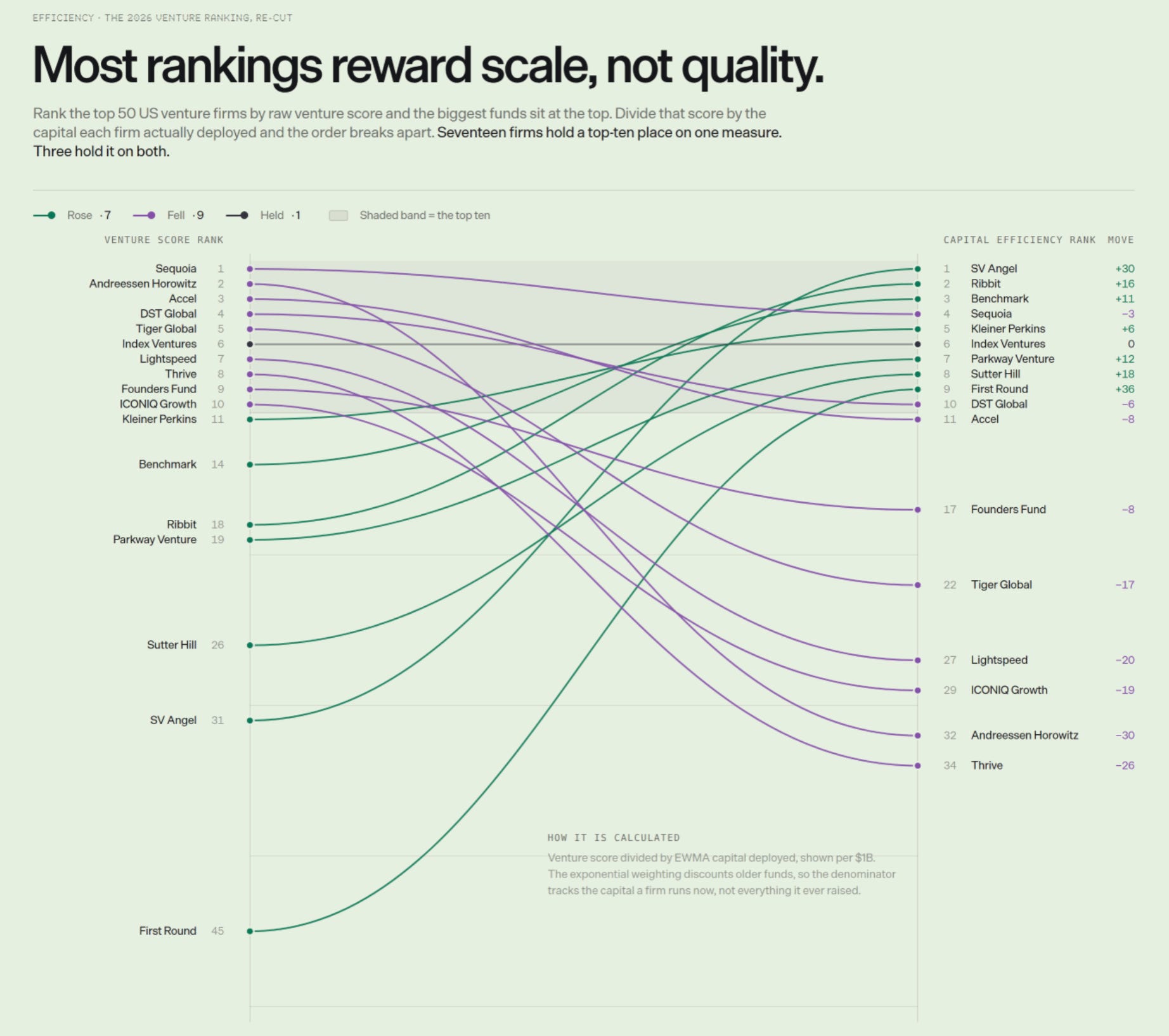
But once the score is divided by estimated capital deployed, effectively asking how much venture impact a firm generates per dollar of capital, the leaderboard changes dramatically.
SV Angel moves from #31 to #1.
Ribbit Capital moves from #18 to #2.
Benchmark moves from #14 to #3.
First Round jumps from #45 to #9, a 36-place improvement.
Meanwhile, some of the largest firms move sharply in the opposite direction.
Andreessen Horowitz falls from #2 to #32, a 30-place drop.
Thrive falls from #8 to #34.
Lightspeed moves from #7 to #27.
Tiger Global drops from #5 to #22.
Only three firms remain in the top ten under both approaches: Sequoia, Index Ventures and DST Global.
That difference exposes an important problem with VC rankings.
Scale and investment quality are not necessarily the same thing.
Imagine Fund A deploys $1 billion and produces $5 billion of value, while Fund B deploys $100 million and produces $1 billion. Fund A created more absolute value, but Fund B generated much more value relative to the capital it needed.
A ranking based on absolute outcomes could favour Fund A. An efficiency-based ranking could favour Fund B.
Neither ranking is automatically wrong. They are answering different questions.
This becomes even more important because actual VC performance is difficult for outsiders to measure. DPI, which tells you how much cash a fund has actually returned to investors relative to the money invested, is generally private.
Public rankings therefore rely on things we can observe: capital raised, AUM, deals completed, portfolio valuations, follow-on funding, exits, board seats and other proxies.
That can create a structural advantage for large, active firms.
For example, Grey notes that 50% of TIME’s 2026 VC ranking methodology explicitly relates to scale, including capital raised, fundraising momentum, dry powder, AUM and deal activity. Another 40% covers performance-related measures that include private valuations and follow-on capital, rather than simply measuring cash returned to LPs.
This doesn’t mean large firms are bad investors. It means a ranking can partly answer “who is biggest and most influential?” while readers interpret it as “who generates the best investment returns?”
And the efficiency-adjusted ranking has limitations too. It starts with the firms already included in the original dataset. A small seed or micro-VC with extraordinary returns could therefore be missing entirely.
There is a broader lesson here for anyone evaluating venture funds.
Don’t start with the ranking. Start with the methodology.
Ask what is actually being rewarded: capital deployed, famous portfolio companies, valuation creation, exits, DPI, fund multiples, consistency or efficiency.
A firm can be excellent at building a huge venture platform without being the most capital-efficient investor. Another can quietly generate exceptional returns from a small fund while barely appearing on mainstream rankings.
The most interesting number on this chart might therefore be 3.
Out of all the firms shown, only Sequoia, Index Ventures and DST Global remain, top-ten investors when measured both by raw venture score and capital efficiency.
That ability to combine scale with efficiency may be a much harder achievement than simply topping either ranking alone.
📄 Must Read Post


SOMETHING MORE
🧩 Frameworks & insightful posts
Why is SaaS’s “Per Seat” pricing starting to break in the AI era?
For decades, SaaS had a beautifully simple business model: charge customers based on how many employees use the software.
AI is making that model much harder to justify.
Jason Lemkin argues that the problem goes beyond AI. Software renewal prices have already risen aggressively, companies are consolidating vendors, and AI spending is increasingly competing with existing software budgets.
Some striking numbers:
Enterprise software renewal increases reached 16.4% in June 2026, versus roughly 2.7% G7 inflation.
79% of IT leaders experienced a price increase at renewal.
78% faced unexpected AI or consumption-related charges.
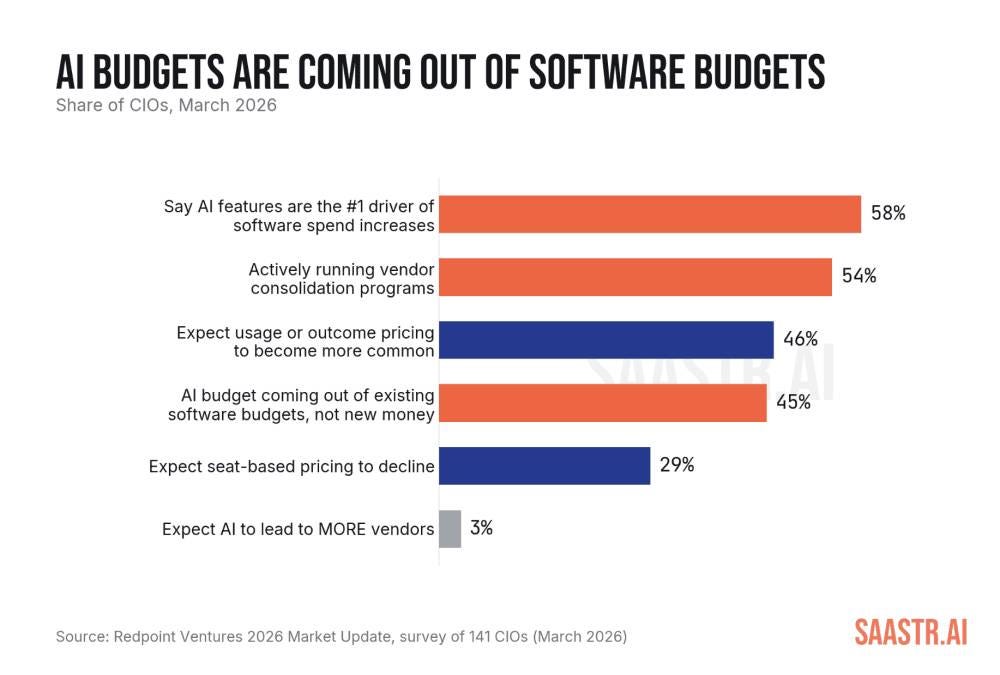
45% of CIOs say AI budgets are coming from existing software budgets rather than entirely new money.
54% are actively consolidating vendors.
But the bigger problem is that seats no longer represent value very well.
Imagine a customer-support team has 40 employees and your software helps them process 3x more tickets. Under seat pricing, your revenue barely changes.
Even worse: if AI lets the company reduce that team from 40 people to 25, your product is creating more value while your SaaS revenue actually falls.
That’s why Lemkin sees three pricing models becoming increasingly important:
Consumption pricing:
Customers pay for what they use - tokens, API calls, credits, searches, tasks or compute. It works when value increases with usage, but vendors need spending caps and predictable commitments to prevent bill shock.
Resolution pricing:
Customers pay when the software successfully completes a clearly defined task. For example, an AI support agent might charge only when it actually resolves a customer issue. This is easier to measure because the result is binary: resolved or not resolved.
Outcome pricing:
Customers pay based on the business result created - revenue generated, costs saved, claims processed, deals completed, etc. It aligns price most closely with value, but attribution and measurement can become difficult.
For established SaaS companies, the transition probably won’t mean eliminating subscriptions overnight. A more realistic model is platform fee + usage/resolution/outcome pricing, introduced gradually.
The larger shift is simple:
SaaS used to charge for access to software. AI software increasingly needs to charge for work performed by software.
That changes not only pricing, but how SaaS companies measure value, forecast revenue, design products, and sell to enterprises.
Is the AI company you’re investing in actually defensible or just a wrapper with ARR?
AI companies can look incredible in a spreadsheet. Strong ARR. Fast growth. Good customer references. Healthy margins.
But Mark Ajzenstadt makes a useful point for anyone evaluating AI businesses:
Those numbers tell you whether customers are paying. They don’t tell you what the company actually built.
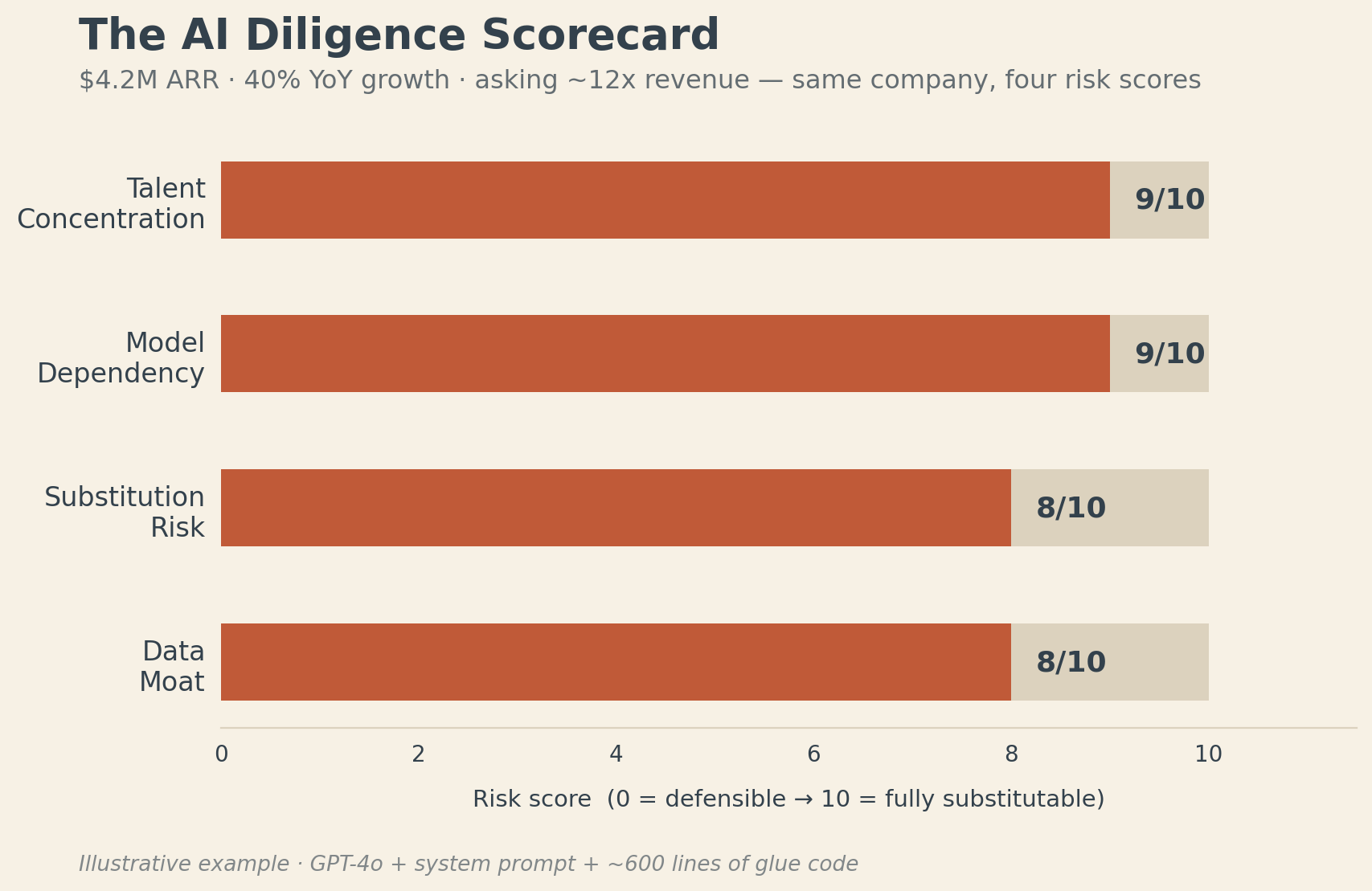
He shared one diligence example where an AI company claimed to have a “proprietary AI platform,” had $4.2M ARR growing 40% YoY, and was asking roughly 12x revenue.
Even most AI startups calculate their ARR in a very wrong way.
Then the codebase was opened.
Behind the deck was GPT-4o, a system prompt, a React frontend, and roughly 600 lines of glue code. No proprietary model. No meaningful proprietary data.
The revenue was real. The defensibility wasn’t.
That changes the question investors should ask from:
“What multiple should we pay on ARR?”
to:
“What exactly are we paying for and how difficult would this be for someone else to reproduce?”
For AI companies, four risks deserve much more attention during diligence:
Model dependency: How much of the product depends on OpenAI, Anthropic, Google or another third-party model? If the model can be swapped in an afternoon, the underlying model probably isn’t the moat.
Data moat: Does the company actually own unique data that improves the product? Is the provenance documented? Could a competitor reproduce similar performance using public data?
Talent concentration: Does the core AI system depend on one or two engineers who understand how everything works? If they leave, can someone else retrain, maintain and improve the system?
Substitution risk: Could a competent team rebuild the core product using frontier APIs and modern coding tools in weeks or even days? If yes, the valuation should probably reflect that.
A simple way to think about it is to score each category from 0 to 10, where 10 means very high risk.
A company might have spectacular revenue growth while simultaneously scoring 9/10 on model dependency, 8/10 on substitution risk and 9/10 on talent concentration. That doesn’t necessarily make it a bad business.
But it makes it a very different asset from a company with proprietary data, deeply embedded workflows and technology that is genuinely difficult to reproduce.
The broader lesson is useful beyond PE and M&A:
ARR tells you whether customers value the product today. Technical diligence tells you whether competitors can erase that value tomorrow.
For traditional SaaS, financial diligence could tell you much of the story. With AI-native companies, investors increasingly need to understand the codebase, data, model dependencies and workflow advantage before deciding what the ARR is actually worth.
The spreadsheet is still important.
It just shouldn’t be the whole diligence process.
Before negotiating your seed valuation, do this VC’s fund math.
Founders often hear some version of: “We like the company, but we’re not there on valuation.”
It sounds like feedback on the business. Maybe the traction isn’t strong enough. Maybe the market story needs work. Maybe you need another few months of growth.
But sometimes the answer was already determined before the pitch started.
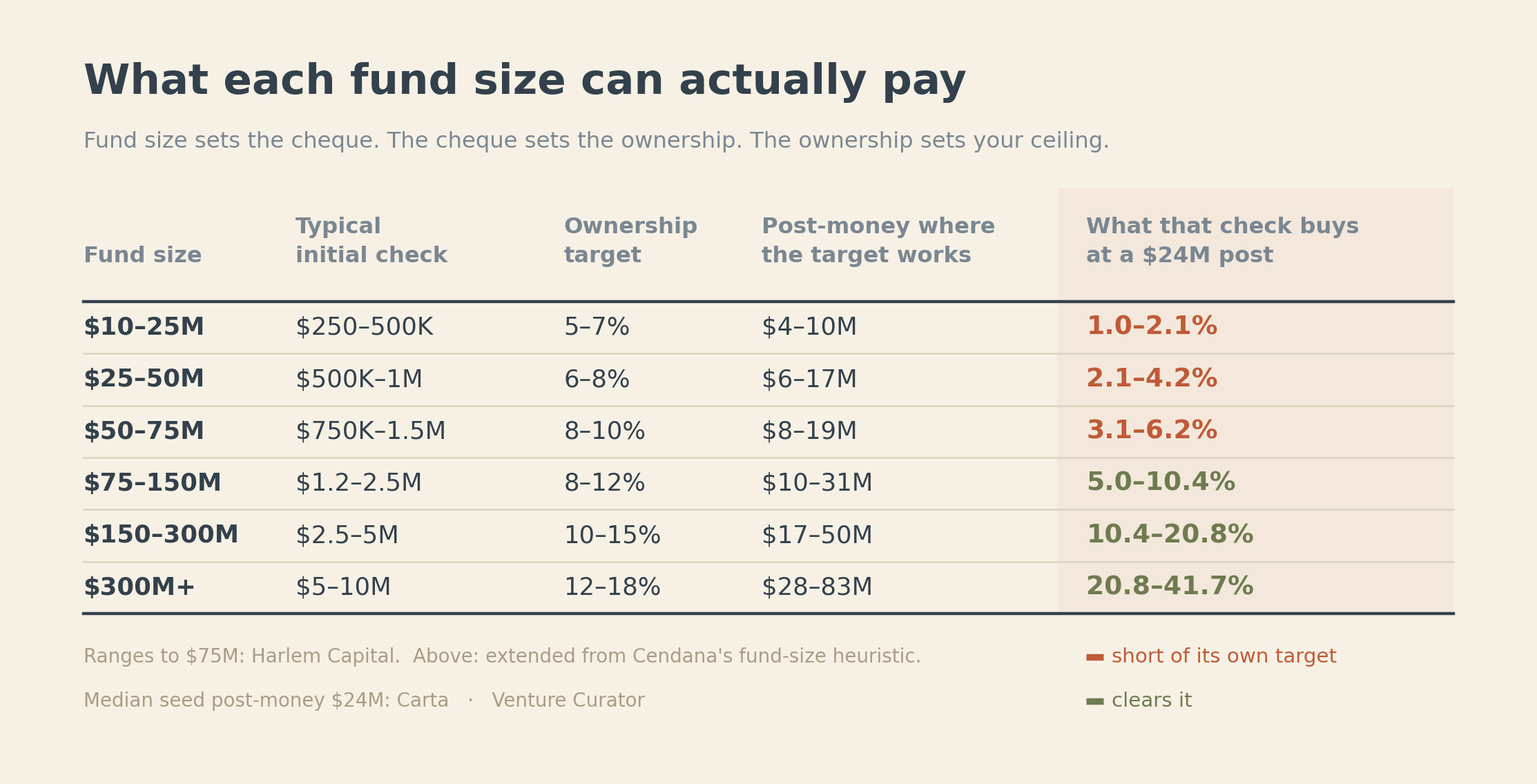
Take a $28M seed fund. If it typically writes a $600K initial cheque and wants roughly 6-8% ownership, the math puts its workable post-money valuation somewhere around $7.5M–$10M.
So if you’re raising at an $18M post, there may be nothing to negotiate. The fund simply can’t write its normal cheque and get enough ownership for its portfolio model to work.
That’s the useful reframe from this Venture Curator deep dive:
Fund size → typical cheque → target ownership → maximum workable valuation.
And today, that matters more because seed pricing has moved up quickly. Carta’s median seed post-money is around $24M. A $50M fund writing a large $1.5M cheque gets only 6.25% at that valuation.
If its model needs 8–10%, the problem isn’t necessarily your company. It’s fund economics and the market price simply don’t match.
This creates an important filter for founders before starting a raise.
Work backwards from your round size - If you need $3M and are comfortable selling roughly 20%, you’re implicitly targeting about a $15M post-money valuation.
Understand what size lead can support that - The lead may need to write $1.5M–$2M of the round. A small seed fund built around $500K checks is probably better suited as a follower, no matter how much they like you.
Ask the fund math early - One useful question on the first call is: “What’s your typical initial check, and what ownership do you usually target?” If they say $500K and 7%, their natural valuation range is roughly $7M post. You now know whether continuing the process makes sense.
There’s another wrinkle founders often overlook: round size itself helps set valuation.
If a fund wants 15% and you tell them you’re raising $3M, the implied post-money is $20M. Raise $1.5M with the same investor and ownership target, and the implied post becomes $10M.
That means the better sequence is often:
Milestone you need to reach → capital required → acceptable dilution → implied valuation → funds capable of leading it.
Not: pick an attractive valuation first and then try to convince every VC that it’s justified.
There’s also a quieter dilution lever worth watching: the option pool. A lead may ask for a 10–15% employee pool to be created pre-money, meaning that dilution comes from the existing shareholders before the investment lands. Founders can spend days negotiating another $1M of headline valuation while giving away more economic value through an oversized pool.
So, before pitching a seed fund, understand its fund size, recent cheque sizes, whether it actually leads rounds, and the ownership it typically targets.
You may discover that some of the investors on your list were never capable of meeting your round on the terms you wanted.
That’s useful information to have before spending six weeks trying to change their mind. Read in more detail here.
📬 Upgrade to Venture Curator Premium
Get access to 150+ premium archive posts, 100+ startup & VC resources, investor databases, fundraising templates, and exclusive startup research - all in one place.
TODAY’S JOB OPPORTUNITIES
💼 Venture capital & startup jobs
Why your CV keeps getting ignored for VC jobs (and how to fix it): How to reframe your experience into clear venture signals, add an investing exposure section, and create proof of work that shows you are already doing the job before anyone hires you.
Associate / Principal - Village Global | USA - Apply Here
Associate or Senior Associate - Bessemer Partner | USA - Apply Here
Partner 18, Events Associate, Crypto - a16z | USA - Apply Here
AI Analyst - Array Venture | USA - Apply Here
SMB Program Associate - Plug and Play Tech Centre | USA - Apply Here
VC Fellow - V11 | Remote - Apply Here
Vice President, Investor Relations - Red Cell Partner | USA - Apply Here
Senior Associate - BVP | USA - Apply Here
Associate / Principal, Follow-on Investing - Village Global | USA - Apply Here
Senior Associate - Yamaha Motor Venture | USA - Apply Here
Portfolio Manager - GCO Venture | Spain - Apply Here
Financial Management Analyst - Duke Capital Partner | USA - Apply Here
Investment Principal - Contrarian Thinking Capital | USA - Apply Here
Financial Management Analyst - Duke Capital Partner | USA - Apply Here
Senior Associate - Yamaha Motor Venture | USA - Apply Here
Incubation Associate, Compute - Primary | USA - Apply Here
Investment Analyst - Mela Venture | India - Apply Here
Associate, Healthcare - B Capital Group | USA - Apply Here
Portfolio Reporting Team Lead - Cerity Partner | USA - Apply Here
Associate - Mount Judi Venture | USA - Apply Here
Partnership With Us
Get your product in front of over 125,000+ audience - Our newsletter is read by thousands of tech professionals, founders, investors and managers worldwide. Get in touch today.
Upgrade to Venture Curator Premium
Get access to 150+ premium archive posts, 100+ startup & VC resources, investor databases, fundraising templates, and exclusive startup research - all in one place.
(Subscribe to Venture Curator Premium and get 20% off forever.)