
👋 Hey, Sahil here - welcome to today’s edition of Venture Curator, where we break down how great startups grow, how top investors think, and what’s shaping the future of tech.
P.S. Get access to 100+ startup & VC resources, investor databases, fundraising templates, 150+ premium archive posts and exclusive startup research - all in one place.
FROM OUR PARTNER - SIMPLEX CHAT
SimpleX is adding something most private messaging apps struggle with: a public identity you can actually remember
SimpleX is a private messaging network built without permanent user identifiers.
Instead of searchable usernames, people usually connect through SimpleX links. That works well for private communication, but long links are difficult for businesses, creators, communities, and public channels to remember or share offline.
That is what SimpleX Public Names are designed to solve.
A business or community can register a memorable name like: venturecurator.simplex or venturedailydigest.simplex
We recently received both names for Venture Crew. With Public Names:
#example can point to a public channel
@example.simplex can be used to contact a business or public address
The owner controls the name through the cryptographic key they hold
If the underlying SimpleX address changes, the name can point to the new one
Public Names are optional. Regular users can still communicate without phone numbers, emails, permanent usernames, or other persistent user identifiers.
So SimpleX can make public discovery easier without changing the private architecture underneath.
SimpleX plans to launch .simplex names on December 12.
📜 DEEP DIVE
Your competitor just raised millions. What do you do this week?
I've watched a lot of founders get this news, and it lands harder than almost anything else that happens while you're building. Your closest competitor just raised. The number is bigger than anything you’ve raised, maybe bigger than everything you’ve raised combined. For a day or two you feel like the ground moved: like the customers you’ve been working on are about to leave, like your existing investors are quietly re-reading their memo on you, like the fund you were about to pitch has already made up its mind. You feel confused, a bit behind, a bit shattered.
It isn’t like that. But it feels like that, and most founders act on the feeling.
Within a day, most of them have done one of three things, and all three are mistakes.
They’ve drafted a “congrats to our friends at X” post.
They’ve told their cofounder it’s time to raise, right now, at whatever price.
Or they’ve opened the roadmap and started adding the features from the competitor’s announcement.
I wanted to know what the founders who handled this well actually did, so I went to two people. A VC friend who’s watched this play out across a portfolio, who told me the thing that reframed the whole issue for me: “When a competitor raises, I don’t worry about the founder who calls me that day. I worry about the one who doesn’t.” And a founder who had his closest competitor announce a round three times his total funding, and then raised his own round eight months later, from a fund that had lost the competitor’s deal. He walked me through what he did in the first week, what he got wrong, and what he’d do differently.
Then I went to the data, because the fear underneath the whole thing is “they have more money, so they win.” And the data on that is a lot less clear than the fear.
Here’s what we’re covering:
Their round
What does a big round actually commit your competitor to?
Does the best-funded company in a category even win? (I checked ten categories)
Is their raise actually a threat to you at all? (Scorecard included)
Your people
What are your customers thinking this week? (Two email templates: one for existing customers, one for live deals)
What are your investors thinking? (The email template to send before they ask)
Who on your team will the competitor call first, and what do you say at the all-hands?
Your moves
What should you do in the first seven days, and in what order? (Day-by-day plan)
Should you cut price or match their roadmap?
Should you raise now, and which investors just did your diligence for you?
Let’s go.
What the round actually commits them to.
The headline is a number. The obligation underneath it is burn and time, and most founders never do that second calculation.
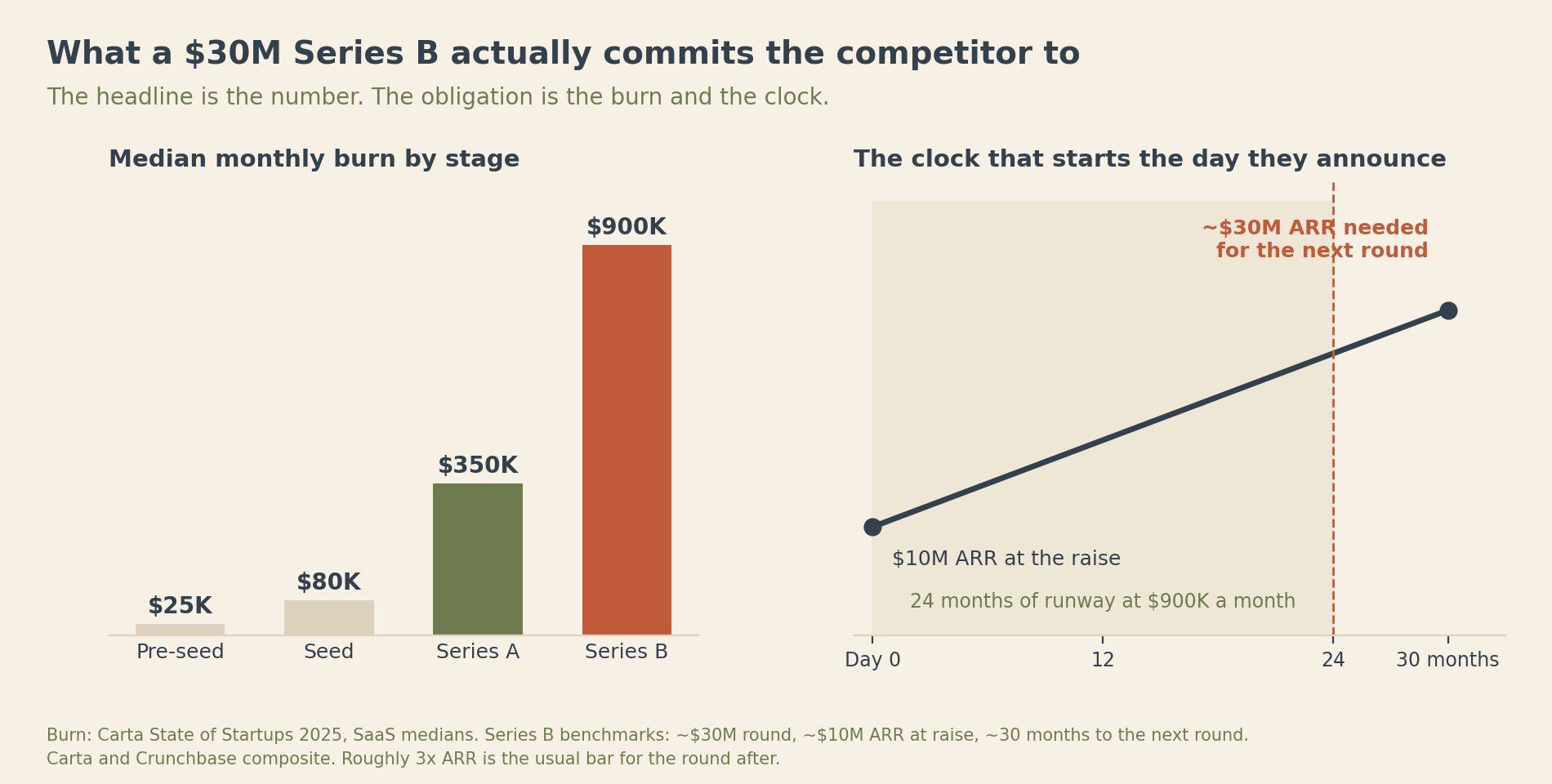
Take the typical case. A median Series B in 2026 is around $30M at roughly $120M post-money, raised at about $10M ARR, with the next round expected around 30 months later. The median Series B company burns about $900K a month, against $350K at Series A. So the $30M that landed on your competitor this morning is roughly 24 months of runway at the burn their investors expect, and it comes with an implicit target: close to 3x ARR before the money runs out, or the next round doesn’t happen.
That’s the first thing to understand about the raise. It is not a war chest. It’s a clock. From today, your competitor has around two years to grow roughly 3x, and every decision they make- hiring, pricing, which segment to chase- is now shaped by that clock.
The founder I spoke with said the thing that calmed him down was writing the competitor’s burn on a whiteboard: “They just committed to spending a million dollars a month. I was spending a hundred thousand. For the first time I understood that they had a problem I didn’t.”
Second thing: the money doesn’t buy what you think it buys. Tom Tunguz looked at headcount growth across companies by round size. He found that companies that raised top-quartile rounds grew headcount by about 6% in the following year, against 12% for everyone else, and the difference wasn’t statistically significant. A big raise does not reliably translate into a bigger team. Carta’s own data has the average Series B team at 45 people, down from 53 two years ago. The hundred engineers you pictured are mostly not coming.
Does the best-funded company win?
This is the fear underneath the whole week, so I checked it against the ten AI categories we’ve mapped in previous issues. For each one: who raised the most during the category’s funding wave, what happened to them, and who leads the category now.
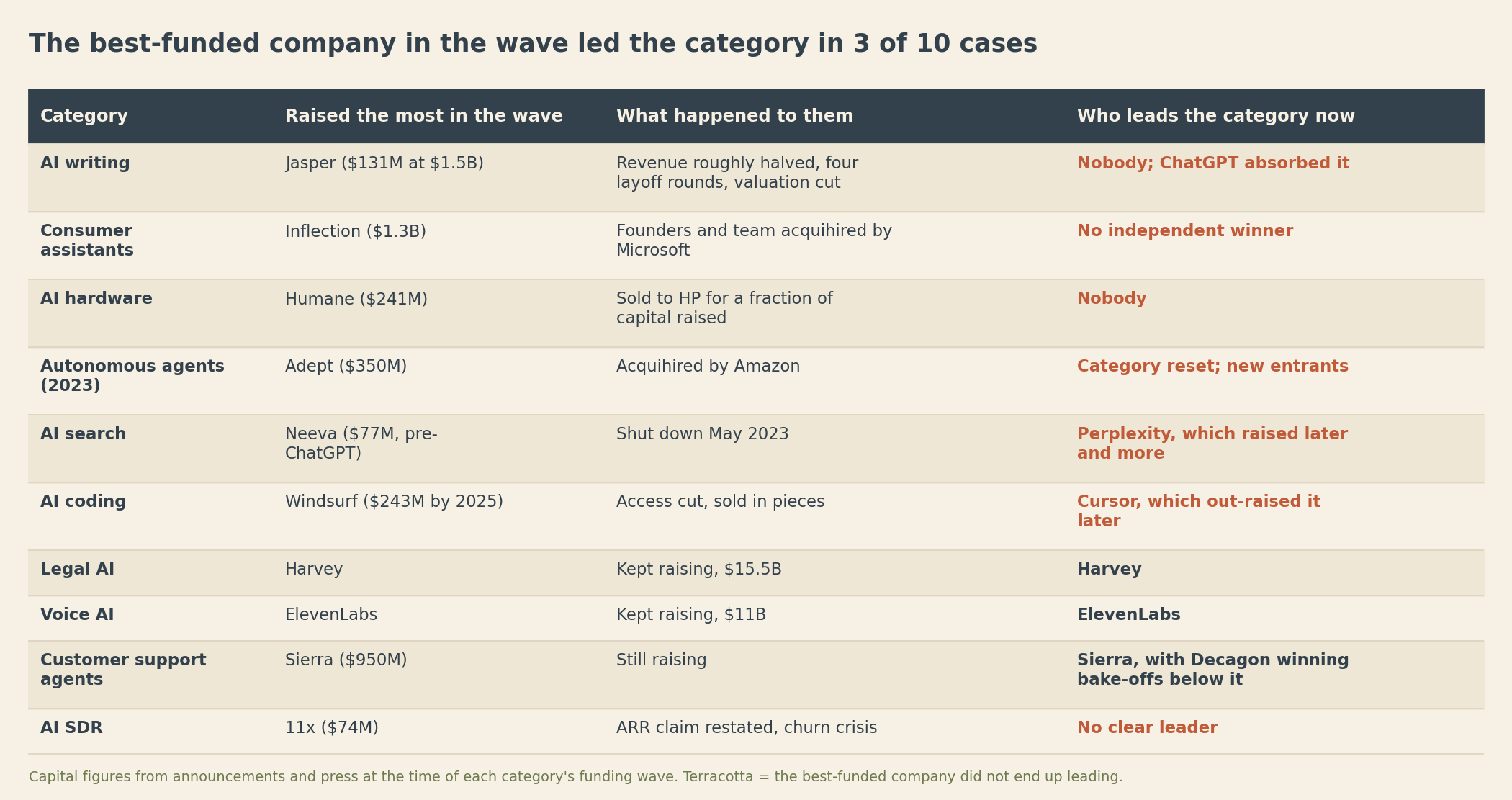
Three out of ten. The company that raised the most in the wave ended up leading the category in Harvey’s, ElevenLabs’ and Sierra’s cases. In the other seven, the best-funded company lost half its revenue (Jasper), got acquihired (Inflexion, Adept), got sold for parts (Humane, Windsurf), shut down (Neeva), or watched its category lose credibility (11x). And in two of the three wins, the leader was the best-funded because it was already winning, not the other way round.
This isn’t just an AI pattern.
CB Insights looked at the biggest tech exits since 2012 and found that the most highly funded startups tended to underperform those that raised less after IPO, and that 32% of the 50 biggest exits came from companies that raised $100M or less. The expensive failures are famous for a reason: Jawbone raised $930M and liquidated; Quibi raised $1.75B and shut in six months.
The honest version of the data: capital matters, and the biggest winners usually did raise a lot eventually. But the company that raises the most first, in a category that hasn’t been decided, wins less than half the time. Their round is a bet that the category can be bought. The data says it often can’t.
Which is exactly why the week matters. The raise doesn’t decide the category. What you do in the seven days after it, with your customers, your investors and your team, is where the category actually gets decided. And most founders spend those seven days either panicking or posting.
That’s the rest of the issue is - the seven days in order and why that order, what your customers are thinking right now and the two messages that worked (one to existing customers, one for the deals the competitor’s sales team is already working), the investor note to send before they ask and what your investors actually think, the five people on your team the competitor will call and what to do before they do, the two moves that feel right and cost the most, whether to raise and the one group of funds that just did your diligence for you, and a scorecard for whether their round is even a threat. If you’ve got a competitor with a round in the works, read this before the announcement, not after.